
Review · POMPEII & HERCULANEUM TOURS
Pompeii: Tour with Archaeologist Guide & Skip-the-Line Entry
Pompeii rewards a guide. This two-hour walk combines priority entry with an authorized archaeology guide who explains how this Roman city worked before Vesuvius buried it in 79 AD. I like the clear route through major sights, and I like that you can stay inside afterward to explore more on your own. The main consideration is that two hours goes quickly, especially in a large archaeological site with uneven walking surfaces.
I especially value the way the tour turns broken walls into daily life: a shop becomes a place where people ate, a bathhouse reveals social customs, and a road shows how Pompeii moved. Guides such as Angelo, Teresa, Lilian, Paolo, Roberta, and Mario have been praised for humor, patience, and strong explanations. The audio system helps when the site is crowded, though some users found the earpieces loud.
This is a good fit if you want context without paying for a long private tour. At $57 per person, the price is reasonable for site entry and a specialist guide, but it is not an all-day visit. Transport, food, tips, and any extra time at Pompeii are your responsibility.
In This Review
- Key points to know before you go
- Why a guide changes Pompeii
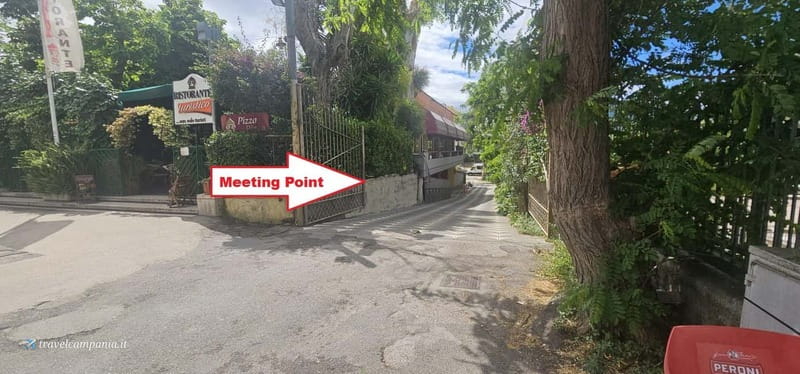
- Meeting at the Welcome Box
- Porta Marina and the first step into ancient Pompeii
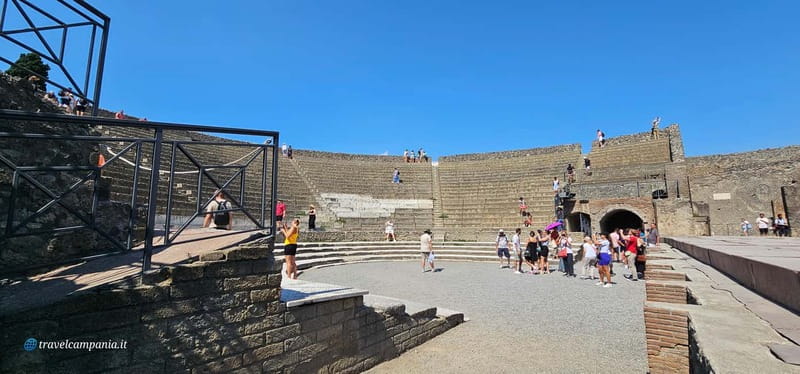
- Teatro Piccolo and Pompeii’s public life
- House of Menander and the Roman home
- Thermopolium and the taste of daily life
- Stabian Baths and the Roman social routine
- Lupanare and the uncomfortable side of Pompeii
- Civil Forum and the city’s central stage
- What the $57 price includes
- Languages, audio equipment, and group comfort
- Practical limits you should take seriously
- Who will get the most from this Pompeii tour
- Should you book it?
- FAQ
- How long does the Pompeii tour last?
- What is included in the price?
- What languages are available?
- Where does the tour begin?
- Where does the activity end?
- Does the tour skip the ticket line?
- What identification do I need?
- Are bags allowed inside?
- Is an audio guide or radio guide provided?
- Can I cancel the booking?
Key points to know before you go

- The route covers Pompeii’s essential sights: Porta Marina, Teatro Piccolo, the House of Menander, a Thermopolium, the Stabian Baths, the Lupanare, and the Civil Forum.
- The guide makes the ruins readable: You learn about Roman homes, food, bathing, theater, streets, crafts, and ordinary routines instead of simply walking past stones.
- Priority entry saves time: You avoid the long ticket queue and begin the archaeological visit sooner.
- The tour may use an audio guide: Groups larger than eight receive a radio guide, while very small groups in the same language may use audio support with an English-speaking guide.
- You can continue after the tour: The guided portion ends at the meeting point, but guides suggest sights to see if you want to remain inside Pompeii.
- Pack light and bring identification: Bags and bicycles are not allowed, and every participant needs a passport or identity card, with copies accepted.
Why a guide changes Pompeii
Pompeii can look simple at first glance: streets, walls, columns, painted rooms, and roofless houses. The difficulty is knowing what you are seeing and why it mattered.
This tour gives you that missing layer. The guide places the city’s buildings in the period from its foundation in the seventh century BC through the eruption of Mount Vesuvius in AD 79. You hear about art, trades, public life, domestic customs, and the practical details of Roman streets.
Small observations can make a big difference. One guide pointed out places where horses could be tied and explained the design of the roads. Details such as these help you picture Pompeii as a functioning town rather than an empty ruin.
The tour also helps with the plaster casts. These casts are among Pompeii’s most moving remains, but they can be difficult to understand without explanation. A guide can provide the setting and human meaning behind what you are seeing, while keeping the focus on the ancient city rather than treating the site as a collection of dramatic objects.
The strongest guide experiences have been associated with clear speaking, humor, patience, and good pacing. Teresa was praised for making the group laugh while explaining life before the eruption. Mario was described as kind and funny, and Paolo received praise for leading the group well. Those personal qualities matter here because Pompeii involves a lot of standing and walking. A lively guide makes the two hours feel shorter.
More Skip-the-Line Tickets in Naples
- Skip the Line Guided Tour of Pompeii led by an Archaeologist
★ 5.0 · 703 reviews - Pompeii Private Tour with an Archaeologist and Skip The Line – 3 hours
★ 5.0 · 564 reviews - Pompeii Skip-the-line Tour with Archaeologist Guide
★ 5.0 · 559 reviews
Meeting at the Welcome Box
The activity begins at the Welcome Box near Pompeii. Your guide meets you there before leading the group toward the archaeological entrance.
Allow time to find the meeting point. Most people found it straightforward, but one person had trouble locating the check-in area. The clearest practical advice is to arrive early, keep your booking details handy, and avoid cutting the timing close.
The provider has sometimes helped when transport caused trouble. Train delays led to missed start times, and the staff arranged general site access or moved people to a later tour when possible. This is useful, but you should not treat it as a guarantee. Build extra time into your journey, especially if you are coming from Naples, Sorrento, or Rome.
A fast train day trip from Rome is possible, but it leaves little room for mistakes. The tour itself lasts about two hours, and getting to Pompeii, finding the meeting point, and reaching your next train all take additional time.
Priority admission is one of the practical benefits. You skip the long ticket line and enter with the group. This does not mean the site will be empty. Pompeii can be crowded, particularly around famous houses and the Lupanare, so the radio system becomes useful once the group is inside.
Porta Marina and the first step into ancient Pompeii
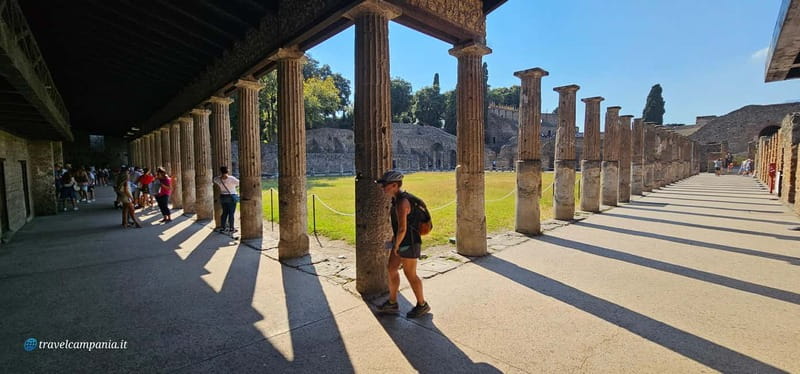
The route begins at Porta Marina, one of Pompeii’s main entrances. The guide spends about 10 minutes here, setting the scene for the city and the eruption.
This is an important opening because Pompeii’s story can otherwise feel scattered. The guide explains that the city was buried under ash and debris during the eruption of Vesuvius in AD 79, preserving buildings, objects, street plans, and traces of everyday life.
You begin to understand the unusual character of the site. Many ancient Roman places survive only as isolated monuments, but Pompeii offers a much broader view of an entire town. You can move from public spaces to homes, shops, baths, theaters, and food counters within a single visit.
Do not expect a long lecture at each stop. The guide has only two hours to cover a lot of ground, so explanations are focused and practical.
Teatro Piccolo and Pompeii’s public life
The next stop is Teatro Piccolo, with about 10 minutes of guided explanation. The small theater gives the route a useful change of pace after the entrance and street views.
Here, the guide helps you think about entertainment as part of ordinary Roman life. Pompeii was not only a place of work and residence. Its residents gathered for performances and shared public events, just as they used baths, forums, and markets.
The stop is brief, so you will not receive an exhaustive study of Roman theater. What you get is a compact explanation that connects the building to the wider social world of Pompeii.
More Pompeii and Herculaneum visits:
- Pompeii Small Group Tour with an Archaeologist
★ 5.0 · 6,593 reviews - Discover the Ancient Ruins of Pompeii: Day Trip from Rome
★ 3.5 · 2,247 reviews - Pompeii and Herculaneum Small Group Tour with an Archaeologist
★ 5.0 · 1,350 reviews - Pompeii Ticket + Tour with Optional Tasting Experience at Pompeii
★ 5.0 · 663 reviews
House of Menander and the Roman home

The House of Menander receives about 15 minutes. This is one of the most useful stops for understanding private life and household status.
A Roman house was not simply a place to sleep. Its design, decoration, and rooms could show wealth, taste, family structure, and the way people received guests. The guide draws your attention to the art and layout so the building feels like a lived-in home, not just a shell.
This is where specialist guidance earns its keep. Without help, you might notice a painted wall or courtyard but miss what it says about the people who lived there. Guides also explain how to look beyond the best-known decoration and notice the practical features of the house.
The 15-minute timing allows enough explanation without letting one residence take over the whole visit.
Thermopolium and the taste of daily life

The Thermopolium, visited for around 15 minutes, offers one of the clearest links to everyday activity. These establishments served food and drink, giving you a glimpse of how Pompeii’s residents ate outside the home.
The guide explains the building’s function and the craft of running such a business. This is one reason the tour feels more human than a monument-only walk. You are not only looking at grand public buildings. You are also considering meals, work, customers, and the small routines that kept the town going.
For many people, this becomes one of the most memorable stops because the purpose is easy to picture. The guide’s job is to add the social and economic setting that the remains alone cannot provide.
Stabian Baths and the Roman social routine
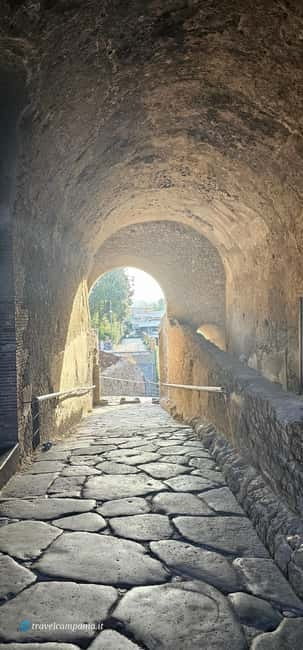
The Stabian Baths receive about 15 minutes. Roman baths were practical facilities, but they were also important social spaces.
The guide explains how bathing fitted into public life and points out the design features that helped the complex function. You learn to see the baths as more than a set of rooms. They were places connected to hygiene, relaxation, conversation, and community.
This stop also helps balance the tour. After a private house and a food shop, the baths show another side of city life, one shared across a wider part of the population.
As with the other buildings, some areas may be busy. The guide’s ability to choose quieter points or adjust the order can make the experience easier to follow. One guide was praised for timing visits so the group avoided the worst crowding.
Lupanare and the uncomfortable side of Pompeii

The Lupanare gets the longest scheduled stop, around 20 minutes. Its rooms and paintings provide evidence of prostitution in Pompeii, but this is not a stop for hurried sightseeing.
The guide gives the social setting and explains how the building fitted into the city. You may find the subject direct and confronting, but it is part of Pompeii’s everyday record. The site preserves grand architecture and domestic routines, yet it also exposes subjects that polite modern tourism often skips.
Crowds can gather here, so the audio equipment is particularly useful. If the group is large, the radio guide lets you hear the explanation while keeping a little distance from the guide.
The stop may not suit every child or every visitor. The available information does not give a specific age policy, so families should use their own judgment.
Civil Forum and the city’s central stage
The route ends at the Civil Forum, where the guide spends about 15 minutes explaining the center of public life. The forum tied together civic, religious, commercial, and social activity.
After seeing homes, food service, baths, and entertainment, this final major stop helps you connect the pieces. Pompeii was a complete community, with spaces for business, politics, worship, and public gathering.
The forum is also a good place to pause and look back at what the guide has shown you. The eruption is the dramatic event, but the real value of Pompeii is the picture of life before it: people working, eating, bathing, performing, shopping, and meeting in public.
A further 10 minutes of free time is scheduled at the forum. That is enough for a quick look around or photographs, but it is not enough to explore the entire archaeological site. Your guide may offer suggestions for continuing after the tour, and several guides specifically encouraged people to stay longer.
What the $57 price includes
The $57 fee includes the Pompeii Express entrance ticket and an authorized guide with expertise in archaeology. That combination is the main reason the price works.
Buying entry alone may cost less, but it leaves you to interpret an enormous site by yourself. Pompeii’s scale can make an unguided visit feel like a sequence of disconnected ruins. Here, the guide gives you a route, explanations, and a basic framework in two hours.
The value is strongest for first-time visitors, people with limited time, and anyone who wants history explained in plain language. It is less attractive if you already know Pompeii well or want to wander slowly through every open street.
Lunch, transport, and tips are not included. The tour finishes back at the meeting point, so plan your own onward journey. Free lockers at the gates may be available for backpacks, and water fountains are present around the site, although they may not be clearly marked. Bags are listed as not allowed, so check your belongings before setting out.
Languages, audio equipment, and group comfort
The tour operates in Italian, Spanish, French, English, and German. If more than eight people are in the group, a radio guide is included.
For groups of four or fewer in the same language, the arrangement may be an audio guide with an English-speaking tour guide. That detail matters if you are expecting a fully live explanation in your chosen language. Check the conditions for your selected departure before booking.
The equipment has generally helped in crowded areas and allows the group to keep moving. One person found the earpieces too loud, so adjust the volume if possible.
Group size can vary. A group of 20 has been handled patiently, but a larger group naturally takes longer to gather and may feel less personal. Guides have been praised for making sure everyone saw the main sights and for giving enough time to understand each stop.
Practical limits you should take seriously
Pompeii is an outdoor archaeological site. This experience is not suitable for wheelchair users or people with mobility impairments, and it is not suitable for people over 95 years according to the activity information.
Bring a passport or identity card for every participant, including children. A copy of a passport or identity card is accepted. You also need to provide the names and ages of the people in your booking.
Bicycles, alcohol, drugs, and bags are not allowed. Wear practical footwear and prepare for two hours of walking and standing, although the tour information does not specify a dress code or footwear requirement.
The activity offers free cancellation up to 24 hours before the start time and a reserve-now, pay-later option. These policies are helpful if your Campania plans depend on trains, weather, or changing day-trip schedules.
Who will get the most from this Pompeii tour
I would choose this tour for a first visit, especially if Pompeii is part of a busy Italy itinerary. The two-hour format covers the major themes without asking you to spend an entire day with a guide.
It also suits families and mixed-age groups when the guide is engaging and patient. The strongest guide experiences have included humor, clear explanations, and help for people who wanted to continue exploring afterward.
You may want something else if you need step-free access, dislike group tours, or want a highly specialized focus on art, architecture, or the eruption. You should also consider a longer visit if Pompeii is a main reason for coming to the area.
Should you book it?
Book this tour if you want Pompeii to make sense, not simply to photograph it. The combination of priority entry, a two-hour route, and an archaeology guide gives you a strong introduction at a fair price.
I would book it early if your schedule is tight, then arrive well before the meeting time at the Welcome Box. Keep your ID ready, carry no bag, and plan extra time after the tour if you want to see more.
Skip it only if you already have strong background knowledge, prefer complete independence, or need accessible arrangements. For most first-time visitors, the guide is the part that turns Pompeii from a huge field of ruins into a Roman town with people, habits, work, and stories.
FAQ
How long does the Pompeii tour last?
The guided tour lasts approximately two hours.
What is included in the price?
The price includes a Pompeii Express entrance ticket and an authorized guide with expertise in archaeology.
What languages are available?
The tour is available in Italian, Spanish, French, English, and German.
Where does the tour begin?
The activity begins at the Welcome Box near Pompeii, listed as the meeting point.
Where does the activity end?
The activity ends back at the meeting point.
Does the tour skip the ticket line?
Yes. The activity includes priority access so you can skip the ticket line.
What identification do I need?
Every participant needs a passport or identity card, including children. A copy of either document is accepted.
Are bags allowed inside?
No. Bags are not allowed. Free lockers at the gates may be available for backpacks.
Is an audio guide or radio guide provided?
Groups larger than eight receive a radio guide. If no more than four participants speak the same language, the tour may use an audio guide together with an English-speaking guide.
Can I cancel the booking?
Yes. You can cancel up to 24 hours in advance for a full refund.
More Fast-Track Entries
- Pompeii Private Tour with an Archaeologist and Skip The Line
★ 5.0 · 391 reviews - Complete Pompeii Skip the Line Tour with Archaeologist Guide
★ 4.5 · 379 reviews - Florence: Skip-The-Line Uffizi Gallery Timed Entry Ticket
★ 4.5 · 27,832 reviews - Vatican Museums & Sistine Chapel Skip-the-Line Entry Ticket
★ 4.4 · 13,838 reviews
Just added around Pompeii
- Pompeii Guided Group Tour with Entry Ticket and Archaeologist★ 4.5 · 269 reviews
- Pompeii: Guided Small Group Tour Max 6 People with Private Option★ 5.0 · 269 reviews
- Private Day Tour to Vesuvius, Herculaneum & Pompeii with Pick Up★ 5.0 · 279 reviews
- Pompeii Vineyard Escape: Private Wine Tasting & Lunch★ 5.0 · 329 reviews
- 2 hours Pompeii Tour with Local Historian – Ticket Included★ 5.0 · 335 reviews
- PompeiI Exclusive Tour with your Archaeologist in a Small Group★ 4.5 · 363 reviews
- Complete Pompeii Skip the Line Tour with Archaeologist Guide★ 4.5 · 379 reviews
- Pompeii 2h Small-Group Tour with Expert Archaeologist★ 5.0 · 385 reviews
Pompeii & Herculaneum Tours, compared.

Pompeii: Entry Ticket and Guided Tour with an Archaeologist
Read our review →
Pompeii: Entry Ticket with Optional Audio Guide
Read our review →
Pompeii: Small Group Tour with an Archaeologist
Read our review →


Pompeii Small Group Tour with an Archaeologist
Read our review →
Pompeii, Amalfi Coast and Positano Day Trip from Rome
Read our review →Browse the lists this tour appears in