
Review · POMPEII & HERCULANEUM TOURS
Pompeii Small Group Tour with an Archaeologist
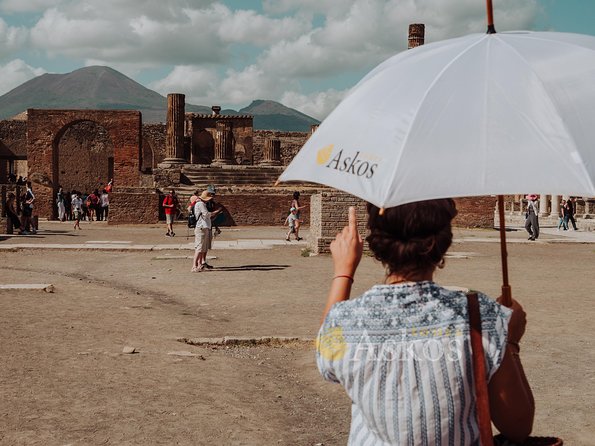
Pompeii still feels startlingly close. This two-hour walk pairs an archaeologist guide with a focused route through the ruins, so you see major landmarks while hearing about the people who lived here before the eruption. I like the sensible selection of sites, especially the Forum, House of Menander, Stabian Baths, Lupanar, House of the Faun, and Teatro Grande. I also like the chance to remain inside the ruins after the guided portion and continue on your own.
The price is about $35.67 per person, a fair deal for a licensed guide, the Pompeii Express entrance ticket, and organized access through a vast archaeological park. The main caution is time. Two hours gives you a useful introduction, not a full visit, and a group of up to 20 can feel large at busy stops.
In This Review
- Key things to know before you book
- Why a guide helps at Pompeii
- Meeting at Porta Marina Superiore
- The Basilica and Forum: Pompeii’s civic center
- The Granaries and the human cost of the eruption
- Walking Pompeii’s original streets
- House of Menander: a look inside an elite home
- Stabian Baths and the Lupanar
- House of the Faun: Pompeii’s grandest private residence
- Teatro Piccolo and Teatro Grande
- Is two hours enough?
- The guides make the biggest difference
- Price, group size, and practical value
- Should you book this Pompeii tour?
- FAQ
- Where does the Pompeii tour start?
- Where does the tour finish?
- How long does the tour last?
- What entrance ticket is included?
- How large is the group?
- Is the tour suitable for people with mobility limitations?
- Can I cancel for a refund?
Key things to know before you book
- The route covers Pompeii’s essential landmarks: You visit the Basilica, Forum, victim casts, House of Menander, Stabian Baths, Lupanar, House of the Faun, Teatro Piccolo, and Teatro Grande.
- The guide shapes the experience: Guides such as Alessandra, Paolo, Teresa, Amedeo, Vincenzo, Julia, and Antonio have been praised for clear storytelling, humor, patience, and strong archaeological knowledge.
- The tour finishes inside Pompeii: You can stay after the formal walk and see more on your own, but ask your guide how to reach the exits.
- Expect rough ground: Original paving stones, ramps, steps, and some slightly steep climbs make sturdy shoes and steady footing important.
- Summer requires planning: There is little shade in much of the site, so bring water, sunscreen, sunglasses, and a hat.
- Late arrival is risky: Pompeii is large, phone signal can be poor, and the guide cannot easily pause a moving group for people who arrive well after the start time.
Why a guide helps at Pompeii
Pompeii is not a compact ruin that you can understand in one quick circuit. Streets branch off in several directions, buildings often need explanation, and a simple wall can be more important than a grand column if you know what you are seeing.
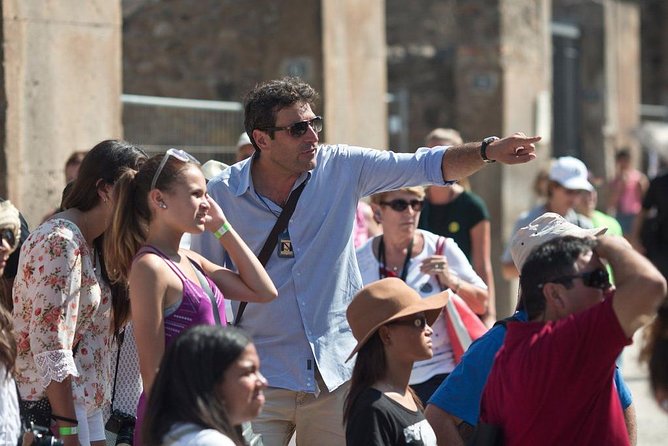
A guide gives the stones a human frame. You hear how the city was organized, what different buildings were used for, and what the eruption meant for ordinary residents. The best guides on this experience, including Alessandra and Paolo, have been praised for connecting the site’s archaeology with current excavation and preservation work.
I especially value the way the route mixes public buildings, private homes, bathing facilities, entertainment venues, and evidence of the disaster. That combination helps you understand Pompeii as a functioning city rather than a collection of disconnected ruins.
The group limit is 20 people per guide. That is small enough to be manageable, though not intimate. With 16 or more people, headsets are provided. They matter here because the streets can be noisy and the group may spread out while looking inside a house or theater.
More Pompeii and Herculaneum visits:
- Discover the Ancient Ruins of Pompeii: Day Trip from Rome
★ 3.5 · 2,247 reviews - Pompeii and Herculaneum Small Group Tour with an Archaeologist
★ 5.0 · 1,350 reviews - Skip the Line Guided Tour of Pompeii led by an Archaeologist
★ 5.0 · 703 reviews
Meeting at Porta Marina Superiore
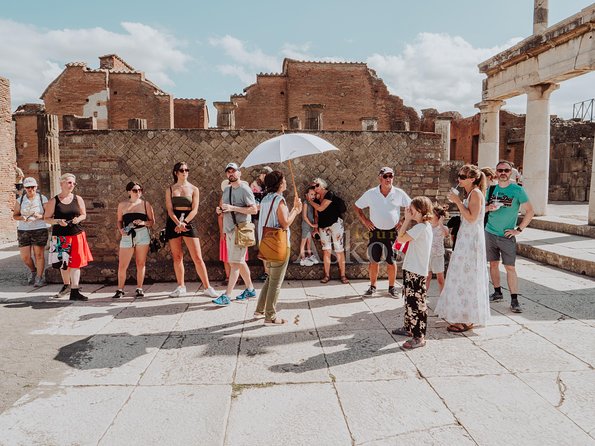
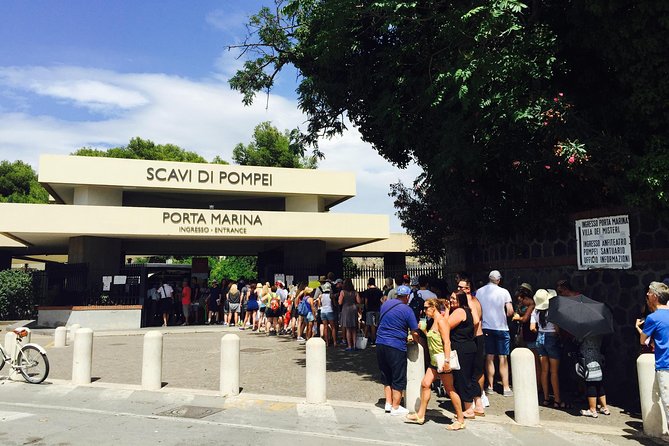
You meet at the main archaeological entrance called Porta Marina Superiore, at Via Villa dei Misteri 2. Look for the guide holding a sign with Askos Tours at the top.
The entrance meeting is worth taking seriously. Arrive early enough to find the correct gate and identify the group before the scheduled start. Pompeii is too large for a guide to spend much time searching for late arrivals, and the site can have weak phone reception.
The included Pompeii Express ticket lets the group enter directly with the guide. Transportation is not included, so you need to arrange your own way to Pompeii. The tour ends inside the ruins, not back at the starting point, which is useful if you want to keep exploring.
One practical detail deserves emphasis: the official walk lasts about two hours, but you may want extra time afterward. Several guides offer useful suggestions for continuing independently, and the ruins are large enough that you will not see everything during the guided route.
The Basilica and Forum: Pompeii’s civic center
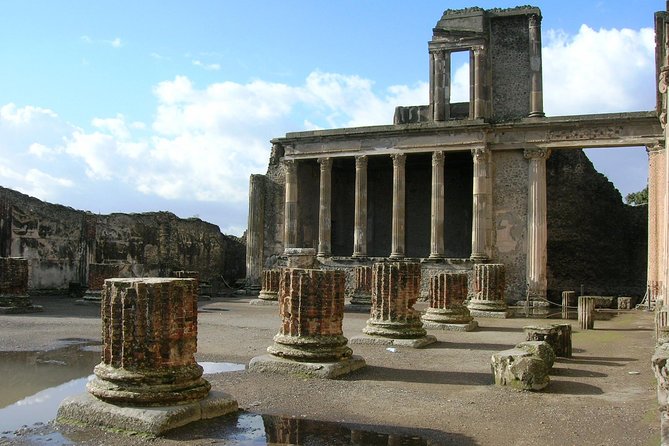
The Basilica is the first major stop. This long, open portico sheltered merchants and supported public and commercial activity. It is not simply a place to photograph columns. Your guide can help you picture the building as a working part of city life, with business and public affairs taking place under cover.
From there, the route moves to the Forum, Pompeii’s main square. This is the point where the city’s public life comes together. The broad open space, surrounding buildings, and surviving architectural fragments give you a basic map of how power, religion, trade, and civic business were arranged.
The Forum is also an important orientation stop. Pompeii stretches well beyond what you can see from this central area, and the guide’s explanation helps you understand why the city is so easy to misread when walking alone.
The tour does not linger at every structure. That is both its strength and its limit. You get a clear introduction without spending the entire morning in one area, but anyone hoping for detailed architectural analysis of every Forum building will need more time afterward.
The Granaries and the human cost of the eruption
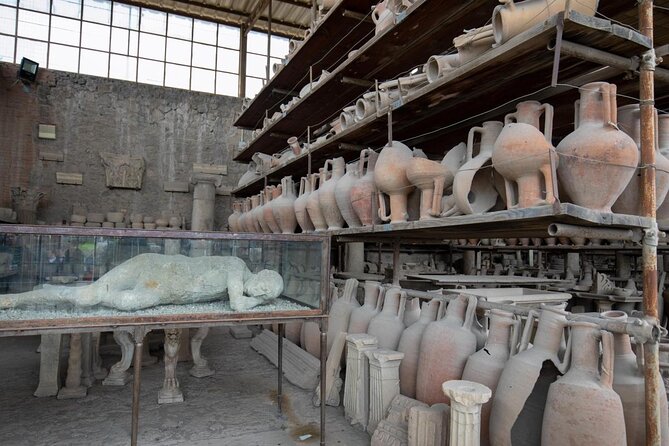
At the Granaries of the Forum, you see marble tables, fountain basins, and plaster casts of victims. There are also casts of a dog and a tree.
This is one of the most emotionally difficult parts of the visit. The casts are not decorative objects. They bring the eruption back to individual bodies and interrupted lives, making the disaster feel personal rather than distant.
A good guide handles this stop with care. The strongest guiding praised on this tour combines archaeological facts with respect for the people who died. Alessandra, in particular, has been praised for presenting Pompeii as both a cultural site and a human tragedy.
You may find this stop more affecting than expected, especially with children or teenagers. The guide’s context helps, but you should still give yourself a moment to look quietly before moving on.
A few more reviews worth comparing before you book
- Pompeii Ticket + Tour with Optional Tasting Experience at Pompeii
★ 5.0 · 663 reviews - Pompeii private tour with an Official Guide
★ 5.0 · 631 reviews - Pompeii Private Tour with an Archaeologist and Skip The Line – 3 hours
★ 5.0 · 564 reviews - Pompeii Skip-the-line Tour with Archaeologist Guide
★ 5.0 · 559 reviews
Walking Pompeii’s original streets
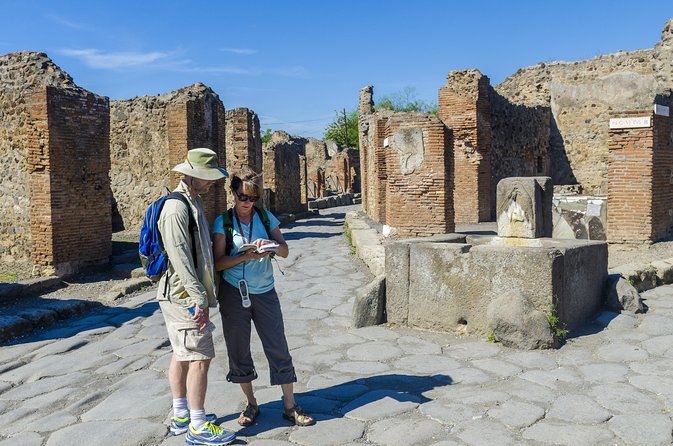
Between the main stops, you walk along original paved roads. This is where comfortable footwear becomes essential. The ground is uneven, and the stones can make your pace slower than expected. There are also steps, ramps, and some slightly steep climbs.
The streets are part of the experience, not just the links between buildings. You get a sense of how people moved around the city and how homes, baths, shops, public buildings, and entertainment spaces related to one another.
Wear sturdy shoes or trainers. Bring a small bottle of water, especially in warm weather. Much of Pompeii has limited shade, and sunglasses, sunscreen, and a hat are sensible additions. The site is open in rain or shine, so check the weather and dress for exposed walking.
House of Menander: a look inside an elite home
The House of Menander is one of Pompeii’s most impressive private residences. Its size, decoration, architecture, and contents show the resources of a wealthy household.
This stop adds balance to the public buildings seen earlier. You are no longer looking at civic space, but at domestic life and social status. Frescoes, mosaics, rooms, and courtyards make the house more understandable when a guide explains how the spaces fit together.
I like this part of the route because it helps you imagine Pompeii beyond the Forum. The city was not only about officials and temples. It was also about families, servants, guests, meals, decoration, and the daily routines of a large private home.
The House of Menander can attract attention at key features, so a group of 20 may need a little patience. The guide usually chooses specific details to explain rather than attempting to cover every room.
Stabian Baths and the Lupanar
The Stabian Baths occupy a broad area near the Brothel Lane, the Holconius crossroads, and Via Stabiana. They are described as Pompeii’s oldest thermal complex.
Baths reveal much about Roman public life. They were places for washing, exercise, social contact, and routine. The remains help you see how engineering and communal habits shaped the city.
Next comes the Lupanar, Pompeii’s best-known brothel. Its small rooms and surviving imagery draw plenty of attention, but the value of the stop is not just the shock factor. The guide provides the setting needed to understand the building as part of urban life in the Roman period.
This is a popular route, so expect a slower pace around the Lupanar. If you are visiting with children or teenagers, the guide can keep the explanation historical and matter-of-fact. The stop is brief but memorable.
House of the Faun: Pompeii’s grandest private residence
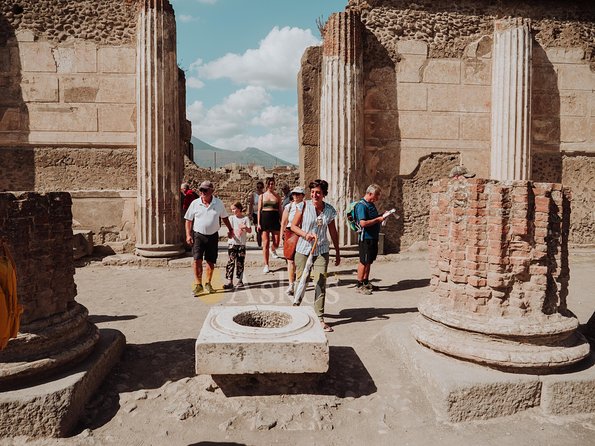
The House of the Faun was one of Pompeii’s largest and most impressive residences. Its scale gives you another view of wealth and status, this time on an even grander level than the House of Menander.
The building is especially useful for showing how Roman houses could be arranged around formal spaces, decoration, and movement through several areas. Your guide can point out details that are easy to miss when you are simply following a map.
The route does not promise every famous artwork or room in Pompeii. Instead, it uses the House of the Faun as a strong example of elite domestic life. If this is the part of Pompeii that most interests you, ask your guide what you can revisit after the tour.
Teatro Piccolo and Teatro Grande
The brief stop at the Teatro Piccolo, also called the small theater, provides a quick look at another side of Pompeii’s entertainment culture. It is a short visit, so do not expect a long performance-history discussion.
The final major stop is Teatro Grande, the city’s most important theater. The scale of the theater makes a fitting end to the route. After seeing homes, civic buildings, baths, and a brothel, you finish with a place built for large public gatherings.
Ending here also leaves you inside the archaeological park. That gives you freedom to continue, but it creates one small practical issue: ask the guide where the best exit is before separating from the group. One useful criticism of the experience is that this information is not always made clear at the end.
Is two hours enough?
Two hours is enough for a strong overview. You see a broad selection of Pompeii’s major categories, hear the basic story of the eruption, and learn how to read the streets and buildings.
Two hours is not enough for a complete exploration. Pompeii is extensive, and you will need additional time if you want to visit more houses, examine smaller streets, or return to the Forum and theaters at your own pace.
The best plan is to treat this as your guided introduction, then stay inside and continue alone. You will already know where the main areas are and what kinds of details deserve attention. That is much more efficient than trying to navigate the entire site with only a map.
The pace appears relaxed rather than frantic. Guides such as Teresa have been praised for adjusting to the group’s ability and making room for questions. Still, the group format means the guide has to keep everyone moving, and some stops may feel shorter than you would prefer.
The guides make the biggest difference
The most praised part of this experience is the guiding. Alessandra has been singled out for archaeological expertise, storytelling, and an engaging explanation of current and future work at Pompeii. Paolo has been praised for his care with preservation and education, while Teresa has been noted for her warm pacing and clear storytelling.
Amedeo is described as humorous and good at involving children, and Vincenzo has been appreciated for combining regional knowledge with humor. Other guides, including Alfredo, Rafaela, Jolianta, Julia, and Antonio, have also received strong praise for making Pompeii understandable and enjoyable.
Guide quality can vary on any scheduled group departure, so it is wise to judge the product by what it promises rather than expecting one particular person. The consistent benefit is access to a licensed guide with an archaeological background, not simply someone leading you from gate to gate.
The overall rating of 4.8 from 6,593 ratings, with 96 percent recommending the experience, points to strong satisfaction. Still, the occasional poor experience matters. One complaint described a late start, faulty headsets, and a long stationary lecture that reduced the walking time. Another involved arriving about 45 minutes late and being unable to join the group.
The lesson is simple: arrive on time, bring patience if equipment needs fixing, and speak up if you cannot hear. A two-hour tour has little spare time for delays.
Price, group size, and practical value
At $35.67 per person, this is good value if you want context without paying for a private tour. The cost includes admission, guidance for the full tour, and headsets for groups of 16 or more.
A ticket alone gets you into the ruins, but it does not explain why one building matters more than another or how the public and private parts of the city connect. The guide is what turns a walk through broken walls into a readable story.
The group limit of 20 keeps the price moderate. If you want a quieter, more personal experience, a smaller private tour may suit you better, but you should expect to pay more. For families, first-time visitors, and people with only part of a day in Pompeii, this format strikes a practical balance.
Children must be accompanied by an adult. Most people can take part, but the tour is not recommended if you have significant mobility limitations. Mobility scooters are not allowed, and the uneven ground, ramps, steps, and inclines can be demanding.
Service animals are allowed. Other dogs must weigh no more than 10 kilograms and measure no more than 40 centimeters in height. They must be leashed, carried inside buildings, and their waste must be collected.
Should you book this Pompeii tour?
I would book it if this is your first visit and you want to understand what you are seeing. The route covers the essentials, the price is reasonable, and the archaeologist-led explanations add real value to the ruins.
It suits families, teenagers, curious first-time visitors, and anyone who finds large archaeological sites confusing. It is also a smart choice if you want a guided framework and then plan to explore independently.
I would think twice if you need a fully accessible route, dislike group pacing, or want a detailed study of every major house and public building. In those cases, ask Askos Tours about a private option suited to your needs.
For most people, arrive early, wear firm shoes, carry water, and reserve extra time after the two-hour walk. Pompeii rewards patience, and this tour gives you a useful way to begin.
FAQ
Where does the Pompeii tour start?
The tour starts at Porta Marina Superiore, the main archaeological entrance, at Via Villa dei Misteri 2, 80045 Pompei. The guide holds a sign with Askos Tours written at the top.
Where does the tour finish?
The tour finishes inside the Pompeii ruins. Transportation is not included, so you must arrange your own transport.
How long does the tour last?
The guided experience lasts approximately two hours. You can remain inside the ruins afterward and continue exploring independently.
What entrance ticket is included?
The tour includes a Pompeii Express entrance ticket.
How large is the group?
The maximum group size is 20 people per guide. Headsets are provided when a group has 16 or more people.
Is the tour suitable for people with mobility limitations?
The tour is not recommended for people with mobility issues or impairments because the route includes uneven ground, steps, ramps, and slightly steep climbs. Mobility scooters are not allowed.
Can I cancel for a refund?
You can cancel at least 24 hours before the local start time for a full refund. Cancellations or changes made less than 24 hours before the start time are not accepted for a refund.
Just added around Pompeii
- Pompeii: Guided Small Group Tour Max 6 People with Private Option★ 5.0 · 269 reviews
- Pompeii Guided Group Tour with Entry Ticket and Archaeologist★ 4.5 · 269 reviews
- Private Day Tour to Vesuvius, Herculaneum & Pompeii with Pick Up★ 5.0 · 279 reviews
- Pompeii Vineyard Escape: Private Wine Tasting & Lunch★ 5.0 · 329 reviews
- 2 hours Pompeii Tour with Local Historian – Ticket Included★ 5.0 · 335 reviews
- PompeiI Exclusive Tour with your Archaeologist in a Small Group★ 4.5 · 363 reviews
- Complete Pompeii Skip the Line Tour with Archaeologist Guide★ 4.5 · 379 reviews
- Pompeii 2h Small-Group Tour with Expert Archaeologist★ 5.0 · 385 reviews
Pompeii & Herculaneum Tours, compared.

Pompeii: Entry Ticket and Guided Tour with an Archaeologist
Read our review →
Pompeii: Entry Ticket with Optional Audio Guide
Read our review →
Pompeii: Small Group Tour with an Archaeologist
Read our review →



Pompeii, Amalfi Coast and Positano Day Trip from Rome
Read our review →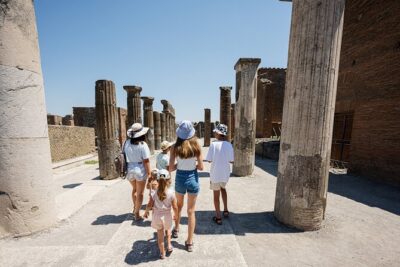
Pompeii and Mount Vesuvius Day Trip from Rome with Pizza Lunch
Read our review →Browse the lists this tour appears in