
Review · POMPEII & HERCULANEUM TOURS
PompeiI Exclusive Tour with your Archaeologist in a Small Group
Pompeii rewards a careful guide. This two-hour small-group tour gives you a clear route through the ancient city, with an authorized archaeology guide explaining what you are seeing and why it matters. I like the separate priority entrance arrangement, and I like the modest group size, advertised at no more than 15 people. The main catch is important: the €19 Pompeii admission ticket is extra.
You meet outside Porta Marina Superiore, look for the Pompeii Vip sign, and then move through the western side of the archaeological park toward the Forum. Guides such as Ricardo, Raffaele, Antonio, Ornella, and PierLuigi have earned especially warm praise for making the ruins understandable, lively, and human. Two hours is enough for the main sights, but not enough to cover every corner of this huge site.
In This Review
- Key things to know before booking
- Why a guide matters at Pompeii
- Meeting at Porta Marina Superiore
- The first temples and Pompeii’s public center
- Jupiter, Vesuvius, and the food market
- The Forum Baths and the old fast-food counter
- The House of the Faun and the House of the Vettii
- Via dell’Abbondanza and Pompeii’s street life
- The Teatro Grande and what you may miss
- Price, group size, and the real value
- Practical advice for a smoother visit
- Who should book this Pompeii tour?
- Should you book it?
- FAQ
- How much does the Pompeii tour cost?
- Are Pompeii entrance tickets included?
- Where does the tour meet?
- How long does the tour last?
- What language is the tour offered in?
- How large is the group?
- Does the tour visit the House of the Faun and House of the Vettii?
- Can I cancel for a full refund?
Key things to know before booking
- The €30.25 tour price excludes entry: Adults must also pay €19 for the archaeological park, while admission is free for children under 18.
- You follow a practical western-to-central route: The walk begins at Porta Marina and reaches the Forum, baths, shops, grand houses, Via dell’Abbondanza, and the theater.
- The guide adds the meaning: Archaeology is used to explain how experts identify buildings, objects, and plaster casts, not just to point out old walls.
- Two hours keeps the visit manageable: You see major landmarks without trying to tackle all of Pompeii in one long, tiring march.
- The small group helps: The advertised maximum is 15 people, though one account described a group closer to 20, so group size may not always be exact.
- Wear sturdy walking shoes: Pompeii has uneven ancient paving, and the tour involves continuous outdoor walking.
Why a guide matters at Pompeii
Pompeii can look like a field of broken walls if you do not know how to read it. A doorway may mark a bakery, a bathhouse, or a private home. A broad open space may have been a commercial center, a political meeting place, or a religious precinct. Without context, much of the site becomes a guessing game.
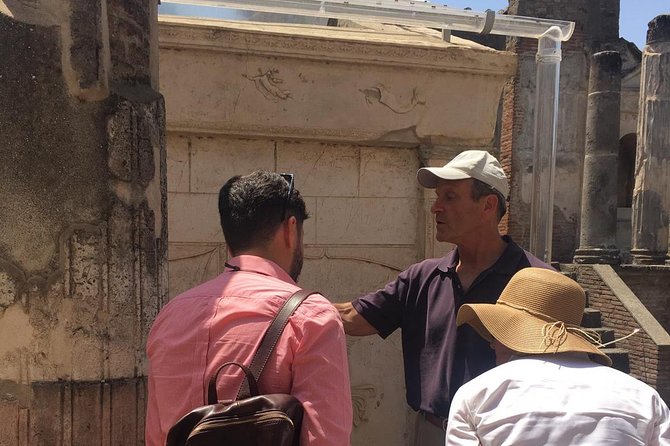
That is where this tour earns its fee. The guides do more than identify buildings. They explain how archaeologists work out a building’s use, how Roman streets functioned, and what small details reveal about daily life. Ricardo, in particular, has been praised for explaining not only what an object was, but how archaeologists knew.
The best guides also connect the ruins to ordinary people. The thermopolium becomes more than a preserved counter. It was a place where residents could buy prepared food and refreshments. The baths show how public services were organized. A house tells you something about status, religion, decoration, and family life.
The English guides have generally been praised for clear speech, humor, and energy. Raffaele has been singled out for his friendly manner, while Antonio has been praised for adjusting the final part of the walk to the group’s interests. Ornella is known for expressive storytelling and a warm presentation. Guide assignments can change, so booking this experience does not guarantee one particular person.
More Pompeii and Herculaneum visits:
- Pompeii Small Group Tour with an Archaeologist
★ 5.0 · 6,593 reviews - Discover the Ancient Ruins of Pompeii: Day Trip from Rome
★ 3.5 · 2,247 reviews - Pompeii and Herculaneum Small Group Tour with an Archaeologist
★ 5.0 · 1,350 reviews
Meeting at Porta Marina Superiore
The tour begins at Via Villa dei Misteri, 1, outside the archaeological park. Your guide waits near Porta Marina Superiore with a sign reading Pompeii Vip. Arrive with enough time to identify the meeting point and sort out your entrance ticket.
Porta Marina is the western gateway into ancient Pompeii. Its name comes from the road that once led toward the sea. This is a useful opening because it places the city in its wider setting before you reach the public center.
The tour price is for the guided experience, not admission to the ruins. The provider sends a link the afternoon before the tour so you can buy a skip-the-line entry ticket online. The details are worth checking closely: the ticket connected with the booking is not your archaeological park admission.
You can also buy the entry ticket on site with help from the tour staff, but the online option is intended to save time. The separate priority arrangement is one of the tour’s practical advantages, especially at busy times.
The first temples and Pompeii’s public center
From Porta Marina, the route moves toward the Temple of Venus. Venus was Pompeii’s patron goddess, so this sanctuary had special importance for the city. The remains are not a complete temple ready for easy viewing, but the guide helps you understand its position and religious role.
Next comes the Basilica, one of the city’s most important public buildings. It was used for business and the administration of justice, and it was among the most lavish structures around the Forum. This is a good place to picture Pompeii not as a quiet ruin, but as a working city filled with commerce, legal disputes, contracts, and civic business.
The Sanctuary of Apollo follows. It was among Pompeii’s oldest places of worship and occupied a strategic spot along the road from Porta Marina to the public heart of town. The route itself matters here. Ancient Pompeii was organized around movement, with streets leading people from the gates into areas for worship, trade, government, and entertainment.
The Forum then brings those functions together. This was the city’s main square and the center of daily public life. You can expect time to pause here while the guide points out the surrounding buildings and explains how the open space operated as a civic center.
Jupiter, Vesuvius, and the food market
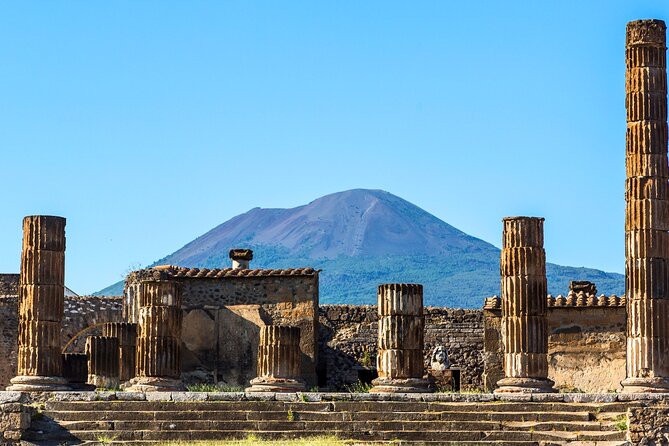
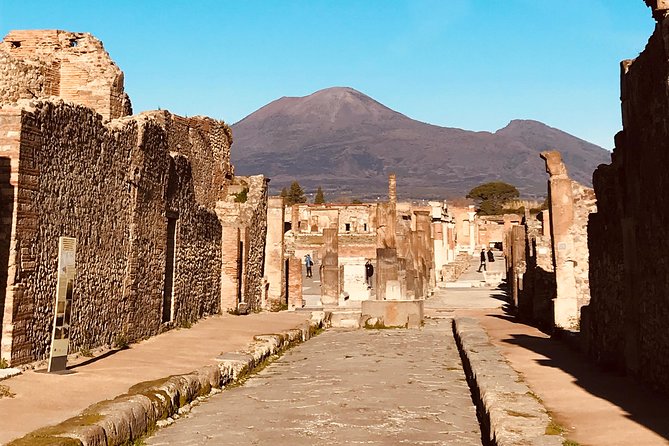
At the northern end of the Forum, the Temple of Jupiter commands attention. Its position gives it visual weight, and Mount Vesuvius rises behind it in a particularly memorable view. The mountain is not just scenery. It frames the event that buried Pompeii and gives the entire visit a constant sense of place.
The Macellum was a large market building for food and everyday consumer goods. This stop helps balance the grand temples and public monuments with the practical side of Roman life. People needed somewhere to shop, eat, and conduct routine business, and the Macellum served that need.
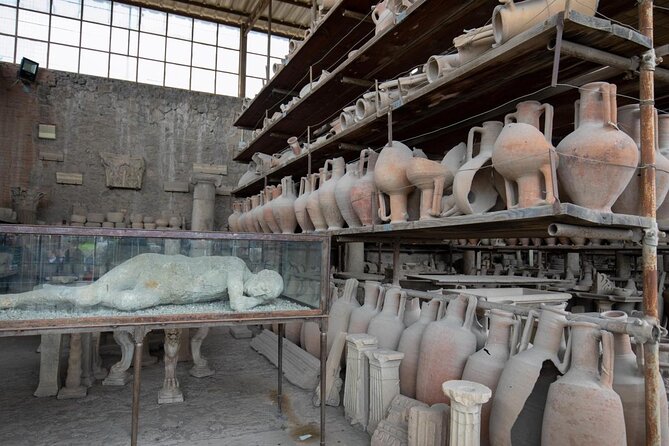
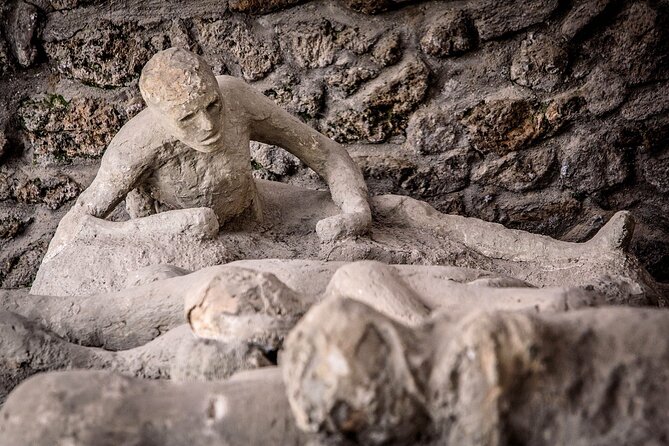
Plaster casts may be shown here. These are made from cavities left in the volcanic material where bodies decomposed. Archaeologists fill the spaces to preserve the shape of people as they were during the eruption. The casts can be upsetting, but they are also a direct reminder that Pompeii was a living community, not simply an architectural site.
A guide is especially useful here. The method can seem mysterious if you only see the finished cast. A clear explanation of how the cavities formed and were found makes the display far more meaningful.
A few more reviews worth comparing before you book
- Skip the Line Guided Tour of Pompeii led by an Archaeologist
★ 5.0 · 703 reviews - Pompeii Ticket + Tour with Optional Tasting Experience at Pompeii
★ 5.0 · 663 reviews - Pompeii private tour with an Official Guide
★ 5.0 · 631 reviews - Pompeii Private Tour with an Archaeologist and Skip The Line – 3 hours
★ 5.0 · 564 reviews
The Forum Baths and the old fast-food counter
The Forum Baths are among Pompeii’s best-preserved buildings. The male and female sections had separate entrances, a detail that gives you a quick sense of how the bathing complex was arranged.
Roman baths were not simply places to wash. They were part of public life, and the surviving rooms allow you to see the planning behind the service. The guide can point out how different spaces worked and help you notice details that would be easy to pass without comment.
The Thermopolium of Vetuzio Placido offers a different view of the city. This old diner served refreshments to Pompeii’s residents. Its counters and serving areas make the ancient street feel surprisingly familiar. You can picture a quick meal or drink being bought here long before modern cafés and takeaway counters appeared.
This is one of the tour’s strongest stretches because the buildings are easy to connect with. A temple may require historical explanation. A bathhouse and food counter speak more directly to the daily routine of the people who lived here.
The House of the Faun and the House of the Vettii
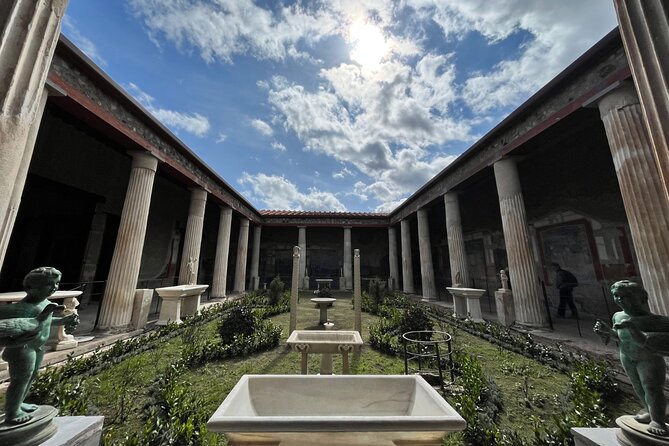
The House of the Faun is one of Pompeii’s largest residences. Its name comes from the famous faun statue associated with the house, while the Latin welcome inscription HAVE appears on the sidewalk outside. That small word is a fine example of how Pompeii preserves personal details alongside large public monuments.
The House of the Vettii is another major private residence. It was among the city’s wealthiest and most famous homes, and its decoration includes the figure of Priapus, associated with prosperity. The house is also subject to seasonal opening and closing, as is the House of the Faun.
That warning matters. The route includes these homes in the plan, but access can change with conservation work, staffing, or seasonal schedules. You may see one, both, or the surrounding area rather than every interior room. A good guide can still explain the importance of the houses if a doorway is closed.
The grand homes also help put the rest of Pompeii in perspective. They show the scale of wealth available to some residents, while the shops, baths, and narrow streets reveal the routines of the wider population.
Via dell’Abbondanza and Pompeii’s street life
Via dell’Abbondanza was the ancient city’s main street, known as the decumanus maximus. Walking along it gives you a better feel for Pompeii as an urban place rather than a collection of isolated monuments.
Look for the relationship between street, doorway, shop, and house. The guide can explain how people moved through the city and how commercial activity fitted beside private life. Even when individual buildings are partly closed, the street itself provides a strong sense of scale.
The paving can be uneven, and ancient roads are not designed for modern comfort. Take the footwear advice seriously. Good walking shoes will make the experience easier, especially in hot, wet, or windy conditions.
The two-hour schedule is sensible here. Pompeii is large, and trying to see every building in one short visit would leave you tired and confused. This route gives you a framework. If you have extra time after the guided walk, you can explore more of the park using the route you have just learned.
The Teatro Grande and what you may miss
The final listed stop is the Teatro Grande, where comedies and tragedies were performed in the Greco-Roman tradition. The theater provides a fitting finish because it shows another side of public life: entertainment, performance, and shared culture.
The route focuses on the city’s key religious, civic, commercial, residential, and entertainment sites. It does not cover everything. The amphitheater and brothel are not guaranteed parts of this two-hour walk, and one account specifically wished the tour had included at least one of them.
That is not necessarily a flaw. A short tour must make choices. If the amphitheater or brothel is your top priority, ask about the route before booking or plan time to visit independently. The guide-led walk is best viewed as an introduction to the central parts of Pompeii, not a complete survey.
Price, group size, and the real value
The advertised price is $30.25 per person, but an adult should budget another €19 for park admission. That makes the full cost higher than the headline figure, and the ticket arrangement can cause confusion if you do not read the details carefully.
Still, the guided portion offers good value if you want the site explained rather than simply photographed. Pompeii is vast, and a poor route can waste time. Two hours with an archaeology specialist gives you a clear foundation and leaves room to continue on your own.
The small-group format is another reason to consider it. The stated maximum is 15 people, and a group of around 12 should allow questions and a closer connection with the guide. One account reported a group of about 20, so I would treat 15 as the stated limit rather than an absolute guarantee.
Several guides have made the experience especially personal by answering questions, allowing photo stops, and changing the last part of the route to suit the group. That flexibility is valuable, but it may depend on the guide and the day’s conditions.
Practical advice for a smoother visit
Book ahead if your schedule is fixed. This tour is commonly reserved about 25 days in advance, which suggests that popular dates can fill well before arrival.
The tour is offered in English and requires good weather. If poor weather cancels the experience, you are offered another date or a full refund. If the minimum number of participants is not reached, the same choice applies.
Cancellation is free when made at least 24 hours before the start time. Changes or cancellations inside that window are not accepted for a refund.
Public transportation is nearby, and most people can take part. Bring comfortable shoes and prepare for exposed outdoor walking. In wet or windy conditions, the guide may use sheltered spots along the route, but you should still dress for the forecast.
The route ends back at the meeting point. That makes it easier to continue exploring Pompeii afterward or arrange transport from the same area.
Who should book this Pompeii tour?
I would choose this tour if you have about half a day for Pompeii and want the main story without committing to an all-day visit. It suits first-time visitors, families, and anyone who feels unsure about interpreting ruins.
It is also a strong choice for people who prefer real conversation to an audio guide. Several guides have been praised for clear English, humor, and explanations that go beyond memorized facts. Families with children aged 11 and 14 have found the two-hour length workable, and the active storytelling can help younger visitors stay focused.
I would look elsewhere if you want to see the amphitheater, brothel, or outer districts as part of a fixed itinerary. I would also avoid assuming that the tour price includes entry. Add the €19 adult admission fee before comparing this experience with other Pompeii options.
Should you book it?
Yes, if your priority is understanding Pompeii’s main temples, Forum, baths, homes, shops, streets, and theater in a focused two-hour walk. The archaeology background of the guides is the central benefit, and the strongest guides turn walls and paving stones into evidence of real city life.
Book it with three expectations: buy the park ticket separately, wear proper shoes, and allow extra time if you want to explore beyond the guided route. If those conditions suit you, this is a well-priced way to get your bearings and see Pompeii with much more meaning than you would gain by wandering alone.
FAQ
How much does the Pompeii tour cost?
The guided experience costs $30.25 per person. Pompeii Archaeological Park admission is not included and costs €19 per adult. Entry is free for children under 18.
Are Pompeii entrance tickets included?
No. The tour price does not include admission to the archaeological park. A link is sent the afternoon before the tour so you can purchase a skip-the-line entry ticket online, or you can buy admission on site with assistance.
Where does the tour meet?
The meeting point is Via Villa dei Misteri, 1, 80045 Pompei NA, Italy. The guide waits outside Porta Marina Superiore with a Pompeii Vip sign.
How long does the tour last?
The experience lasts about two hours. It ends back at the meeting point.
What language is the tour offered in?
The tour is offered in English.
How large is the group?
The stated maximum is 15 participants. One account described a group of about 20, so the actual group size may occasionally differ from the advertised limit.
Does the tour visit the House of the Faun and House of the Vettii?
They are included in the planned route, but both houses can have seasonal openings and closures. Access may therefore vary.
Can I cancel for a full refund?
Yes, if you cancel at least 24 hours before the experience start time. Cancellations or changes made less than 24 hours in advance are not refunded. Weather or minimum-participant cancellations may result in another date or a full refund.
Just added around Pompeii
- Pompeii Guided Group Tour with Entry Ticket and Archaeologist★ 4.5 · 269 reviews
- Pompeii: Guided Small Group Tour Max 6 People with Private Option★ 5.0 · 269 reviews
- Private Day Tour to Vesuvius, Herculaneum & Pompeii with Pick Up★ 5.0 · 279 reviews
- Pompeii Vineyard Escape: Private Wine Tasting & Lunch★ 5.0 · 329 reviews
- 2 hours Pompeii Tour with Local Historian – Ticket Included★ 5.0 · 335 reviews
- Complete Pompeii Skip the Line Tour with Archaeologist Guide★ 4.5 · 379 reviews
- Pompeii 2h Small-Group Tour with Expert Archaeologist★ 5.0 · 385 reviews
- Pompeii Private Tour with an Archaeologist and Skip The Line★ 5.0 · 391 reviews
Pompeii & Herculaneum Tours, compared.

Pompeii: Entry Ticket and Guided Tour with an Archaeologist
Read our review →
Pompeii: Entry Ticket with Optional Audio Guide
Read our review →
Pompeii: Small Group Tour with an Archaeologist
Read our review →


Pompeii Small Group Tour with an Archaeologist
Read our review →
Pompeii, Amalfi Coast and Positano Day Trip from Rome
Read our review →Browse the lists this tour appears in