
Review · POMPEII & HERCULANEUM TOURS
Pompeii: Entry Ticket and Guided Tour with an Archaeologist
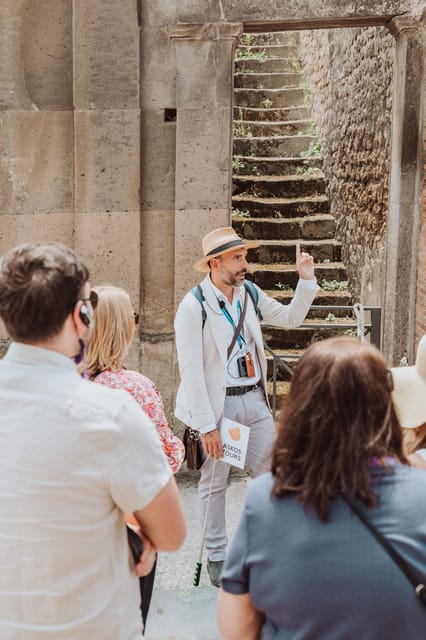
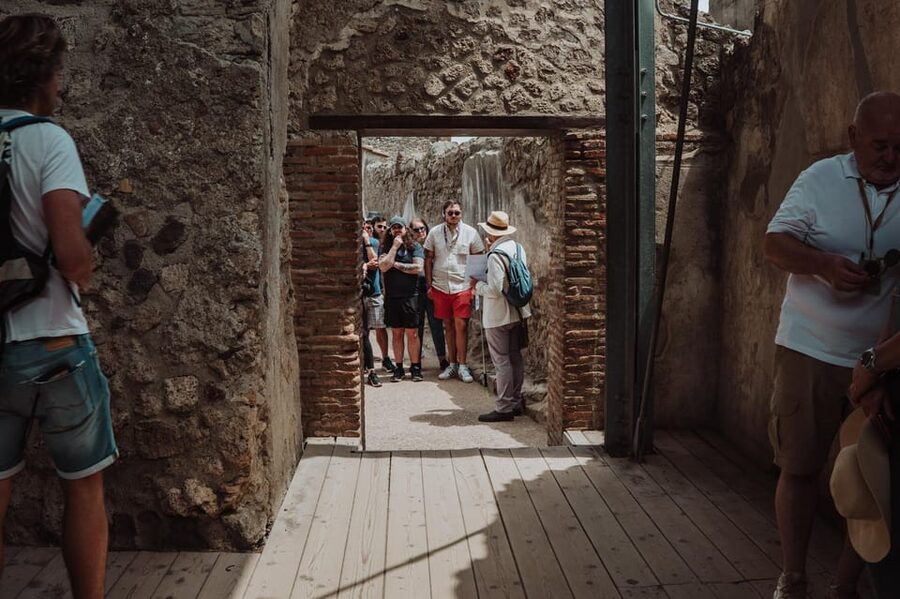
Pompeii rewards a guide. This two-hour archaeologist-led tour gives you a clear route through a huge, confusing site, with stops at the House of the Faun, the Lupanar, and the House of Menander. I especially like the skip-the-line entry and the small groups of up to 20 people. The main drawback is physical: Pompeii’s uneven ancient streets require steady walking, and this is not a good fit for wheelchair users or anyone who struggles with steps.
The guides are the heart of the experience. Teresa, Anna, Raffaella, Alfredo, Sergio, and Mario are among the names praised for turning walls, temples, homes, and shops into scenes from daily Roman life. Bring water, wear shoes with a firm sole, and leave extra time afterward if you want to explore beyond the guided route.
In This Review
- Key points to know before you book
- Why Pompeii makes a guided visit worthwhile
- Starting near Porta Marina
- The Forum and the public center of Pompeii
- The House of the Faun and Pompeii’s wealthy residents
- The Lupanar and the less polished side of Roman life
- The House of Menander and everyday domestic life
- The Macellum, where food and trade shaped city life
- The Forum Baths and the practical Roman city
- The plaster casts and the human cost of the eruption
- Theaters, streets, and the scale of the ancient city
- What the guide adds to the experience
- Is $35 good value for Pompeii?
- Practical advice for a smoother visit
- Who should choose this Pompeii tour?
- Should you book it?
- FAQ
- How long does the Pompeii guided tour last?
- What is included in the price?
- Does the tour include skip-the-line entry?
- Which Pompeii sights are visited?
- What languages are available?
- Is transportation included?
- Is the tour suitable for wheelchair users?
- Can children join the tour?
- Are dogs allowed inside Pompeii?
Key points to know before you book
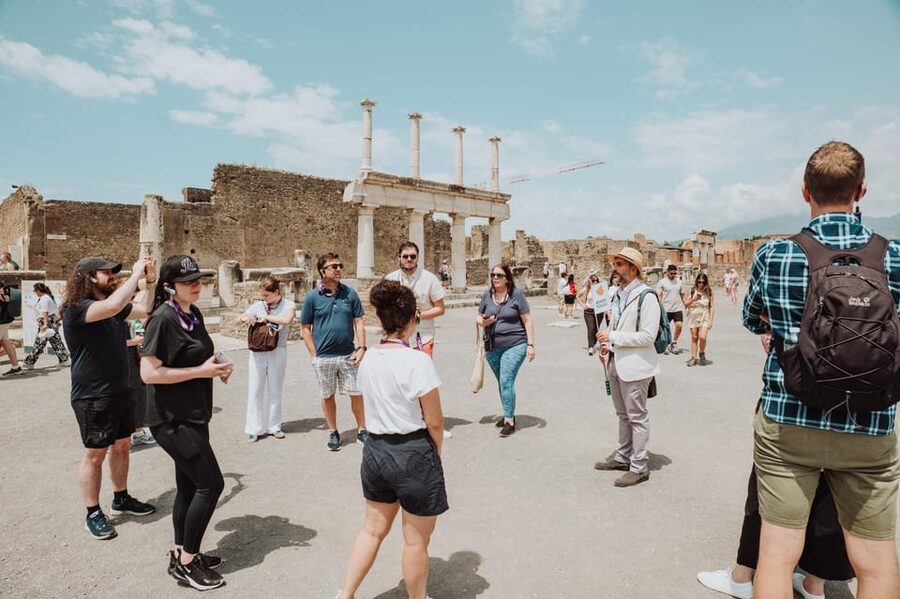
- You see Pompeii’s essential landmarks in two hours: The route includes the Forum, Temple of Apollo, House of the Faun, Lupanar, House of Menander, Macellum, baths, and plaster casts.
- An archaeologist gives the ruins meaning: You get context about architecture, religion, commerce, household life, and Roman society instead of simply walking past old stones.
- Skip-the-line entry saves time: The Pompei Express ticket is included, so you avoid the ticket line and get inside with less fuss.
- Expect a real walking tour: Ancient paving is uneven, the site is large, and some areas involve steps or awkward footing.
- You can continue alone afterward: Guides often suggest additional areas to see once the tour ends, which is useful because two hours only covers a fraction of Pompeii.
- The $35 price is fair for guided access: You are paying for admission, a specialist guide, and a planned route, not just a basic entry ticket.
Why Pompeii makes a guided visit worthwhile
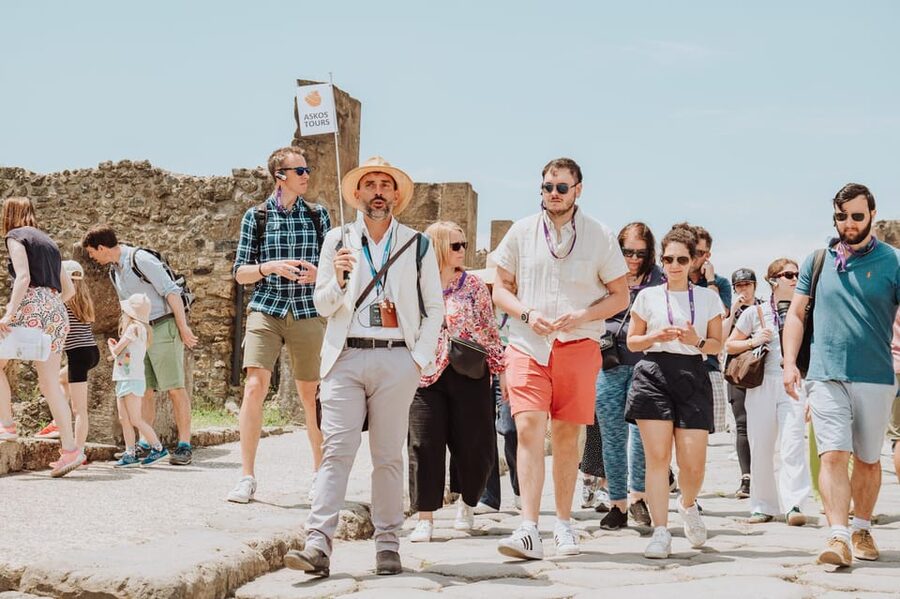
Pompeii is not a compact ruin with a single grand monument at its center. It is an ancient city spread across streets, homes, public buildings, temples, baths, theaters, shops, and service counters. Without context, you can easily spend hours looking at doorways and painted walls without understanding how the city worked.
That is where this tour earns its price. The guide explains what you are seeing and why it mattered. A large private home becomes evidence of wealth and social status. A food counter hints at the eating habits of ordinary residents. A public bath reveals how social life extended beyond the household.
The eruption of Mount Vesuvius in 79 AD gives Pompeii its fame, but the site is much more than a disaster scene. The best guides shift your attention toward the people who lived here before the eruption: shopkeepers, household workers, worshippers, politicians, bathers, diners, and families.
The group size is capped at 20 people. That is not truly intimate, but it is far easier to follow than a large crowd. For groups of 10 or more, headsets are provided. They help when other groups gather nearby, although the listening equipment is not perfect for everyone. One visitor found it necessary to hold the earpiece close in noisy areas.
More Pompeii and Herculaneum visits:
- Pompeii Small Group Tour with an Archaeologist
★ 5.0 · 6,593 reviews - Discover the Ancient Ruins of Pompeii: Day Trip from Rome
★ 3.5 · 2,247 reviews - Pompeii and Herculaneum Small Group Tour with an Archaeologist
★ 5.0 · 1,350 reviews
Starting near Porta Marina
The meeting point can vary according to the option you book, with the listed starting location on Via Villa dei Misteri, 2. Check your confirmation carefully so you do not head to the wrong entrance.
The tour generally begins at Porta Marina, one of Pompeii’s main entrances. You pass through the gateway and quickly get a sense of the site’s scale. The name refers to the road toward the sea, and the gate connected the city with its wider surroundings.
This opening section is useful because it gives you orientation before the streets begin to blur together. Pompeii can feel like a maze, especially after the guided portion ends. Pay attention to the route from the start, since you may want to retrace part of it later.
You will also pass the Temple of Apollo. This is one of the oldest religious areas in Pompeii, and its position near the Forum shows how important religion was to the city’s public life. The stop is listed as a pass-by section rather than a long interior visit, so do not expect a detailed examination of every feature.
The Forum and the public center of Pompeii

The Foro Civile di Pompei receives about 20 minutes on the route. This is the city’s main public square and one of the most important places to understand Pompeii as a functioning community.
The Forum was used for politics, religion, business, and public gatherings. You see the remains of major buildings around an open central space, with Mount Vesuvius often forming the dramatic backdrop. A guide helps you picture the missing columns, statues, crowds, speeches, and ceremonies without pretending that the ruins are still intact.
This part of the tour is especially good for first-time visitors. The Forum gives you a framework for the rest of the city. Once you understand the difference between civic, religious, commercial, and domestic areas, later stops make more sense.
The open space can be exposed to sun and weather. There is little reason to rush, but you should listen closely here, since the guide may explain the city’s political and religious structure in a short amount of time.
The House of the Faun and Pompeii’s wealthy residents
The House of the Faun is one of Pompeii’s best-known private residences and receives about 20 minutes of guided attention. Its name comes from the bronze statue of a dancing faun found in the house.
The scale tells you immediately that this was not an ordinary home. Large atriums, courtyards, decorative floors, and elegant rooms show how wealthy Roman families displayed status. The house is also associated with the famous Alexander Mosaic, although the original mosaic is now in the Naples National Archaeological Museum. What you see at Pompeii is the setting that once held it.
This is a good place to let the guide handle the details. The remains can look like a series of rooms until someone explains how visitors moved through the house, where social business took place, and how decoration communicated wealth.
You will have time for photographs, but the house can attract several groups at once. Keep your attention on the guide and avoid trying to capture every doorway. The value here is not just the size of the residence. It is seeing how Roman architecture shaped family life, hospitality, privacy, and social rank.
A few more reviews worth comparing before you book
- Skip the Line Guided Tour of Pompeii led by an Archaeologist
★ 5.0 · 703 reviews - Pompeii Ticket + Tour with Optional Tasting Experience at Pompeii
★ 5.0 · 663 reviews - Pompeii private tour with an Official Guide
★ 5.0 · 631 reviews - Pompeii Private Tour with an Archaeologist and Skip The Line – 3 hours
★ 5.0 · 564 reviews
The Lupanar and the less polished side of Roman life
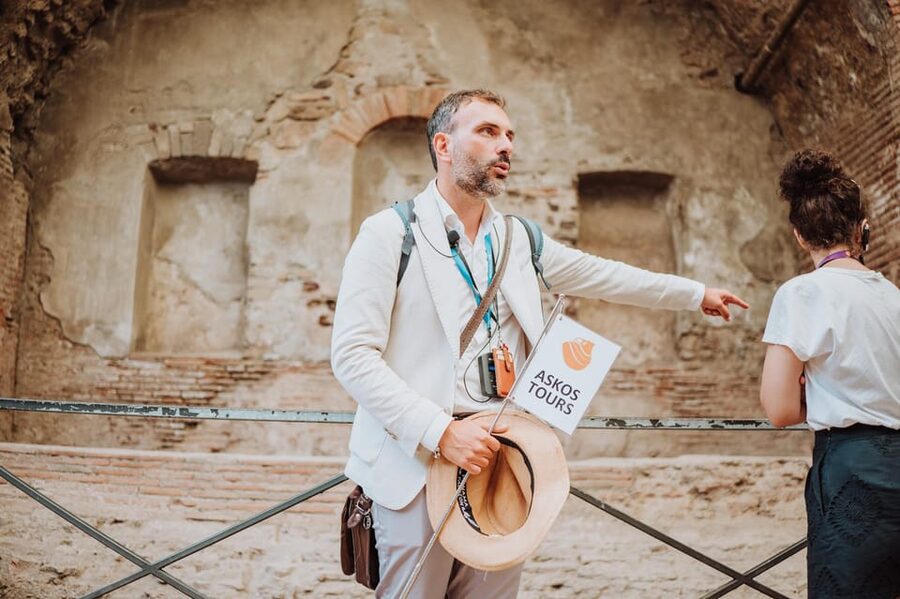
The Lupanare, or brothel, is another 20-minute guided stop. It is one of Pompeii’s most talked-about buildings, partly because of its small rooms and erotic images.
A good guide adds needed context instead of treating the site as a cheap joke. The Lupanar offers a glimpse into the commercial and sexual life of the ancient city, including the way painted images and inscriptions were used. The surviving rooms are cramped, and the building may feel more stark than grand.
Crowds can gather here, and access may feel tight. If you dislike congested spaces, stay near the guide and let the group move at its own pace. This is also a stop where clear explanation matters. The building is memorable, but it needs social context to become more than a famous curiosity.
The House of Menander and everyday domestic life
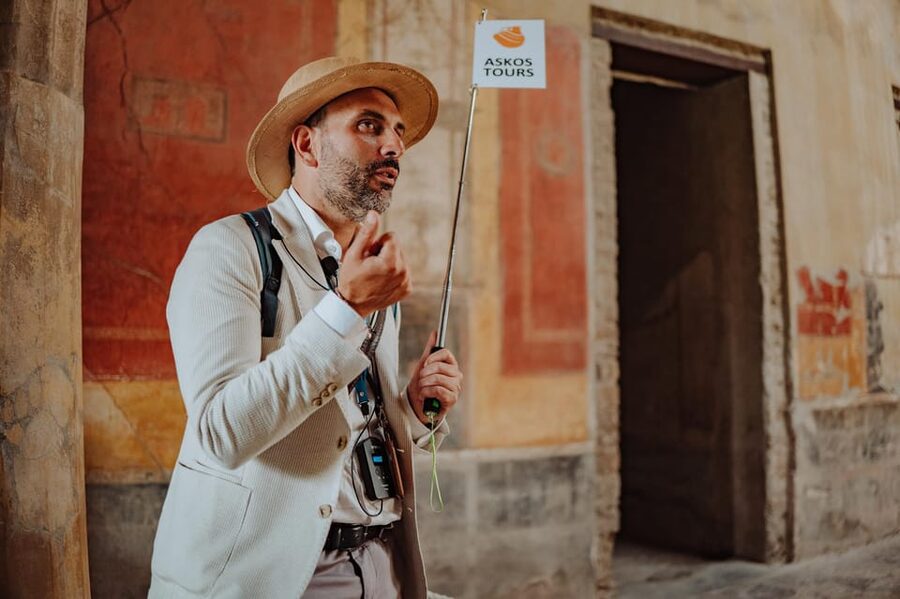
The House of Menander receives another 20-minute guided visit. It is named after a portrait of the Greek playwright Menander, found within the property.
Like the House of the Faun, this residence shows the importance of decoration and household design. But its appeal lies in how it helps you think about daily routines. Pompeii’s houses were not simply places where people slept. They were spaces for receiving visitors, managing work, displaying status, and organizing family life.
The guide may point out small details that are easy to miss on your own. Several tour participants praised guides for explaining ordinary life, not just emperors, volcanoes, and famous artworks. That focus is one of the strongest reasons to choose this experience.
The House of Menander also reinforces a useful lesson: Pompeii was a Roman city with strong Greek cultural influence. Names, theater, art, religion, and education did not fit into a single simple category.
The Macellum, where food and trade shaped city life
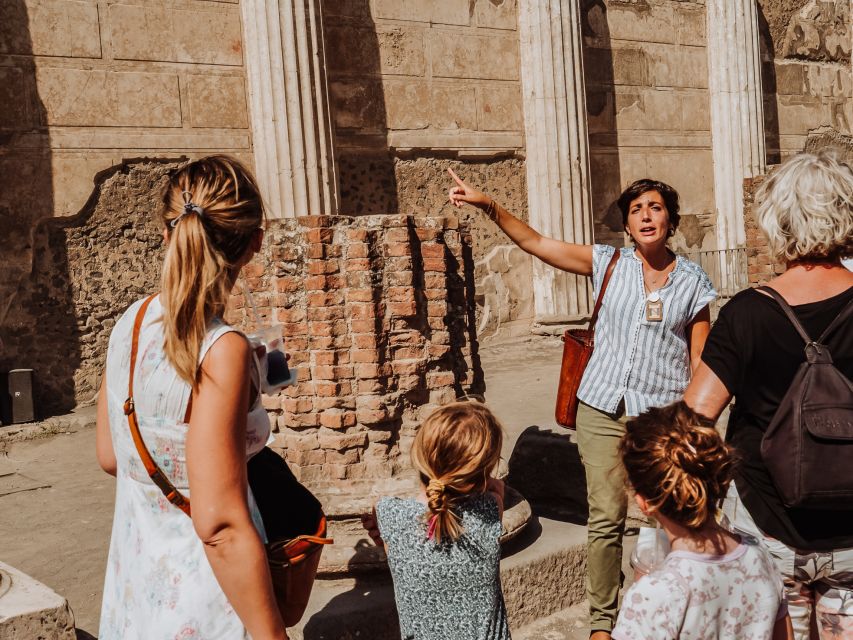
The Macellum takes about 10 minutes. This was a market building connected with food sales and public commerce.
The short visit works well because the market is part of a larger story. After seeing wealthy homes and public monuments, you get a look at how the city supplied itself. The guide can help you identify the building’s layout and explain how markets fit into the Forum area.
Do not expect a long stop with time to examine every detail. The tour has a lot to cover, and this is one of several brief visits. Still, it adds balance to the itinerary. Pompeii was not only a city of grand houses and temples. It was also a place where people bought food, worked, argued, ate, and went about routine business.
The Forum Baths and the practical Roman city
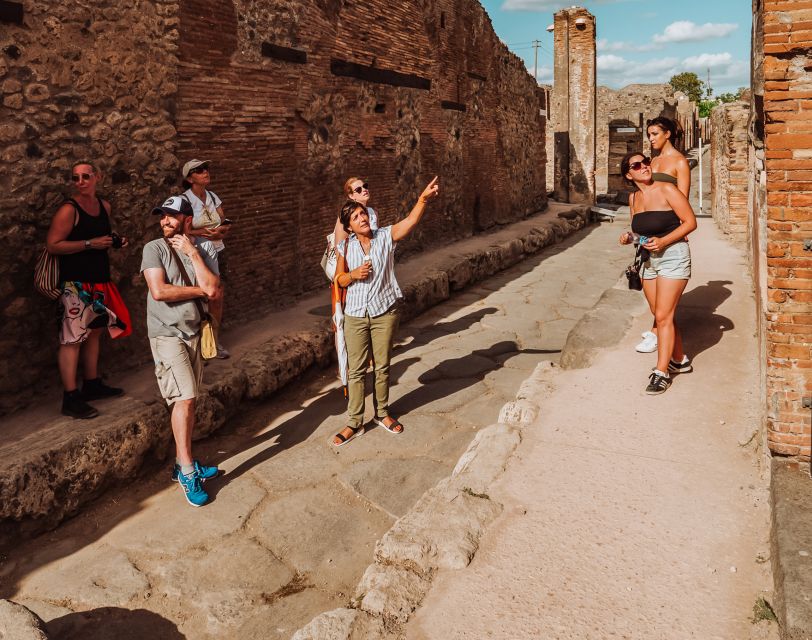
The Forum Baths receive about 10 minutes of guided attention. Ancient bathing was not merely about washing. Baths were social spaces where people exercised, met friends, conducted business, and spent part of the day.
The remains show the practical skill behind Roman heating and water systems. A guide can explain how different rooms served different purposes and how the bathing complex fit into urban life.
Again, 10 minutes is enough for an introduction, not a full study. If baths are a special interest, ask the guide what else to see after the tour. Pompeii contains more than the sites listed here, and the walking route is designed to give you a strong first look rather than cover every building.
The plaster casts and the human cost of the eruption
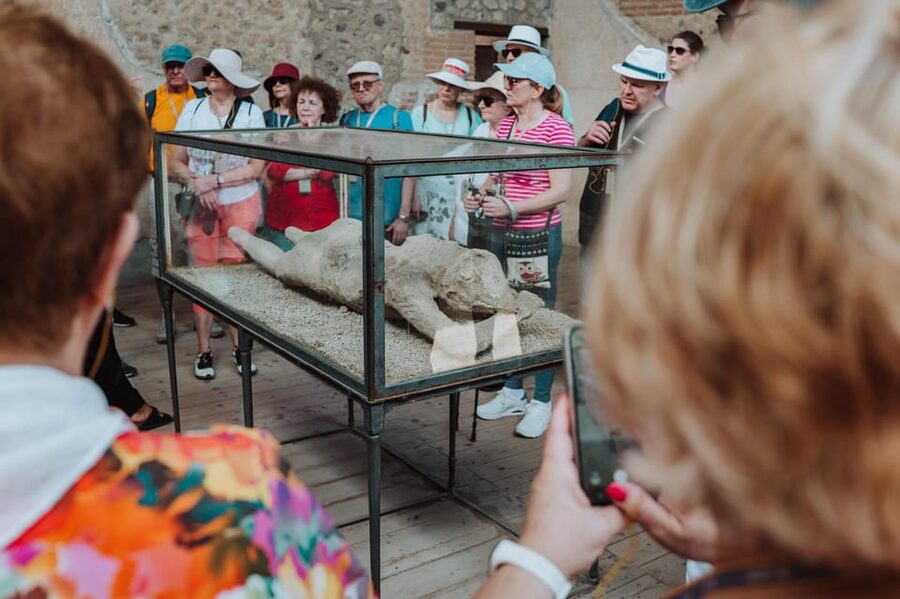
The plaster casts of victims are among the most emotional sights in Pompeii. They are not always described as a formal timed stop in the itinerary, but the route includes them among the major features you may see.
The casts were made from voids left in the hardened volcanic material. They preserve the shapes of people who died during the eruption, making the disaster suddenly personal. This is a quiet part of the visit for many people, and it can feel very different from admiring mosaics or columns.
Your guide’s tone matters here. The strongest guides treat the casts with care and explain what they show without turning suffering into spectacle. You may want to pause rather than rush straight to photographs.
Theaters, streets, and the scale of the ancient city
The tour also includes the historic theaters and the main streets as part of the wider route. These sections help you understand Pompeii’s size and the variety of public life.
The streets are one of the site’s most striking features. Ancient paving stones, raised sidewalks, building fronts, and crossing points give you a physical sense of how residents moved around town. They are also the part most likely to test your feet. Surfaces are uneven, and you may need to step up or down without much warning.
The theaters show another side of Roman entertainment. Their presence reminds you that Pompeii had organized public culture, not just temples and houses. The guide can connect theatergoing with language, art, social rank, and civic identity.
The route covers a lot of ground. One participant found the tour lasted longer than expected and showed a wide range of Pompeii. That can be a plus if you want maximum coverage, but it also means you should not arrive expecting a relaxed stroll.
What the guide adds to the experience
The most praised part of this tour is the quality of the guiding. Teresa was praised for clear English and a warm, personal style. Anna made difficult subjects easy to follow and kept the pace lively. Raffaella was described as funny, energetic, and engaging, even in poor weather.
Other guides, including Alfredo, Sergio, Mario, Giancarlo, Amedeo, and Alexandra, were praised for connecting architecture with social life. Mario, in particular, was described as linking history with sociology, mythology, art, and Roman philosophy. That range is useful because Pompeii rewards more than a list of dates.
You should still remember that the exact guide shapes the experience. The advertised service includes an archaeologist guide, but personalities and teaching styles will vary. The repeated praise for humor, clear explanations, and practical advice suggests a strong standard, but no tour can guarantee one particular guide.
Headsets are included for groups of 10 or more. They are helpful near crowded buildings, though sound quality and comfort may vary. If you have trouble hearing, tell the guide early instead of quietly falling behind.
Is $35 good value for Pompeii?
At $35 per person, this is a sensible middle-ground choice. You receive a Pompei Express entrance ticket, a two-hour guided route, a specialist guide, and skip-the-line access.
A basic entry ticket gives you freedom, but Pompeii is so large that freedom can become confusion. You might miss the best houses, walk past important details, or lose time figuring out where you are. The guide’s route and explanations are the main value here.
The price does not include food, drinks, hotel pickup, drop-off, or transportation. You need to reach the meeting point yourself. If you are arriving from Naples, allow extra time for the train and possible delays. One group arrived late because of a train problem and was helped into a later time slot, but you should not rely on that kindness.
The tour is also a good first visit rather than a final word on Pompeii. Several guides give suggestions for continuing alone, and you can remain in the site after the guided portion to see more. Plan for that if you want to visit additional homes, gardens, theaters, or outer streets.
Practical advice for a smoother visit
Wear comfortable shoes with strong grip. This is not optional fashion advice. The old paving can be rough, and you may climb steps or negotiate uneven surfaces.
Carry water. Pompeii involves substantial walking, and one participant became dehydrated and hungry after spending extra time exploring alone. Food and drinks are not included, so bring what you need or plan a stop outside the archaeological area.
Sun and rain can both affect the visit. Several people enjoyed the tour despite rain because their guides adjusted well, but weather still changes how comfortable the streets feel. A hat, sunscreen, and a light rain layer are sensible additions.
The site is not suitable for wheelchair users, people with mobility impairments, or visitors using mobility scooters. Dogs are allowed only within strict limits: no more than 10 kilograms in weight and no more than 40 centimeters in height. They must be leashed, held in the arms inside buildings, and cleaned up after.
Visitors under 18 should bring a passport or identity card to qualify for free admission. Unaccompanied minors are not permitted.
Who should choose this Pompeii tour?
I would choose this tour if you are visiting Pompeii for the first time, have about two hours, and want the major sights explained in a sensible order. It suits history fans, families with older children, couples, and anyone who prefers stories and context to wandering without a plan.
It is especially useful if you are coming from Naples or Sorrento on a tight schedule. The planned route reduces wasted time, while the skip-the-line entry helps you get inside promptly.
I would not choose it if you need a fully accessible route, dislike walking on rough ground, or want to explore at your own speed from the first minute. Independent visitors may prefer a longer visit with no fixed pace, but even then, a guided introduction can help you get your bearings before continuing alone.
Should you book it?
Book this Pompeii tour if you want the site to make sense, not just look impressive. The strongest value is the archaeologist’s interpretation, especially at the House of the Faun, Lupanar, House of Menander, and the Forum.
Keep your expectations practical. Two hours gives you a strong overview, not every corner of the ancient city. Wear good shoes, carry water, check the meeting point, and reserve time afterward if you want to continue exploring.
With a 4.8 rating from 19,459 reviews, the service has a strong record, and the praise centers on exactly what Pompeii needs: clear explanations, lively guides, good routes, and help seeing details you would likely miss alone. At $35, that is a fair deal for a first visit.
FAQ
How long does the Pompeii guided tour last?
The tour lasts two hours. Starting times vary, so you need to check availability for your chosen date.
What is included in the price?
The price includes the Pompei Express entrance ticket, an archaeologist guide, a small group tour, and headsets for groups of 10 people or more.
Does the tour include skip-the-line entry?
Yes. Skip-the-ticket-line access is included.
Which Pompeii sights are visited?
The route includes Porta Marina, the Temple of Apollo, the Forum, the House of the Faun, the Lupanar, the House of Menander, the Macellum, and the Forum Baths. The wider experience also includes major streets, theaters, and plaster casts of victims.
What languages are available?
Live guiding is available in English, Spanish, French, Italian, Portuguese, and German.
Is transportation included?
No. Hotel pickup, hotel drop-off, and transportation are not included. You must reach the meeting point yourself.
Is the tour suitable for wheelchair users?
No. The experience is not suitable for wheelchair users or people with mobility impairments. Mobility scooters are also not allowed.
Can children join the tour?
Unaccompanied minors are not permitted. Visitors under 18 are advised to bring a passport or identity card to qualify for free admission.
Are dogs allowed inside Pompeii?
Only dogs weighing no more than 10 kilograms and measuring no more than 40 centimeters in height are permitted. They must be leashed, carried in the arms inside buildings, and their waste must be collected.
Just added around Pompeii
- Pompeii: Guided Small Group Tour Max 6 People with Private Option★ 5.0 · 269 reviews
- Pompeii Guided Group Tour with Entry Ticket and Archaeologist★ 4.5 · 269 reviews
- Private Day Tour to Vesuvius, Herculaneum & Pompeii with Pick Up★ 5.0 · 279 reviews
- Pompeii Vineyard Escape: Private Wine Tasting & Lunch★ 5.0 · 329 reviews
- 2 hours Pompeii Tour with Local Historian – Ticket Included★ 5.0 · 335 reviews
- PompeiI Exclusive Tour with your Archaeologist in a Small Group★ 4.5 · 363 reviews
- Complete Pompeii Skip the Line Tour with Archaeologist Guide★ 4.5 · 379 reviews
- Pompeii 2h Small-Group Tour with Expert Archaeologist★ 5.0 · 385 reviews
Pompeii & Herculaneum Tours, compared.

Pompeii: Entry Ticket with Optional Audio Guide
Read our review →
Pompeii: Small Group Tour with an Archaeologist
Read our review →


Pompeii Small Group Tour with an Archaeologist
Read our review →
Pompeii, Amalfi Coast and Positano Day Trip from Rome
Read our review →
Pompeii and Mount Vesuvius Day Trip from Rome with Pizza Lunch
Read our review →Browse the lists this tour appears in