
Review · POMPEII & HERCULANEUM TOURS
Pompeii and Herculaneum Small Group Tour with an Archaeologist
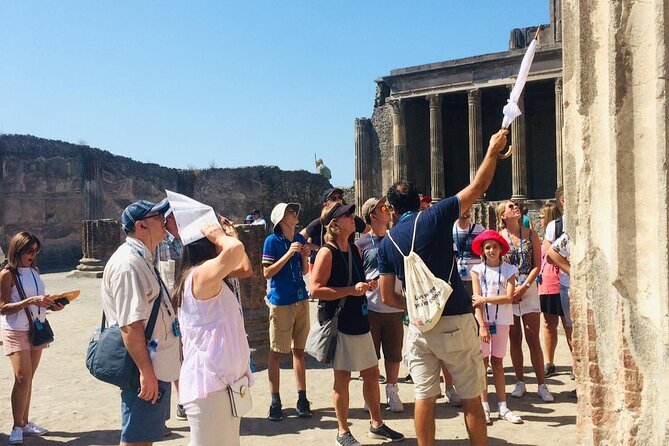
Ancient cities, frozen in a single day. This Pompeii and Herculaneum tour pairs Italy’s two great Roman archaeological sites with an archaeologist guide, included admission, and organized transport. I like the expert storytelling and the chance to see both cities in one day. I also like that the guide handles the train or minibus transfer, so you are not left puzzling over local transport.
The main tradeoff is time. Pompeii is enormous, yet the guided visit lasts about two hours, and the full day can feel brisk. A lunch stop is included, but meals cost extra and may take place at a modern shopping center rather than beside the ruins.
In This Review
- The essential points before you book
- Why seeing Pompeii and Herculaneum together matters
- Meeting points and the day’s transport
- Pompeii begins with public life
- Pompeii’s houses reveal private wealth
- Baths, brothels, and theaters at Pompeii
- The lunch break is useful, but not atmospheric
- Herculaneum shows a closer view of Roman homes
- The best-preserved interiors come later
- How the archaeologist guides shape the visit
- Is $77.09 a fair price?
- Who should book this experience?
- Final verdict: book for context, not unlimited free time
- FAQ
- How long does the Pompeii and Herculaneum tour last?
- What languages are available?
- Are entrance tickets included?
- Where do I meet the guide?
- How do I travel from Pompeii to Herculaneum?
- Is transport included from Naples or Sorrento?
- Is transport included from Rome?
- Is lunch included?
- What happens after the Pompeii departure reaches Herculaneum?
The essential points before you book
- Two ancient cities in one day: Visit Pompeii and Herculaneum, then compare how the volcanic eruption preserved them in very different ways.
- Archaeologist-led guiding: Guides such as Michele, Diego, Paulo, Michael, Antonio, and Alfredo have earned especially strong praise for clear explanations and lively storytelling.
- Included admission: Entry to Pompeii and Herculaneum is included, along with headsets for the walking tours.
- Transport depends on your starting point: Naples, Sorrento, and Rome departures use a modern minibus, while the Pompeii option uses the Circumvesuviana train to Herculaneum.
- A packed schedule: Expect roughly six to eleven hours, with about two hours at each site and a short lunch break between them.
- Good value for a first visit: At $77.09 per person, the package can save you the work of arranging tickets, transfers, and a guide separately.
Why seeing Pompeii and Herculaneum together matters
Pompeii gives you the scale of a Roman city. Its streets, public buildings, theaters, baths, shops, houses, and forum create a sense of urban life on a grand scale.
Herculaneum is smaller, but its preservation can feel more intimate. Wooden fittings, decorated rooms, and traces of upper floors help you picture the details of daily life. Seeing both sites in one day makes the contrast clear: Pompeii shows the city, while Herculaneum often brings you closer to the homes and possessions of individual families.
That contrast is the strongest reason to choose this experience instead of visiting Pompeii alone. You do not get enough free time to inspect every corner, but you do get a guided introduction to two very different archaeological sites.
The tour is rated 4.8 out of 5 from 1,350 reviews, with 95 percent of customers recommending it. The high marks are tied mainly to the guides. Michele, Diego, Paulo, Michael, Antonio, Alfredo, Tomas, Amadeo, and Gianni are repeatedly praised for making architecture and Roman daily life easier to understand.
More Pompeii and Herculaneum visits:
- Pompeii Small Group Tour with an Archaeologist
★ 5.0 · 6,593 reviews - Discover the Ancient Ruins of Pompeii: Day Trip from Rome
★ 3.5 · 2,247 reviews - Skip the Line Guided Tour of Pompeii led by an Archaeologist
★ 5.0 · 703 reviews
Meeting points and the day’s transport
You choose your departure location when booking. The Pompeii option meets at Porta Marina Superiore. Naples departures meet outside Starhotels Terminus, while the Sorrento meeting point is Piazza Angelina Lauro. The Rome option also uses Starhotels Terminus in Naples as the local meeting point after the included train journey from Rome.
The Naples, Sorrento, and Rome versions use a modern minibus for the day’s road transport. That takes away the need to arrange your own connection to Herculaneum. Several guides and drivers, including Giuseppe, received praise for keeping the transport comfortable and well organized.
If you start in Pompeii, you receive a one-way Circumvesuviana ticket to Herculaneum. The train ride takes about 30 minutes, followed by a walk of roughly 10 minutes from Ercolano Scavi station to the ruins. Your guide accompanies you during this transfer.
One point deserves special attention: the Pompeii departure ends directly at Herculaneum. The return journey to Pompeii is not part of that option, so if you leave a car near Pompeii, you must arrange your own way back. This is easy to miss when planning your day.
Pompeii begins with public life
The guided Pompeii visit lasts about two hours. That is enough for the major sights, but not enough for a slow wander through the entire archaeological park.
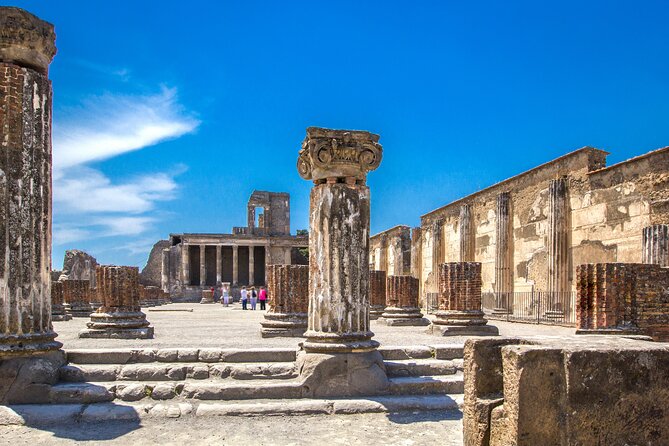
You begin around the Basilica, an open portico used for business and other public activity. From there, the guide moves toward the Forum, Pompeii’s main square. These first stops help you understand the city’s public center before the tour turns toward private houses and entertainment venues.
The Basilica and Forum can look like a collection of broken columns if you do not know what you are seeing. A good guide gives the ruins a job and a purpose. You begin to recognize where commerce, civic business, religion, and public gatherings once took place.
The route also follows a main Pompeii street. Ancient paving stones, building fronts, and raised stepping stones show how residents moved through the city. The narrow streets are among the most useful parts of the visit because they make Pompeii feel like a functioning town instead of an isolated group of ruins.
Pompeii’s houses reveal private wealth
The House of Menander is one of the most important private residences on the route. Its architecture, wall decoration, and contents give you a sense of how an affluent Pompeian family lived.
The House of the Faun is even larger and more impressive. Its name comes from a statue of a dancing faun, and its scale shows the difference between an ordinary home and a grand Roman residence. These houses are where the archaeologist guide adds real value, pointing out how rooms, courtyards, decorations, and social spaces fit together.
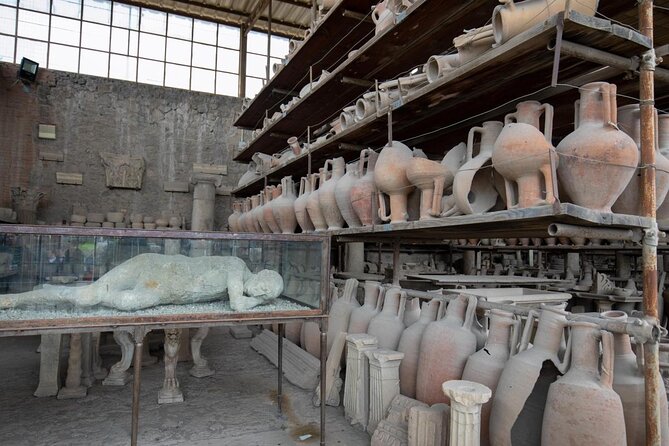
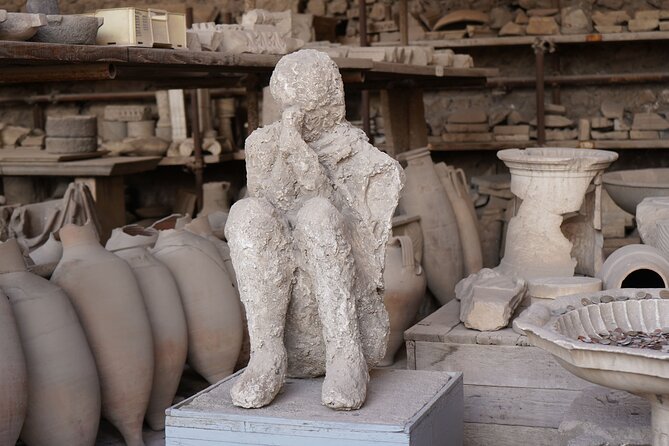
The Granaries of the Forum offer a more sobering stop. Marble tables, fountain basins, household objects, and plaster casts are displayed here. You may see casts of victims, including a dog and a tree, reminders that this is not simply a collection of attractive mosaics and frescoes.
The plaster casts can be difficult to see, especially for younger visitors. They are also central to understanding the human cost of the eruption. The number of casts shown during the route can vary, and one past itinerary included only one plaster mold, so you should not expect a long, dedicated presentation of every cast.
A few more reviews worth comparing before you book
- Pompeii Ticket + Tour with Optional Tasting Experience at Pompeii
★ 5.0 · 663 reviews - Pompeii private tour with an Official Guide
★ 5.0 · 631 reviews - Pompeii Private Tour with an Archaeologist and Skip The Line – 3 hours
★ 5.0 · 564 reviews - Pompeii Skip-the-line Tour with Archaeologist Guide
★ 5.0 · 559 reviews
Baths, brothels, and theaters at Pompeii
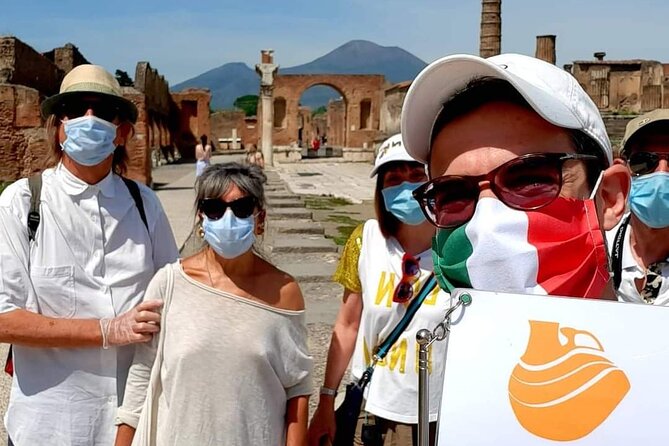
The Stabian Baths are the city’s oldest thermal complex. The group passes through the former bathing facilities, which were divided into spaces for different uses and social routines. The guide explains how Roman baths worked as places for washing, exercise, meeting, and conversation.
The Lupanar, Pompeii’s famous brothel, is a popular stop. Its small rooms and surviving wall images attract attention, but the useful part of the visit is the context. The guide can help you see the building as one part of a working city rather than as an isolated curiosity.
The tour continues to the Odeon, also called the Teatro Piccolo, a smaller theater designed for performances that required a more compact setting. The Teatro Grande, Pompeii’s principal theater, gives you a bigger sense of public entertainment and the city’s social life.
The route covers a lot of ground in a short period. You will see the major monuments, but you may not have much time to sit, take photographs, or study every fresco. One practical tip is to treat this as a first look. If Pompeii catches your imagination, plan a separate return visit with extra time.
The lunch break is useful, but not atmospheric

After Pompeii, you get a short lunch break before continuing to Herculaneum. Food and drinks are not included.
The stop may be at a modern shopping center, which has the practical advantage of offering several food choices and avoiding some of the tourist traps around Pompeii’s entrance. It is not, however, the most atmospheric place to eat after walking through an ancient city.
If lunch matters to you, bring a snack or pack a picnic. One useful suggestion is to eat something before the transfer to Herculaneum, since the train journey on the Pompeii option may not offer much time to find food. You should also keep the break short, since the day’s schedule is already tightly arranged.
Herculaneum shows a closer view of Roman homes
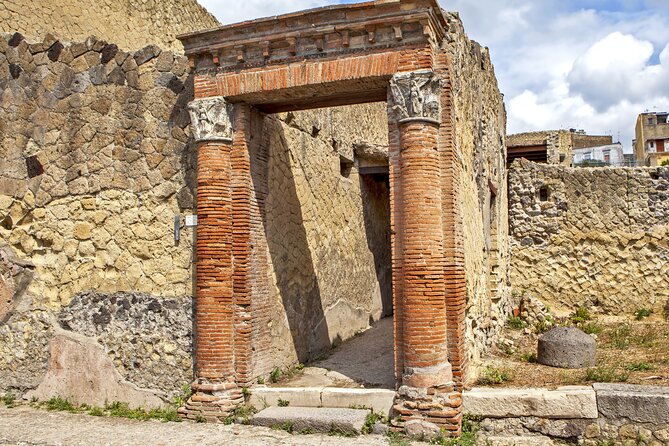
Herculaneum receives about two hours of guided attention. The archaeological area is smaller than Pompeii, so this amount of time feels more manageable, though you still will not see every corner.
The first stops include the House of the Deer and the terrace of Marcus Nonius Balbus. The House of the Deer takes its name from marble stag statues found in its courtyard. The terrace honors Balbus, a major benefactor whose public works and funeral honors reveal how civic generosity could shape a Roman town.
The College of the Augustales was linked to the worship of Emperor Augustus and may also have served as a local civic headquarters. It helps explain the political and religious systems that shaped public life in Herculaneum.
The House of the Telephus Relief is notable for its connection to the town’s leading families and for its private access to the nearby Suburban Baths. That unusual arrangement gives you a glimpse of the comfort and status available to wealthy residents.
The House of the Wooden Partition is especially important because a delicate carbonized wooden screen survived. Wooden features are rare at most Roman ruins, so this small detail can say more about domestic interiors than a large but familiar stone wall.
The best-preserved interiors come later
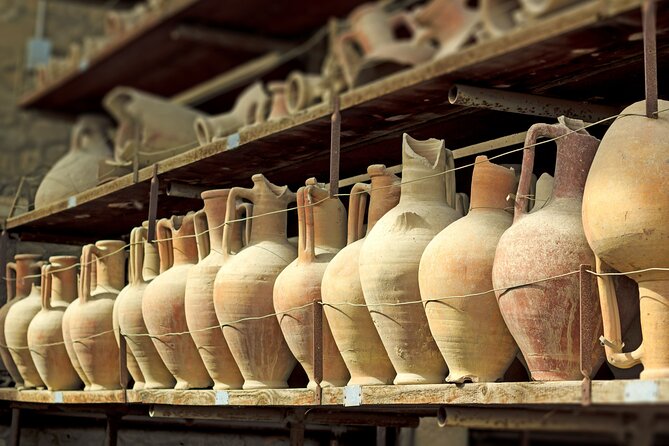
The House of the Skeleton takes its name from human remains found in an upper room in 1831. It may have formed from three smaller buildings, which makes it useful for understanding how houses changed over time.
The Central Baths date from around the beginning of the first century AD. Men’s and women’s bathing areas had separate entrances, following common Roman practice. The guide’s explanation helps connect the surviving rooms with the routines of ordinary residents.
The House of the Black Hall is one of Herculaneum’s more luxurious homes. Its monumental entrance still contains carbonized doorposts and a lintel, a rare reminder that wood once played a major role in Roman buildings.
The Samnite House has an atrium surrounded by a gallery with Ionic columns. Its frescoed rooms and arrangement reflect an older Samnite style. The House of the Beautiful Courtyard is different again, using a courtyard, stairway, and stone balcony instead of the more familiar atrium plan.
The final stop, the House of the Grand Portal, contains columns, frescoes, and charred wooden remains. By this point, you will have seen why Herculaneum rewards close attention. Its appeal is not only size or famous monuments. It is the surviving texture of ordinary buildings.
How the archaeologist guides shape the visit
The guide is the heart of this tour. The best guides do more than identify buildings. They explain how the city worked, why a house was built in a certain way, and what small details reveal about Roman society.
Michael is praised for making ancient daily life understandable and for pointing out details that are easy to miss. Diego is described as passionate and engaging, while Antonio combines strong historical explanations with humor. Paulo is praised for answering questions clearly, and Alfredo is noted for being efficient, patient, and interesting.
Your actual guide will depend on the date and departure option, so you cannot assume you will receive a particular person. The consistent theme is that an archaeologist-led visit adds context that a map or audio guide may not provide.
Headsets are supplied for all participants. They are valuable in crowded areas, especially when the guide is explaining a building from several steps away. The system is not perfect. If the group spreads out, you may lose the connection, and the brisk pace can make it hard to catch every sentence. Stay close to the guide and check that your headset is working before moving on.
Is $77.09 a fair price?
At $77.09 per person, this is a reasonable package if you want both admission tickets, a guide at both sites, headsets, and transport from Naples, Sorrento, or Rome.
The listed adult admission prices are 20 euros for Pompeii and 16 euros for Herculaneum. That leaves part of the fee for guiding, minibus transport or train arrangements, and the convenience of moving between the sites without planning the connections yourself.
The value is strongest for a first visit, especially if you are staying in Naples or Sorrento and want one organized day. The Rome option includes train tickets to Naples and full-day transport service, making it useful for someone with limited time in southern Italy.
The value is weaker if you already know both sites well or prefer to linger. You are paying for structure and interpretation, not free exploration. Pompeii alone deserves more than two hours, and an independent visit would give you greater control over the pace.
Who should book this experience?
I would choose this tour if you want the major sights explained in plain language and you do not want to manage two archaeological parks, admission tickets, and transport on your own.
It suits first-time visitors, history fans, couples, families with older children, and anyone staying in Naples, Sorrento, or Rome for a short time. The maximum group size is 20, so this is not a private tour, but it is more focused than a large coach outing.
It is less suitable if your main goal is photography, quiet study, or a complete exploration of Pompeii. The pace is active, and most stops last only 10 to 15 minutes. The experience is also not recommended for visually impaired participants unless accompanied by a dedicated personal assistant.
You can cancel for a full refund up to 24 hours before the start time. Changes or cancellations inside that window are not accepted.
Final verdict: book for context, not unlimited free time
Book this tour if you want to compare Pompeii and Herculaneum in one organized day. The archaeologist guide, included tickets, and transport solve the hardest practical problems, while the two sites give you a powerful contrast between a large Roman city and a smaller town with remarkably preserved interiors.
Do not book it expecting a leisurely Pompeii visit. The schedule is packed, lunch is your own responsibility, and the Pompeii departure ends at Herculaneum. Bring water, wear comfortable shoes, stay near the guide for the headset, and consider carrying a snack.
For most first-time visitors, the chance to see both sites and understand what you are looking at makes the $77.09 price worthwhile. If you fall for Pompeii, as many people do, return another day and give it the unhurried visit it deserves.
FAQ
How long does the Pompeii and Herculaneum tour last?
The experience lasts approximately six to eleven hours, depending on your departure location and transport arrangements.
What languages are available?
The tour is offered in English.
Are entrance tickets included?
Yes. Admission to both Pompeii and Herculaneum is included. The listed adult ticket prices are 20 euros for Pompeii and 16 euros for Herculaneum.
Where do I meet the guide?
Pompeii departures meet at Porta Marina Superiore. Naples and Rome options meet at Starhotels Terminus in Naples. Sorrento departures meet at Piazza Angelina Lauro.
How do I travel from Pompeii to Herculaneum?
The Pompeii option includes a one-way Circumvesuviana train ticket. The journey takes about 30 minutes, followed by a walk of about 10 minutes from Ercolano Scavi station to the ruins.
Is transport included from Naples or Sorrento?
Yes. The Naples option includes round-trip transport from outside Starhotels Terminus. The Sorrento option includes round-trip transport from Piazza Angelina Lauro.
Is transport included from Rome?
Yes. The Rome option includes train tickets to and from Rome and Naples, plus full-day transport service.
Is lunch included?
No. Meals and drinks are not included. A short lunch break is available between the two archaeological sites.
What happens after the Pompeii departure reaches Herculaneum?
The Pompeii option concludes directly at the Herculaneum ruins. The return journey to Pompeii is not included, so you must arrange your own return if needed.
Just added around Pompeii
- Pompeii Guided Group Tour with Entry Ticket and Archaeologist★ 4.5 · 269 reviews
- Pompeii: Guided Small Group Tour Max 6 People with Private Option★ 5.0 · 269 reviews
- Private Day Tour to Vesuvius, Herculaneum & Pompeii with Pick Up★ 5.0 · 279 reviews
- Pompeii Vineyard Escape: Private Wine Tasting & Lunch★ 5.0 · 329 reviews
- 2 hours Pompeii Tour with Local Historian – Ticket Included★ 5.0 · 335 reviews
- PompeiI Exclusive Tour with your Archaeologist in a Small Group★ 4.5 · 363 reviews
- Complete Pompeii Skip the Line Tour with Archaeologist Guide★ 4.5 · 379 reviews
- Pompeii 2h Small-Group Tour with Expert Archaeologist★ 5.0 · 385 reviews
Pompeii & Herculaneum Tours, compared.

Pompeii: Entry Ticket and Guided Tour with an Archaeologist
Read our review →
Pompeii: Entry Ticket with Optional Audio Guide
Read our review →
Pompeii: Small Group Tour with an Archaeologist
Read our review →


Pompeii Small Group Tour with an Archaeologist
Read our review →
Pompeii, Amalfi Coast and Positano Day Trip from Rome
Read our review →Browse the lists this tour appears in