
Review · POMPEII & HERCULANEUM TOURS
Pompeii 2h Small-Group Tour with Expert Archaeologist
Pompeii rewards a good guide. This two-hour walking tour gives you a focused route through the ancient city, with stops at theaters, grand houses, baths, the forum, and the famous Lupanar. I like the efficient use of time and the chance to hear the site brought to life by guides such as Luca, Roberta, Manuela, and Patrizia. I also like that the tour is family-friendly and costs about $32.67 per person, with admission included.
The main caution is the group size. It may be a genuinely small group, but the stated maximum is 30 people, and one booking was reassigned to a group of about 20. Two hours is enough for a strong introduction, not a full exploration of Pompeii. Guide quality can also vary, with most feedback praising the storytelling and a few accounts finding the explanations too basic.
In This Review
- Key points to know before booking
- Why a two-hour Pompeii tour makes sense
- Meeting at Piazza Esedra
- The archaeological park: a quick orientation
- Teatro Piccolo and Teatro Grande
- House of Menander and Roman domestic life
- Stabian Baths: seeing public life beyond the villas
- The Lupanar and Via dell’Abbondanza
- House of the Faun and Pompeii’s grandest homes
- Forum and Basilica: Pompeii’s civic center
- How the guides shape the experience
- Group size, headsets, and the meaning of small-group
- Families, older relatives, and the physical effort
- Price and overall value at $32.67
- Who should book this Pompeii tour?
- FAQ
- How long does the Pompeii tour last?
- What language is the tour offered in?
- Where does the tour meet?
- Where does the tour end?
- What places are included on the route?
- Is Pompeii admission included?
- How large can the group be?
- Can I cancel for a full refund?
- Should you book it?
Key points to know before booking
- A fast route through Pompeii: You visit major sights without spending your first hour figuring out the map.
- The guides are the main attraction: Luca, Roberta, Manuela, Patrizia, and others are praised for humor, clear English, warmth, and strong storytelling.
- The route covers famous highlights: Expect the theaters, House of Menander, Stabian Baths, Lupanar, House of the Faun, Forum, Basilica, and Via dell’Abbondanza.
- Two hours suits families and tight schedules: Parents with children and older relatives found the pace manageable, though one family had a poor experience with a guide.
- Small group is not guaranteed in every case: The tour can hold up to 30 people, and a booking change may place you in a larger group with headsets.
- The heat matters: Guides have stopped in shaded areas and adapted the pace, but you should still prepare for a hot, exposed archaeological site.
Why a two-hour Pompeii tour makes sense
Pompeii is not a compact museum. It is a large Roman city with streets, homes, public buildings, theaters, shops, baths, and religious and civic spaces spread across a broad archaeological park. You can walk in alone, but it is easy to spend too long at the first house you see, miss a major building, or lose track of how the pieces fit together.
That is where this tour earns its price. For $32.67, you get a guide for about two hours and admission is included. You are paying less for a long visit than for a well-planned introduction, but that introduction can make the rest of your time far more useful.
I especially like this format if you have a train to catch, are visiting Pompeii between Naples and the Amalfi Coast, or are traveling with children who will not enjoy an all-day archaeological marathon. One family found two hours just about right for young children. Another group wished the tour lasted longer, which tells you exactly what to expect: a brisk survey, not every lane and house.
The tour is offered in English. The overall rating is listed as 5 out of 5 from 385 ratings, and 99 percent of customers recommend it. Those numbers suggest a strong average experience, though they do not remove the usual uncertainty that comes with assigning different guides to different departures.
More Pompeii and Herculaneum visits:
- Pompeii Small Group Tour with an Archaeologist
★ 5.0 · 6,593 reviews - Discover the Ancient Ruins of Pompeii: Day Trip from Rome
★ 3.5 · 2,247 reviews - Pompeii and Herculaneum Small Group Tour with an Archaeologist
★ 5.0 · 1,350 reviews
Meeting at Piazza Esedra
The meeting point is Ristorante Suisse at Piazza Esedra, 10/13, in Pompei. The tour ends back at the same meeting point, so you are not left at a different gate or neighborhood after the walk.
The location is near public transportation, and one account notes that the train station is about a five-minute walk away. That makes this outing practical for a day trip. Still, give yourself enough time to find the restaurant and gather before departure. A few minutes of delay can be stressful when a group is waiting, even though one guide kindly helped a group whose train from Naples was late.
Confirmation arrives when you book. The tour needs at least six participants, and the operator can cancel after confirmation if that number is not reached. In that case, you are offered another option or a full refund.
The archaeological park: a quick orientation
The first stop is the Archaeological Park of Pompeii. The listed time is about ten minutes, which functions as an opening orientation rather than a complete visit to the park.
Your guide sets the scene: Mount Vesuvius erupted in AD 79, covering Pompeii and preserving much of the Roman city. The value here is not just hearing the date. A good guide helps you see Pompeii as a functioning place, with homes, entertainment, commerce, public bathing, and political activity.
The opening also gives you a sense of scale. Pompeii can feel like a collection of separate ruins unless someone explains how the streets and major buildings relate to one another. This is one of the strongest reasons to use a guide instead of relying only on signs.
Teatro Piccolo and Teatro Grande
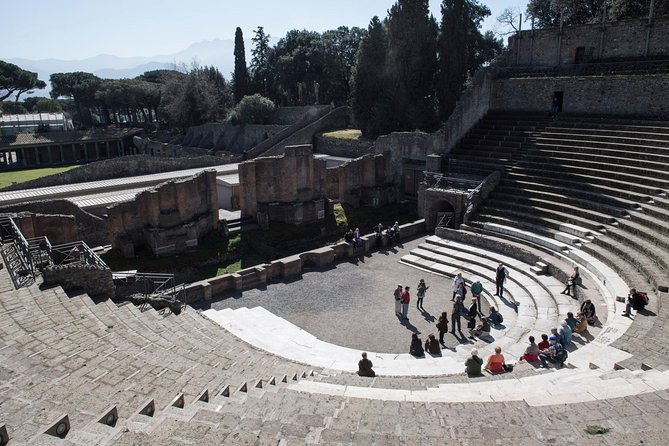
The route then reaches the Odeon, also called the Teatro Piccolo. This smaller theater offers a useful contrast with the Teatro Grande, which receives about 15 minutes on the tour.
The Teatro Piccolo is a good place to hear about public entertainment and the different settings used for performances. The larger theater was the city’s major performance venue and is described as the most important theater in Pompeii. Together, the two stops show that Pompeii was not merely a settlement buried by disaster. It had organized leisure, public gatherings, and spaces built for large audiences.
A two-hour route cannot give each theater the time it deserves. You will likely hear the key points, look around, and move on. If theaters are your main interest, you may want to return after the guided portion ends.
A few more reviews worth comparing before you book
- 2 hours Pompeii Tour with Local Historian – Ticket Included
★ 5.0 · 335 reviews - Lucca: 2-Hour City Center Walking Tour
★ 4.7 · 1,314 reviews - Milan Duomo and Rooftop 2-Hour Guided Tour
★ 4.6 · 1,076 reviews - Vatican Museums & Sistine Chapel Express 2-Hour Guided Tour
★ 4.5 · 1,037 reviews
House of Menander and Roman domestic life
The House of Menander is one of the most impressive stops. It is known for its architecture, decoration, and contents, and the tour gives it about 15 minutes.
This is where a guide can add real value. A house such as this is not simply a pretty ruin. Its rooms, decoration, and layout offer clues about wealth, status, household life, and the way Roman homes were used. The name refers to Menander, a Greek comic playwright whose image appears in the house.
You should expect a stop that focuses on what you can see and how the spaces worked. The exact detail will depend on your guide. Luca has been praised for explaining how people lived in the ancient city, while Manuela is often described as both thorough and engaging. Those strengths matter in a house, where a quick glance at walls and floors does not tell the whole story.
Stabian Baths: seeing public life beyond the villas
The Stabian Baths occupy a large area near the Brothel Lane, the Holconius crossroads, and Via Stabiana. They are described as Pompeii’s oldest thermal complex, and the tour allows about 15 minutes here.
The baths help broaden your picture of Roman life. Pompeii was not only about wealthy private residences. Public bathing was part of daily social life, and a large bath complex shows the planning, labor, and public facilities needed by an urban community.
This stop also breaks up the house-and-theater sequence. You move from private decoration to a public institution, which makes the city feel more complete. As with the other stops, fifteen minutes is enough for explanation and a look around, but not enough for a slow architectural study.
The Lupanar and Via dell’Abbondanza
The Lupanar is Pompeii’s most famous brothel, and the tour gives it around ten minutes. It is a popular stop, but it can also be crowded and sensitive for families with young children.
A guide helps explain the building without turning it into a cheap joke. The Lupanar is part of the broader story of commercial and social life in Pompeii, and its small rooms and surviving decoration provide a glimpse into an aspect of Roman society that is often discussed without much context.
The route also includes Via dell’Abbondanza, one of the city’s major streets. This is an important connector between individual sights. As you walk it, pay attention to the street surface, building fronts, crossings, and the way homes and businesses faced the road.
The tour data does not assign a time to this section, so the pace may vary. It is one of the places where your guide’s skill matters most. A good explanation can turn an ordinary-looking street into evidence of how people moved, traded, and lived.
House of the Faun and Pompeii’s grandest homes
The House of the Faun receives about ten minutes. It was one of Pompeii’s largest and most impressive private residences, making it a useful counterpoint to the House of Menander.
The scale tells you that Pompeii had residents with substantial wealth. The name comes from a bronze statue of a dancing faun, and the house is also associated with important ancient mosaics. Your guide can help you read the building as a home with a social purpose, not just a large floor plan.
Ten minutes is a short visit for such a major residence. You will get the essential story and see the main features selected by the guide, but you should not expect every room or decorative detail. If you want a more leisurely look at elite Roman housing, plan to continue exploring on your own afterward.
Forum and Basilica: Pompeii’s civic center
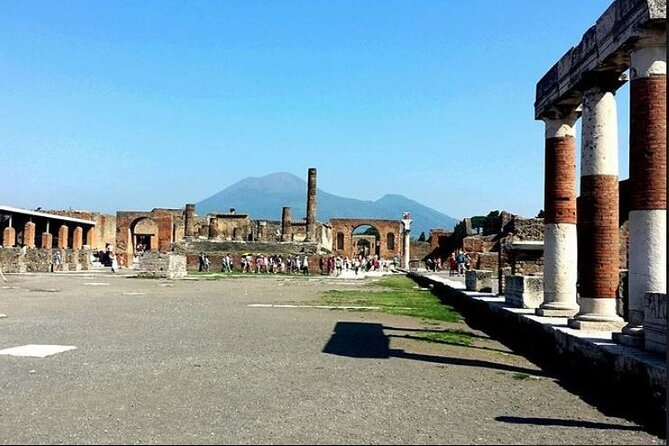
The Forum is allotted about 15 minutes. This was the ancient city’s main square and the place where political, religious, commercial, and public activity came together.
The open space can be hard to interpret at first. Broken columns and partial walls do not immediately show you how the Forum looked when Pompeii was alive. This is another point where storytelling makes a difference. Guides such as Roberta and Luca have been praised for helping people picture the ancient city and understand how its buildings worked together.
The Basilica gets another 15 minutes. It was an open portico that sheltered merchants and other activities, and it helps explain the business and legal side of Pompeii. The Forum and Basilica are best understood as a pair: one is the civic heart, while the other shows how commerce and public dealings were organized around it.
This final portion gives the tour a strong finish. You end with the city’s public center rather than only a series of private houses.
How the guides shape the experience
The strongest part of this tour is the human guide. Several guides receive especially warm praise for making Pompeii clear and lively.
Luca is described as passionate, funny, and strong at explaining daily life. One group found his two-hour route a thorough introduction and wished it had lasted longer. Roberta is praised for archaeology, storytelling, crowd management, and patience with a ten-year-old. Manuela is repeatedly singled out for combining humor with solid explanations and for keeping children and teenagers involved.
Patrizia has been praised for kindness and patience with children aged seven, ten, and thirteen. Barbara is described as approachable and attentive to shade, rest breaks, and the interests of the group. Other guides, including Clare and Mafilda, are also credited with clear English, enthusiasm, and an ability to make the past feel present.
There is one important qualification. A poor experience involved a guide who gave basic information and made inappropriate comments about children attending the tour. That account is very different from the many positive family experiences, but it is worth keeping in mind. The tour is marketed as family-friendly, yet the guide assigned to your group can shape that claim in practice.
Group size, headsets, and the meaning of small-group
The experience has a minimum of six people and a maximum of 30. That maximum is larger than many people expect from the phrase small-group.
Some departures may be genuinely intimate. One group of four had a highly personal experience, and another group of nine found the size comfortable. However, one party that had booked a small-group experience was moved into a group of around 20 after two members could not attend. Headsets were used, and one person had trouble hearing.
This matters because Pompeii is best experienced when you can stay close to your guide and ask questions. A group of 30 can still work, but you should not assume the quiet, flexible pace of a private walk. If a small group is essential, ask about the expected size before booking and consider the private upgrade mentioned for a more personal experience.
Families, older relatives, and the physical effort
The tour is family-friendly in principle, and many guides have handled children well. Parents have described successful visits with children from about seven through the teenage years. Guides have kept young people involved, answered questions, and adjusted the pace when the heat became difficult.
The one negative family account shows why expectations matter. Pompeii is not an amusement park, and the subject requires some attention. Children aged six and eight may enjoy a warm, lively guide, but they may struggle if the talk stays at an adult lecture level.
You should have a moderate level of physical fitness. The visit is on foot across an archaeological site, and the heat can be intense. There are few opportunities to escape the sun, though guides have stopped in shaded spots and taken breaks when needed. Wear practical shoes, bring water, and consider a morning departure if your schedule allows it.
The feedback also suggests the pace can work for older family members. Gianluca was praised for taking the group at a moderate speed that suited an older father. That is encouraging, but you should still be ready for uneven surfaces and a lot of standing.
Price and overall value at $32.67
At $32.67 per person, this is a reasonable price for a guided introduction if admission is included, as stated. You are paying for route planning, interpretation, and the chance to see major sights without doing the homework first.
The value is strongest when you have only two hours or when your group includes children. A guide helps you move directly to major buildings and gives meaning to ruins that can otherwise blur together. The price is less attractive if you prefer slow, independent exploration or already have a strong archaeology background.
Pompeii’s entrance ticket is free on the first Sunday of each month. It is also free for people under 18, provided they show a valid ID or passport on the day. Those rules can change the calculation for your party, since you may be paying mainly for the guide rather than admission.
Free admission does not make the tour pointless. It simply means you should compare the cost of guided interpretation with the cost of entering alone. Pompeii is easy to walk through on your own, and self-guided audio options are available in several languages, according to one dissatisfied customer. The tradeoff is that you must plan your own route and decide what deserves your limited time.
Who should book this Pompeii tour?
I would choose this tour if you want a clear first look at Pompeii, have a tight schedule, or are visiting with family. It is also a good fit if the Forum, theaters, grand houses, baths, and Lupanar are your priority sights.
I would be more cautious if you want specialist archaeology at every stop. Most guide feedback points to strong explanations and excellent storytelling, but one person found the content too basic. The title promises an expert archaeologist, yet the actual depth can vary by guide.
Book with realistic expectations about group size and the weather. Confirm the meeting point, arrive ready to walk, and do not treat the two-hour route as a complete Pompeii visit. Think of it as a well-chosen introduction that leaves you free to continue on your own.
Free cancellation is available up to 24 hours before the start time. Changes or cancellations inside that window are not accepted for a refund.
FAQ
How long does the Pompeii tour last?
The tour lasts approximately two hours.
What language is the tour offered in?
The tour is offered in English.
Where does the tour meet?
The meeting point is Ristorante Suisse, Piazza Esedra, 10/13, 80045 Pompei, Italy.
Where does the tour end?
The activity ends back at the meeting point.
What places are included on the route?
The route includes the Archaeological Park of Pompeii, Teatro Piccolo, Teatro Grande, House of Menander, Stabian Baths, Lupanar, Via dell’Abbondanza, House of the Faun, the Forum, and the Basilica.
Is Pompeii admission included?
Admission is listed as included with the tour. Pompeii also offers free entrance on the first Sunday of each month and for people under 18 who show valid identification.
How large can the group be?
The tour requires at least six participants and can include up to 30 people. A private upgrade is available for a more personal experience.
Can I cancel for a full refund?
Yes. You can cancel at least 24 hours before the experience start time for a full refund. Cancellations or changes made less than 24 hours in advance are not accepted, and the tour may also be canceled if the minimum group size is not reached.
Should you book it?
Yes, if you want the key sights explained clearly in a short visit, especially with children, older relatives, or a tight travel schedule. The price is fair, the route is useful, and guides such as Luca, Roberta, Manuela, and Patrizia have shown how much a warm, skilled storyteller can add.
Skip it if you want several hours of quiet independent wandering or guaranteed specialist-level archaeology. For most first-time visitors, though, this tour offers a practical way to get oriented, see the major highlights, and leave Pompeii with enough understanding to explore further on your own.
Just added around Pompeii
- Pompeii: Guided Small Group Tour Max 6 People with Private Option★ 5.0 · 269 reviews
- Pompeii Guided Group Tour with Entry Ticket and Archaeologist★ 4.5 · 269 reviews
- Private Day Tour to Vesuvius, Herculaneum & Pompeii with Pick Up★ 5.0 · 279 reviews
- Pompeii Vineyard Escape: Private Wine Tasting & Lunch★ 5.0 · 329 reviews
- 2 hours Pompeii Tour with Local Historian – Ticket Included★ 5.0 · 335 reviews
- PompeiI Exclusive Tour with your Archaeologist in a Small Group★ 4.5 · 363 reviews
- Complete Pompeii Skip the Line Tour with Archaeologist Guide★ 4.5 · 379 reviews
- Pompeii Private Tour with an Archaeologist and Skip The Line★ 5.0 · 391 reviews
Pompeii & Herculaneum Tours, compared.

Pompeii: Entry Ticket and Guided Tour with an Archaeologist
Read our review →
Pompeii: Entry Ticket with Optional Audio Guide
Read our review →
Pompeii: Small Group Tour with an Archaeologist
Read our review →


Pompeii Small Group Tour with an Archaeologist
Read our review →
Pompeii, Amalfi Coast and Positano Day Trip from Rome
Read our review →Browse the lists this tour appears in