
Review · POMPEII & HERCULANEUM TOURS
Pompeii: Guided Tour with Skip-the-Line Entry
Pompeii rewards curious eyes. This two to three-hour walking tour gives you a clear route through the vast Roman ruins, with a guide who explains what you are seeing instead of leaving you to puzzle over broken walls. I like the priority entry and the choice between a small group and a private tour. I also like that guides such as Frankie, Angelo, Anna, and Sasa bring different strengths, from humor and storytelling to archaeology and volcanology.
The main drawback is the short format. Pompeii is enormous, so even a well-planned two-hour visit can only cover the major sights. The site also offers limited shade, and summer heat can make the walking demanding. If you want to explore every neighborhood at a slow pace, plan to stay after the guided portion.
In This Review
- Key points to know before booking
- Meeting your guide near Pompeii’s entrance
- Why a guide changes the Pompeii experience
- The Antiquarium and Pompeii’s story
- The Forum, Basilica, and public Pompeii
- Homes, bakeries, and the details of ordinary life
- Thermal baths and Roman routines
- The theaters and entertainment in ancient Pompeii
- Crowd control, pace, and the two-hour limit
- Heat, shade, and choosing your time
- Is $58 a fair price?
- Who should book this Pompeii tour?
- Final verdict: book it for meaning, not just entry
- FAQ
- How long does the Pompeii guided tour last?
- What is included in the $58 price?
- Where does the tour meet?
- Is parking included?
- What languages are available?
- Can I choose a private tour?
Key points to know before booking
- The separate entrance saves time: Your ticket includes priority access through a separate entrance, a useful advantage when Pompeii is busy.
- You see the civic heart first: The Forum, Basilica, baths, theaters, Antiquarium, shops, and homes give you a strong overview of Roman city life.
- Guide quality is the real value: Frankie is praised for humor and interaction, while Angelo adds a specialist’s view of Vesuvius and volcanic activity.
- Small groups feel more personal: Group sizes can be modest, and private tours allow more room for questions and individual interests.
- The route may avoid the worst crowds: Several guides use a reverse route or begin at places such as the House of the Vettii before larger groups arrive.
- Heat matters: Early morning or a cooler season is easier, though an afternoon start can sometimes bring more mountain air.
Meeting your guide near Pompeii’s entrance
You meet at Ristorante Bar Sgambati, where you should look for the Enjoy Pompeii red sign. This is a practical arrangement because a cafe is easier to spot than an anonymous point beside a large archaeological entrance.
Arrive with enough time to identify the sign and group. The entry process is designed to be simple, and the separate entrance means you avoid the standard line. That convenience matters most during busy periods, when standing outside in the sun can drain energy before you even reach the ruins.
Parking is not included. If you are arriving by car, you need to arrange and pay for parking separately. The tour itself focuses on the archaeological site and does not include transport.
The guide leads the visit in Italian or English. Private and small-group choices are available, so check the option carefully when booking. A small group usually gives you a better chance to hear explanations and ask questions without turning the tour into a private price.
More Skip-the-Line Tickets in Naples
- Skip the Line Guided Tour of Pompeii led by an Archaeologist
★ 5.0 · 703 reviews - Pompeii Private Tour with an Archaeologist and Skip The Line – 3 hours
★ 5.0 · 564 reviews - Pompeii Skip-the-line Tour with Archaeologist Guide
★ 5.0 · 559 reviews
Why a guide changes the Pompeii experience
Pompeii can look straightforward at first: streets, foundations, columns, and walls. The difficulty is knowing what those pieces once meant. A guide adds the missing links between the remains and the people who used them.
That context is especially useful in the Forum, where the buildings are important but not always easy to read. Your guide can explain how public and civic life worked, then connect those ideas to the Basilica, temples, commercial buildings, and nearby streets.
The strongest guides do more than list dates. Frankie is repeatedly praised for humor, warm delivery, and a habit of bringing people into the discussion. His friendly Follow Frankie call became a memorable part of several tours, but the more important point is that he encouraged questions rather than talking without pause.
Angelo receives similar praise for combining clear explanations with careful crowd management. He is also a volcanologist, which gives him a useful angle on Mount Vesuvius and the eruption that buried Pompeii in 79 AD. That does not replace the wider social story, but it adds scientific context to the city’s final hours.
Anna has been praised for her background in art history and her personal connection to Pompeii. Sasa, also called Sa Sa or Sas in some accounts, is noted for passion, humor, and attention to the group’s comfort. You cannot select a particular guide with certainty, but the range of strengths is encouraging.
The Antiquarium and Pompeii’s story
The new Antiquarium is among the listed stops, and it helps set the scene before or during the walk through the ruins. Pompeii is often reduced to a disaster story, but the city was a functioning Roman community before Vesuvius erupted.
A good guide helps you see the people behind the catastrophe. You learn about homes, work, trade, public bathing, entertainment, and civic duties. The point is not simply that ash preserved a city. The point is that Pompeii was an active place with routines, social divisions, businesses, and private spaces.
This broader view is one of the tour’s best features. One guide specifically corrected common ideas about Pompeii as nothing more than a city frozen at the moment of destruction. You get a better sense of it as a growing urban center with a full life before the eruption.
The Antiquarium can also make later stops easier to understand. Once you have some background, a bakery is no longer just a room with a stone feature. A house is no longer merely a collection of decorated walls. You begin to ask who used each space and what role it played.
The Forum, Basilica, and public Pompeii
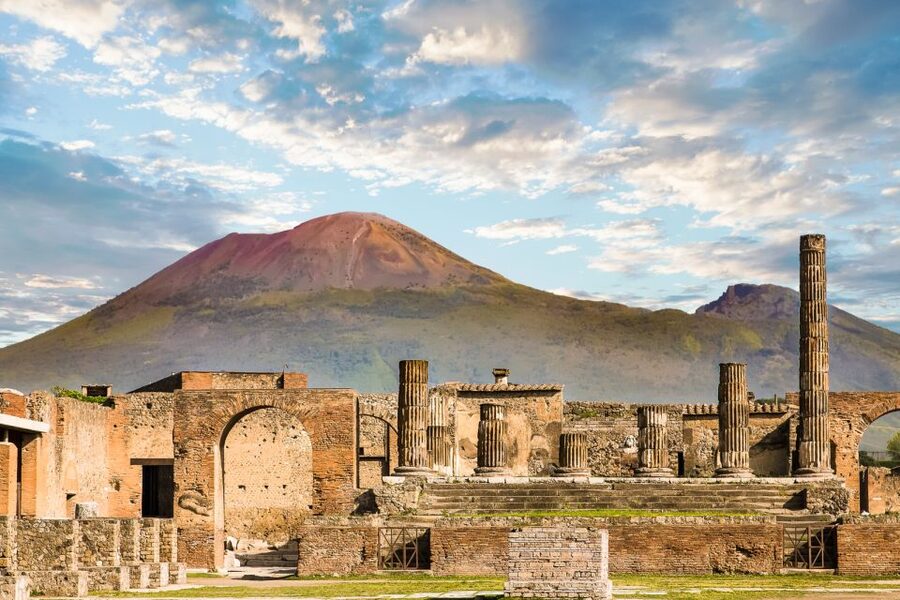
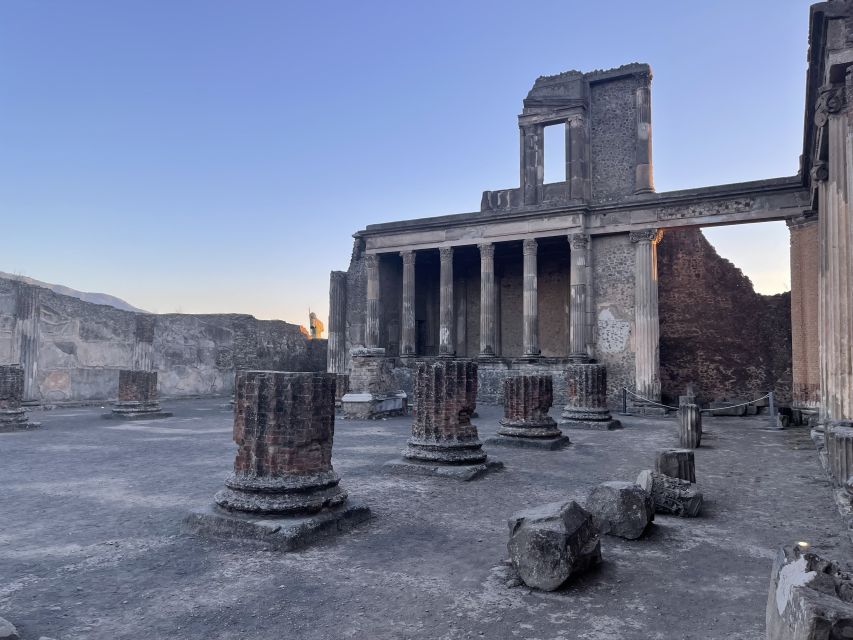
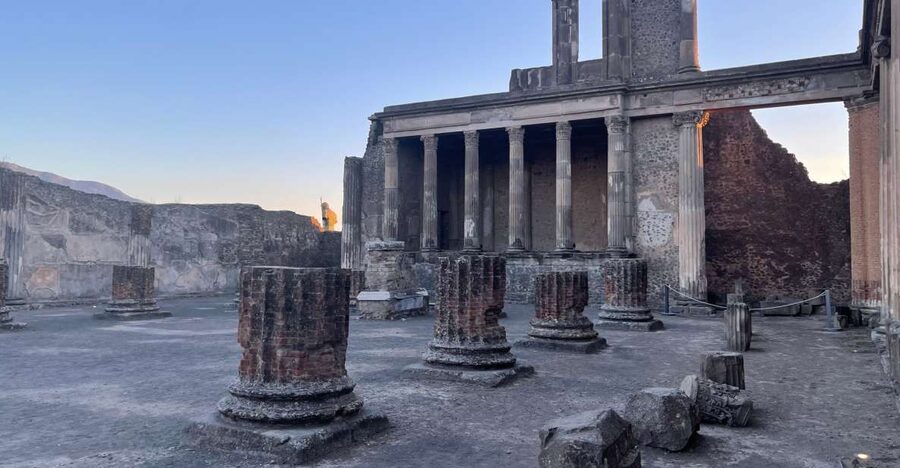
The Forum forms the natural civic center of the visit. This broad public area connected political, religious, and commercial life, and it gives you a strong visual sense of Pompeii’s scale.
The Basilica is another important stop. In Roman cities, a basilica was tied to public business and legal activity rather than serving only as a religious building in the later Christian sense. Your guide can help you understand how this space fitted into daily affairs.
These open areas are impressive, but they can also be exposed to sun. Several guides have been praised for giving explanations from shaded spots whenever possible. That small decision makes a major difference on a hot day, especially for children, older adults, or anyone who struggles in direct sun.
Do not expect the entire Forum to feel quiet. Pompeii is one of Europe’s most important archaeological sites, and popular areas can draw many groups. The guide’s route choice matters here. Angelo and other guides have used less predictable paths to reach key places before larger crowds gather.
More Pompeii and Herculaneum visits:
- Pompeii Small Group Tour with an Archaeologist
★ 5.0 · 6,593 reviews - Discover the Ancient Ruins of Pompeii: Day Trip from Rome
★ 3.5 · 2,247 reviews - Pompeii and Herculaneum Small Group Tour with an Archaeologist
★ 5.0 · 1,350 reviews - Pompeii Ticket + Tour with Optional Tasting Experience at Pompeii
★ 5.0 · 663 reviews
Homes, bakeries, and the details of ordinary life
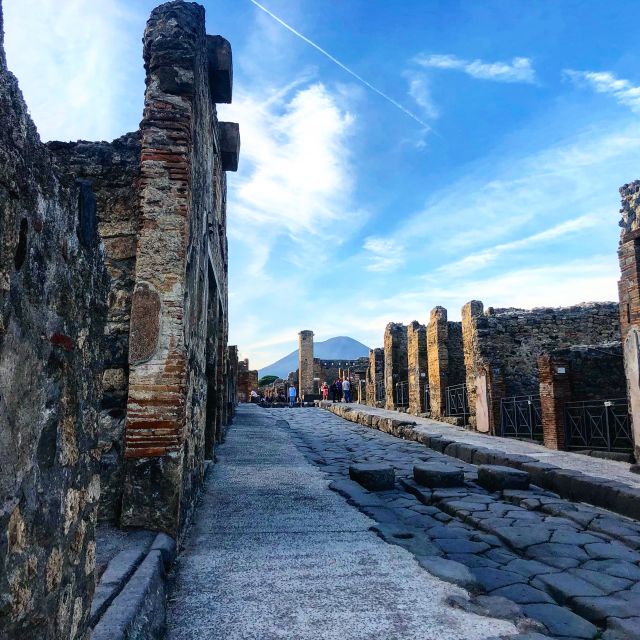
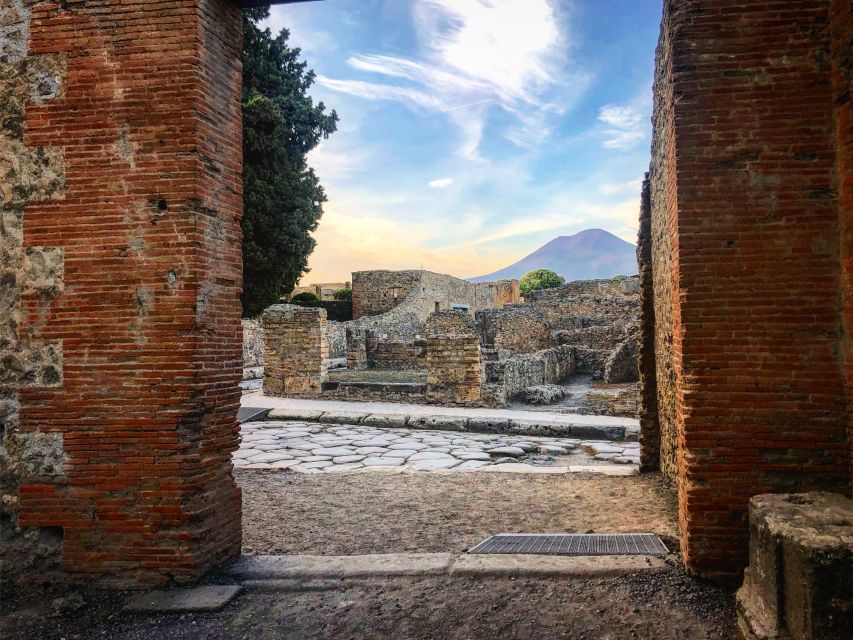
The tour includes commercial and residential areas, including a bakery and typical housing blocks. These stops add balance to the grand public buildings.
The bakery is valuable because it points to work and food production, not just elite culture. A home can reveal how rooms were arranged and decorated, while a housing block suggests that Pompeii included more than large private residences.
The House of the Vettii is mentioned as a possible early stop on some routes. When it is open and included in your path, reaching it early can be a smart move. One guide deliberately began there to give the group a better chance of seeing it with fewer people around.
You should not assume every departure follows the same route or includes every interior space. Archaeological access can change, and the exact order depends on openings, crowd levels, and the guide. Still, this is one reason a live guide is useful. You receive a route adjusted to conditions rather than following a fixed audio track.
The preserved frescoes are among the most memorable parts of Pompeii. They show that the city was not made up only of plain stone. Decorative details, domestic rooms, and traces of commercial life help you picture the place as lived-in rather than abandoned.
Thermal baths and Roman routines
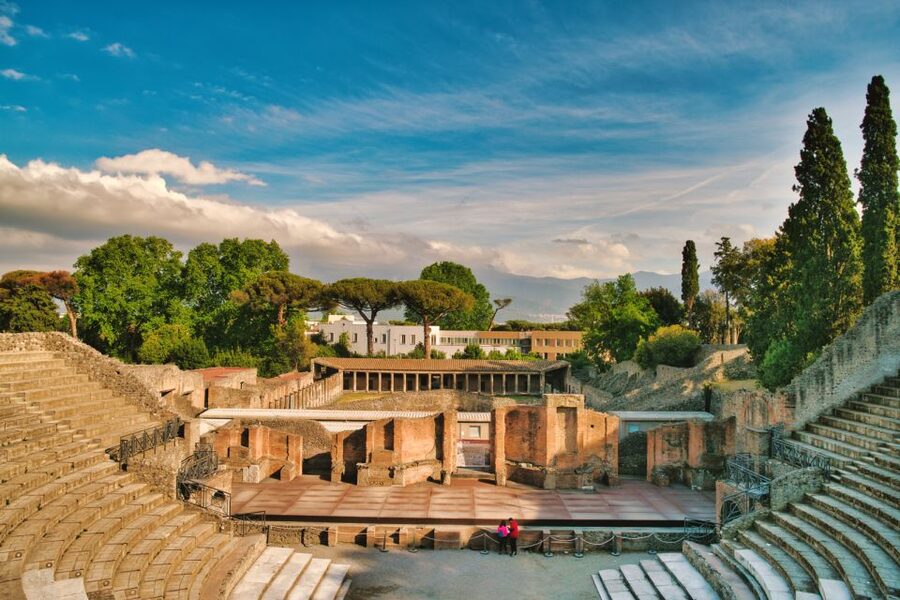
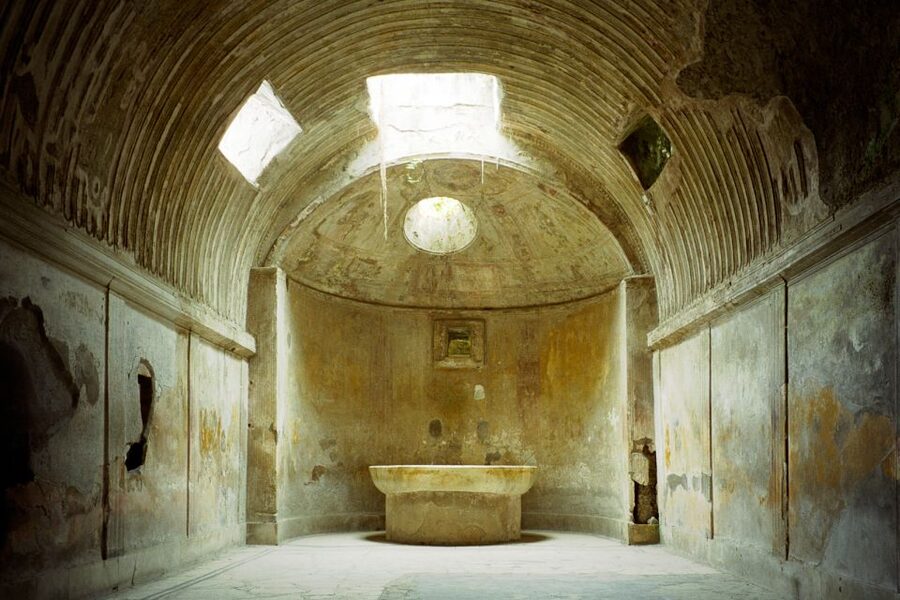
The thermal baths show how public life extended beyond politics and commerce. Bathing was a social activity as well as a matter of cleanliness, and the buildings give you another way to understand Roman routines.
The ruins may not immediately explain themselves. You might see walls, passages, and partially preserved rooms without knowing how people moved through them. A guide’s explanation turns the layout into a sequence of actions and habits.
The baths also work well as a contrast to private homes. Pompeii’s residents lived within a shared urban system, using public facilities and gathering in common spaces. That is more revealing than looking at a single grand house in isolation.
As with the other stops, listen for the guide’s interpretation rather than trying to record every fact. Two or three hours passes quickly, and the best experience comes from following the main story, asking questions, and taking time to look.
The theaters and entertainment in ancient Pompeii
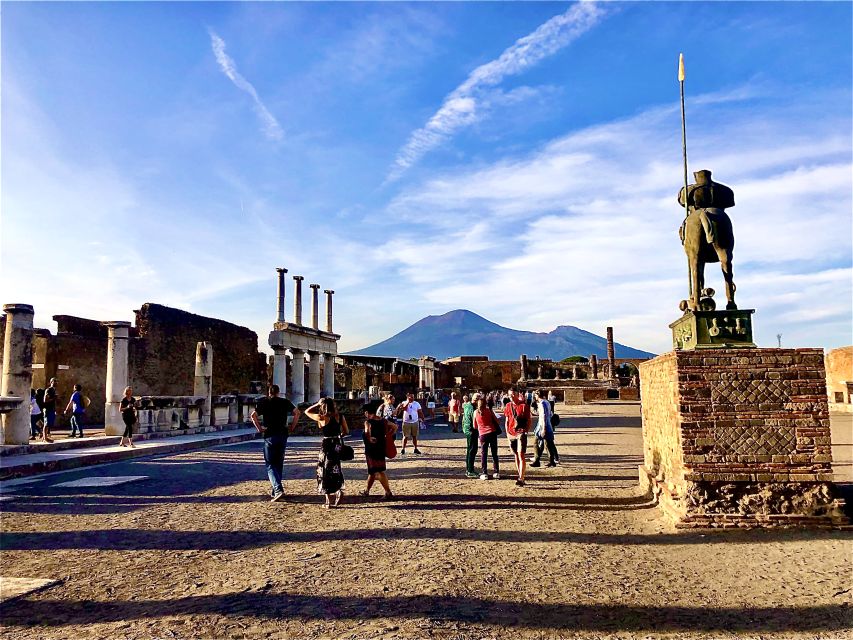
The theaters are among the tour’s listed highlights. They show the city’s interest in performance and public entertainment, while also giving you a break from the civic and domestic parts of the route.
A theater is easy to appreciate visually because the shape survives better than many ordinary buildings. Your guide can explain how the space worked and why it mattered to the city.
This is also a place where storytelling helps. A list of construction dates will not make the theater memorable. A guide who explains how people gathered, watched performances, and used public spaces gives the ruins a human scale.
The itinerary is not designed to cover every theater, street, or house in Pompeii. It aims at the main sights and a useful cross-section of the city. That is a fair trade for a short visit, but you should stay longer afterward if theater architecture is a special interest.
Crowd control, pace, and the two-hour limit
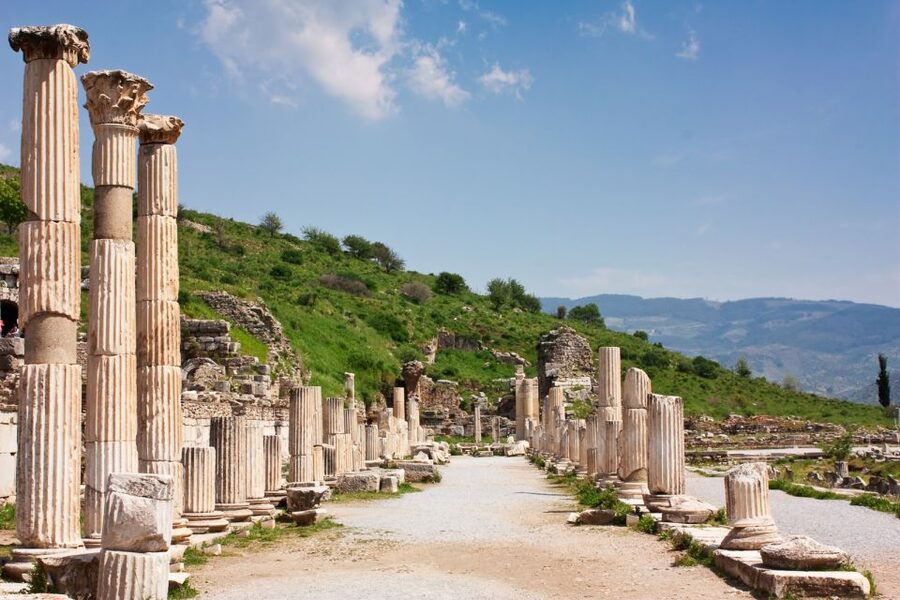
The most practical strength of this tour is not only the ticket. It is the way several guides manage the site.
Frankie is praised for choosing paths that reduce crowd pressure. Angelo is repeatedly described as finding less crowded approaches and giving people time to look around. Another guide used a reverse route to reach a major house early. These choices cannot guarantee an empty Pompeii, but they can make the walk calmer and more productive.
The advertised duration is two to three hours. Most comments describe the tour as roughly two hours, though one guide continued about half an hour longer because there was still more to explain. That flexibility is welcome, but you should not treat an extended visit as guaranteed.
Two hours is enough for orientation and major highlights. It is not enough for a complete visit to a site this large. Several people stayed inside the park after the guide finished, using the extra time for independent exploration. That is the best way to use this experience: let the guide give you the framework, then wander on your own if your ticket and schedule allow.
The pace appears manageable for many people, but this is still a walking tour over ancient streets. The information specifically says it is not suitable for people with pre-existing medical conditions. If that applies to you, consider your comfort carefully before booking.
Heat, shade, and choosing your time
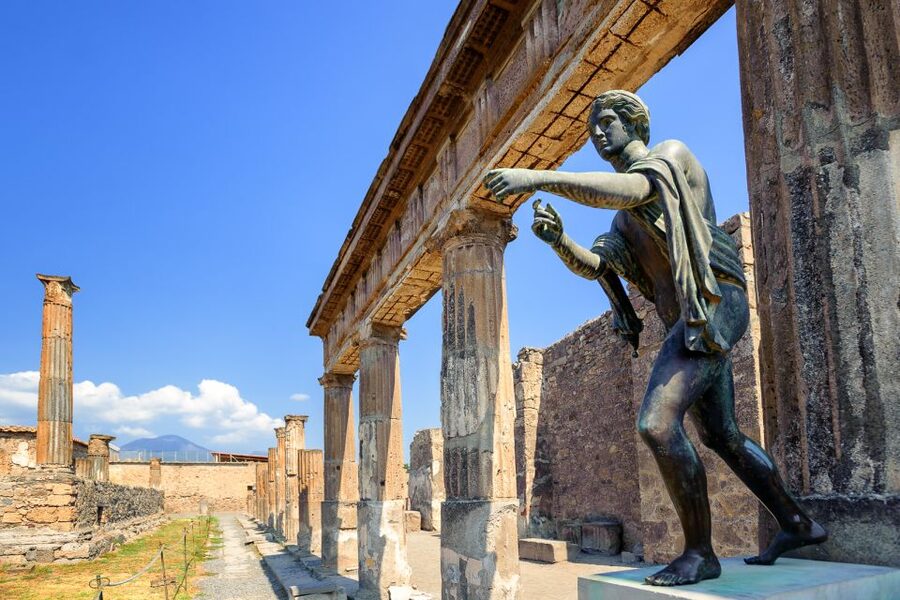
Pompeii can be very hot, with limited shade. This is not a minor detail. In warm months, your ability to listen and enjoy the ruins depends partly on how well you manage sun and water.
Guides have made a point of explaining buildings from shaded positions when possible. That helped families with children and older adults, but shade cannot be guaranteed at every stop.
Early visits are a sensible choice if available. One group found the morning crowds manageable, and reaching popular houses early can improve the experience. An afternoon tour may still work well. One guide explained that later hours can bring more air from the mountains, even though the start of the tour may coincide with peak heat.
Cooler months offer another advantage. A November or December visit can mean pleasant weather and fewer people. The archaeological site remains the main attraction, but comfortable conditions make it easier to concentrate on the details.
Wear practical shoes, carry water, and bring protection from the sun. Those are basic needs for any long walk through exposed ruins, and Pompeii gives you little reason to ignore them.
Is $58 a fair price?
At $58 per person, the cost includes the skip-the-line entry ticket, the walking tour, and a live guide. It does not include parking.
I consider that a reasonable price if you want structure and explanation. The ticket removes the need to arrange admission separately, while the guide helps you understand buildings that can otherwise blur together. The value is strongest when you get a small group and a guide who adjusts the route, answers questions, and explains daily life rather than reciting a script.
A private tour offers more personal attention, but the higher cost is not stated here, so you need to compare the available options for your date. A group tour is likely the better value for solo visitors, couples, and families who want expert interpretation without paying for a guide alone.
The first Sunday of each month has free entrance. That may affect the ticket value, but the priority-entry arrangement and guided service can still be useful. Check the exact conditions for your date before assuming that a free-admission day will save you money or time.
Free cancellation up to 24 hours before the start and reserve-now, pay-later terms add flexibility. Keep in mind that these benefits matter most when your transport plans are uncertain.
Who should book this Pompeii tour?
I would choose this tour if you have a limited schedule, want the main sights explained, or prefer not to manage a huge archaeological site alone.
It is especially suited to:
- First-time visitors who want the Forum, Basilica, baths, theaters, homes, and bakery placed in context.
- Families who need a clear route and a guide who can keep the story moving.
- History, architecture, and art fans who want to ask questions.
- Visitors arriving during a busy period who value a separate entrance and crowd-aware routing.
- People planning to stay afterward for self-guided exploration.
I would think twice if you want a quiet, unhurried study of every neighborhood. The guided portion is short compared with Pompeii’s size, and a group schedule may not match your preferred pace.
The tour is also less appealing if heat or extended walking is a serious concern. The guides appear attentive to shade and comfort, but the site itself remains exposed and demanding.
Final verdict: book it for meaning, not just entry
Pompeii is worth seeing on its own, but this tour helps you understand why the ruins matter. The strongest part is the human explanation: how people lived, worked, bathed, worshiped, traded, and gathered before Vesuvius changed everything.
I especially like the skip-the-line access, the option for a small or private group, and the guide-led route through the city’s major buildings. Frankie’s humor, Angelo’s volcano expertise, Anna’s art history background, and Sasa’s attentive style show the range of guides you might receive.
Book it if you want a well-shaped introduction in two or three hours. Pick a cooler time when possible, arrive at Ristorante Bar Sgambati early, and keep time afterward if you want to explore more. Skip it only if your main goal is a full-day archaeological study or if the walking and heat are likely to overwhelm you.
FAQ
How long does the Pompeii guided tour last?
The stated duration is two to three hours. Most visits focus on the main highlights within about two hours, though the guide may continue longer.
What is included in the $58 price?
The price includes skip-the-line entry, a guided walking tour of Pompeii, and a live tour guide.
Where does the tour meet?
Meet at Ristorante Bar Sgambati and look for the Enjoy Pompeii red sign.
Is parking included?
No. Parking is not included in the activity price.
What languages are available?
The tour is offered in Italian and English.
Can I choose a private tour?
Yes. Private and small-group options are available when booking.
More Fast-Track Entries
- Pompeii Private Tour with an Archaeologist and Skip The Line
★ 5.0 · 391 reviews - Complete Pompeii Skip the Line Tour with Archaeologist Guide
★ 4.5 · 379 reviews - Florence: Skip-The-Line Uffizi Gallery Timed Entry Ticket
★ 4.5 · 27,832 reviews - Vatican Museums & Sistine Chapel Skip-the-Line Entry Ticket
★ 4.4 · 13,838 reviews
Just added around Pompeii
- Pompeii Guided Group Tour with Entry Ticket and Archaeologist★ 4.5 · 269 reviews
- Pompeii: Guided Small Group Tour Max 6 People with Private Option★ 5.0 · 269 reviews
- Private Day Tour to Vesuvius, Herculaneum & Pompeii with Pick Up★ 5.0 · 279 reviews
- Pompeii Vineyard Escape: Private Wine Tasting & Lunch★ 5.0 · 329 reviews
- 2 hours Pompeii Tour with Local Historian – Ticket Included★ 5.0 · 335 reviews
- PompeiI Exclusive Tour with your Archaeologist in a Small Group★ 4.5 · 363 reviews
- Complete Pompeii Skip the Line Tour with Archaeologist Guide★ 4.5 · 379 reviews
- Pompeii 2h Small-Group Tour with Expert Archaeologist★ 5.0 · 385 reviews
Pompeii & Herculaneum Tours, compared.

Pompeii: Entry Ticket and Guided Tour with an Archaeologist
Read our review →
Pompeii: Entry Ticket with Optional Audio Guide
Read our review →
Pompeii: Small Group Tour with an Archaeologist
Read our review →


Pompeii Small Group Tour with an Archaeologist
Read our review →
Pompeii, Amalfi Coast and Positano Day Trip from Rome
Read our review →Browse the lists this tour appears in