
Review · POMPEII & HERCULANEUM TOURS
Pompeii: Group Tour with an Archeologist Guide
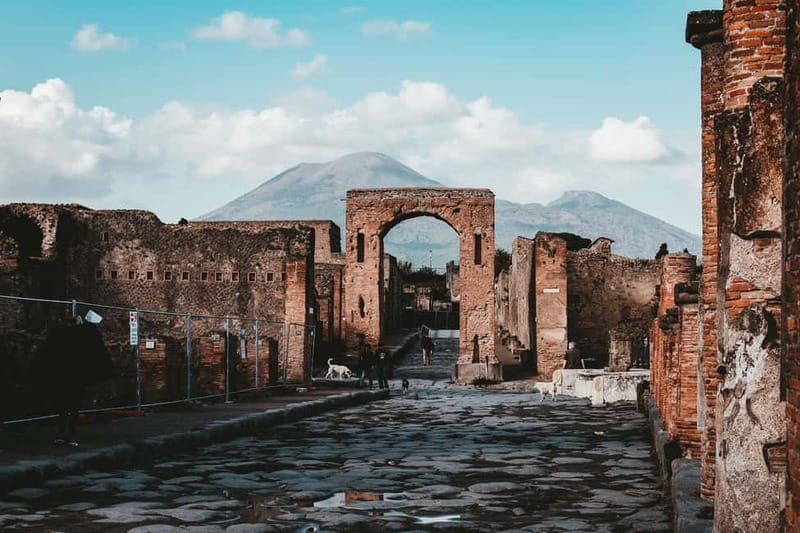
Pompeii makes the past feel startlingly close. This two-hour walk brings you through the city buried by Mount Vesuvius in 79 AD, with an archaeologist guide explaining what you are seeing instead of leaving you to puzzle over broken walls. I especially like the efficient route through the Forum, baths, theaters, named houses, and plaster casts. I also like the skip-the-ticket-line entry, a real help when the site is busy.
The main tradeoff is time. Two hours gives you a strong first look, not a full exploration of Pompeii, which is enormous. Group sizes can also be fairly large, although whisper headsets help you hear the guide. At $50.11 per person, this is a sensible choice if you value context and have limited time, but independent explorers may want longer inside the ruins.
In This Review
- Key points to know before booking
- Meeting at Tempio Travel near the station
- Entering through Porta Marina and the western ruins
- The Forum, Basilica, and public life
- Baths, theaters, and the Lupanar
- Named houses and Pompeii’s painted interiors
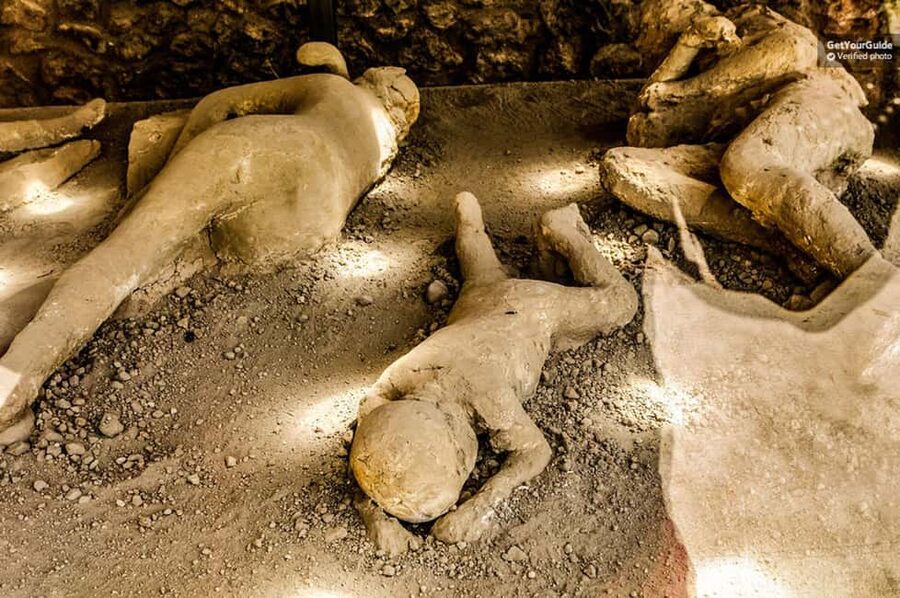
- The Garden of the Fugitives and plaster casts
- What the two-hour format does well
- Is $50.11 a fair price?
- Heat, footwear, bags, and timing
- Staying in modern Pompeii afterward
- Who should book this Pompeii tour?
- FAQ
- Where does the Pompeii tour start?
- How long does the guided tour last?
- Which languages are available?
- What does the price include?
- What sights are included?
- Can I bring luggage or a large bag?
- Is the tour accessible for people with mobility impairments?
- Should you book it?
Key points to know before booking
- The tour starts at Tempio Travel by the Circumvesuviana station, not at the archaeological entrance.
- The route covers Pompeii’s western area, including the Marina Gate, Basilica, Forum, baths, Lupanar, theaters, and major houses.
- An archaeologist guide gives the ruins a human story, explaining daily life, public buildings, art, and the eruption.
- Plaster casts of victims and the Garden of the Fugitives provide some of the site’s most moving moments.
- Whisper headsets help in a group, though the tour may still feel busy during popular visiting hours.
- Comfortable shoes, water, and sun protection matter, while large bags and luggage are not allowed.
Meeting at Tempio Travel near the station
The tour begins at the Tempio Travel office on the first floor of the Circumvesuviana train station. This location is useful if you arrive in Pompeii by train, but do not walk straight to the ruins expecting to meet the guide there. Give yourself time to find the office before the scheduled start.
Look for the building with the red Tempio Travel logo. One important practical note is that directions about the exact floor can be confusing. The stated meeting information places the office on the first floor, while a direct instruction describes taking the stairs to the second floor. I would confirm the floor and office signage as soon as you arrive rather than wait until the group is ready to leave.
From there, the staff gathers the group and leads you toward the entrance. The listed itinerary names Porta Marina as the next stop, with only a brief guided segment there. In practice, this is the gateway into the archaeological area and the point where your Pompeii visit properly begins.
The activity finishes back at the meeting point. Hotel pickup and drop-off are not included, so you need to arrange your own way to the station. Free parking may be available, but only if the parking area is open and spaces remain.
More Pompeii and Herculaneum visits:
- Pompeii Small Group Tour with an Archaeologist
★ 5.0 · 6,593 reviews - Discover the Ancient Ruins of Pompeii: Day Trip from Rome
★ 3.5 · 2,247 reviews - Pompeii and Herculaneum Small Group Tour with an Archaeologist
★ 5.0 · 1,350 reviews
Entering through Porta Marina and the western ruins
Porta Marina was one of Pompeii’s important entrances, and it provides a useful opening to the ancient city. Rather than simply walking among stones, you begin to see Pompeii as an organized Roman town with routes, public buildings, homes, shops, and religious spaces.
The tour focuses on the western part of Pompeii, where many of the best-known monuments are located. This is a practical choice for a two-hour visit. You get a concentrated look at the core sights instead of spending most of the tour walking between distant sections.
Your guide’s role matters here. Pompeii can feel confusing at first because walls, streets, and buildings do not always announce their original purpose. A good explanation helps you read the remains: a broad public space becomes a civic center, a bath complex becomes part of ordinary Roman life, and a house becomes a clue to family status, taste, and custom.
The strongest praise for this experience goes to the guides’ ability to explain clearly without making the tour feel like a lecture. Guides named in direct feedback include Ernaldo, Eraldo, Alfonso, Giuseppe, Lena, Laura, and Antonio. Individual guide assignments can change, but the repeated pattern is clear: the best guides combine facts with stories, answer questions, keep the pace moving, and make sure the group stays together.
The Forum, Basilica, and public life
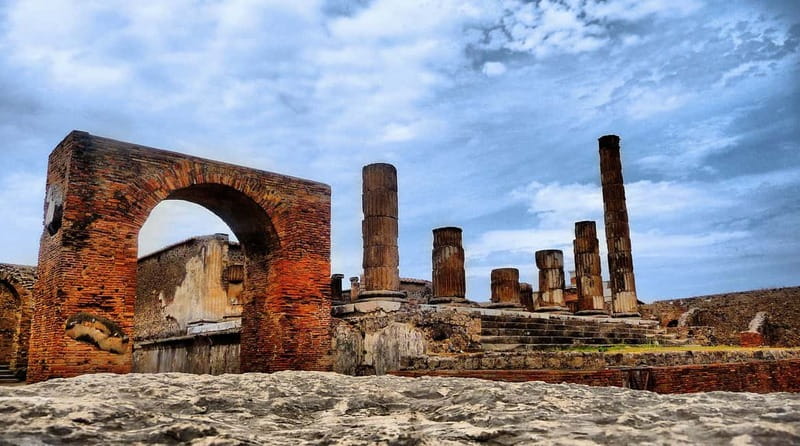
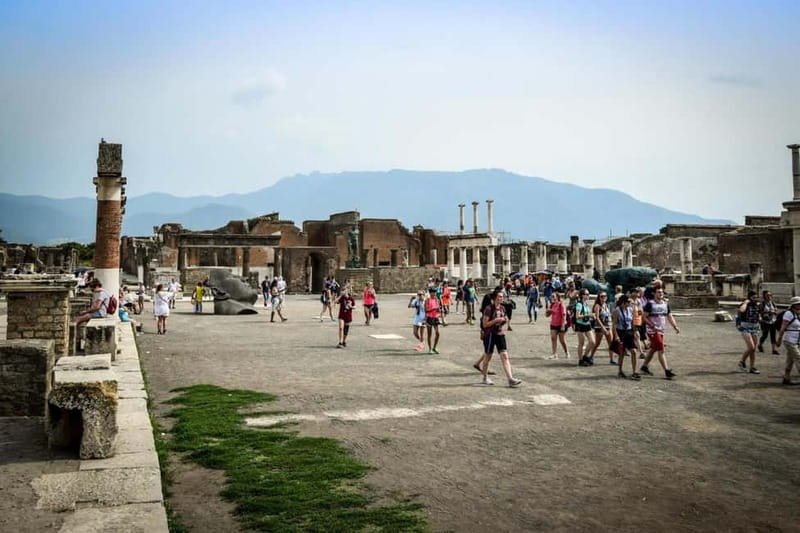
The Forum is one of the essential stops. This was the heart of Pompeii’s public life, and it gives you a sense of how the city was arranged around shared civic, religious, and commercial activity.
Nearby, the Basilica helps show how important public buildings shaped Roman towns. You are not just looking at a ruin. You are looking at the remains of a place where people gathered for official and legal business.
This is one area where a guide earns the admission price. Without help, you might recognize the Forum as an open rectangle surrounded by ruins, then move on. With an archaeologist explaining the spaces, you can better understand how the buildings worked together and why the area mattered.
The tour does not promise a detailed stop at every structure in the Forum. That is part of the time limit. You receive a clear overview, then continue to other headline sights. If your main goal is to study inscriptions, architectural details, or individual temples, you will need extra time after the guided walk.
Baths, theaters, and the Lupanar
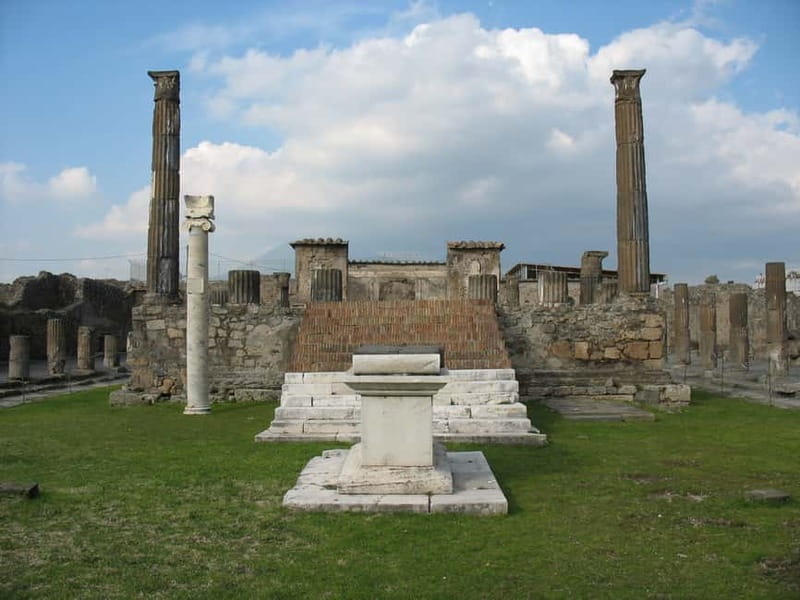
The route also includes the baths, the theaters, and the Lupanar brothel. These stops broaden the picture of Pompeii beyond grand public monuments.
The baths show the social side of Roman life. They were not simply places to wash. They were part of the city’s public routine, and the remains help explain how people spent time together.
The theaters offer another view of public entertainment. Their inclusion is especially useful on a first visit because they remind you that Pompeii was a lived-in city with leisure, performance, politics, trade, and household life all operating together.
The Lupanar is among Pompeii’s most famous named buildings. It attracts attention, but a guide can place it within the wider town rather than treating it as a sensational stop. The practical benefit is that you get context and can ask questions as you go.
The main street connects these sights and helps you understand movement through the city. Uneven paving and ancient road surfaces are part of the experience, so comfortable shoes are not optional. The site can also be very hot, with little relief on exposed stretches. One direct account found two hours about right in hot weather, even though more time would be useful in cooler conditions.
A few more reviews worth comparing before you book
- Skip the Line Guided Tour of Pompeii led by an Archaeologist
★ 5.0 · 703 reviews - Pompeii Ticket + Tour with Optional Tasting Experience at Pompeii
★ 5.0 · 663 reviews - Pompeii private tour with an Official Guide
★ 5.0 · 631 reviews - Pompeii Private Tour with an Archaeologist and Skip The Line – 3 hours
★ 5.0 · 564 reviews
Named houses and Pompeii’s painted interiors
Pompeii’s houses are where the visit becomes more personal. The route includes the House of the Tragic Poet and the House of the Golden Cupid, along with other famous named homes.
These residences help you see how wealthy families displayed taste and status. The names themselves often come from mosaics, paintings, objects, or discoveries connected to the house. Your guide can help you notice details that are easy to miss when you are moving through room after room.
The frescoes are a major reason to take this tour. Pompeii is famous for its painted walls, but the colors and subjects can be hard to interpret without some explanation. A guide can point out how decoration worked across courtyards, dining rooms, and private spaces, giving you a better sense of how the home was designed.
Conditions vary from building to building. Some areas may be closed or less accessible on a particular day, and the group cannot linger everywhere. Still, these houses are among the tour’s most rewarding stops because they shift your attention from monumental ruins to domestic life.
The direct feedback repeatedly praises guides for making the information clear, concise, and entertaining. One guide was praised for inviting the group to guess what a building or feature was before explaining it. That approach works well at Pompeii because the site rewards careful looking.
The Garden of the Fugitives and plaster casts

The Garden of the Fugitives is one of the most emotionally powerful parts of the visit. It is connected with victims who tried to escape the eruption, and the plaster casts make the disaster painfully human.
These casts are not just archaeological objects. They show the final positions of people caught in the eruption, making the scale of the event easier to grasp. The moment can be sobering, especially after the guide has spent time explaining ordinary life in the city.
The Garden and the casts also show why a guided visit is useful. Pompeii is filled with impressive walls and paintings, but the human story can get lost if you move through the site quickly. A thoughtful guide sets the scene without turning the experience into spectacle.
This part may not suit every child, though the tour can work for families. One guide, Lena, received especially warm praise for explaining the site clearly, communicating where the group needed to go, and showing patience with children between eight and twelve. Parents should still prepare children for the plaster casts so the visit does not come as a shock.
What the two-hour format does well
Two hours is long enough to get your bearings and see many of the famous places. It is short enough to fit neatly into a day that also includes the modern town of Pompeii, Mount Vesuvius, Naples, or a cruise schedule.
The route is paced rather than rushed. Direct feedback describes guides who kept the group together, moved at a comfortable speed, and still allowed enough time to take in the major sights. The headsets are useful when the group spreads out, although the earpieces may feel slightly uncomfortable after a while.
The limitation is obvious: Pompeii is too large for a complete visit in two hours. You may pass buildings that you want to inspect or leave with a list of places to see later. That is not a flaw if you treat the tour as a guided introduction. It is a drawback if you expect an all-day archaeological study.
You can remain in Pompeii and explore further after the guided portion. This is one of the best ways to use the experience. Let the guide handle the main route, then revisit an area that caught your attention or walk toward sections not included in the tour.
Is $50.11 a fair price?

At $50.11 per person, the cost covers a two-hour guided visit, skip-the-line entrance tickets, and whisper headsets for larger groups. Food, drinks, and hotel transportation are not included.
The value depends on how you like to visit major archaeological sites. If you are short on time, the ticket access and focused route save effort. More important, the guide gives meaning to buildings that might otherwise look like a collection of walls and columns.
I consider the price fair for a first visit, especially if you are arriving by train or fitting Pompeii into a busy day. The value is strongest when the guide is as effective as the better-rated guides described in the feedback, with clear English or Italian, strong subject knowledge, and a lively manner.
If you already have a detailed Pompeii guidebook, plenty of time, and a strong interest in wandering independently, you may prefer to buy entry and explore alone. You will lose the built-in route and explanations, but you will gain control over your pace.
Heat, footwear, bags, and timing
Wear shoes that can handle uneven ancient paving. Sandals with poor support are a risky choice, since you will be walking across rough surfaces for much of the two-hour visit.
Bring a passport or identity card, as this is listed among the required items. Large bags and luggage are not allowed, so plan your storage before arriving.
Heat can shape the whole experience. One direct account described the afternoon as very hot and found two hours to be just right. Bring water and protect yourself from the sun. An umbrella bought near the entrance was useful for shade, and roadside stalls may also sell rain gear when the weather turns wet. The tour continues in rain, so an umbrella or raincoat is worth carrying when the forecast is poor.
The tour is conducted in English or Italian. If you need a language other than these, this is not the right option. It is also not suitable for people with mobility impairments, given the uneven archaeological setting and amount of walking.
Cancellation is flexible: you can cancel up to 24 hours before the activity for a full refund. You can also reserve now and pay later, which helps if your schedule is still changing.
Staying in modern Pompeii afterward
The guide can suggest how to spend the rest of your day in the modern city of Pompeii. You can also get directions to the Sanctuary Dedicated to Our Lady of the Holy Rosary, only a few steps from the archaeological site.
That follow-up advice is a nice touch because the ancient ruins and modern town are close together, yet they offer very different experiences. You do not have to rush away after the tour. Use the afternoon to see more of the archaeological area, visit the sanctuary, or find food and drinks in town, which are not part of the tour itself.
The meeting-point arrangement also makes it easy to return to the station area when you are finished. Just remember that the tour ends where it began, rather than at a hotel or separate transport stop.
Who should book this Pompeii tour?
I would choose this tour for a first visit, a cruise stop, or a tight schedule. It is especially useful if you want the major monuments explained in plain language and do not want to spend your first hour figuring out the site map.
Families can benefit from the storytelling and steady pace, provided children are ready for the plaster casts. The tour also suits anyone who prefers a guided overview before exploring alone.
I would hesitate only if you need step-free access, want a very small private group, or plan to spend most of the day examining minor houses and inscriptions. Group tours are efficient, but they cannot give every building unlimited time.
FAQ
Where does the Pompeii tour start?
Meet at the Tempio Travel office on the first floor of the Circumvesuviana train station in Pompeii. Look for the red Tempio Travel logo and confirm the exact floor on arrival, since directions provided for the office can vary.
How long does the guided tour last?
The guided tour lasts two hours. Starting times vary, so check availability when booking.
Which languages are available?
The live guide conducts the tour in English or Italian.
What does the price include?
The $50.11 price includes the two-hour guided tour, skip-the-line entrance tickets, and whisper headsets for large groups. Free parking may be available if it is open and spaces remain.
What sights are included?
The route includes Porta Marina, the Basilica, Forum, baths, Lupanar, main street, theaters, Garden of the Fugitives, House of the Tragic Poet, House of the Golden Cupid, plaster casts, and other named houses.
Can I bring luggage or a large bag?
No. Luggage and large bags are not allowed. You should also bring comfortable shoes and a passport or identity card.
Is the tour accessible for people with mobility impairments?
The experience is not suitable for people with mobility impairments. The archaeological site includes uneven surfaces and requires walking.
Should you book it?
Book this tour if you want Pompeii explained, not just visited. The guide-led route covers the major western sights, and the strongest part of the experience is the way a good archaeologist connects frescoes, public buildings, homes, and victims to everyday Roman life.
For $50.11, you are paying for structure, entry convenience, and interpretation. The two-hour limit means you should not expect to see every corner. But as a focused introduction, especially before continuing on your own, this is a practical and worthwhile way to meet Pompeii.
Just added around Pompeii
- Pompeii Guided Group Tour with Entry Ticket and Archaeologist★ 4.5 · 269 reviews
- Pompeii: Guided Small Group Tour Max 6 People with Private Option★ 5.0 · 269 reviews
- Private Day Tour to Vesuvius, Herculaneum & Pompeii with Pick Up★ 5.0 · 279 reviews
- Pompeii Vineyard Escape: Private Wine Tasting & Lunch★ 5.0 · 329 reviews
- 2 hours Pompeii Tour with Local Historian – Ticket Included★ 5.0 · 335 reviews
- PompeiI Exclusive Tour with your Archaeologist in a Small Group★ 4.5 · 363 reviews
- Complete Pompeii Skip the Line Tour with Archaeologist Guide★ 4.5 · 379 reviews
- Pompeii 2h Small-Group Tour with Expert Archaeologist★ 5.0 · 385 reviews
Pompeii & Herculaneum Tours, compared.

Pompeii: Entry Ticket and Guided Tour with an Archaeologist
Read our review →
Pompeii: Entry Ticket with Optional Audio Guide
Read our review →
Pompeii: Small Group Tour with an Archaeologist
Read our review →


Pompeii Small Group Tour with an Archaeologist
Read our review →
Pompeii, Amalfi Coast and Positano Day Trip from Rome
Read our review →Browse the lists this tour appears in