
Review · POMPEII & HERCULANEUM TOURS
Pompeii: Exclusive Tour with Archaeologist and Entry Tickets
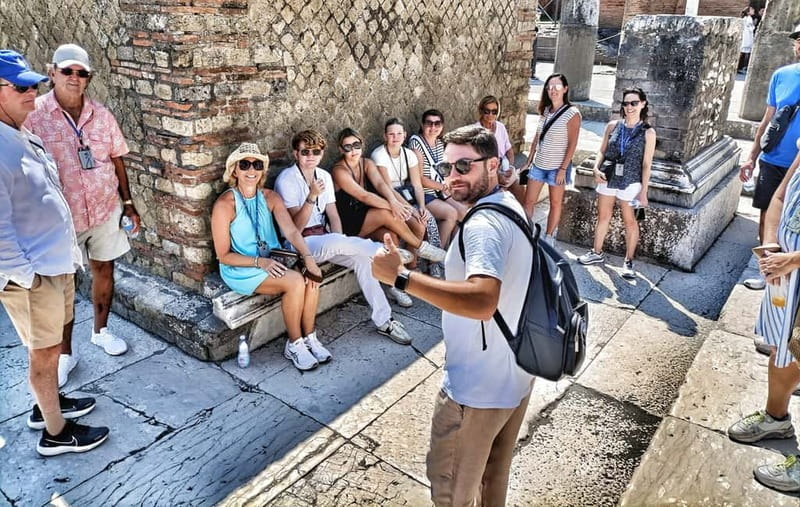
Pompeii rewards a closer look. This two-hour walk pairs skip-the-line entry with a licensed archaeologist who can explain not only the grand temples, but also the ovens, taverns, homes, and street life that make the ruins feel personal. I like the small-group format, and I like that the tour gives you a useful framework before you continue exploring on your own.
The guides are the main strength. Names praised for warmth, humor, and clear explanations include Antonio, Riccardo, Livio, Raffaelle, Loredana, Rafael, Ivan, and Pierluigi. The supplied headsets also matter in a large, noisy archaeological park. The main drawback is time: two hours is enough for an excellent introduction, not enough to see all of Pompeii.
In This Review
- Key points to know before booking
- Why an expert guide helps at Pompeii
- Starting at Porta Marina and the civic center
- Temples, baths, and the Roman idea of public life
- The Macellum and the human cost of the eruption
- Pompeii’s houses: frescoes, mosaics, and social status
- Thermopolia, bakeries, and ordinary Pompeian life
- The Lupanare and the Theatre District
- What $50 buys you
- Practical details that can make or break the visit
- Who should book this Pompeii tour?
- Should you book it?
- FAQ
- Where does the Pompeii tour meet?
- Are Pompeii entry tickets included?
- How long does the guided visit last?
- Is this a private tour?
- Which languages are available?
- What should I bring to Pompeii?
Key points to know before booking

- Meet at Porta Marina Superiore: The meeting point is outside the entrance, directly in front of Pompei Scavi, Villa dei Misteri train station.
- The tour covers major landmarks quickly: You visit the Forum, temples, baths, market, houses, brothel, and theatre district.
- A real archaeologist leads the walk: The guide adds detail about daily life, excavation work, and how archaeologists interpret the remains.
- The group can be shared or private: A small shared group costs $50 per person, while a private option is available for a more personal visit.
- You may remain inside afterward: The tour ends at Pompeii Ruins or Piazza Esedra, and the guide points out what deserves more time after the group walk.
- Comfort matters: Bring water, sturdy shoes, and identification for every participant, including children.
Why an expert guide helps at Pompeii
Pompeii is not a compact ruin where you can glance around and understand the whole story. It is a broad ancient city with streets, public buildings, private houses, shops, religious spaces, and theatres spread across a large area. Without context, you can easily spend your visit admiring old walls without understanding what happened there.
A good guide gives those walls a purpose. The bakery becomes evidence of food production. A counter in a thermopolium, or ancient fast-food shop, becomes a clue to how ordinary people ate. A painted room tells you something about taste, wealth, and social display.
This tour is particularly useful because the guide is described as an archaeologist who has worked at Pompeii. That background can add a layer beyond standard dates and names. You can ask how excavation works, what archaeologists look for, and how researchers piece together daily life from incomplete remains.
The guides also seem to handle mixed groups well. Clare found the pace and level of detail suitable for adults and children, while several families appreciated explanations that kept teenagers interested. Antonio was praised for adding humor without treating the subject lightly. That balance is important at Pompeii, where the subject can become either too dry or too grim.
The headsets are another practical advantage. Pompeii has open courtyards, broad streets, and plenty of competing noise. Being able to hear the guide clearly means you do not need to remain shoulder to shoulder with the group.
More Pompeii and Herculaneum visits:
- Pompeii Small Group Tour with an Archaeologist
★ 5.0 · 6,593 reviews - Discover the Ancient Ruins of Pompeii: Day Trip from Rome
★ 3.5 · 2,247 reviews - Pompeii and Herculaneum Small Group Tour with an Archaeologist
★ 5.0 · 1,350 reviews
Starting at Porta Marina and the civic center
The meeting point outside Porta Marina Superiore is convenient if you arrive by the Circumvesuviana train. The station is Pompei Scavi, Villa dei Misteri, not one of the other stations serving the modern town of Pompeii. Check your route carefully, since arriving at the wrong station can make a close meeting time uncomfortable.
Once inside, the tour begins at Porta Marina, one of the original entrances to the Roman city. This is a fitting starting point because it helps you picture Pompeii as a working town connected to the wider region, rather than as a collection of ruins created solely for modern visitors.
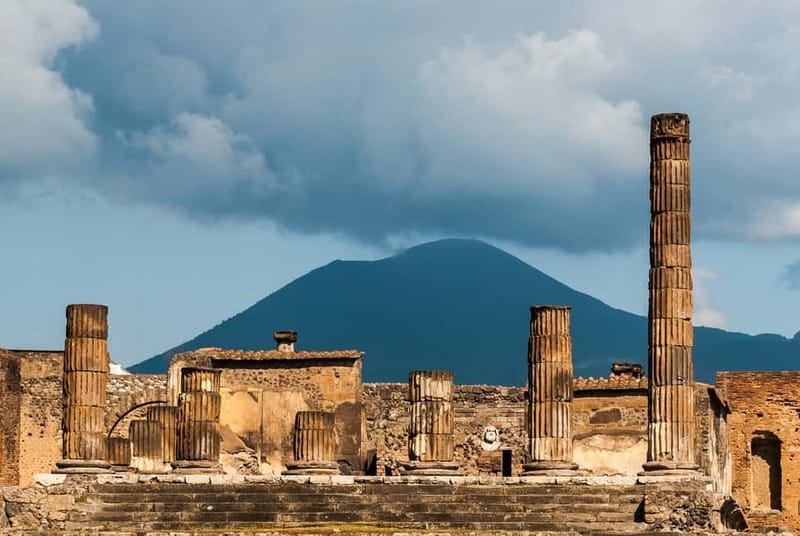
From there, you move toward the Basilica and the Foro Civile di Pompei, or civic Forum. This was the city’s central public area, where political, religious, and commercial life came together. The Forum is one of the most important stops, but it can also be hard to read on your own. Columns, foundations, and partial walls do not automatically tell you which building served which role.
The Basilica adds a useful civic and legal dimension. Here, your guide can explain how public business, law, and administration fitted into the urban plan. The value of this part of the tour is not just the architecture. It gives you a way to understand the other buildings you see later.
Temples, baths, and the Roman idea of public life
The Temple of Jupiter, Temple of Apollo, and Temple of Venus show the religious side of Pompeii. They also reveal how Roman cities used architecture to display power, identity, and devotion.
The Temple of Apollo is especially useful for showing that Pompeii’s religious life changed over time. The city was influenced by different cultures and political powers before the eruption. Ask your guide how religious traditions developed and how the temples related to the Forum.
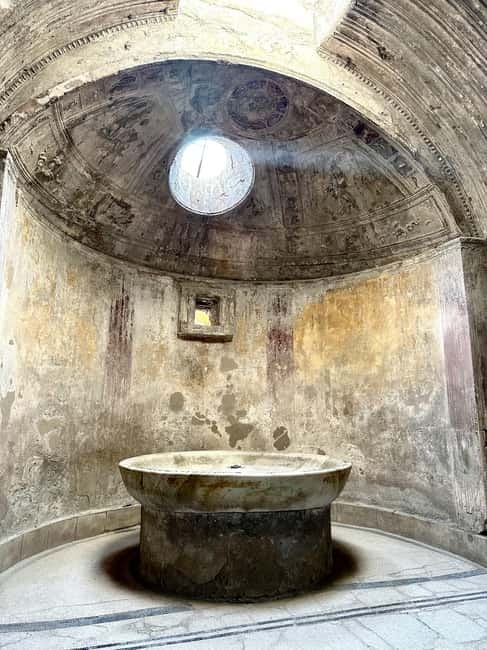
The Forum Baths offer a look at everyday routines. Roman baths were not simply places to wash. They were public spaces tied to social life, exercise, conversation, and leisure. Even a short explanation here can help you notice the practical details of heating, room layout, and decoration.
I like this section because it moves the story beyond catastrophe. Pompeii was not only a doomed city. It was a place where people went to work, worship, meet friends, conduct business, and take care of ordinary needs.
The Macellum and the human cost of the eruption
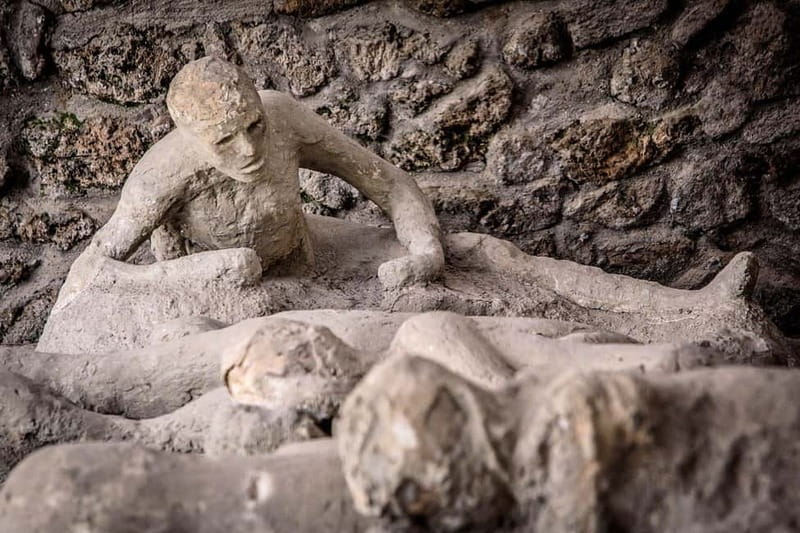
The Macellum was a market building, and it is one of the tour’s more emotionally difficult stops because it is associated with plaster casts of victims. These casts do not show the city as an abstract historical site. They bring you face to face with individual human beings caught in the eruption.
The subject deserves a careful explanation, and an archaeologist can provide needed context about how the casts were made and what they can, and cannot, tell us. The experience is haunting, but it should not be treated as a theatrical shock moment. A thoughtful guide helps connect the casts to the broader story of Pompeii’s population and the sudden force of the disaster.
The tour’s approach also keeps the eruption in proportion. The people of Pompeii lived in a functioning Roman city for years before Mount Vesuvius erupted in 79 AD. Seeing the market, baths, houses, and theatres first makes the final tragedy more understandable because you have already seen what was lost.
A few more reviews worth comparing before you book
- Skip the Line Guided Tour of Pompeii led by an Archaeologist
★ 5.0 · 703 reviews - Pompeii Ticket + Tour with Optional Tasting Experience at Pompeii
★ 5.0 · 663 reviews - Pompeii private tour with an Official Guide
★ 5.0 · 631 reviews - Pompeii Private Tour with an Archaeologist and Skip The Line – 3 hours
★ 5.0 · 564 reviews
Pompeii’s houses: frescoes, mosaics, and social status
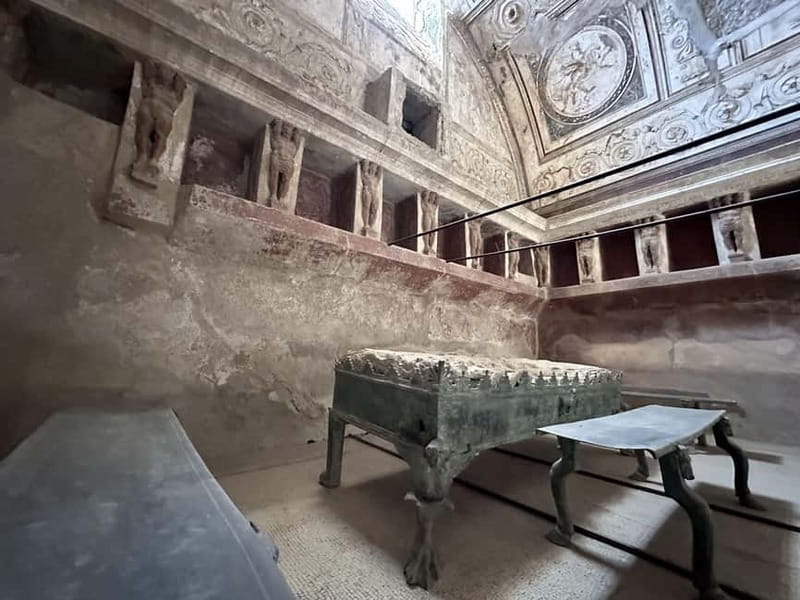
The House of the Tragic Poet, House of the Vettii, and House of the Faun are among the tour’s strongest stops for art and domestic life.
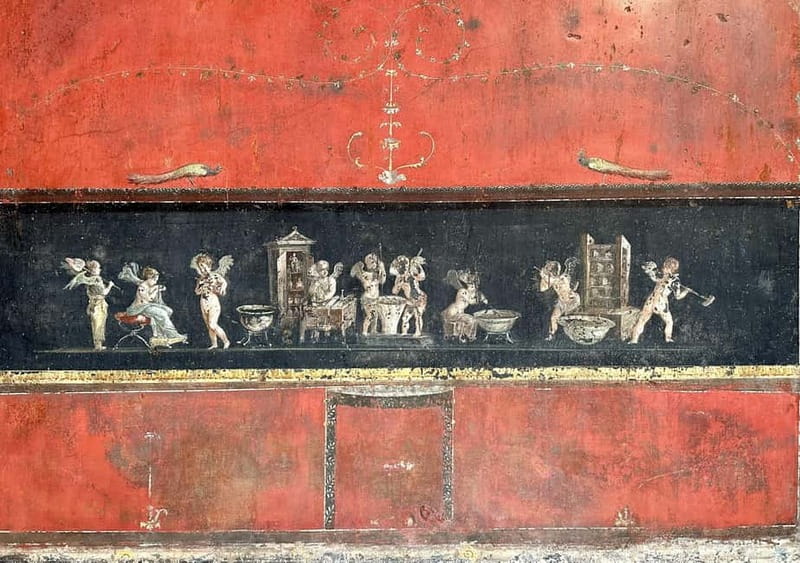
The House of the Tragic Poet is known for its painted decoration and famous mosaic imagery. It helps you see how private homes used art to shape a visitor’s impression. A guide can point out the difference between a decorative image and a scene that carries a mythological or symbolic meaning.
The House of the Vettii offers a glimpse into a particularly elaborate home, with frescoes that show the owners’ wealth and taste. The restoration and preservation of the paintings may be a highlight, though access to individual rooms can change as conservation work continues. You might find that some spaces are open while others are closed on your visit.
The House of the Faun is among Pompeii’s largest and most impressive residences. Its scale and mosaics help you understand the gap between a wealthy household and more modest homes. The famous Alexander Mosaic is associated with the house, though what you see in place can depend on current display and conservation arrangements. Ask your guide what is original on site and what has been moved for protection.
These houses are where a guide adds real value. A quick look at a wall painting is pleasant. A clear explanation of room function, social status, household design, and artistic choices makes the visit far more memorable.
Thermopolia, bakeries, and ordinary Pompeian life
The thermopolium is one of Pompeii’s most appealing stops because it feels so familiar. These establishments served prepared food and drink from counters built into the street-facing room. They offer a glimpse of people eating outside the home, much like modern customers stopping for a quick meal.
The ancient bakeries provide another practical connection. Heavy ovens and working spaces show that food production was part of the city’s daily economy. When you see these places after visiting grand public buildings and wealthy homes, Pompeii becomes more balanced. It was not only marble, frescoes, and civic ceremony. It was also bread, cooking, trade, and paid work.
The guide may also point out small details that are easy to miss, such as street design, shop layouts, or traces of how buildings were used. This is one reason a small group helps. You can ask questions without losing the guide in a crowd, and the guide can pause for photographs while keeping the walk moving.
The Lupanare and the Theatre District
The Lupanare, commonly identified as Pompeii’s brothel, is one of the site’s most famous attractions. Its small rooms and painted imagery raise questions about sex work, social class, and the way modern visitors interpret ancient evidence.
This is a brief stop, and access can be affected by crowd levels or site rules. It is worth seeing, but I would not judge Pompeii by this single sensational building. The surrounding streets and nearby shops often provide a more complete picture of how the district functioned.
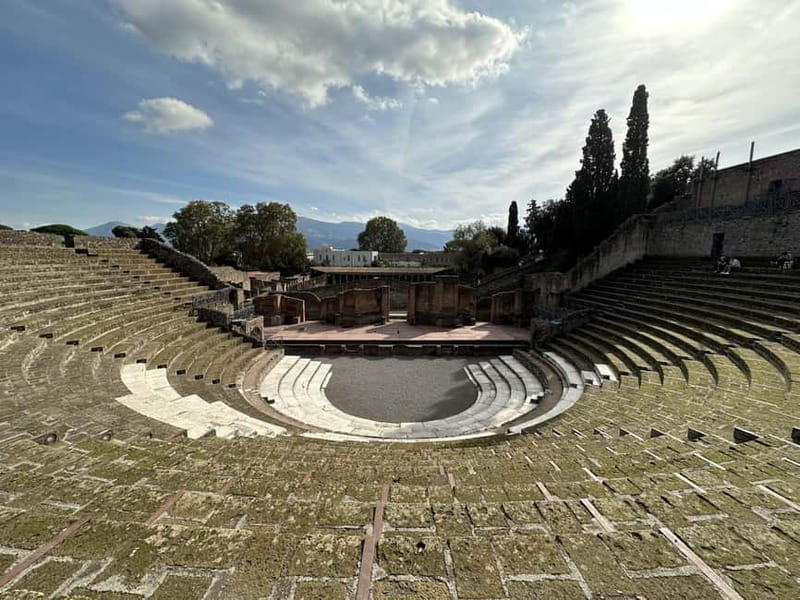
The Large Theatre then shifts the mood again. The theatre district shows Pompeii as a place of performance and public entertainment. The scale of the seating area gives you a sense of how many people could gather for an event, while the design reflects the importance of shared spectacle in Roman life.
The theatre area is also a good place for photographs, though two hours requires discipline. If you stop for every picture, you may lose time at the houses or Forum. The guides praised for good pacing, including Antonio, Riccardo, Monica, and Pierluigi, seem to understand this balance: keep the group moving, but allow enough time to take in the setting.
What $50 buys you
At $50 per person, this tour sits in the middle range for a guided Pompeii experience. The price includes entry, an express admission ticket, a licensed archaeologist guide, a headset, and a small shared group. Transportation, food, and drinks are not included.
The key value is not simply getting through the gate. Pompeii’s size makes poor use of time expensive. If you wander without a plan, you may miss major buildings or leave without understanding what you saw. A good two-hour introduction can make the rest of your day more productive.
That value is strongest if you are visiting Pompeii once, have limited time, or prefer history explained in person. It is also useful for families because the guide can connect architecture to daily life instead of giving a long stream of dates.
The price is less compelling if you already have strong knowledge of Roman archaeology, plan to spend a full day with a detailed guidebook, or want a very slow visit focused on photography. In that case, you may prefer to enter independently and set your own pace.
The private option changes the calculation. A private booking costs more than the shared rate, but it can make sense for a family, a group with special interests, or anyone who wants more questions and less waiting. The shared tour still appears to offer good value, particularly because the group is kept small and headsets are provided.
Practical details that can make or break the visit
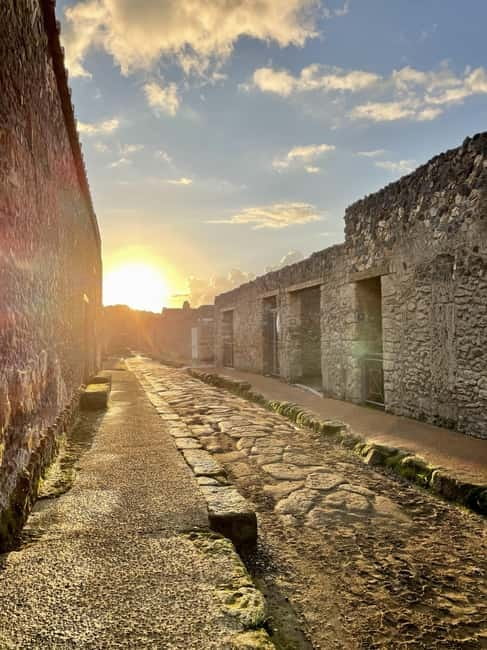
Wear comfortable shoes with firm soles. Pompeii’s ancient paving can be uneven, and one guide even helped a participant after a slip near the site exit. Bring water, especially in warm weather, and expect limited shade in some areas.
You need to send the full name, surname, and age of every participant through the booking message system because the ticketing rules require names on the tickets. Bring a passport or identity card for each person, including children. A photo of the document is accepted according to the tour information, but carrying the required identification avoids needless worry.
The tour is not suitable for wheelchair users or people with mobility impairments. Electric wheelchairs are specifically not allowed, and pets are not permitted. Swimwear, alcohol, and drugs are also prohibited.
The meeting point is outside Porta Marina, in front of the Pompei Scavi, Villa dei Misteri station. The guide carries a sign marked Pompei VIP. After the walk, the group can finish at Pompeii Ruins or Piazza Esedra, and the guide points out what to visit independently.
You can cancel up to 24 hours before the start for a full refund, and the reserve-now, pay-later option keeps your plans flexible. Starting times vary, so check availability for your date.
Who should book this Pompeii tour?
I would choose this tour if you want a clear introduction rather than a self-guided wander. It suits first-time visitors, families, couples, solo visitors, and anyone arriving by train who wants a simple meeting point near the entrance.
It is also a strong choice for history fans who want to ask about excavation methods, Latin and Greek influences, architecture, or household life. The guides praised for their passion, such as Antonio and Riccardo, appear to add more than memorized facts. They explain why the evidence matters.
You should think twice if you need a fully accessible route, dislike walking over uneven ground, or want to inspect every corner at leisure. Two hours moves at a sensible but purposeful pace. You will see many of Pompeii’s essential sights, but you will not see everything.
Should you book it?
Yes, if you want Pompeii to make sense. The combination of entry tickets, a small group, headsets, and an archaeologist guide removes much of the guesswork from a sprawling site. At $50, it offers solid value for a first visit, especially if you plan to remain inside after the guided portion.
Book the private option if personal attention matters more than price. Choose the shared tour if you want the strongest balance of cost and expert guidance. Either way, arrive with water, proper shoes, and enough time afterward to follow the guide’s suggestions. Pompeii is too large for a rushed exit.
FAQ
Where does the Pompeii tour meet?
The meeting point is outside Pompeii’s Porta Marina entrance, directly in front of the Pompei Scavi, Villa dei Misteri train station. The guide holds a sign marked Pompei VIP.
Are Pompeii entry tickets included?
Yes. The tour includes skip-the-line entry tickets and Pompeii’s admission Express ticket.
How long does the guided visit last?
The guided tour lasts two hours. Starting times vary, so you need to check availability for your chosen date.
Is this a private tour?
You can choose either a shared small-group experience or a private booking.
Which languages are available?
The live tour guide is available in English, Italian, French, and Spanish.
What should I bring to Pompeii?
Bring comfortable shoes, water, and a passport or identity card for every participant, including children. A photo of the identification document is accepted according to the tour information.
Just added around Pompeii
- Pompeii: Guided Small Group Tour Max 6 People with Private Option★ 5.0 · 269 reviews
- Pompeii Guided Group Tour with Entry Ticket and Archaeologist★ 4.5 · 269 reviews
- Private Day Tour to Vesuvius, Herculaneum & Pompeii with Pick Up★ 5.0 · 279 reviews
- Pompeii Vineyard Escape: Private Wine Tasting & Lunch★ 5.0 · 329 reviews
- 2 hours Pompeii Tour with Local Historian – Ticket Included★ 5.0 · 335 reviews
- PompeiI Exclusive Tour with your Archaeologist in a Small Group★ 4.5 · 363 reviews
- Complete Pompeii Skip the Line Tour with Archaeologist Guide★ 4.5 · 379 reviews
- Pompeii 2h Small-Group Tour with Expert Archaeologist★ 5.0 · 385 reviews
Pompeii & Herculaneum Tours, compared.

Pompeii: Entry Ticket and Guided Tour with an Archaeologist
Read our review →
Pompeii: Entry Ticket with Optional Audio Guide
Read our review →
Pompeii: Small Group Tour with an Archaeologist
Read our review →


Pompeii Small Group Tour with an Archaeologist
Read our review →
Pompeii, Amalfi Coast and Positano Day Trip from Rome
Read our review →Browse the lists this tour appears in