
Review · POMPEII & HERCULANEUM TOURS
Pompeii: Afternoon to Sunset Guided Tour with Ticket
Pompeii comes alive after the heat fades. This 2.5-hour walking tour gives you a focused introduction to the Roman city buried by Mount Vesuvius in 79 AD, with an archaeologist guide leading you through its streets, civic buildings, homes, shops, and public spaces. You meet at Ristorante Bar Sgambati, look for the red Enjoy Pompeii sign, and enter through a separate entrance with your ticket included.
I like the late-afternoon timing, especially in the warmer months, when the sun is less fierce and the site may feel calmer. I also like the human touch of a live archaeologist guide. Guides such as Francesco, often called Frankie, Angelo, Anna, Sasa, and others have been praised for turning broken walls and paved roads into clear stories about Roman life.
The main tradeoff is simple: 2.5 hours is enough for highlights, not all of Pompeii. The site is huge, so you will not see every neighborhood or building. This tour suits you best if you want a guided route through the essential sights, then plan to continue exploring on your own if opening hours allow.
In This Review
- Key points before you book
- Why late afternoon is the smart time for Pompeii
- Meeting at Ristorante Bar Sgambati
- Entering the archaeological site with a guide
- The Antiquarium and Pompeii’s public face
- The Basilica and Forum
- Thermal Baths and Roman engineering
- Bakeries, housing blocks, and ordinary streets
- The Theater and the final stretch
- What the guide adds to the price
- What the guide style is like
- How to make the most of your visit
- Who should book this Pompeii tour?
- FAQ
- How long does the Pompeii tour last?
- What is included in the price?
- Is transportation included?
- Where do I meet the guide?
- What languages are available?
- Can I book a private or small-group tour?
- What should I bring?
- Is the tour suitable for people with mobility or health concerns?
- Can I cancel the booking?
Key points before you book
- Sunset timing helps with heat and crowds: Afternoon departures, including a popular 3:30 PM start, can make Pompeii easier to handle than the hottest part of the day.
- The guide is the real value: Archaeologists explain architecture, engineering, art, commerce, and daily life in ways a map alone cannot.
- You visit major civic landmarks: The route includes the Antiquarium, Basilica, Forum, Thermal Baths, and Theater.
- Small groups improve the experience: Private and small-group options are available, and several groups have been as small as five to ten people.
- The route includes ordinary Pompeii: Bakeries, housing blocks, streets, and commercial areas reveal more than grand monuments alone.
- Bring practical protection: Wear comfortable walking shoes, carry a sun hat, and bring an ID card or an accepted copy.
Why late afternoon is the smart time for Pompeii
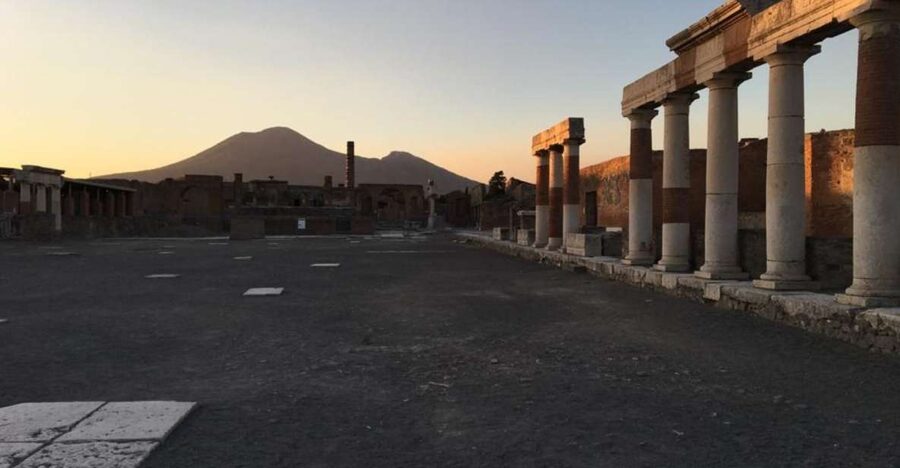
Pompeii is exposed, paved, and wide open. There is not much shade across the site, and the ancient streets can make a hot day feel even hotter. Starting later gives you a better chance of walking in softer light and cooler air, particularly from spring through early autumn.
The sunset angle is not just a marketing flourish. It changes how the ruins feel. Stone walls take on warmer tones, long shadows fall across the roads, and the end of the tour can feel quieter than midday. You should not expect a special sunset viewpoint or a separate sunset ceremony, but the light adds atmosphere to the final part of the walk.
The afternoon slot also helps with energy. Pompeii can become tiring if you arrive after a full morning of sightseeing, yet the later start lets you treat the archaeological site as the main event rather than squeezing it between several other stops. Several people found the timing cooler and less crowded, while one group appreciated having time after the tour to see more independently.
Do check the exact departure time when booking. The activity lasts 2.5 hours, but the available start times can vary.
More Pompeii and Herculaneum visits:
- Pompeii Small Group Tour with an Archaeologist
★ 5.0 · 6,593 reviews - Discover the Ancient Ruins of Pompeii: Day Trip from Rome
★ 3.5 · 2,247 reviews - Pompeii and Herculaneum Small Group Tour with an Archaeologist
★ 5.0 · 1,350 reviews
Meeting at Ristorante Bar Sgambati
The meeting point is Ristorante Bar Sgambati. Look for the red Enjoy Pompeii sign, and allow enough time to find the spot without rushing. The meeting point is near the Pompeii area and has been described as convenient for people arriving by train, but transportation itself is not part of the tour.
That distinction matters. You need to arrange your own way to the meeting point, and you should plan your onward journey too. One useful piece of advice is to leave extra time if you need to catch a train after the visit. The tour finishes inside the archaeological experience, and you may need time to walk back, orient yourself, or collect belongings.
The meeting instructions are fairly simple, though it is worth checking them carefully before you leave. A red sign is easier to spot than a staff member’s name, especially around a busy station and restaurant area.
Entering the archaeological site with a guide
Your skip-the-line ticket is included, with access through a separate entrance. That saves you from arranging admission separately and can protect precious sightseeing time. It does not mean you can rush through every part of Pompeii. Once inside, the pace is still a walking tour, and the ancient streets demand attention.
The guide’s role becomes clear almost at once. Pompeii is not a single monument with one obvious path. It is a large Roman city made up of roads, blocks, homes, shops, temples, public buildings, and open spaces. Without context, you can spend hours looking at walls without understanding what you are seeing.
An archaeologist guide can point out how the city worked. You learn to read the relationship between public squares and private homes, between shops and streets, and between practical features and social life. Guides also answer questions as they come up, which makes the visit more flexible than an audio guide.
This is especially useful for families and mixed-age groups. Sasa was praised for keeping an age range from 11 to people in their seventies interested, while Francesco was described as patient with teenagers and careful to adjust the walking pace. That does not remove the physical demands of the site, but it can make them easier to manage.
The Antiquarium and Pompeii’s public face
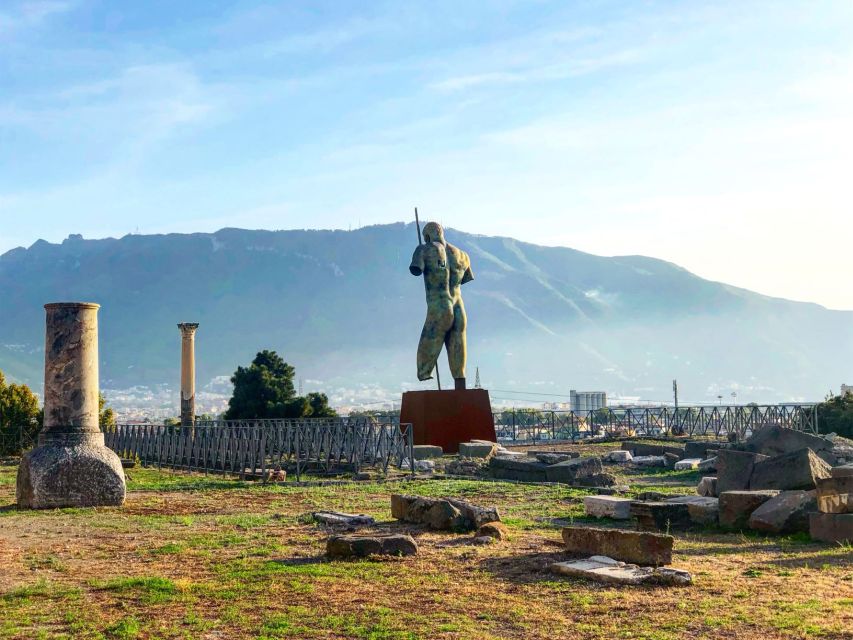
The new Antiquarium is one of the important stops listed for the route. It provides a useful starting point for understanding Pompeii before you walk deeper into the city. The exact emphasis may depend on your guide and the conditions at the site, but the purpose is clear: connect the objects and remains with the people who used them.
From there, the tour moves toward the public heart of Pompeii. The city’s civic buildings help you picture it as a functioning community rather than simply a disaster site. The remains show planning, public life, trade, politics, worship, and recreation.
A good guide will keep the eruption in proportion. The destruction is central to Pompeii’s story, but the city was not created for the eruption. People lived, worked, shopped, worshiped, argued, and relaxed there long before Vesuvius changed everything. That everyday focus is one of the strongest reasons to take a guided tour.
More after-dark outings:
- Winner 2025 Florence Sunset Food & Wine Tour by Eating Europe
★ 5.0 · 5,015 reviews - Catania: Mount Etna Morning or Sunset Day Trip with Tasting
★ 4.8 · 4,028 reviews - Catania: Sunset Jeep Tour of Mount Etna and Lava Flow Caves
★ 4.8 · 2,113 reviews - Rome: City Highlights Open-Top Bus Night Tour
★ 4.1 · 2,038 reviews
The Basilica and Forum
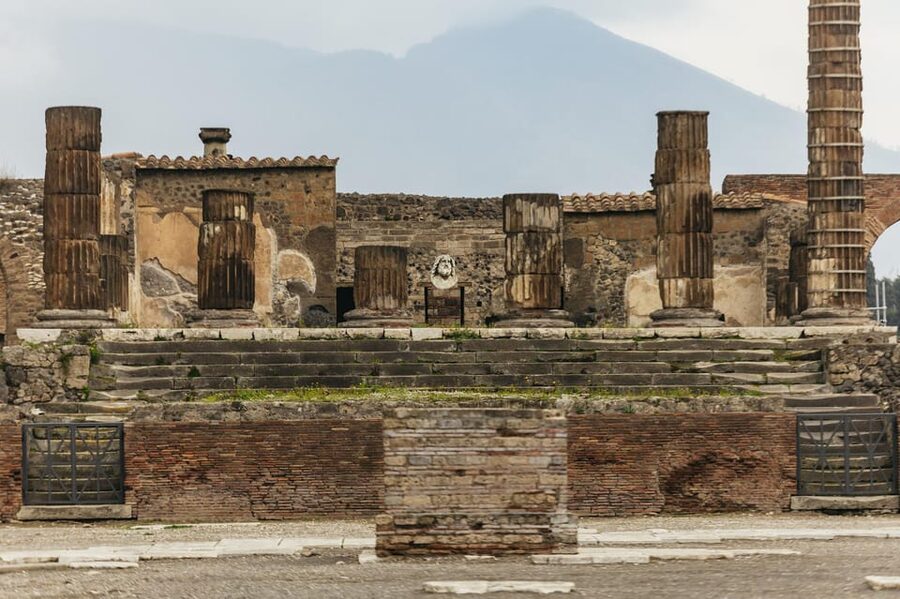
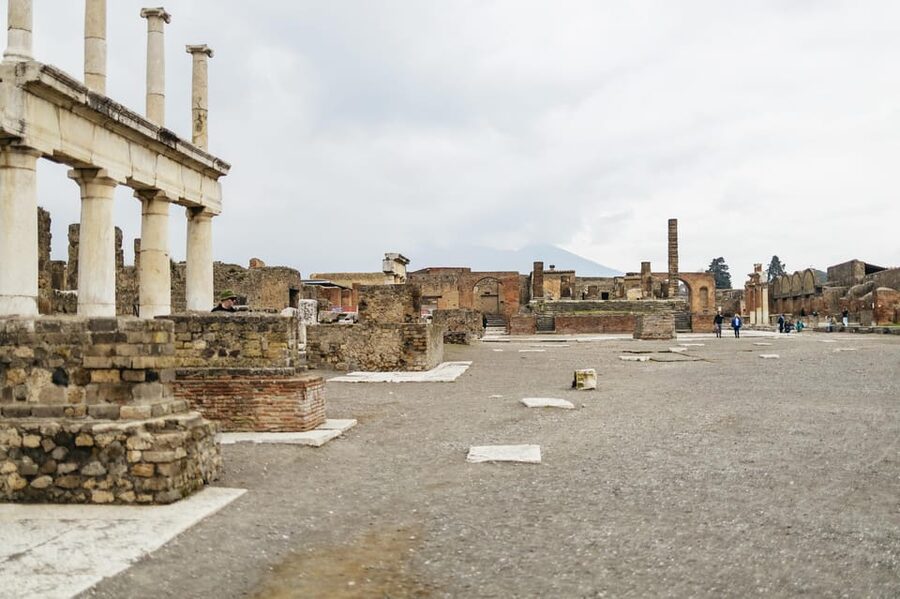
The Basilica and Forum offer the clearest sense of Pompeii’s civic life. The Forum was the city’s major public gathering area, while the Basilica served important legal and administrative purposes. Together, they help explain how Roman cities organized business, government, and public affairs.
The Forum can feel overwhelming because so much is visible at once. Columns, foundations, open spaces, and surrounding buildings do not always tell you their purpose without explanation. This is where the guide’s architectural knowledge earns its keep. You get help separating a temple from a civic building, a public space from a commercial one, and decoration from structural function.
The scale also rewards patience. You may be tempted to photograph everything and move on, but a short explanation about how a Roman forum worked can turn a pile of stones into a place with a clear social role. Guides have been praised for using humor and stories without losing the serious meaning of the site.
Thermal Baths and Roman engineering
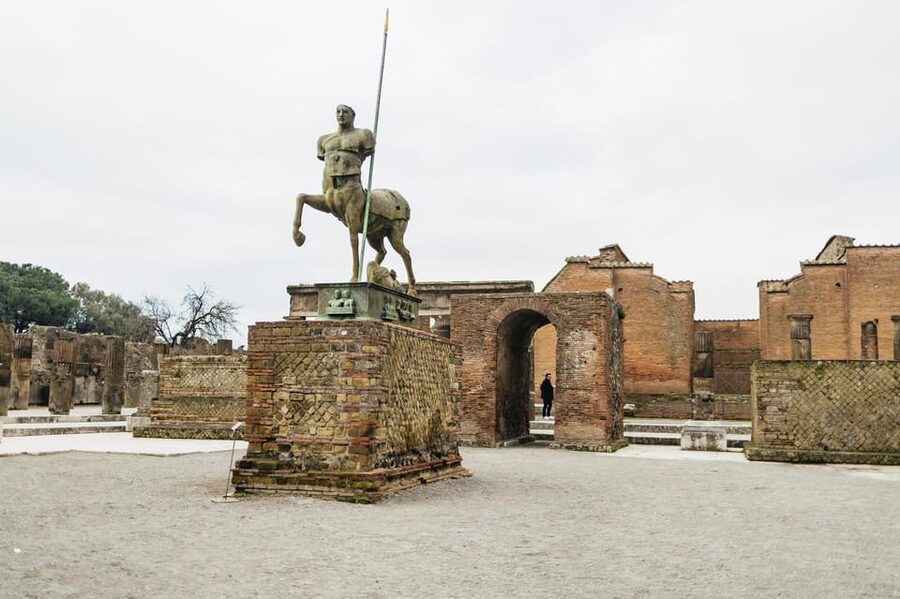
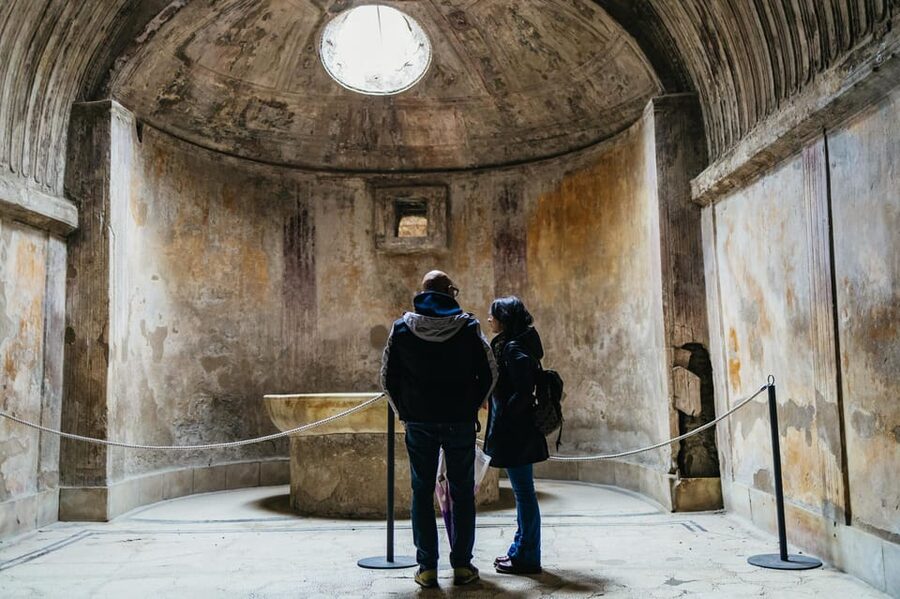
The Thermal Baths show how much public life depended on shared facilities. These were not simply places to wash. Roman baths were tied to exercise, conversation, routine, and status, and their construction required careful planning.
The buildings also reveal Roman engineering. Your guide may explain how rooms were arranged and how heating systems worked, depending on what is accessible during your visit. The supplied tour information specifically highlights Roman architecture and engineering, and past guests valued explanations that connected the structures to practical life.
The baths are a good reminder that Pompeii was not a crude settlement frozen in time. It was an organized urban center with public amenities, specialized buildings, and a strong sense of civic order. You may spend less time here than you would on a full-day archaeological visit, but the stop gives useful context for the rest of the route.
Bakeries, housing blocks, and ordinary streets
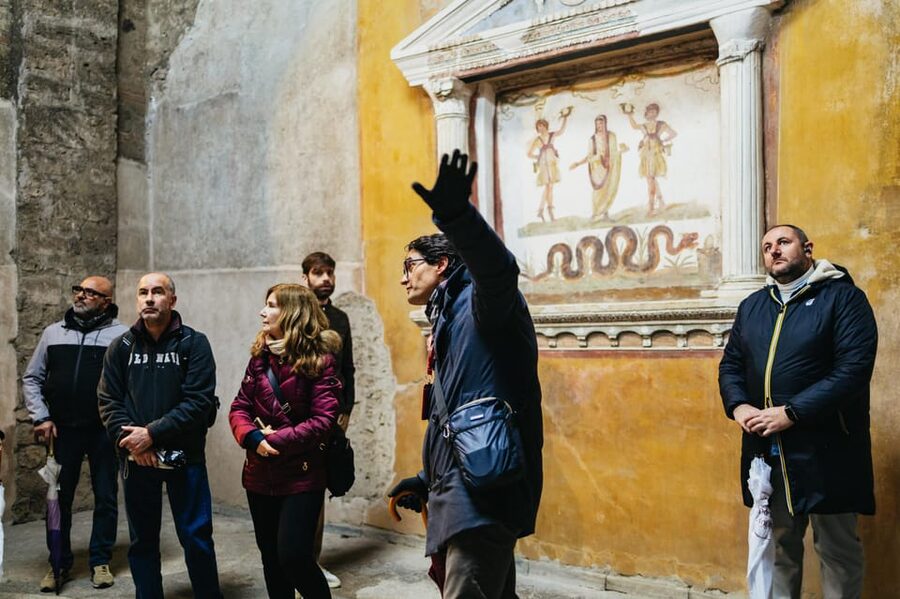
The most memorable part of Pompeii may be the ordinary side of the city. The tour includes commercial and residential neighborhoods, with a bakery and typical housing blocks among the sights.
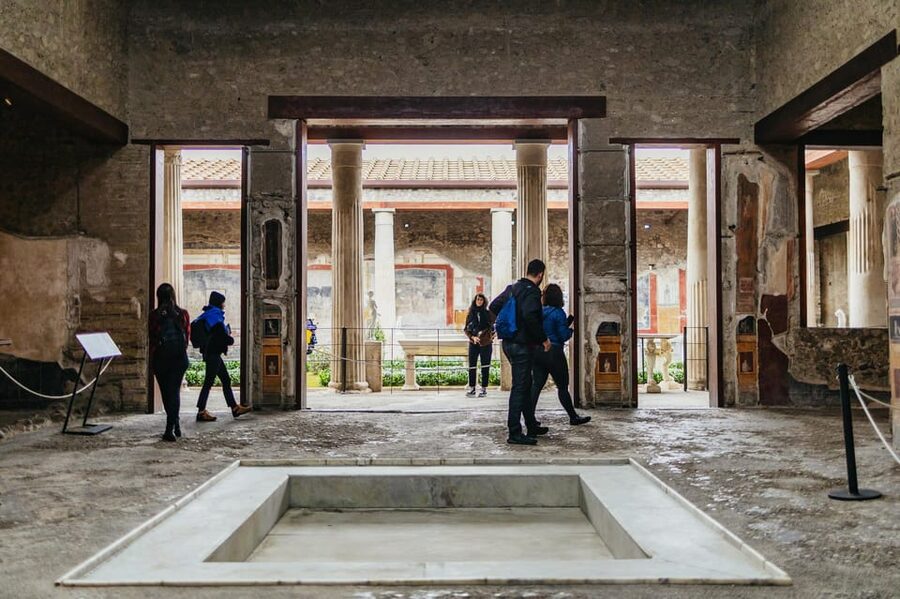
These areas make the visit personal. Grand buildings tell you how a city presented itself, but homes and shops show how people actually lived. A bakery points to food production and commerce. Housing blocks reveal how private space met public streets. Narrow roads and worn paving stones help you imagine people moving through the city for work, shopping, errands, and social visits.
The guide can also explain what you are not seeing. A wall may have belonged to a home, shop, or public building, but its meaning depends on position and design. Stories about domestic routines, business, social rank, and neighborhood life help you read the ruins with more care.
This is also where the tour avoids becoming a procession of famous names. You are not only ticking off the Forum and Theater. You are seeing the city at street level, where the evidence of normal life often feels most direct.
The Theater and the final stretch
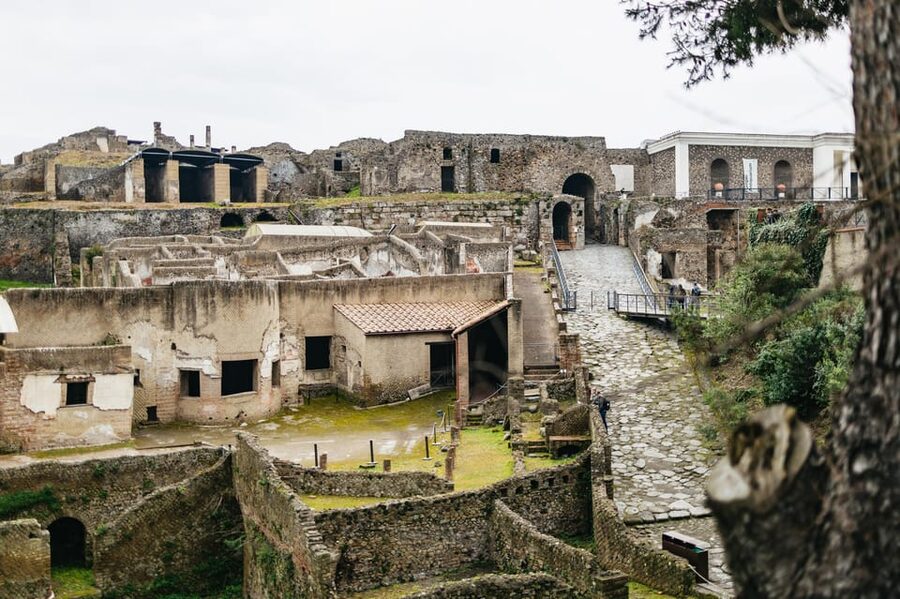
The Theater is another major highlight. Its presence shows that entertainment was part of civic life, just as it was in other Roman towns. The architecture gives the guide a chance to discuss performance, public gatherings, and the way a city used shared spaces.
As the tour moves toward its close, the fading light can make the ruins easier on the eyes and the body. You may notice fewer people around certain corners, although Pompeii is still a popular archaeological site and conditions vary by day.
One practical advantage of a guided route is stamina. A guide can choose key sights and keep you moving without making you race. Francesco was especially praised for finding shade during explanations, pointing out uneven surfaces, and helping groups manage the heat. Those small choices matter on a large paved site.
You should still expect plenty of walking. The activity is not suited to people with mobility impairments, heart problems, or respiratory issues, and it is not recommended for people over 95. Comfortable footwear is essential. Bring a sun hat, and carry water even though it is not specifically listed among the required items.
What the guide adds to the price
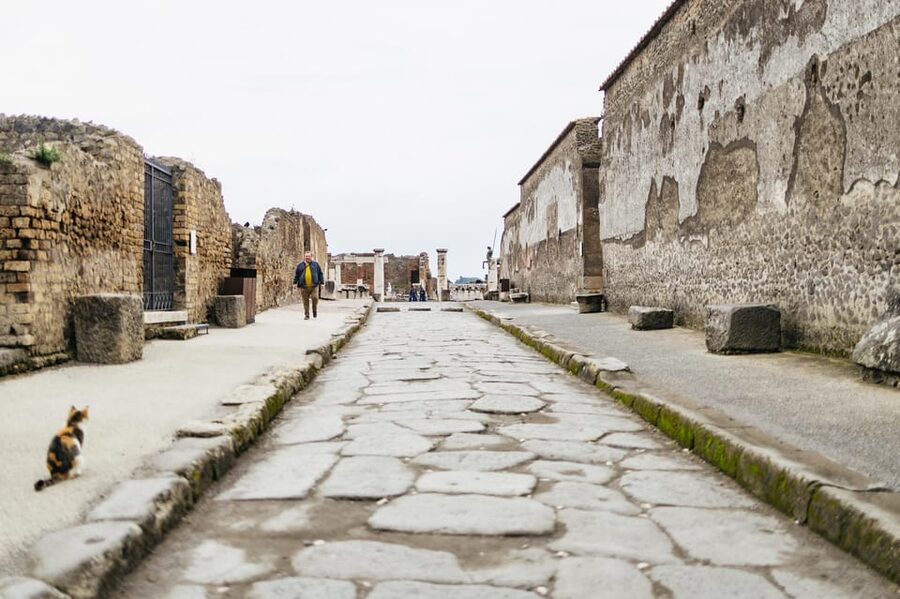
At $58 per person, this is not the cheapest way to enter Pompeii. You are paying for the admission ticket, a separate entrance, and 2.5 hours with an archaeologist guide. There is no transportation, so you must also cover your own train, taxi, or other local travel.
For me, the price makes sense if you are visiting Pompeii for the first time and want the major sights explained. The site is too large and layered for a casual wander to guarantee that you understand what you are seeing. A guide also helps you use limited time well, rather than spending half the visit trying to locate the Forum or deciding which streets matter.
The value is weaker if you already know Pompeii well, want to spend a full day exploring independently, or prefer to stop at every house and inscription. A 2.5-hour route has limits. You will see selected highlights, not the entire archaeological park.
The option of a private or small group adds flexibility. Small groups can make it easier to ask questions, hear the guide, and adjust the pace. They also create a more personal feel than a large crowd moving behind a flag.
What the guide style is like
The most consistently praised feature is the quality of the guiding. Francesco, often called Frankie, appears repeatedly in the feedback, with strong marks for humor, patience, passion, and clear explanations. Angelo was praised for his warmth and command of the subject, while Anna brought the added perspective of being an archaeologist who had lived in Pompeii all her life.
Guide assignments can change, so you should not book on the assumption that one specific person will lead your group. Still, the pattern is encouraging: the guides are expected to make Roman architecture, art, engineering, culture, and daily life understandable rather than simply reciting dates.
That human element matters at Pompeii. You want someone who can explain why a building mattered, answer an unexpected question, and notice when the group needs shade or a slower pace. Several guides also offered suggestions for what to see after the tour, which is useful because the guided route cannot cover everything.
How to make the most of your visit
Plan to arrive at the meeting point with time to spare. Find the red Enjoy Pompeii sign, confirm your language, and keep your ID card or an accepted copy available.
Wear shoes that can handle uneven ancient paving. The site involves extended walking, and you may spend time standing while the guide explains a building. A sun hat is specifically recommended, and the late start does not eliminate the need for protection.
Think of the tour as your introduction, not your entire Pompeii visit. If the site remains open after the guided portion, use the extra time to visit areas the guide could not include. The Arena was singled out as a worthwhile place to see beyond the main route, so ask your guide for current advice before you leave.
Finally, plan your train connection conservatively. Do not schedule an immediate departure after the tour. You may want time to walk back, find the station, and deal with delays or a slower-than-expected finish.
Who should book this Pompeii tour?
I would choose this experience for a first visit, especially if you have only a few hours and want the main landmarks explained by a specialist. Families, couples, and mixed-age groups should also appreciate the small-group format and the guides’ reported patience.
It is a good fit for you if summer heat worries you, if you prefer conversation to headphones, or if you want help making sense of a vast archaeological site. The late slot is particularly appealing in July and August, when a midday walk can be punishing.
I would choose something else if you need step-free access, have serious heart or respiratory concerns, or want an all-day exploration of every district. You may also prefer an independent ticket if you want total control over your route and pace.
With free cancellation up to 24 hours before the start and a reserve-now, pay-later option, the booking terms are flexible. The strongest case for booking is not the ticket alone. It is the chance to see Pompeii through a guide who can connect public monuments with the ordinary streets, shops, and homes that made the city real.
FAQ
How long does the Pompeii tour last?
The guided walking tour lasts 2.5 hours.
What is included in the price?
The price includes skip-the-line entry to Pompeii through a separate entrance and an archaeologist guide.
Is transportation included?
No. Transportation to and from the meeting point is not included.
Where do I meet the guide?
Meet at Ristorante Bar Sgambati and look for the red Enjoy Pompeii sign.
What languages are available?
The tour is available in Italian, English, and French.
Can I book a private or small-group tour?
Yes. Private and small-group options are available.
What should I bring?
Bring a sun hat and an ID card. A copy of the ID card is accepted.
Is the tour suitable for people with mobility or health concerns?
The tour is not suitable for people with mobility impairments, heart problems, or respiratory issues. It is also not suitable for people over 95.
Can I cancel the booking?
Yes. You can cancel up to 24 hours in advance for a full refund. You can also reserve now and pay later.
Just added around Pompeii
- Pompeii: Guided Small Group Tour Max 6 People with Private Option★ 5.0 · 269 reviews
- Pompeii Guided Group Tour with Entry Ticket and Archaeologist★ 4.5 · 269 reviews
- Private Day Tour to Vesuvius, Herculaneum & Pompeii with Pick Up★ 5.0 · 279 reviews
- Pompeii Vineyard Escape: Private Wine Tasting & Lunch★ 5.0 · 329 reviews
- 2 hours Pompeii Tour with Local Historian – Ticket Included★ 5.0 · 335 reviews
- PompeiI Exclusive Tour with your Archaeologist in a Small Group★ 4.5 · 363 reviews
- Complete Pompeii Skip the Line Tour with Archaeologist Guide★ 4.5 · 379 reviews
- Pompeii 2h Small-Group Tour with Expert Archaeologist★ 5.0 · 385 reviews
Pompeii & Herculaneum Tours, compared.

Pompeii: Entry Ticket and Guided Tour with an Archaeologist
Read our review →
Pompeii: Entry Ticket with Optional Audio Guide
Read our review →
Pompeii: Small Group Tour with an Archaeologist
Read our review →


Pompeii Small Group Tour with an Archaeologist
Read our review →
Pompeii, Amalfi Coast and Positano Day Trip from Rome
Read our review →Browse the lists this tour appears in