
Review · POMPEII & HERCULANEUM TOURS
Explore Pompeii with an Archaeologist
Pompeii rewards a guide who can read the ruins. This two-hour walk pairs skip-the-line admission with an archaeologist who explains what you are seeing, from the forum and basilica to painted houses, baths, shops, and theaters. I especially like the compact route and the chance to ask questions in a group capped at 20 people. The main catch is time: Pompeii is enormous, and two hours gives you a strong introduction, not the whole ancient city.
The route covers many of the site’s best-known corners without wasting much time finding them. Guides such as Mario Celentano, Alexandra, Teresa, Rosanna, and Ilaria have earned praise for clear explanations, humor, patience, and good pacing. Still, crowds can build inside popular buildings, and uneven paving, heat, and occasional noise can make it hard to hear.
In This Review
- What makes this Pompeii tour worth considering
- Meeting your guide at Porta Marina Superiore
- The forum and basilica: Pompeii’s public center
- Lupanar and the forum granaries
- House of Menander and House of the Faun
- Stabian Baths and Via dell’Abbondanza
- Thermopolium VI and the taste of ordinary life
- Teatro Grande and Casa dei Vettii
- What two hours can and cannot do
- The guides and the quality of the explanations
- Price, group size, and practical value
- Who should book this Pompeii walk
- Should you book Explore Pompeii with an Archaeologist?
- FAQ
- How long does the Pompeii tour last?
- Where does the tour meet?
- Where does the tour finish?
- Is Pompeii admission included?
- Is the tour conducted in English?
- How many people can join the tour?
- Can I cancel for a full refund?
What makes this Pompeii tour worth considering
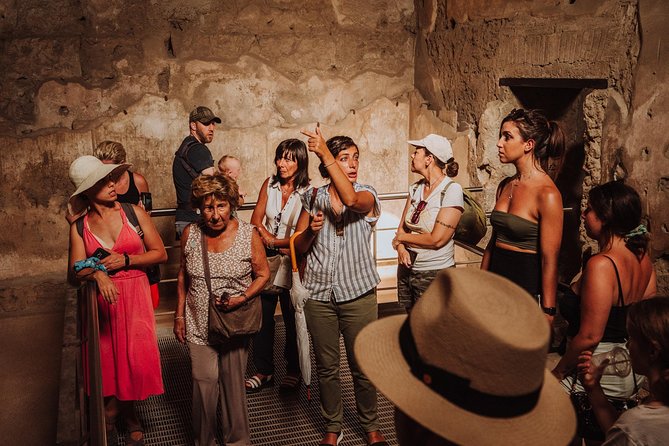
- A trained archaeologist leads the walk: You get explanations about buildings, streets, and daily life rather than a simple list of dates and names.
- Twelve major stops fit into about two hours: The route includes the forum, Lupanar, House of the Faun, Stabian Baths, Via dell’Abbondanza, theaters, and more.
- The group is limited to 20 people: That gives you a better chance to ask questions than a large coach-style outing.
- Admission is included: You do not need to arrange a separate Pompeii entry ticket.
- Headsets help in larger groups: Audio equipment is provided when the group has 16 or more people, though crowded rooms may still be noisy.
- You can continue exploring afterward: The tour ends at Piazza Esedra, leaving you free to spend more time inside the park if you have the energy.
Meeting your guide at Porta Marina Superiore
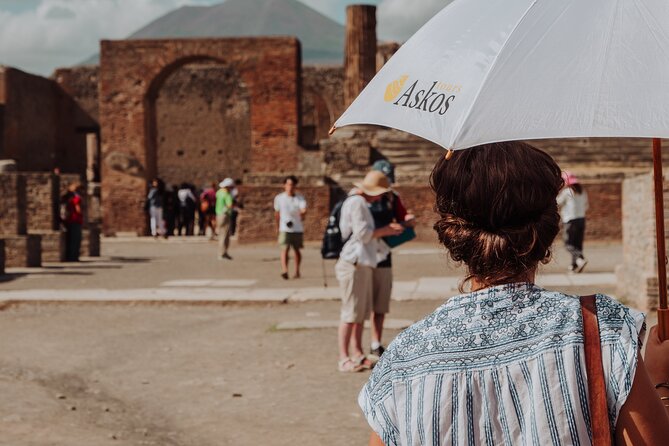
You meet at the main entrance called Porta Marina Superiore, at Via Villa dei Misteri 2 in Pompeii. Look for a guide holding an Askos Tours sign. That detail matters because the entrance area can feel busy, and you do not want to lose precious minutes circling the gates.
The tour begins with a short orientation to the archaeological park. Your guide handles the included admission, then leads you through the site on foot. The pace is purposeful. You stop often, but the walk between buildings is part of the lesson because Pompeii makes the most sense when you see how houses, shops, public buildings, and streets fit together.
The route finishes at Piazza Esedra, rather than returning you to the starting gate. Plan your onward route before you begin, especially if you have a train, a lunch booking, or a timed visit elsewhere. The site is near public transportation, and one traveler found it easy to reach by train, but transportation to and from Pompeii is not included.
More Pompeii and Herculaneum visits:
- Pompeii Small Group Tour with an Archaeologist
★ 5.0 · 6,593 reviews - Discover the Ancient Ruins of Pompeii: Day Trip from Rome
★ 3.5 · 2,247 reviews - Pompeii and Herculaneum Small Group Tour with an Archaeologist
★ 5.0 · 1,350 reviews
The forum and basilica: Pompeii’s public center
The Foro de Pompeya is the first major stop, and it gives you the best quick picture of how public life was organized. This was the city’s main square, surrounded by important buildings and used for civic, religious, and commercial activity.
A good guide makes this open space easier to understand. Without context, the forum can look like a collection of columns and broken walls. With an explanation of its role, you begin to see it as the place where Pompeii’s residents conducted business, gathered for public events, and displayed civic pride.
Next comes the Basilica, the city courthouse. Its large scale helps you picture Pompeii as a functioning Roman town rather than a frozen collection of homes. Your guide can point out how law, trade, politics, and social life were tied together in the same central district.
These first stops also help you get your bearings. The rest of the walk moves through private homes, public baths, shops, and entertainment spaces, but the forum and basilica provide the civic framework.
Lupanar and the forum granaries
The Lupanar, Pompeii’s brothel, is one of the most talked-about stops. It is compact, and lines may form because the rooms attract plenty of attention. The paintings and small spaces give a blunt glimpse of commercial sex in the Roman city, though the stop can feel rushed if the interior is crowded.
This is a place where a guide adds real value. You can ask questions about the building’s function and about what is known from the structure itself. The guide can also help separate solid evidence from the colorful stories that have grown around Pompeii over time.
The nearby granaries of the forum offer a different kind of evidence. These ancient storage spaces show the practical side of city life: food had to be stored, distributed, and sold. The display areas also help you understand that Pompeii was not only a place of grand villas and dramatic death. It was a working town with ordinary systems and daily needs.
House of Menander and House of the Faun
The House of Menander takes you into the world of an affluent household. Pompeii’s homes were not just private shelters. Their layouts, wall paintings, courtyards, and decorative details reveal how Roman families presented status and received guests.
The House of the Faun is one of the site’s famous residences, and its size makes clear how wide the gap could be between wealthy homeowners and ordinary residents. The name comes from a small statue of a dancing faun. Your guide can help you notice the design of the house rather than simply moving from one famous object to another.
Both houses are rewarding, but do not expect to study every room during a two-hour walk. The guide has to keep the group moving, and some sections may be closed or crowded on the day of your visit. If a particular house catches your interest, note its location and return after the guided portion.
This is one of the strongest reasons to continue exploring alone after the tour. The walk gives you a clear map of what matters. You can then spend extra time with the rooms and decorations that speak to you.
A few more reviews worth comparing before you book
- Skip the Line Guided Tour of Pompeii led by an Archaeologist
★ 5.0 · 703 reviews - Pompeii Ticket + Tour with Optional Tasting Experience at Pompeii
★ 5.0 · 663 reviews - Pompeii private tour with an Official Guide
★ 5.0 · 631 reviews - Pompeii Private Tour with an Archaeologist and Skip The Line – 3 hours
★ 5.0 · 564 reviews
Stabian Baths and Via dell’Abbondanza
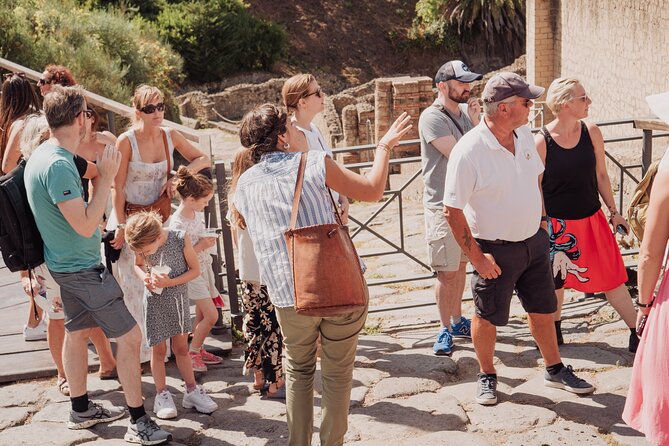
The Terme Stabiane, or Stabian Baths, show how much public infrastructure Pompeii once had. Roman baths were places to wash, exercise, socialize, and conduct business. The surviving spaces help you picture the sequence of rooms and the engineering needed to heat them.
The baths can be especially useful for families because the purpose of the building is easy to grasp. A guide can connect the architecture to daily routines, making the ruins less abstract for younger visitors. Several families have praised guides for explaining Pompeii in a way that kept children engaged.
Then you walk along Via dell’Abbondanza, one of Pompeii’s main streets. This is where the city feels most like a neighborhood rather than a museum. You see the street grid, doorways, shops, and worn paving that supported everyday movement.
The walk is not flat and polished. Pompeii’s ancient surfaces are uneven, and the amount of walking deserves serious attention. One particularly useful piece of advice is to bring a hat or umbrella in hot weather, along with a refillable water bottle. Water is available from fountains, but the site offers limited shade in many areas.
Thermopolium VI and the taste of ordinary life
Thermopolium VI is an ancient food shop, a Roman version of a quick-service counter. These small businesses make Pompeii feel unusually personal. You are not only looking at temples and official buildings. You are looking at the places where people stopped for food and drink during a normal day.
The stop works well after the broad public spaces and grand homes because it brings the scale back down. Pompeii had wealthy houses, public institutions, baths, theaters, storage areas, and modest commercial businesses all within the same urban system.
Your guide’s explanation matters here. A counter with openings or storage jars can be hard to interpret on your own. With the right context, it becomes a clue about how residents ate, traded, and moved through the city.
Teatro Grande and Casa dei Vettii
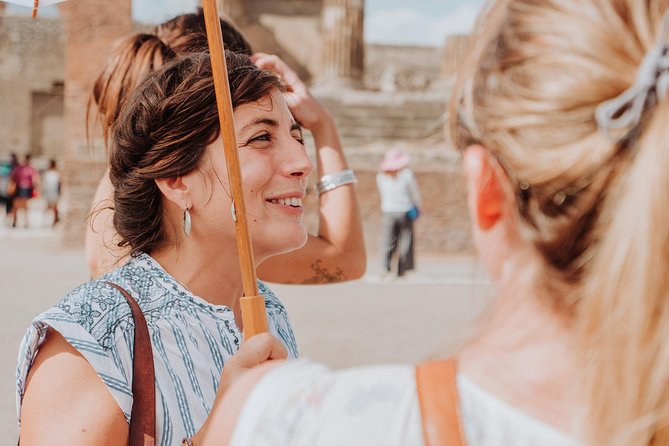
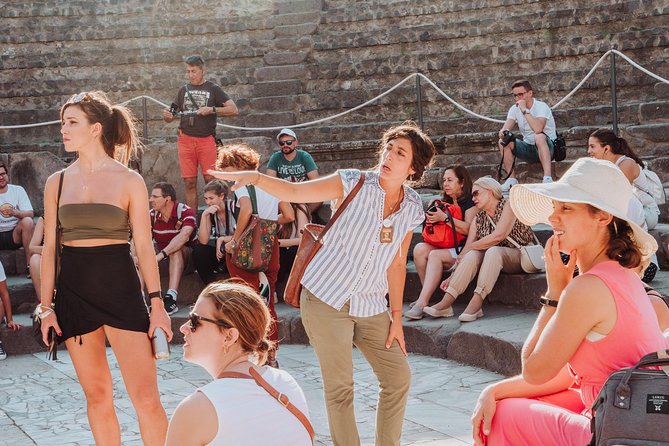
The Teatro Grande, or large theater, brings the tour into the world of entertainment. Its scale gives you a sense of Pompeii’s social life beyond work and household duties. The theater is also a useful reminder that public gatherings could be about performance and leisure, not only politics or religion.
The final listed stop is Casa dei Vettii, the House of the Vettii. Like the House of Menander and House of the Faun, it helps explain wealth through decoration, layout, and domestic space. The building is memorable because it combines grand presentation with clues about how a private residence functioned.
Ending with another important house gives the tour a strong visual finish. By this point, you have seen the city’s main square, courthouse, commercial spaces, baths, street life, theater, and elite homes. You leave with a workable picture of Pompeii’s structure, even though plenty remains unseen.
What two hours can and cannot do
The schedule assigns roughly ten minutes to each main stop. That is enough for a clear explanation and a few questions, but not enough for a slow examination of every room. I would treat this as a guided introduction, then stay on if your admission and schedule allow.
The route is efficient because it checks off many highlights. It is less suitable if you want to visit excavation areas currently being opened, study inscriptions, or spend long stretches photographing details. One person also found that the group did not reach some areas being excavated. That is not necessarily a flaw in the route, but it is important to set your expectations.
Crowds are another factor. Skip-the-line admission reduces the wait at the main entry, but it does not guarantee empty buildings. Lines can form inside popular rooms, especially at the Lupanar and well-known houses. In a busy period, other groups may also make it harder to hear.
The tour provides headsets for groups of 16 or more. They are a useful aid, and one person specifically praised the audio equipment. Still, sound can be affected by nearby groups and the hard surfaces inside the ruins. If hearing every word is essential to you, a private visit may offer a calmer experience.
The guides and the quality of the explanations
Guide quality is central here, and the feedback is strongly positive. Mario Celentano is praised for answering questions patiently, checking whether the pace is too fast or too slow, and telling stories rather than reciting a script. Alexandra is praised for precise detail and for keeping a child interested. Teresa is described as passionate about archaeology and ready to answer questions beyond the planned route.
Rosanna receives particular praise for making complex material easy to follow while adding humor. Ilaria is described as kind and well informed, and Julia is praised for explaining the main areas clearly. Other guides, including Antonio, Diego, Jolanta, Sergio, and Rafaela, are also credited with clear delivery, friendly help, and strong command of the subject.
That said, no group tour is perfectly uniform. One experience fell short because the guide spoke slowly, allowed little interaction, and did not answer questions well. The company responded by saying it would work on pace, question time, and delivery. I would not ignore that criticism. If you prefer a lively conversation, make your questions early and clearly, and consider a private tour if personal attention is your top priority.
Price, group size, and practical value
At $35.67 per person, this is a reasonable price for a two-hour guided visit when admission and an archaeologist are included. You are paying not only for entry, but also for a route that saves you from wandering through a huge site without knowing what deserves your attention.
The value is strongest for a first visit, a short stop from Naples, or a family trip when you want structure. The small-group limit of 20 is not the same as a private tour, but it is more manageable than a large tour bus group. You have a fair chance to hear the guide and ask something during the walk.
The cost is less compelling if you already know Pompeii well or plan to spend many hours reading and exploring at your own pace. In that case, an audio guide or independent visit may suit you better. The guided portion also does not include food, drinks, or transportation, so budget and plan those separately.
Confirmation arrives at booking, and free cancellation is available up to 24 hours before the start time. Changes or cancellations inside that window are not refunded. If a rail strike or other transport problem could affect your arrival, pay close attention to the deadline and contact the provider as soon as possible.
Who should book this Pompeii walk
I would choose this tour if you want the major sights explained in plain English, prefer a guided route, and have only a couple of hours. It is also a good fit for families, since several guides have been praised for making the subject clear and entertaining for children.
You should be comfortable walking on uneven ground. Heat can be tiring, and you may find yourself exposed to the sun for much of the route. Wear practical shoes, carry water, and bring a hat or umbrella in summer.
Most people can take part, and service animals are allowed. For dogs, the rules are strict: only animals no heavier than 10 kilograms and no taller than 40 centimeters may enter. They must be leashed, carried in buildings, and cleaned up after.
Travelers under 18 are advised to bring a passport or identity card to qualify for free admission. That is an easy item to forget, so place it with your booking details before leaving your hotel.
Should you book Explore Pompeii with an Archaeologist?
Book it if you want a well-priced first look at Pompeii with an expert voice beside you. The route covers an impressive range of buildings in two hours, and the strongest guides turn walls, streets, and paintings into understandable pieces of city life.
Do not book it expecting to see every corner or avoid all lines inside the park. For a slower visit, excavation areas, or sustained one-to-one questions, choose a private tour or plan several more hours after this walk.
For most first-time visitors with limited time, I would book it. Arrive early at Porta Marina Superiore, watch for the Askos Tours sign, bring water and sun protection, and keep the rest of your day flexible enough to continue exploring after the guide says goodbye.
FAQ
How long does the Pompeii tour last?
The tour lasts approximately two hours.
Where does the tour meet?
Meet at Porta Marina Superiore, the main entrance to Pompeii, at Via Villa dei Misteri 2, 80045 Pompei, Italy. The guide holds an Askos Tours sign.
Where does the tour finish?
The tour ends at Piazza Esedra in Pompeii.
Is Pompeii admission included?
Yes. The Pompeii admission fee is included in the tour price.
Is the tour conducted in English?
Yes. The experience is offered in English.
How many people can join the tour?
The maximum group size is 20 people per guide. Headsets are provided for groups of 16 or more.
Can I cancel for a full refund?
Yes, if you cancel at least 24 hours before the experience start time. Cancellations or changes made less than 24 hours before the start are not refunded or accepted.
Just added around Pompeii
- Pompeii: Guided Small Group Tour Max 6 People with Private Option★ 5.0 · 269 reviews
- Pompeii Guided Group Tour with Entry Ticket and Archaeologist★ 4.5 · 269 reviews
- Private Day Tour to Vesuvius, Herculaneum & Pompeii with Pick Up★ 5.0 · 279 reviews
- Pompeii Vineyard Escape: Private Wine Tasting & Lunch★ 5.0 · 329 reviews
- 2 hours Pompeii Tour with Local Historian – Ticket Included★ 5.0 · 335 reviews
- PompeiI Exclusive Tour with your Archaeologist in a Small Group★ 4.5 · 363 reviews
- Complete Pompeii Skip the Line Tour with Archaeologist Guide★ 4.5 · 379 reviews
- Pompeii 2h Small-Group Tour with Expert Archaeologist★ 5.0 · 385 reviews
Pompeii & Herculaneum Tours, compared.

Pompeii: Entry Ticket and Guided Tour with an Archaeologist
Read our review →
Pompeii: Entry Ticket with Optional Audio Guide
Read our review →
Pompeii: Small Group Tour with an Archaeologist
Read our review →


Pompeii Small Group Tour with an Archaeologist
Read our review →
Pompeii, Amalfi Coast and Positano Day Trip from Rome
Read our review →Browse the lists this tour appears in