
Review · WALKING TOURS
The Best of Florence Walking Tour in a Small Group
Florence rewards a good first walk. This 1 hour 45 minute tour connects Medici landmarks, the Duomo, Piazza della Signoria, and Ponte Vecchio with a local guide, giving you a useful city framework before you tackle museums on your own. I like the small maximum of 15 people, and I like the practical food and sightseeing advice built into the walk. The main consideration is that most interiors and admission tickets are not included.
The route covers a lot of ground at a fairly brisk but manageable pace. Guides such as Manuel, Simona, Camilla, Sarah, and Julio have been praised for making the past easy to follow, using humor, personal knowledge, and stories about everyday Florence. Start at 12:15 p.m. near the Duomo, and expect the walk to finish around Ponte Vecchio.
In This Review
- Key Points at a Glance
- Why This Florence Walk Works Best on Your First Day
- San Lorenzo and the Medici Family’s Florence
- Palazzo Medici Riccardi and the Rise of a Banking Dynasty
- The Duomo District: Cathedral, Baptistery, Dome, and Campanile
- Piazza della Signoria and Florence’s Civic Center
- Ponte Vecchio and the Walk Toward Pitti Palace
- Pace, Group Size, and What the $59.26 Price Buys
- Practical Details Before You Book
- Should You Book the Best of Florence Walking Tour?
- FAQ
- How long does the Best of Florence Walking Tour last?
- What time and where does the tour begin?
- Where does the tour finish?
- Is the tour limited to a small group?
- Are entrance tickets included?
- Can I cancel for a full refund?
Key Points at a Glance
- Medici power in one compact route: Follow the family’s influence from San Lorenzo and Palazzo Medici Riccardi to the chapels, Pitti Palace, and the Uffizi area.
- A useful first-day orientation: The walk links Florence’s biggest sights, helping you decide which museums and churches deserve your later time.
- Small-group format: The group is capped at 15, with a whisper system so you can hear the guide in busy squares.
- Strong local recommendations: Guides point out places to eat, street food, side streets, shops, and smaller churches along the way.
- Outdoor sightseeing with optional interiors later: Most stops are brief exterior explanations, and entrance fees are generally not part of the tour.
- Good value at $59.26: You pay for a focused guide, local context, and efficient orientation rather than museum admission.
Why This Florence Walk Works Best on Your First Day
Florence is compact, but its attractions can feel like a jumble of marble, Medici names, sculptors, churches, and grand squares. This route gives those pieces an order. You move from the Medici family’s neighborhood near San Lorenzo through the Duomo district and into the civic and commercial heart of the city.
I especially like the way the tour connects buildings to people. The Medici were not simply wealthy patrons with good taste. Their banking power shaped Florence, their political reach changed the city, and their support helped produce the art and architecture that define it today.
The guides bring different personalities to the walk. Manuel is described as personable, funny, and able to adjust the pace or focus for families and individuals. Simona brings humor and personal stories, while Camilla is praised for her attention to architecture, art, local shops, and less obvious churches.
That human touch matters. A guide can point out a detail you would likely pass without noticing, then explain why it matters. You also get advice for the rest of your stay, including places to eat, things to watch for, and sights worth returning to.
The walk is offered in English and uses a whisper system. That small device can make a real difference near the cathedral, where traffic noise, conversations, and crowds can swallow a normal speaking voice.
More Walking Tours in Florence
- Florence: Guided Walking Tour
★ 4.5 · 3,334 reviews - Skip the line: Uffizi and Accademia Small Group Walking Tour
★ 4.5 · 3,135 reviews - Florence: Guided Walking Tour
★ 4.6 · 1,602 reviews
San Lorenzo and the Medici Family’s Florence
The meeting point is Caffè Scudieri Firenze at Piazza di San Giovanni 19R, close to the cathedral. From there, the route begins with the Basilica di San Lorenzo, one of Florence’s largest churches and an important Medici burial place.
The church is tied to the family from Cosimo il Vecchio through Cosimo III. Even a short explanation here helps you see Florence as a city shaped by dynastic ambition. The five-minute stop is mainly an orientation point, not a full church visit, and admission is not included.
Next comes the Biblioteca Medicea Laurenziana, the Laurentian Library. The library was supported by Medici pope Clement VII and held manuscripts and books from the family’s private collection. Michelangelo designed its famous architectural elements, which make it an important example of Mannerist design.
Again, five minutes is enough for a guide to explain the building’s purpose and Michelangelo’s role, but not enough for a full look inside. If you are drawn to books, architecture, or Michelangelo, mark this place for a separate visit and check its opening arrangements during your stay.
The Cappelle Medicee, or Medici Chapels, continue the family story. Built in the 16th and 17th centuries as extensions to Brunelleschi’s church, the chapels were meant to honor the Medici rulers and patrons. Michelangelo designed the Sagrestia Nuova, or New Sacristy.
This is one of the most useful moments on the tour for deciding how to spend your museum time. The guide can explain why the chapels matter, but the ticket is not included, and the brief stop does not replace going inside.
Palazzo Medici Riccardi and the Rise of a Banking Dynasty
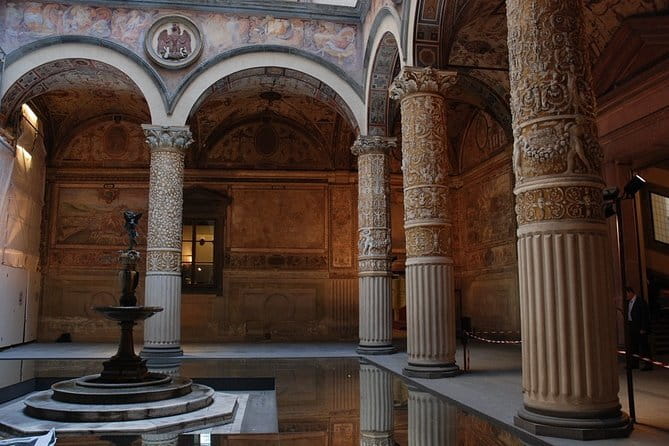
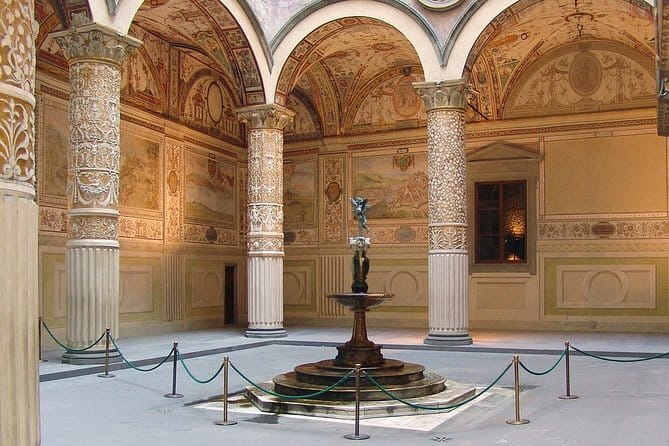
At Palazzo Medici Riccardi, you see the family’s original urban power base. Cosimo de’ Medici commissioned the palace, which was built between 1444 and 1484.
The building helps explain how the Medici moved from banking into public life. It was not just a residence. It was a visible statement that the family belonged at the center of Florence’s political and cultural world.
The tour pauses here for about five minutes. Admission is not included, so you will need a separate ticket if you want to explore the palace interiors. For many people, the exterior explanation will be enough to place the building in the larger Medici story.
This part of the route is also a good test of the tour’s pace. Florence’s streets are close together, but they are often full of people, bicycles, and distractions. The group moves between major landmarks rather than stopping for long periods at one site.
The Duomo District: Cathedral, Baptistery, Dome, and Campanile
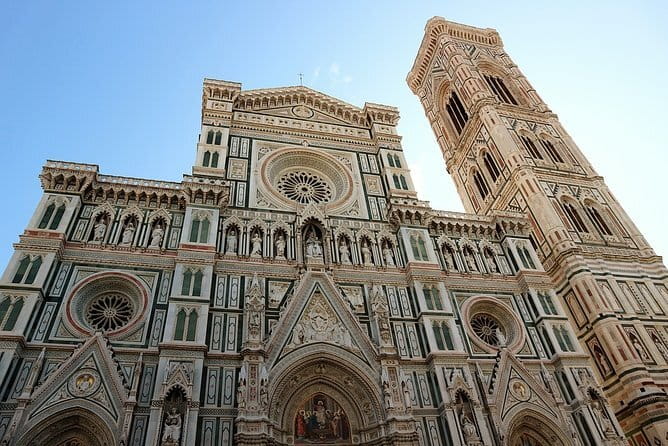
The Duomo is the visual high point of the walk, even if the tour does not include a full cathedral visit. Santa Maria del Fiore began in 1296 in the Gothic style under the direction of Arnolfo di Cambio. Its white, green, and pink marble exterior is one of Florence’s defining sights.
The cathedral complex includes the cathedral, the Baptistery, and Giotto’s Campanile. Together, they form part of the UNESCO World Heritage area covering Florence’s historic center.
The itinerary lists the cathedral twice, which reflects the fact that the group may approach and discuss it from more than one point. Do not read that as two separate cathedral admissions. The tour is an exterior-focused overview, and admission to most monuments is not included.
Across from the cathedral is the Baptistery of Saint John. It is one of Florence’s oldest buildings, dating from 1059 to 1128, and its Florentine Romanesque design is very different from the cathedral’s Gothic scale.
The Baptistery is a worthwhile stop because it shows that Florence’s religious center developed over centuries, not in one burst of Renaissance activity. The tour provides a short explanation, while a separate visit lets you spend more time with the building’s decoration and history.
The Cupola del Brunelleschi receives a slightly longer stop of about 10 minutes. The dome was once the largest in the world and remains the largest brick dome ever built. Its construction is one of the great problems solved in Renaissance architecture.
That 10-minute explanation is useful for understanding the achievement, but it does not mean you climb the dome. The ticket is not included. If you want the climb, plan it separately and arrange admission ahead of time as part of your wider Florence schedule.
Giotto’s Campanile adds another piece to the cathedral complex. The tower is known for its Florentine Gothic design, sculptural decoration, and bands of colored marble. It is adjacent to both the cathedral and Baptistery, so the tour lets you compare the three buildings without spending time crossing the city.
This cluster is where the whisper system earns its keep. The squares can be loud, and a quiet guide can be hard to hear without an earpiece.
More guided walks:
- Florence: Renaissance and Medici Tales Guided Walking Tour
★ 4.8 · 1,549 reviews - Florence: Uffizi & Accademia Small Group Walking Tour
★ 4.7 · 1,380 reviews - Lucca: 2-Hour City Center Walking Tour
★ 4.7 · 1,314 reviews - Skip-the-Line Florence Highlights and David Walking Tour
★ 5.0 · 1,127 reviews
Piazza della Signoria and Florence’s Civic Center
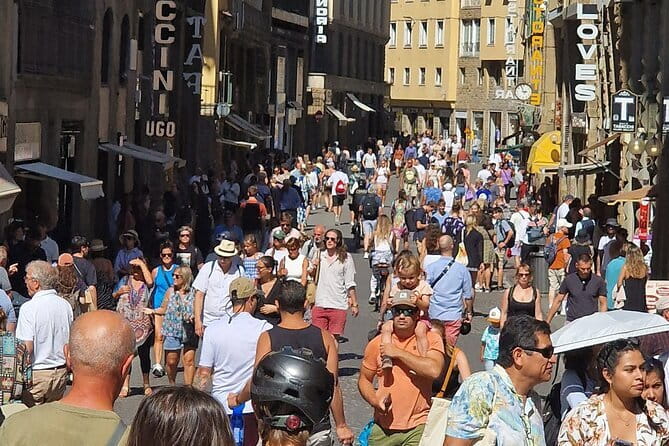
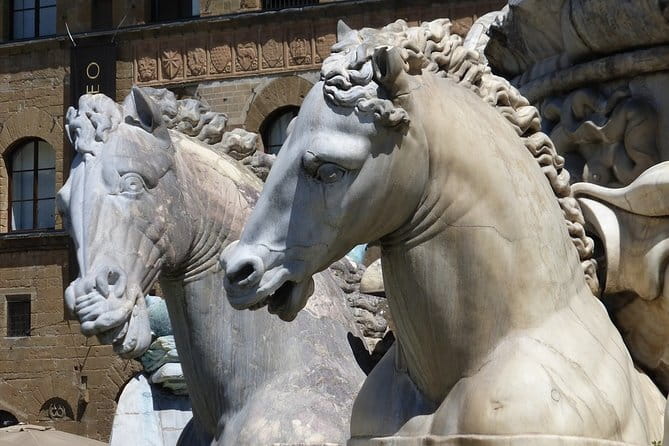
From the Duomo, the walk continues toward Piazza della Signoria, the L-shaped square in front of Palazzo Vecchio. This is Florence’s public stage, where civic power, sculpture, politics, and daily city life meet.
The square is free to enter, but the nearby buildings and museums charge separate admission. The guide can help you understand why this open space matters before you decide if Palazzo Vecchio or the Uffizi belongs on your schedule.
Palazzo Vecchio is Florence’s town hall, built in the form of a fortress-palace. Its severe exterior gives you a clear change of mood from the cathedral’s religious grandeur. Outside, you can see the copy of Michelangelo’s David and the statues in the adjoining Loggia dei Lanzi.
This is another stop that works well as a preview. A five-minute explanation can identify the major figures and the building’s civic role, but anyone interested in Renaissance sculpture or Medici politics will want more time inside the palace and surrounding museums.
The Uffizi Gallery sits beside Piazza della Signoria. It began in 1560 under Giorgio Vasari for Cosimo I de’ Medici, who needed offices for Florentine magistrates. The word uffizi means offices.
The building later became one of Italy’s most important art museums, with a major collection of Renaissance works. The tour does not include Uffizi admission, and five minutes outside cannot substitute for the museum itself. Still, the guide’s introduction can help you understand why the gallery belongs near the top of many Florence itineraries.
If this is your first visit, the walk’s order is practical. You see where the Uffizi is, learn how it fits into the city’s political story, and can return later with a better idea of what you want to see.
Ponte Vecchio and the Walk Toward Pitti Palace
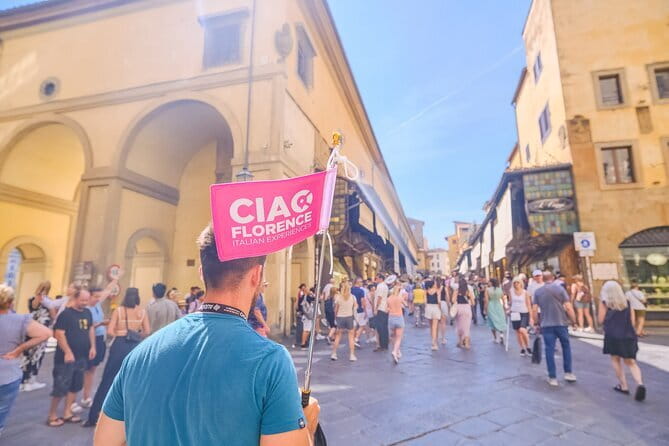
The route ends around Ponte Vecchio, Florence’s oldest bridge over the Arno River. Its shops are built directly along the bridge, a tradition that once served butchers, tanners, and farmers. Today, jewelers and art dealers occupy the storefronts.
Ponte Vecchio is free to cross and is a natural place to continue exploring after the guide says goodbye. The endpoint is only indicative and may vary slightly within the area, so keep your phone handy if you need to meet someone at a precise location afterward.
The bridge also points toward Palazzo Pitti, the final listed sight. The Medici bought the palace in 1549, and it later became the chief residence of the ruling families of the Grand Duchy of Tuscany. Over time, it filled with paintings, dinnerware, jewelry, and other luxury possessions.
The tour’s short stop gives you a useful reason to consider the palace, especially if you have already visited the central sights and want a larger museum complex. Admission is not included, so treat this as a stopping point and planning suggestion rather than a palace tour.
Ending at Ponte Vecchio is convenient, but it also means the experience does not return you to the Duomo. That is helpful if you want to continue toward the Oltrarno side of the river. It is less convenient if you have another appointment near San Lorenzo immediately afterward.
Pace, Group Size, and What the $59.26 Price Buys
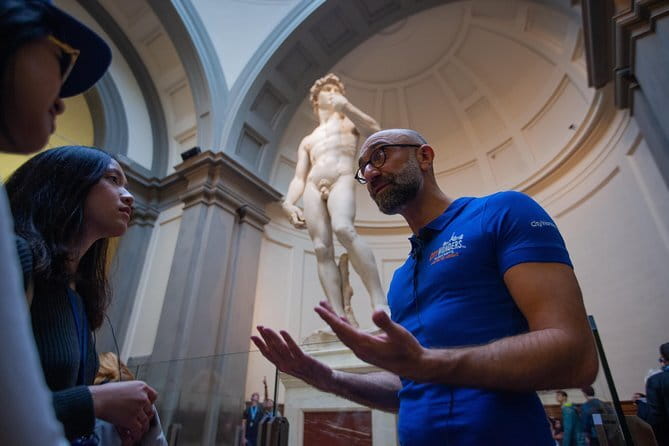
At $59.26 per person, this is not the cheapest way to walk around Florence. You can see the exteriors of most stops without paying anything. The value comes from the guide’s explanations, the efficient route, the local recommendations, and the chance to ask questions in a small group.
The maximum group size is 15. That is small enough to feel more personal than a large city tour, though one comment notes that the group felt a little large on that particular departure. A smaller group can also allow a guide to adjust the walk for children or respond to a request for less touristy streets.
The pace has been described as comfortable, with enough distance covered to see the center in roughly two hours. You should still expect steady walking and repeated stops in open squares. Wear practical shoes, especially if you plan to continue sightseeing after the tour.
The published rating is 5 out of 5 from 504 ratings, with 99 percent of people recommending the experience. The strongest praise centers on the guides’ storytelling, humor, local perspective, and ability to explain Florence in a short time.
The walk is particularly useful for:
- First-time visitors who want an organized introduction
- People in Florence for only a day
- Families who benefit from a guide who can keep children involved
- Repeat visitors who want a different look at familiar sights
- Anyone who wants food and neighborhood advice before choosing restaurants
- Museum fans who want help deciding which interiors deserve separate tickets
It may be less suitable if your main goal is extended time inside the Duomo, Medici Chapels, Uffizi, or Palazzo Vecchio. This is a city orientation walk, not a collection of museum visits.
Practical Details Before You Book
The start time is 12:15 p.m. Confirmation is provided when you book, and the meeting point is near public transportation. Most people can take part, and service animals are allowed.
The tour is offered in English. Tips and gratuities are optional and not included in the price.
Free cancellation is available until 24 hours before the local start time. Cancellations or changes made later are not refunded or accepted. The tour also depends on good weather and a minimum number of participants. If poor weather or low enrollment cancels it, you are offered another date or experience, or a full refund.
Should You Book the Best of Florence Walking Tour?
I would book this tour early in a Florence visit, especially if you want the city to make sense before you enter its museums. Manuel, Simona, Camilla, Sarah, and Julio are all associated with the qualities you want in a city guide: clear English, humor, local insight, and the ability to turn buildings into a connected story.
The best reason to book is not the number of landmarks. It is the advice you receive between them. You may finish with a better sense of where to eat, which side streets deserve another walk, and which museums are worth your limited time.
Skip it if you want long interior visits or a slow art lecture at each monument. Book it if you want a focused introduction, a manageable route, and a local voice to help you get your bearings in Florence before exploring on your own.
FAQ
How long does the Best of Florence Walking Tour last?
The tour lasts approximately 1 hour and 45 minutes.
What time and where does the tour begin?
It begins at 12:15 p.m. at Caffè Scudieri Firenze, Piazza di San Giovanni 19R, Florence.
Where does the tour finish?
It finishes around Ponte Vecchio. The endpoint is indicative and may vary slightly within the stated area.
Is the tour limited to a small group?
Yes. The group has a maximum of 15 people.
Are entrance tickets included?
Most admission tickets are not included. The cathedral is listed with free admission, but the tour is primarily a brief sightseeing walk, so separate entry arrangements may be needed for attractions you want to visit inside.
Can I cancel for a full refund?
Yes, if you cancel at least 24 hours before the local start time. Late cancellations and changes are not refunded, while weather or minimum-participant cancellations offer another date, another experience, or a full refund.
Just added around Florence
- Palazzo Vecchio guided experience with entrance ticket★ 4.5 · 249 reviews
- Lucca Bikes and Bites with food tastings for Small Groups or Private★ 5.0 · 249 reviews
- Perfume Masterclass in Florence: Make your Own Personal Fragrance★ 4.5 · 253 reviews
- Florence Oltrarno Neighborhood Food & Wine Dine Around★ 5.0 · 253 reviews
- Florence: Cathedral, Dome and Terraces Guided Tour★ 4.5 · 253 reviews
- Florence: 1.5-hour Santa Croce Guided Experience★ 4.8 · 254 reviews
- Florence: Pitti Palace and Palatina Gallery Ticket and Tour★ 4.9 · 255 reviews
- Private Florence Tour by Golf Cart ETukTuk with Audio Guide★ 4.0 · 256 reviews
Walking Tours, compared.

Guided Walking Tour & Last Supper Visit with Ticket
Read our review →

Rialto Bridge & Offbeat Unusual Venice Walking Tour
Read our review →

Private 3 hrs Venice Tour: St Mark’s, Walking tour & Boat tour
Read our review →

Skip the line: Uffizi and Accademia Small Group Walking Tour
Read our review →Browse the lists this tour appears in