Review · FLORENCE TOURS
Florence: Cathedral, Dome and Terraces Guided Tour
Florence looks best from above. This two-hour guided visit combines the cathedral interior with the Duomo’s northern terrace and Brunelleschi’s famous dome, giving you both art below and wide views over the city above. I especially like the reserved access and the chance to enter narrow rooftop corridors that are not part of an ordinary cathedral visit. The three-day pass also lets you return to the Baptistery and Opera del Duomo Museum at your own pace.
The main catch is the climb. You face 153 steps to the terraces, followed by another 310 to the top of the cupola, and the stairways can feel tight and tiring. A few visitors also had trouble hearing their guide through the listening devices, so the experience depends partly on the quality of the equipment and your guide’s English.
In This Review
- Key points at a glance
- Meeting at Ciaoflorence and getting started
- Inside Florence Cathedral: marble, frescoes, and a surprising floor
- The northern terrace, where the tour becomes unusual
- Brunelleschi’s dome and the final 310 steps
- A room of statues and working restorers
- What the three-day pass adds
- Price and practical value at $133.85
- Dress, bags, and physical demands
- Guide quality and the listening system
- Who should book this Duomo experience?
- Should you book it?
- FAQ
- How long does the Florence Cathedral, Dome, and Terraces tour last?
- What is included in the ticket?
- Is Giotto’s Bell Tower included?
- How many steps are there to the terraces and dome?
- Where does the tour begin and end?
- What should I wear to enter the Duomo?
- Can children under seven join the tour?
- Is the tour suitable for wheelchair users?
Key points at a glance
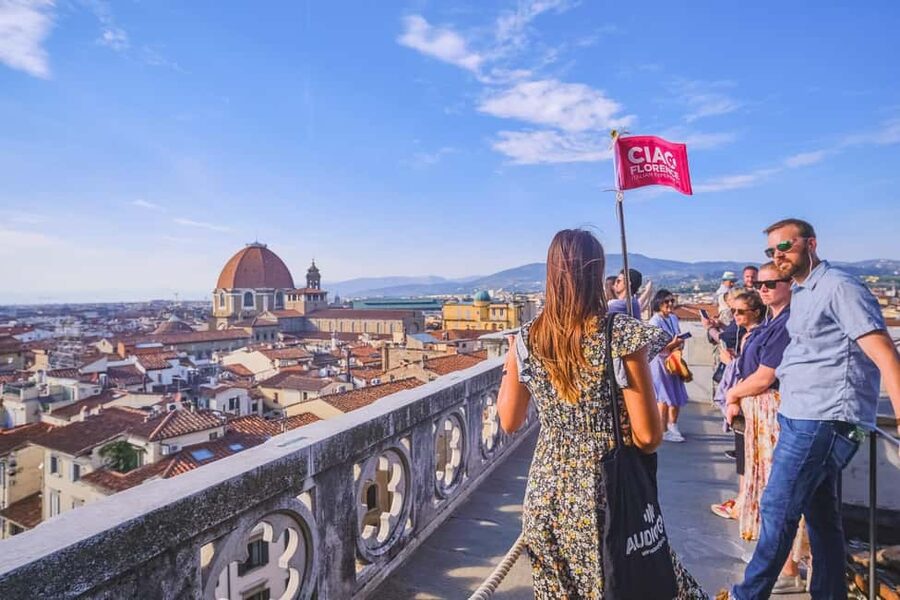
- The northern terrace is the special access: You walk through old open-air passages and get unusually close to Brunelleschi’s cupola.
- The climb totals 463 steps: First come 153 steps to the terraces, then 310 more to the top of the dome.
- Your ticket lasts three days: Use it for the cathedral complex, Baptistery, and Opera del Duomo Museum after the guided visit.
- The cathedral tour goes beyond the main nave: Expect Vasari and Zuccari frescoes, Paolo Uccello’s clock, patterned marble floors, and underground ruins.
- The tour is in English: Guide quality has generally been a strong point, with Giacomo, Carl, Maria, Ben, Christina, and others praised for clear and engaging presentations.
- Dress and mobility rules matter: Cover your shoulders and knees, wear proper shoes, and leave bulky bags behind.
Meeting at Ciaoflorence and getting started
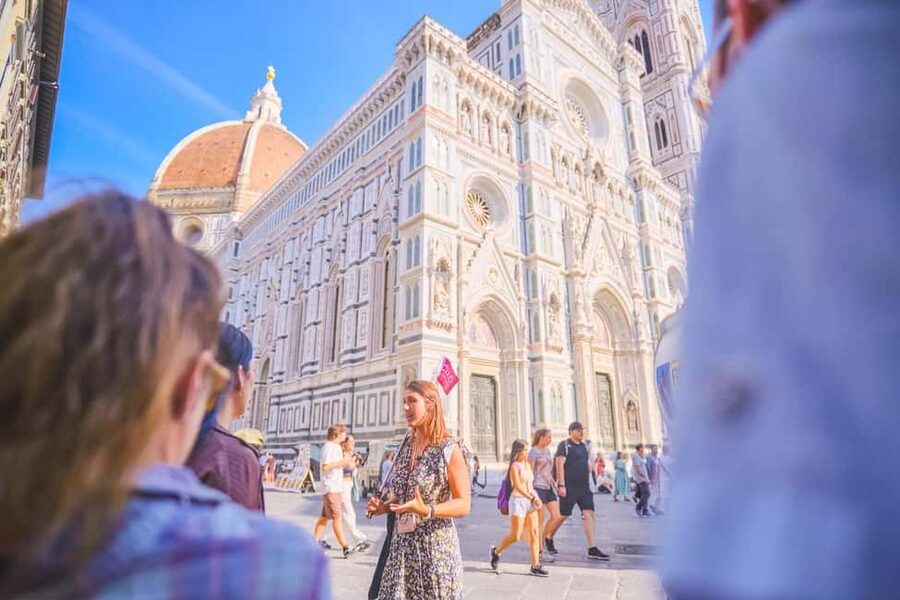
Your tour begins in front of the Ciaoflorence sales office. This is important: the meeting point can be easy to confuse with the wider cathedral square, so check the precise location before setting out. Arrive with enough time to find the office rather than relying on a last-second dash through Florence’s busy center.
The tour is offered in English with a live guide. Headsets are used so you can hear commentary inside the cathedral and during the walk. In the best cases, the system lets you look around while still following the explanation. In less successful cases, sound quality can make it hard to catch every word, especially if the group is large or you fall behind.
The experience is scheduled for two hours. That is enough time for a guided look at the cathedral, the northern terrace, and the dome climb, but it is not a leisurely half-day visit. I would treat the guided portion as the structured introduction, then use the 72-hour pass for the other buildings.
A few more reviews worth comparing before you book
- Florence: Skip-The-Line Uffizi Gallery Timed Entry Ticket
★ 4.5 · 27,832 reviews - Tuscany Day Trip from Florence: Siena, San Gimignano, Pisa and Lunch at a Winery
★ 5.0 · 21,634 reviews - Florence: Timed Entrance Ticket to Michelangelo’s David
★ 4.6 · 16,983 reviews
Inside Florence Cathedral: marble, frescoes, and a surprising floor
The first major stop is Florence Cathedral, officially Santa Maria del Fiore. The exterior is famous for its green, pink, and white marble, but the interior is more restrained than many people expect. It is enormous, solemn, and less packed with decoration than some Italian churches.
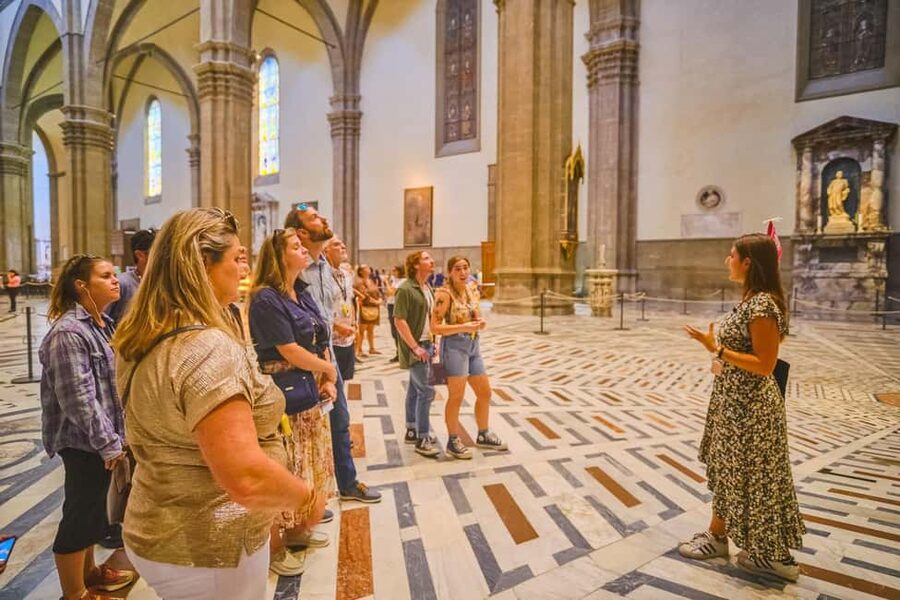
That is where a good guide earns the fee. Rather than simply pointing at the biggest fresco, your guide can explain how the building developed and identify the people who funded, designed, and constructed it. Maria was praised for giving a clear sense of the Duomo’s development without burying the group in technical art history. Giacomo was noted for adapting his explanations to the group and making the talk feel personal.
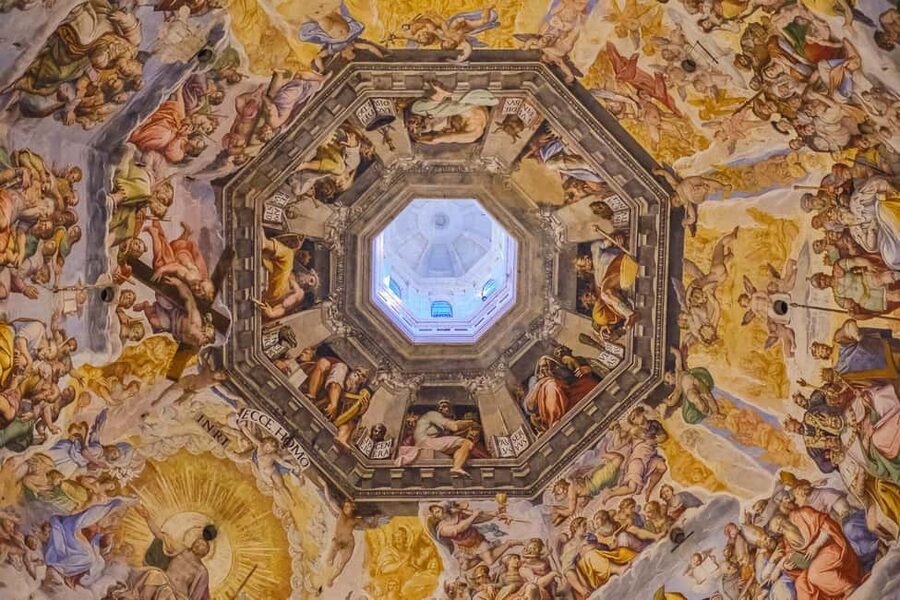
Look up at the enormous Last Judgment fresco inside the cupola, painted by Giorgio Vasari and Federico Zuccari. From the cathedral floor, the scale is difficult to grasp. The figures are far overhead, and the curved surface makes the whole work feel like a vast painted canopy.
The cathedral also contains Paolo Uccello’s unusual 24-hour clock. It is easy to miss without help because it does not work like a modern clock. A guide can point out how its display relates to the old Italian system of counting the day from sunset.
Do not ignore the floor. Its polychrome marble patterns use geometric decoration on a grand scale. The design can look almost abstract from a distance, but close inspection reveals careful work in many colors and shapes. Parts of the cathedral floor also connect with archaeological remains below, giving you a glimpse into earlier stages of the site.
One useful point from the visit is that the cathedral interior may not immediately overwhelm you. Florence has many richly decorated churches, and the Duomo’s open scale can feel plain by comparison. I found the building easier to appreciate after hearing about its structure, artwork, and purpose. The guide’s context matters here.
The northern terrace, where the tour becomes unusual
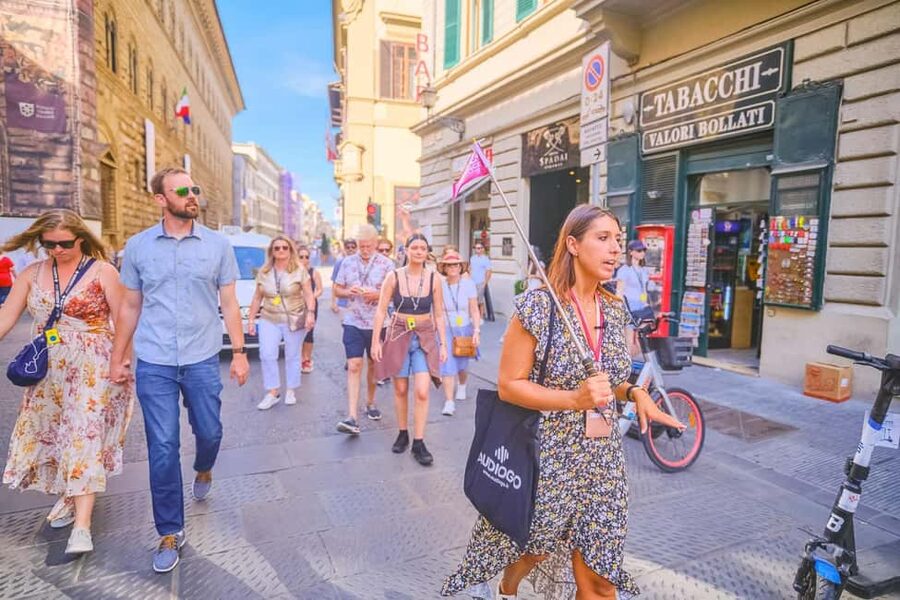
The northern terrace is the signature part of this experience. You leave the main interior and climb 153 steps toward a rooftop level that most cathedral visitors do not see.
The route includes narrow, open-air corridors that were closed to the public for centuries. This is not a broad viewing platform with plenty of room to wander. You should expect confined passageways, stairs, and a route that requires steady footing.
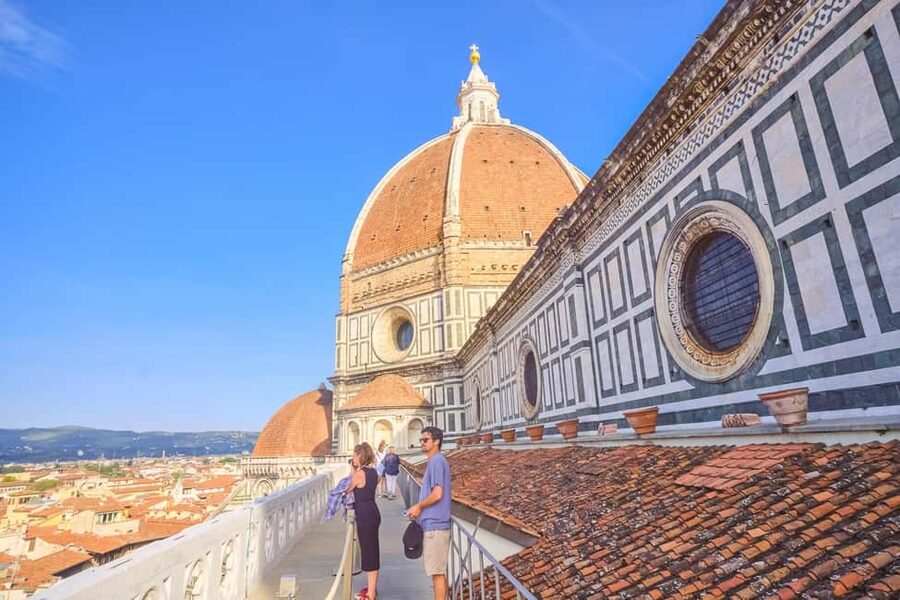
The payoff is a close view of Brunelleschi’s cupola. From the street, the dome is Florence’s defining shape. From the terrace, you are close enough to study the red tiles and the engineering around them. The changing angle helps you understand how the dome fits into the cathedral instead of seeing it only as a distant landmark.
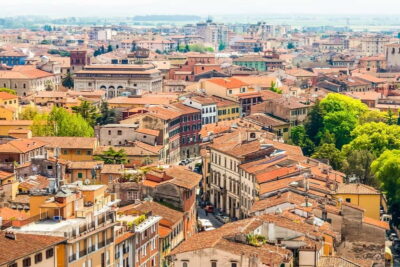
The terrace also opens the city around you. You get a panorama over Florence, with the historic center spread below and the surrounding Tuscan setting beyond. Weather matters greatly. On a clear day, the view can be the emotional high point of the tour. On a hazy day, the architecture close at hand still makes the climb worthwhile, but the distant panorama will be less impressive.
This section is also where the tour feels most different from a standard skip-the-line cathedral entry. You are not just moving through a famous church. You are using service spaces, rooftop passages, and elevated areas that give the building a more physical character.
Brunelleschi’s dome and the final 310 steps
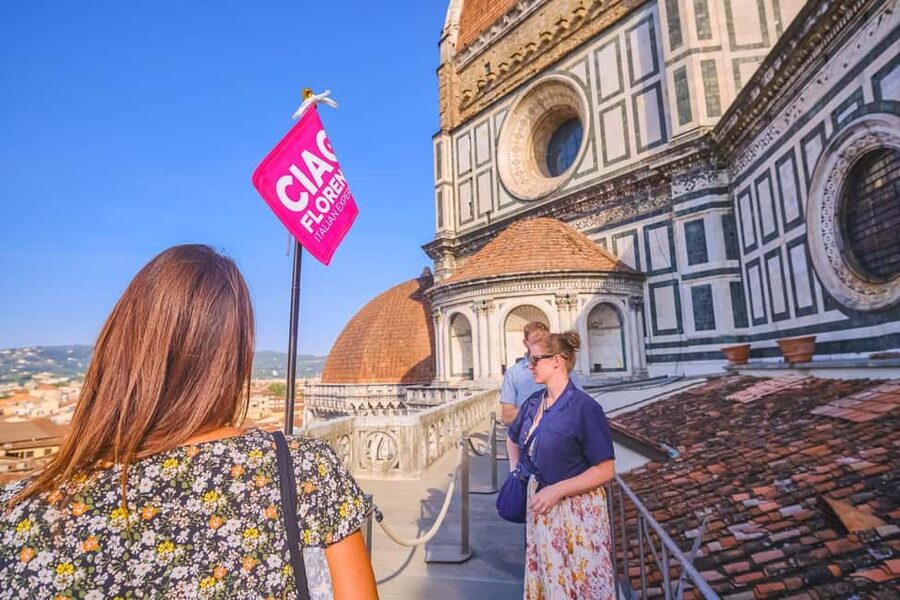
After the terraces, you can continue upward to the top of Brunelleschi’s dome. The stated climb is another 310 steps, making 463 steps in total when combined with the terrace route.
The climb is part of the attraction, but it should not be treated as a minor detail. The stairway is narrow, and sections pass between the inner and outer shells of the cupola. You may find yourself walking in a confined space with other people moving in the same direction. Comfortable shoes are essential, and anyone with breathing problems should think carefully before booking.
At the upper level, Florence opens out in every direction. You can look back at the terrace route and see the scale of the cathedral complex from a new angle. The view is rewarding because you have reached it under your own power, not simply taken an elevator to a lookout.
Still, you do not have to force the full climb if your body is telling you to stop. One person managed the first 150 steps and decided not to continue to the top. That is a sensible choice, not a failed visit. The cathedral and terrace already provide a strong experience, and pushing through a difficult climb can spoil the rest of your day.
The tour includes reserved access to the cupola, which saves you from trying to arrange the dome entry separately. That reserved slot is a major practical benefit in Florence, where popular sights can consume a great deal of time in lines and security checks.
A different sort of day out around Florence:
- Florence: Michelangelo’s David Skip-the-Line Entry Ticket
★ 4.5 · 12,764 reviews - The Best tour in Florence: Renaissance & Medici Tales – guided by a STORYTELLER
★ 5.0 · 12,316 reviews - Florence: Leonardo Interactive Museum Entry Ticket
★ 4.5 · 11,763 reviews - The Best Tour in Florence: Renaissance and Medici Tales
★ 5.0 · 10,810 reviews
A room of statues and working restorers
The route ends with access to a circular room filled with old statues that once decorated the Duomo’s facade. This gives the tour a quieter finish after the effort of the stairs.
You may also see restoration work taking place. Craftspeople work with spatulas and chisels, and the area can retain the smell of stucco. It is a useful reminder that the cathedral is not a frozen museum object. Parts of it require constant care, and the work depends on patient hand skills.
This stop is easy to overlook when the dome views are the headline attraction, but I like it because it connects the finished building with the labor behind it. The statues are not simply decorative pieces. They show how the cathedral’s appearance changes over time and how damaged or aging elements are treated.
What the three-day pass adds
Your ticket includes a 72-hour full-access pass for the Duomo complex. The guided tour itself lasts two hours, but the pass gives you time to return to the other included sites without cramming everything into one visit.
The Opera del Duomo Museum is especially useful after the climb. It holds works and architectural material connected with the cathedral, and it can help you make more sense of the sculptures and construction details you saw outside. You can visit when your legs have recovered and give the displays the attention they deserve.
The Baptistery is also included. Its separate setting and famous doors make it a natural companion to the cathedral. Visit it on the same day if energy allows, or use the pass on another day.
Be careful with one change: from January 1, 2025, the 72-hour pass no longer includes Giotto’s Bell Tower. The activity information also lists Giotto’s Bell Tower as not included, so do not assume the pass covers that climb.
The 4:15 PM departure has a special limitation. It does not include the cathedral visit. Instead, you receive a guided visit to the Opera del Duomo Museum, or the Baptistery on Tuesdays. If seeing the cathedral interior is central to your plans, choose another departure time.
Price and practical value at $133.85
At $133.85 per person, this is not a budget entry ticket. You are paying for a live English guide, reserved access to Brunelleschi’s cupola, the northern terrace experience, and a three-day pass for other parts of the complex.
I think the price makes the most sense if you want the terrace and dome climb and value help with the cathedral’s art and structure. The exclusive rooftop route is the feature you cannot easily replicate with a simple cathedral admission. The three-day access also spreads the value across several visits.
The calculation is less favorable if you only want to step inside the cathedral. Some people found the guided portion shorter than expected, and a few felt the cost was high for the amount of time spent with the guide. A large group or a weak listening device can also reduce the benefit of paying for guided commentary.
For me, the strongest value comes from combining the guided explanation with independent follow-up visits. See the cathedral and dome with the guide, then return to the museum and Baptistery without rushing. That turns a brief tour into a fuller Duomo program.
Dress, bags, and physical demands
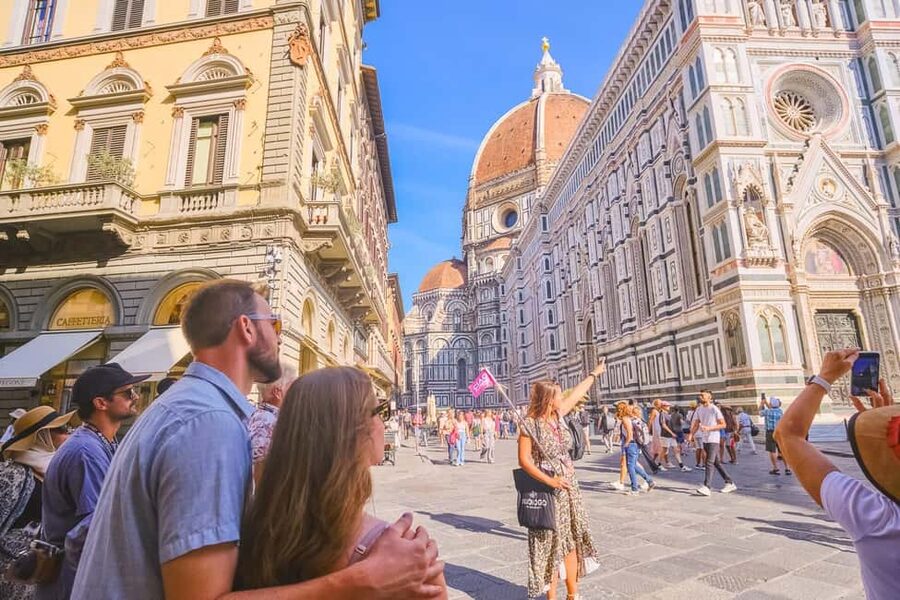
The Duomo enforces a strict dress code. Your shoulders and knees must be covered, so avoid sleeveless shirts and shorts. Entry can be refused for improper clothing, and the tour provider cannot change that decision.
Bulky backpacks, luggage, and large bags are not allowed inside the dome and terrace areas. Travel light. A small, practical bag is safer than arriving with a full daypack or rolling case.
This activity is not suitable for wheelchair users or people with impaired mobility. The stairs and narrow passages make the restriction clear. It is also not allowed for children under seven.
Wear shoes with a solid grip and bring enough water for the effort, while keeping in mind the restrictions on bags. The climb is much easier when you are not carrying unnecessary weight. The full ascent may be exhausting, but the views and close look at the cupola reward people who are comfortable with strenuous stairs.
Guide quality and the listening system
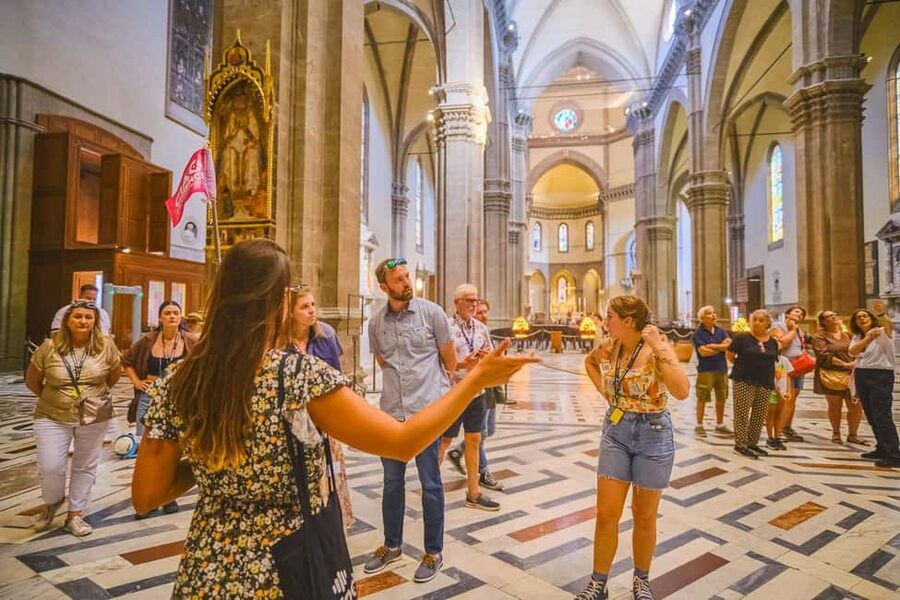
The best part of this tour is often the guide. Giacomo received praise for being personal and responsive. Carl was described as doing a good job, although one person expected him to enter the basilica and felt the handoff was abrupt. Maria was appreciated for giving the right amount of information, while Ben was easy to listen to and willing to answer questions. Christina was also praised for her strong command of the subject.
That pattern tells me to expect a range of guide styles rather than a fixed script. Most of the feedback points to clear, energetic explanations, but there were also cases where English was difficult to understand or the presentation felt dull.
The listening device is the other variable. Several people had trouble hearing through the headset, even when the guide’s content was strong. Stay close enough to keep visual contact with the guide, check the volume early, and speak up if the sound is not working. That small step can make a large difference inside a crowded stone building.
Who should book this Duomo experience?
I would recommend it to first-time Florence visitors who want the main cathedral sights explained in one organized visit. It is also a good choice if you strongly want the northern terrace and the inside-the-dome climb, since those are the elements that make this more than a regular entry ticket.
It suits active adults and older children over seven who can manage steep, confined stairways. People who enjoy architecture, engineering, restoration, and city views will get the most from it.
I would hesitate if you have mobility limits, breathing problems, or dislike tight stairs. I would also choose another departure if the cathedral interior is important to you and the only available time is 4:15 PM.
Should you book it?
Book this tour if you want Florence’s Duomo as a physical experience, not just a photo from the square. The close terrace route, views from the cupola, and access between the dome’s shells are the strongest reasons to pay more.
Skip it if you only want a quick church visit or prefer to explore silently at your own pace. At $133.85, the tour needs to deliver more than basic admission, and its value depends on using the three-day pass and completing the climb. For an active visitor with suitable clothing, steady legs, and an interest in how the cathedral works, it is a memorable way to see Florence from inside and above.
FAQ
How long does the Florence Cathedral, Dome, and Terraces tour last?
The guided tour lasts two hours. The included pass remains valid for 72 hours, allowing you to visit the other included sites within three days.
What is included in the ticket?
The ticket includes a live English-speaking guide, a guided cathedral visit, a guided visit to the Duomo’s northern terrace, reserved skip-the-line access to Brunelleschi’s cupola, and a three-day pass for the Duomo complex.
Is Giotto’s Bell Tower included?
No. Giotto’s Bell Tower is not included. From January 1, 2025, it is no longer part of the 72-hour skip-the-line pass.
How many steps are there to the terraces and dome?
You must climb 153 steps to reach the terraces and another 310 steps to reach the top of Brunelleschi’s dome.
Where does the tour begin and end?
The tour begins in front of the Ciaoflorence sales office and ends back at the meeting point.
What should I wear to enter the Duomo?
Your shoulders and knees must be covered. Shorts and sleeveless shirts are not allowed, and improper clothing can result in denied entry.
Can children under seven join the tour?
No. The activity is not permitted for children under seven years of age.
Is the tour suitable for wheelchair users?
No. The tour is not suitable for wheelchair users or people with impaired mobility because of the stairs and narrow rooftop passages.
Just added around Florence
- Palazzo Vecchio guided experience with entrance ticket★ 4.5 · 249 reviews
- Lucca Bikes and Bites with food tastings for Small Groups or Private★ 5.0 · 249 reviews
- Perfume Masterclass in Florence: Make your Own Personal Fragrance★ 4.5 · 253 reviews
- Florence Oltrarno Neighborhood Food & Wine Dine Around★ 5.0 · 253 reviews
- Florence: 1.5-hour Santa Croce Guided Experience★ 4.8 · 254 reviews
- Florence: Pitti Palace and Palatina Gallery Ticket and Tour★ 4.9 · 255 reviews
- Private Florence Tour by Golf Cart ETukTuk with Audio Guide★ 4.0 · 256 reviews
- From Florence: Chianti Wine and Food Tasting Safari★ 4.9 · 256 reviews
Florence Tours, compared.

Skip-The-Line Uffizi Gallery Timed Entry Ticket
Read our review →
Tuscany Day Trip from Florence: Siena, San Gimignano, Pisa and Lunch at a Winery
Read our review →
Timed Entrance Ticket to Michelangelo’s David
Read our review →
Michelangelo’s David Skip-the-Line Entry Ticket
Read our review →
The Best tour in Florence: Renaissance & Medici Tales – guided by a STORYTELLER
Read our review →
The Best Tour in Florence: Renaissance and Medici Tales
Read our review →