
Review · POMPEII & HERCULANEUM TOURS
Herculaneum: Skip-the-Line Guided Tour with Archaeologist
History is startlingly close here. This two-hour Herculaneum tour brings you through one of Italy’s best-preserved Roman towns with an archaeologist at your side. I especially like the skip-the-line entry, which saves useful time at the ticket office, and the guides’ ability to turn walls, mosaics, and charred timber into a clear picture of daily Roman life. A possible drawback is the pace: two hours covers many major buildings, so you may want extra time afterward to explore quietly.
I also like the practical use of headsets, particularly when the group spreads out among the narrow streets and houses. Guides such as Luciano Leone, Diego, Teresa, and Angelo have been praised for clear explanations, humor, visual aids, and real enthusiasm for the site. Groups can reach around 15 to 20 people, so you may occasionally need to stay close to hear every word.
In This Review
- Key points to know before you go
- Why Herculaneum feels different from Pompeii
- Meeting at the Via dei Papiri Ercolanesi ticket office
- Entering a Roman town preserved by volcanic disaster
- Casa dei Cervi and the homes of Herculaneum’s wealthy residents
- Casa di Nettuno ed Anfitrite and the famous mosaic decoration
- The House of Skeletons and the waterfront tragedy
- Casa dell’Albergo and Casa del Salone Nero
- The Samnite house, baths, Forum, and Gymnasium
- The Temple of the Augustales
- The archaeologist guides make the two hours count
- Two hours, then more time on your own
- Is $53 good value?
- Who should book this Herculaneum tour?
- FAQ
- Where does the Herculaneum tour meet?
- How long does the guided tour last?
- Is admission to Herculaneum included?
- Does the tour include transportation from Naples?
- Which languages are available?
- What should I bring?
- Can I bring luggage or a large bag?
- Is the tour suitable for wheelchair users?
- Should you book it?
Key points to know before you go

- The tour begins at the Herculaneum ticket office: Look for the guide holding an Askos Tours sign. The meeting point is at Via dei Papiri Ercolanesi, not inside Naples.
- You see more than grand ruins: The route includes homes, baths, a gymnasium, the Temple of the Augustales, the Forum, and the waterfront shelters where more than 300 people died trying to escape.
- Herculaneum differs sharply from Pompeii: The smaller site often feels calmer, while its carbonized wood, household objects, wall paintings, and mosaics give an unusually close look at Roman interiors.
- The archaeologist guide is the main value: Luciano Leone is often praised for vivid explanations and visual material, while Diego, Teresa, Anna, Roberta, Angelo, and others have also received strong praise.
- Bring practical gear: Wear closed-toe comfortable shoes, use sunscreen, carry a hat and rain protection, and leave large bags elsewhere.
- The $53 price includes admission: Since adult entry alone costs €16, the rest pays for the guide, skip-the-line service, headsets, and structure.
Why Herculaneum feels different from Pompeii
Many people pair Herculaneum with Pompeii, and I think that is a smart plan if your schedule allows. The two sites were destroyed by Mount Vesuvius nearly 2,000 years ago, but the experience of seeing them is not the same.
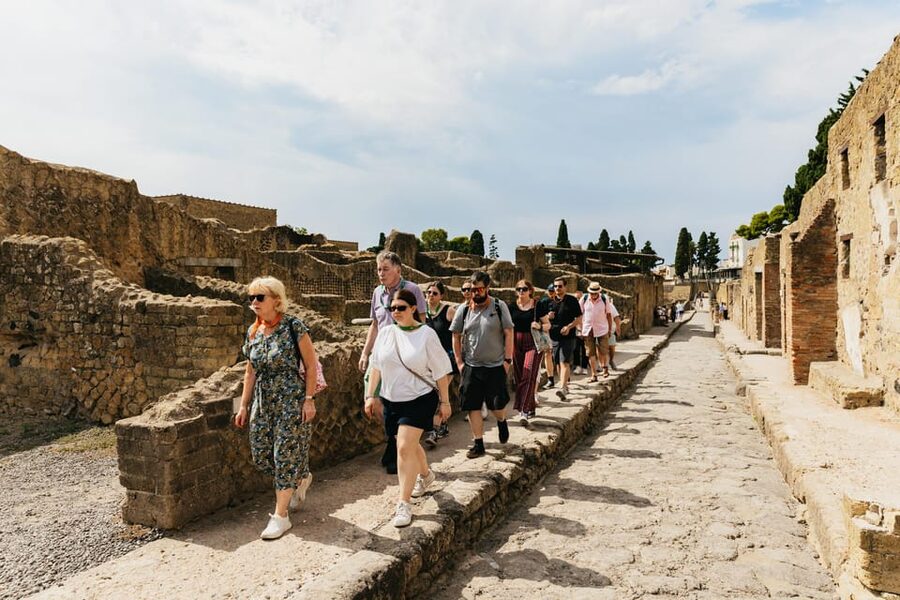
Pompeii is much larger and gives you broad streets, public buildings, and a sense of an entire city spread over a wide area. Herculaneum is more compact, yet the preservation inside individual buildings can be astonishing. You may see carbonized wood, painted plaster, marble decoration, ceramics, mosaics, and household spaces that make Roman life feel close at hand.
The disaster also unfolded differently. A guide can explain how the eruption affected the two towns and why Herculaneum’s remains look different from those at Pompeii. Several guides use photographs, books, binders, or overlays to show how the site looked before the eruption and how excavation has changed its appearance.
That comparison is one of the tour’s best features. You are not simply walking past old walls. You are learning how volcanic material buried the town, how the remains were found, and why certain materials survived. I would not treat Herculaneum as a shorter version of Pompeii. It has its own character, and this tour helps you see it.
More Skip-the-Line Tickets in Naples
- Mount Vesuvius: Skip-the-Line Ticket and Smart Digital Guide
★ 4.2 · 2,780 reviews - From Naples: Pompeii Skip-the-Line Entry Ticket and Tour
★ 4.4 · 2,753 reviews - Pompeii: Skip-the-Line Entrance Ticket with Audio Guide
★ 4.0 · 2,509 reviews
Meeting at the Via dei Papiri Ercolanesi ticket office
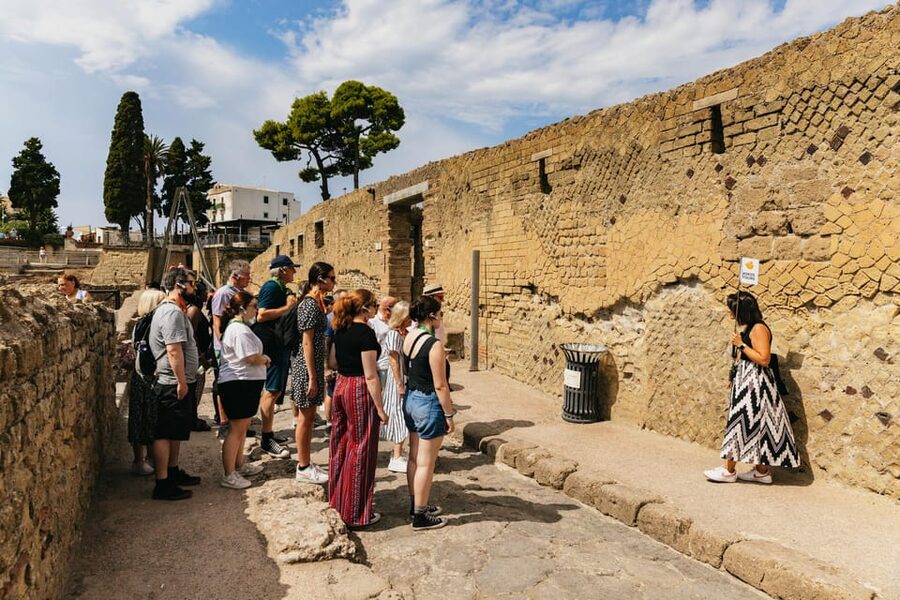
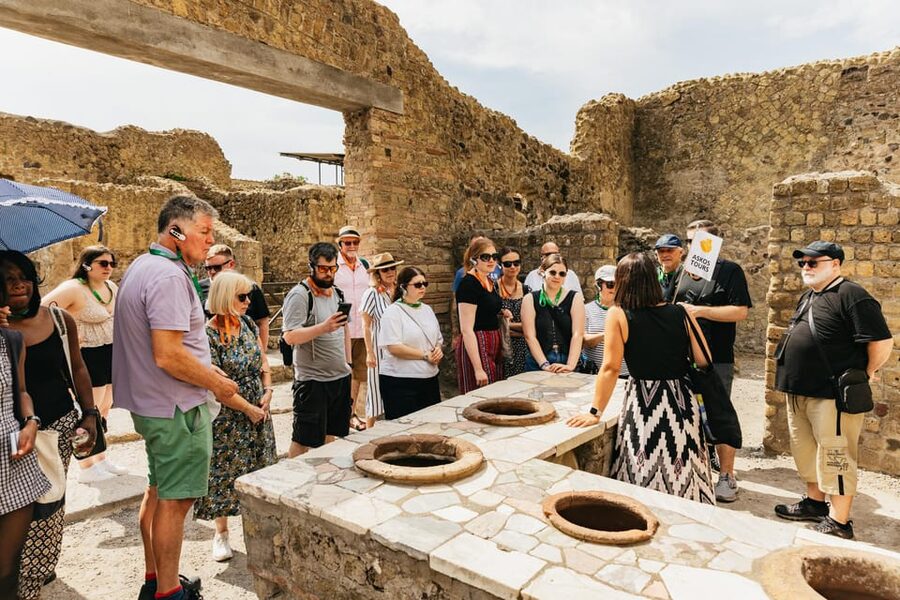
Your meeting point is the ticket office of the Herculaneum ruins on Via dei Papiri Ercolanesi. The guide carries an Askos Tours sign, which makes the group easier to spot.
Pay close attention to the exact location shown in your booking details. One visitor found that the map pin was about 300 meters away from the actual meeting place, which was the ticket booth. The ticket office makes practical sense as the meeting point, but I would not rely on a street-view image or a map marker alone.
Arrive with your passport or identity card. A valid ID is required, and children must be accompanied by an adult. Unaccompanied minors cannot join the tour.
The tour includes admission, so you do not need to buy a separate Herculaneum ticket for the group visit. Adult entry to the archaeological site is listed at €16, with a €2 rate for European Union citizens aged 18 to 25. At $53 per person, the total price is not just a guiding fee. It also covers the ticket, the time saved at entry, and the headsets.
Transportation is not included. You need to make your own way to the ruins from Naples or elsewhere in Campania. Food and drinks are also your responsibility.
Entering a Roman town preserved by volcanic disaster
Once inside, expect a lot of walking over ancient surfaces. Herculaneum is exposed, and the site can be hot under the sun. Sunscreen and a hat are sensible, while a raincoat matters because the tour runs in wet weather as well as dry weather.
Closed-toe shoes are a better choice than sandals. The ruins can be uneven, and comfortable footwear lets you focus on the buildings rather than every step.
The site is not suitable for people with mobility impairments or wheelchair users. Large bags and luggage are not allowed, so pack lightly. These rules are not small details: they shape how easily you can move through the streets and rooms.
The guide uses a headset system, allowing you to hear explanations while standing in a courtyard or moving between buildings. It works best if you stay within range. One person found that a fast-moving guide sometimes went beyond headset range, while another noted that sound could drop out at the back of a group of 16. Stay near the guide, especially in busy or spread-out areas.
Casa dei Cervi and the homes of Herculaneum’s wealthy residents
Casa dei Cervi, the House of the Deer, is one of the important residential stops on the route. The tour uses houses like this to explain the lives of wealthy merchants and noble residents, rather than focusing only on emperors, battles, and eruption dates.
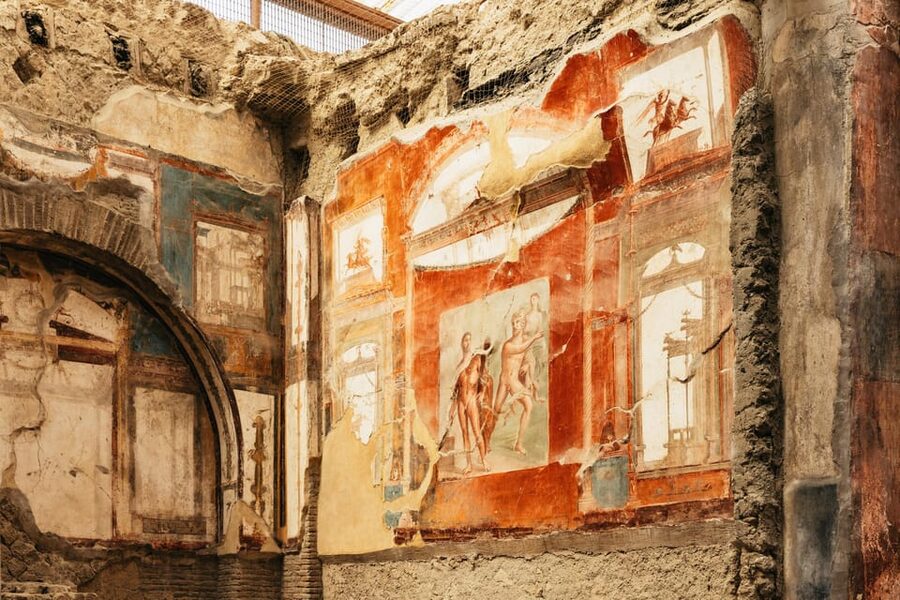
That approach is valuable. Herculaneum’s homes reveal how people arranged private rooms, decorative surfaces, courtyards, and views. You may notice the contrast between practical construction and signs of status, including marble, painted walls, and carefully placed mosaics.
I like this part of the route because it gives context to the smaller objects. A ceramic vessel or fragment of wood matters more when you understand where it belonged and how a household functioned. The guide’s job is to connect those pieces without leaving you to guess what you are seeing.
The drawback is that ancient houses can look like bare shells at first glance. Their importance is not always obvious without explanation. This is exactly where an archaeologist guide earns the fee, pointing out details that are easy to walk past.
More Pompeii and Herculaneum visits:
- Pompeii: Entry Ticket and Guided Tour with an Archaeologist
★ 4.8 · 19,459 reviews - Pompeii: Entry Ticket with Optional Audio Guide
★ 4.2 · 12,360 reviews - Pompeii: Small Group Tour with an Archaeologist
★ 4.8 · 12,264 reviews - From Naples: Pompeii Ruins & Mount Vesuvius Day Tour
★ 4.3 · 11,459 reviews
Casa di Nettuno ed Anfitrite and the famous mosaic decoration
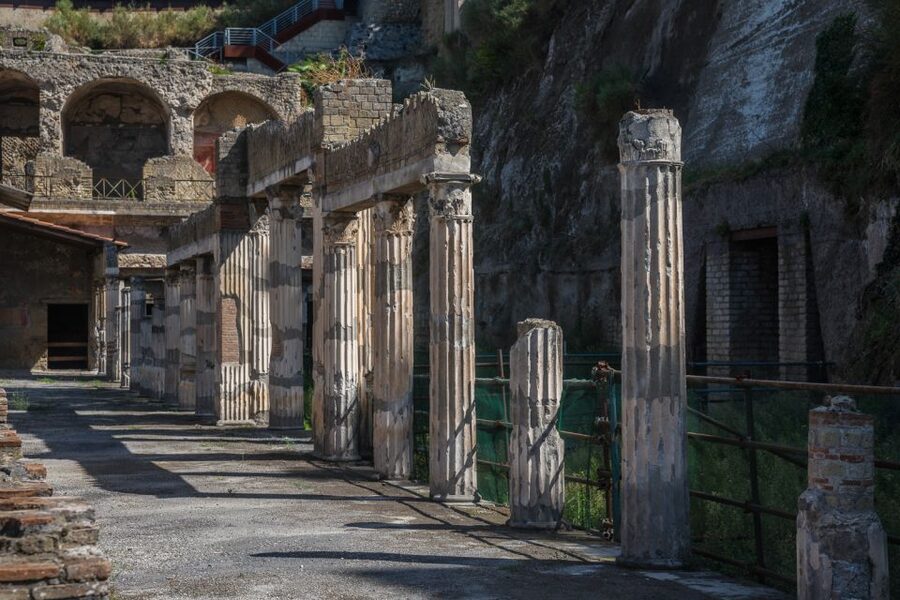
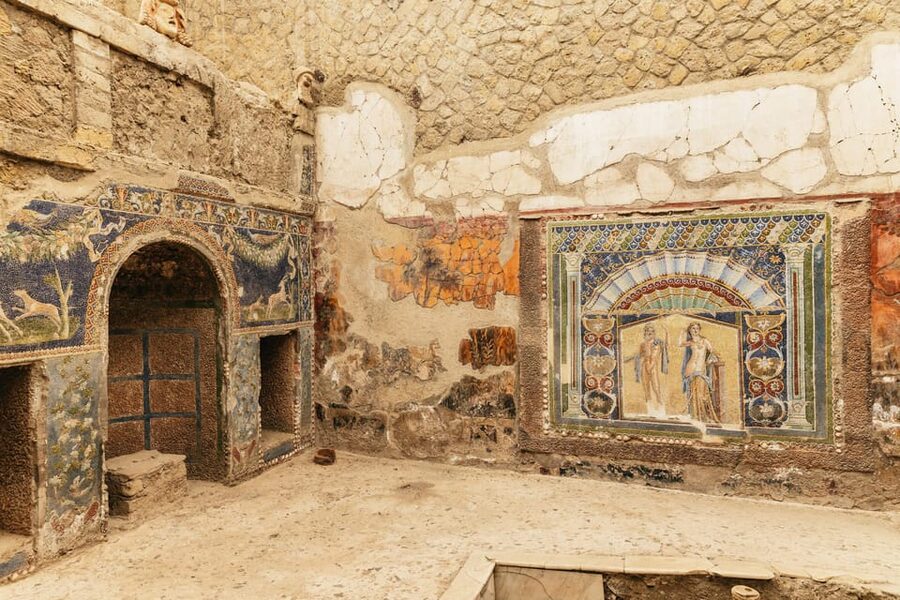
The House of Neptune and Amphitrite is one of the tour’s visual highlights. Its name comes from the Neptune and Amphitrite mosaic, and the building helps show how decoration shaped Roman domestic life.
Here, look for surviving mosaics, painted surfaces, and colorful details. The preservation gives you a better sense of how much visual decoration existed inside Roman homes. What now appears as a fragmentary ruin once formed part of a carefully designed interior.
Guides often use images or books to help you picture missing sections. Angelo, for example, has been praised for bringing photographs and overlays to show the site before and after the eruption. Luciano Leone is also noted for using visual material to explain the difference between Herculaneum and Pompeii.
This stop can become crowded around a single mosaic, and you may need to wait for a clear view. Headsets help, but the experience remains more rewarding when you stay close and let the guide control the flow.
The House of Skeletons and the waterfront tragedy
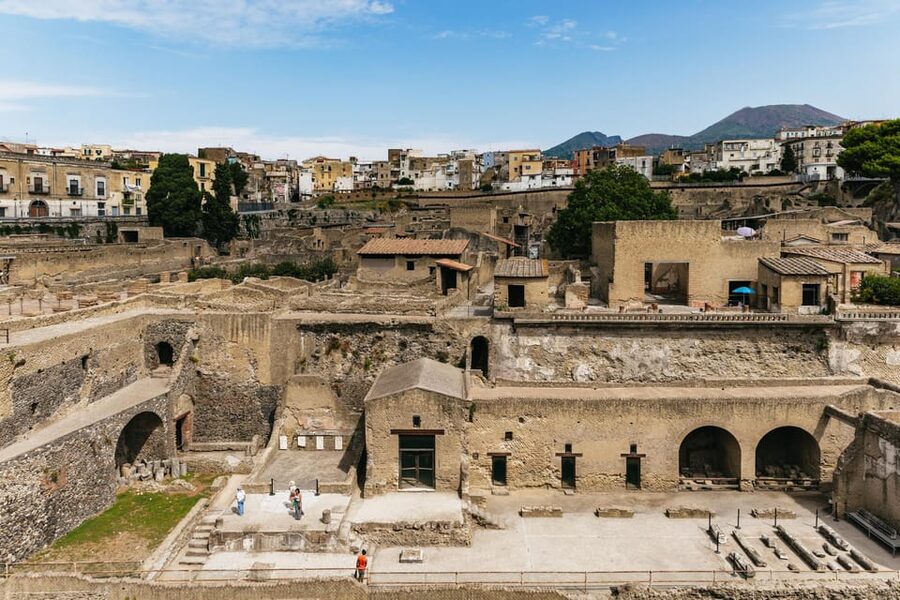
The House of Skeletons leads toward one of Herculaneum’s most sobering areas. At the waterfront, the remains of more than 300 people were found in the vaulted shelters near the ancient shore. They died while trying to escape by sea during the eruption.
This is a powerful part of the visit, but it is not light sightseeing. The guide explains the human cost of the disaster and how the waterfront fits into the town’s layout. The site’s former connection to the sea also helps explain why Herculaneum was an important port town.
The House of Skeletons and the waterfront are useful reminders that Herculaneum was not simply a collection of grand homes. It was a living community with families, workers, merchants, and public spaces. The eruption ended those lives with terrifying speed, leaving a record that is both archaeological and deeply personal.
If you are visiting with children, pay attention to their interest level here and throughout the tour. One family found that an 11-year-old became bored after already spending an afternoon at Pompeii. The guide can make the subject lively, but two hours of Roman archaeology still asks for some patience.
Casa dell’Albergo and Casa del Salone Nero
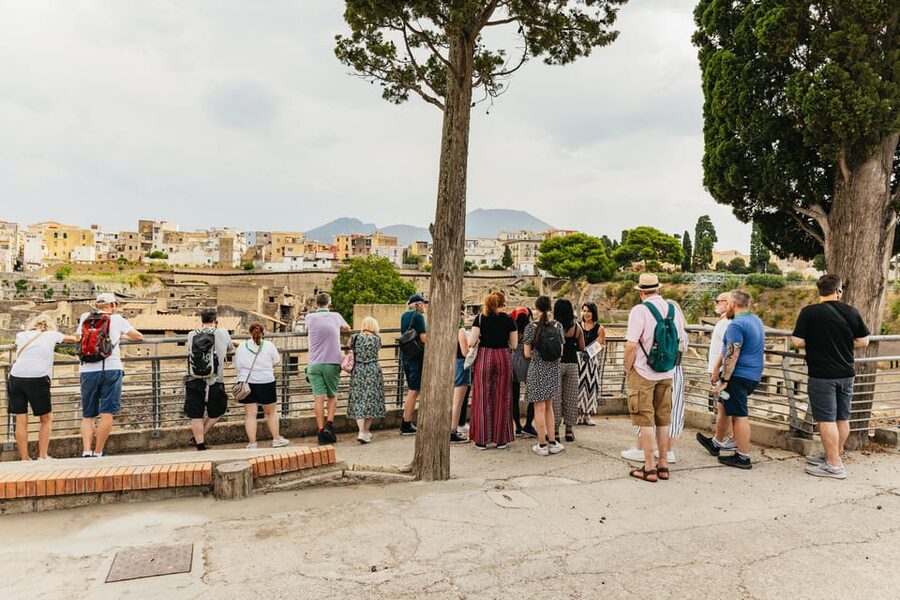
The route continues through Casa dell’Albergo and Casa del Salone Nero. These homes help build a broader picture of the town’s private architecture and social range.
The value of these stops is cumulative. One house shows a mosaic, another reveals wall painting or timber, and another gives you a different arrangement of rooms. After several examples, you begin to recognize how Roman domestic spaces worked instead of viewing each building as an isolated ruin.
Casa del Salone Nero is especially useful for seeing how color and decoration shaped interiors. Much of the pleasure here comes from looking carefully at surfaces. Keep your eyes at different heights, since painted plaster, stonework, and surviving architectural details may appear in different parts of a room.
You should not expect every house to be open in exactly the same way on every visit. The supplied route identifies these buildings as stops, but archaeological sites can have changing access. The guide will direct the group according to what is available.
The Samnite house, baths, Forum, and Gymnasium
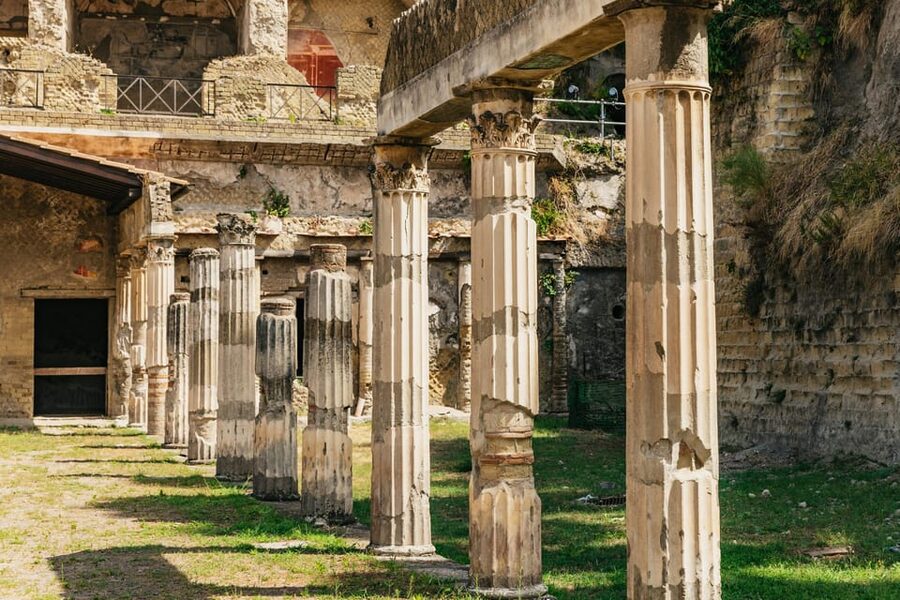
The Samnite house offers another look at domestic life and earlier building traditions. It sits within a wider story of how Herculaneum developed before becoming the Roman town preserved by the eruption.
The thermal baths are an important public stop. Roman bathing was not only about washing. It was part of social life, and the baths help you understand the public side of the town after seeing several private homes.
The route also includes the Forum, a central public area, and the Gymnasium. These spaces balance the house visits with the civic and communal side of Herculaneum. You get a better sense of the town when you see where people lived, gathered, exercised, and attended public business.
One especially memorable detail comes from the gymnasium. A guide took the group through a tunnel toward the center, where a swimming pool would have been. Access can depend on conditions, but this kind of view shows why staying with the archaeologist matters. You may see more than the obvious street-level remains.
The Temple of the Augustales
The Sacellum of the Augustales, also called the Temple of the Augustales, is another major stop. This building connects religion, civic identity, and local status.
The guide explains what the Augustales were and how this institution fitted into public life. You may notice painted decoration and architectural details that would be easy to miss without a trained eye.
This is a good example of the tour’s balance. It does not spend the whole time on famous houses. It also explains institutions and beliefs that shaped the town. The result is a fuller picture of Herculaneum’s residents and the society they built.
The archaeologist guides make the two hours count
The strongest reason to book this tour is the guide. Names praised for warmth, clarity, and enthusiasm include Luciano Leone, Diego, Teresa, Anna, Roberta, Angelo, Alfredo, Giovanni, Giulia, Bruno, and Gerardo.
Luciano appears especially effective for people who enjoy a lively presentation. His explanations are described as detailed but easy to follow, with humor, photographs, videos, and comparisons between the town before and after the eruption. Diego is also praised for making the site feel alive and for answering questions carefully. Teresa has been noted for explaining complicated material in a way that worked well for an eight-year-old.
The guides speak English, Italian, German, Spanish, or French, depending on the selected tour. Strong command of your chosen language matters at a site where small details carry much of the meaning.
Group size is not fixed in the information provided. Groups of about 15 to 20 have been reported, with some tours split into two groups. That is manageable, but not private. If you want a quiet, personal archaeological conversation, a group tour may feel busy.
Two hours, then more time on your own
The guided portion lasts two hours. That is enough to cover many major highlights, but it is a brisk introduction rather than a complete study of every street and building.
Some people find the pace ideal. You move from one important area to the next and avoid wasting time deciding where to go. Others want more time to stand quietly in a house or examine a mosaic without a group waiting.
The admission included with the tour lets you remain at the site and continue exploring afterward, subject to the site’s opening hours. This makes the tour more flexible than a simple two-hour visit. You can take the guide’s overview first, then return to areas that caught your attention.
Book a morning time if you want a relaxed self-guided follow-up. A late afternoon tour may leave little time afterward, especially if the site is due to close. One person on a 2:30 p.m. tour found there was no spare time to wander after the guided visit.
Is $53 good value?
I consider $53 fair for this experience, particularly if you want the site to make sense rather than simply walk through it. The adult admission alone is €16, and the package adds an archaeologist guide, headsets, and skip-the-line access.
The time saving matters most during busy periods. Skip-the-line entry does not make the archaeological site empty, but it removes one avoidable wait at the entrance.
The price is less attractive if you already have strong archaeological knowledge, prefer to read independently, or want complete control over your pace. In that case, a self-guided visit may suit you better. For a first visit, though, the explanations about the eruption, excavations, homes, and public buildings give the tour real value.
Free cancellation up to 24 hours before the start and reserve-now, pay-later booking add useful flexibility. The tour runs rain or shine, so check the forecast and bring a raincoat when needed.
Who should book this Herculaneum tour?
I would choose this tour if you are visiting Herculaneum for the first time, want a clear route, or plan to compare it with Pompeii. Families can enjoy it if children are interested in Roman life, though younger children may lose focus during a full two-hour archaeology talk.
It also suits anyone who wants more than a guide reading dates from a plaque. The best guides use humor, visual material, practical examples, and clear comparisons to explain what you are seeing.
I would think twice if you have mobility limitations, carry luggage, dislike group pacing, or need a private guide. The site is uneven and exposed, large bags are not allowed, and the group can be large enough for headsets to lose clarity at the back.
FAQ
Where does the Herculaneum tour meet?
Meet at the ticket office of the Herculaneum ruins on Via dei Papiri Ercolanesi. The guide will hold an Askos Tours sign.
How long does the guided tour last?
The guided visit lasts two hours.
Is admission to Herculaneum included?
Yes. The tour includes admission fees to the Herculaneum archaeological site.
Does the tour include transportation from Naples?
No. Transportation is not included, so you must arrange your own way to the meeting point.
Which languages are available?
The live guide may lead the tour in English, Italian, German, Spanish, or French, depending on the selected option.
What should I bring?
Bring a valid passport or ID card, comfortable closed-toe shoes, sunscreen, and a hat. A raincoat is also useful because the tour operates in wet weather.
Can I bring luggage or a large bag?
No. Luggage and large bags are not allowed at the site.
Is the tour suitable for wheelchair users?
No. The experience is not suitable for wheelchair users or people with mobility impairments.
Should you book it?
Book this Herculaneum tour if you want the ruins explained by an archaeologist and would rather spend your time looking at the site than figuring out the route. The best guides, especially Luciano, Diego, Teresa, and Angelo, add humor, context, and visual detail that make the houses and mosaics easier to understand.
Choose an earlier start if you want time to continue alone afterward. Wear serious walking shoes, stay within headset range, and arrive at the actual ticket office rather than trusting an imprecise map pin.
For most first-time visitors, the combination of admission, skip-the-line entry, a two-hour route, and expert interpretation makes $53 a sensible spend. If Pompeii is already on your schedule, all the better: seeing both sites reveals two different sides of life and death beneath Vesuvius.
More Fast-Track Entries
- Pompeii: Skip-the-Line Entry Ticket with Audio Guide or Tour
★ 4.1 · 1,364 reviews - From Naples: Pompeii Guided Tour with Skip-the-Line Tickets
★ 4.8 · 1,171 reviews - Pompeii: Skip-the-line-Ticket and Guided Tour
★ 4.6 · 1,152 reviews - Herculaneum: Skip-the-Line Entry Ticket with Audio Guide
★ 4.3 · 870 reviews
Just added around Naples
- From Naples/Salerno: Pompeii, Sorrento, and Positano Tour★ 4.5 · 250 reviews
- Pompeii: Day Tour of Pompeii and Vesuvius with Bus Transfer★ 4.2 · 250 reviews
- Ischia: Island Boat Tour with Neapolitan Lunch & Snorkeling★ 4.9 · 253 reviews
- Explore Naples & Pompeii in One Day – Guided Half-Day Tour★ 4.5 · 253 reviews
- Discover Pompeii: French Walking Tour of the Buried City★ 4.8 · 253 reviews
- Private Transfer from Naples to Sorrento or from Sorrento to Naples★ 5.0 · 254 reviews
- From Pompeii: Mount Vesuvius Guided Tour with Transfer★ 4.8 · 255 reviews
- Private Transfer from Naples to Positano or Amalfi or vice versa★ 5.0 · 265 reviews
Pompeii & Herculaneum Tours, compared.

Pompeii: Entry Ticket and Guided Tour with an Archaeologist
Read our review →
Pompeii: Entry Ticket with Optional Audio Guide
Read our review →
Pompeii: Small Group Tour with an Archaeologist
Read our review →


Pompeii Small Group Tour with an Archaeologist
Read our review →
Pompeii, Amalfi Coast and Positano Day Trip from Rome
Read our review →Browse the lists this tour appears in