
Review · WALKING TOURS
Florence Walking Tour
Florence rewards a good first walk. This 2.5-hour tour links the city’s big sights with stories about the Medici, art, food, and daily life, giving you a useful map in your head before you explore alone. I especially like the very low price and the broad route, which reaches the Duomo, Ponte Vecchio, Uffizi, Santa Croce, and several less obvious stops.
I also like the guides’ practical help. Armando has been praised for restaurant ideas, public restroom locations, opening hours, and patient explanations, while Alessandro has pointed visitors toward memorable sandwich and gelato stops. The main consideration is that this is an outdoor overview, not an inside tour, and one person found a microphone hard to hear. Check the start-time notice carefully, too.
In This Review
- Key points to know before you book
- Why this Florence walk is useful at the start
- Starting at Piazza dell’Unità Italiana
- San Lorenzo: Medici power, markets, and church history
- The Duomo and Baptistery: Florence’s most famous view
- Repubblica Square and Orsanmichele Church
- Porcellino and Signoria Square
- The Uffizi from outside, then across the Ponte Vecchio
- Santa Croce Square and the end of the route
- What the guides add to the experience
- Value, comfort, and who should take it
- Should you book this Florence walking tour?
- FAQ
- How long does the Florence Walking Tour last?
- How much does the tour cost?
- Where does the tour start?
- Does the tour end where it starts?
- Which Florence sights are included?
- Are admission tickets included?
- Is the tour offered in English?
- How many people can join the tour?
- Can I cancel for a full refund?
Key points to know before you book
- A two-and-a-half-hour city primer: You see Florence’s main landmarks in one continuous walk.
- A striking price: The listed cost is $3.63 per person, with a voluntary tip expected at the end.
- A compact central route: The walk includes the Duomo, Baptistery, Uffizi exterior, Ponte Vecchio, and Santa Croce Square.
- Guide quality matters: Armando, Alessandro, Gino, Manuel, Barbara, Simone, Elizabeth, Deb, Samona, and others have been praised for history, humor, and local advice.
- No museum entries are included: You view the sights from outside and decide later which places deserve your admission fee.
- Small maximum group: The activity lists a maximum of four people, though you should confirm the current arrangement when booking.
Why this Florence walk is useful at the start
Florence is compact, but it can feel confusing at first. Its famous buildings sit close together, and a short walk can take you from a market street to a Renaissance palace, a cathedral square, a medieval church, and the Arno in minutes. Without context, you may see beautiful stone and miss the story connecting it all.
This tour is designed to solve that problem. You begin at Piazza dell’Unità Italiana and move through central Florence on foot, stopping often for explanations. The route is not built around one museum or one monument. Instead, it gives you a citywide introduction.
That makes it most useful on your first day or early in your stay. You can note the museums you want to enter later, learn which streets are convenient for returning to your hotel, and collect food suggestions before you spend money on a mediocre meal.
The walk lasts about 2 hours and 30 minutes. That is long enough to cover a substantial part of the center, but short enough to fit around an afternoon plan. You should still expect to be on your feet for the full outing, with pauses at the major sights.
The price is the unusual part. At $3.63 per person, it costs less than many short coffee stops in Florence. The model relies on a voluntary tip at the end, so the listed price is not the whole social expectation. If your guide gives you a strong introduction, useful advice, and a pleasant afternoon, budget for a fair tip rather than treating the tiny booking price as the final value of the experience.
More Walking Tours in Florence
- Florence: Guided Walking Tour
★ 4.5 · 3,334 reviews - Skip the line: Uffizi and Accademia Small Group Walking Tour
★ 4.5 · 3,135 reviews - Florence: Guided Walking Tour
★ 4.6 · 1,602 reviews
Starting at Piazza dell’Unità Italiana
The meeting point is Piazza dell’Unità Italiana, near public transportation and close to Florence’s central station area. This is a practical place to begin if you have just arrived by train or are staying near the center.
You need to pay attention to the exact start time. One participant arrived after a time change and missed the group, so check your booking messages and notifications shortly before the walk. That small bit of preparation matters more here than it might on a self-guided stroll.
The group maximum is listed as four people. If that limit is applied as stated, you should get a more personal experience than on a large city tour. A small group also makes it easier to ask about restaurants, shops, transport, and places you want to revisit.
The activity ends at a different location from the starting point. The available information does not give a precise final address, so check the current details before you set a restaurant reservation or train departure immediately afterward.
San Lorenzo: Medici power, markets, and church history
The first stretch includes the Medici Chapel, San Lorenzo Market, Medici Riccardi Palace, and San Lorenzo Church. This is a strong opening because it introduces the family that shaped Florence’s politics, art, and architecture.
You see how close these places are to one another, which helps explain the city’s unusual concentration of major sights. The Medici Chapel brings you to the family’s ceremonial world, while the market area gives the neighborhood a more everyday feel. The contrast is useful: Florence is not only a collection of grand façades. It is also a working city built around food, trade, and local movement.
The Medici Riccardi Palace adds another layer. From outside, your guide can explain its role in Florence and point out details you might otherwise walk past. San Lorenzo Church continues the story, giving you an early look at the city’s religious and political importance.
The limitation is simple: admission tickets are free for the tour, but this does not mean the interiors are included. You should think of these stops as guided orientation from public areas. If the Medici Chapel or another interior catches your attention, save it for a separate visit.
The Duomo and Baptistery: Florence’s most famous view
The route then reaches the Duomo Cathedral and the Baptistery. This is likely the moment when the walk feels most recognizably Florentine. The cathedral’s scale and the patterned exterior are difficult to appreciate from a quick photograph alone, and a guide can help you read the square as a group of connected buildings rather than one isolated monument.
The Baptistery is especially important to see alongside the cathedral. The two buildings share the same space, but they serve different roles in the story of Florence. A good explanation here can turn a familiar postcard view into a clearer picture of how religious spaces organized the medieval city.
Expect a pause rather than a cathedral climb or interior visit. The tour covers the sights from outside, and no admission tickets are part of the walk. That is a benefit if you want a quick first look, but it means you should not book this expecting detailed art discussion inside the cathedral complex.
Several guides have been praised for explaining history through stories rather than a dry list of dates. Armando, Gino, Alessandro, and others have been described as enthusiastic and funny, which matters in a square where you may be absorbing a lot of information at once.
More guided walks:
- Florence: Renaissance and Medici Tales Guided Walking Tour
★ 4.8 · 1,549 reviews - Florence: Uffizi & Accademia Small Group Walking Tour
★ 4.7 · 1,380 reviews - Lucca: 2-Hour City Center Walking Tour
★ 4.7 · 1,314 reviews - Skip-the-Line Florence Highlights and David Walking Tour
★ 5.0 · 1,127 reviews
Repubblica Square and Orsanmichele Church
From the Duomo area, the walk continues to Repubblica Square and Orsanmichele Church. These stops help you see changes in Florence beyond the most famous Renaissance landmarks.
Repubblica Square has a more open, urban character than the tight streets near San Lorenzo. It is a useful place to pause and understand the modern city’s central meeting areas. Orsanmichele offers a different view again, linking religious purpose with the commercial life of Florence.
You may appreciate these stops most if you are interested in how the city developed over time. They also break up the run of headline attractions. A good walking tour needs quieter points, because otherwise the famous sights blur together.
This is one place where the guide makes a major difference. The route itself is easy enough to follow with a map. The value comes from hearing why a church, square, or palace matters. Guides such as Manuel and Simone have been praised for stopping often, telling stories, and keeping the walk lively.
Porcellino and Signoria Square

The next section brings you to Porcellino and Signoria Square. Porcellino is a memorable public landmark, and it gives the walk a lighter moment after the formal churches and palaces. It is also the kind of stop you might pass without understanding its local importance if you were rushing between major museums.
Signoria Square is one of Florence’s essential outdoor spaces. Here, you can look at the architecture and public sculpture while your guide explains the square’s civic role. This is not simply a pretty plaza. It is a place where Florence’s public identity is visible in stone, statues, and surrounding buildings.
I like this part of the route because it connects sightseeing with city life. You are not only checking off a famous square. You are learning where Florence’s public business and grand statements took place.
The square can also be a busy listening environment. One person found the microphone and speaker system garbled and hard to hear, while another found a guide’s accent and quick delivery difficult at times. If you have hearing concerns, stay close to the guide and ask for repetition when needed. The tour is inexpensive, but clear audio still affects how much you take away.
The Uffizi from outside, then across the Ponte Vecchio
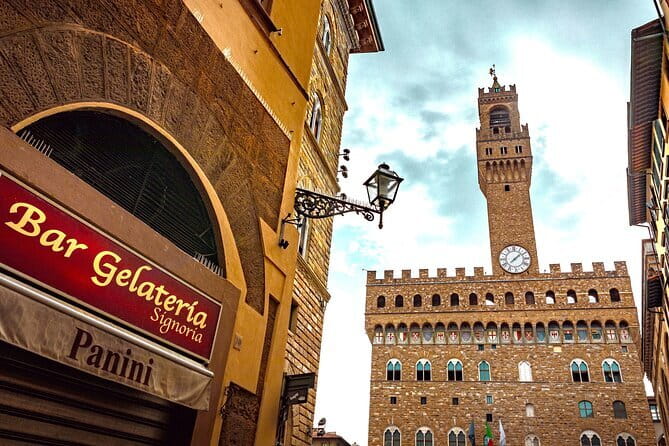
The walk includes the Uffizi from the exterior, followed by Ponte Vecchio. This pairing works well because it lets you connect Florence’s art institutions with the river crossing that has become one of the city’s most recognizable views.
At the Uffizi, you get an orientation to the building and its place in the city. You do not go inside, so use this stop to decide if you want to return for a museum visit. If you have limited time in Florence, a guide’s short explanation can help you judge which major interiors deserve priority.
Ponte Vecchio changes the mood. The bridge gives you a view of the Arno and a chance to experience Florence as a city divided and joined by water. You can pause for photographs, but remember that a walking group cannot linger forever. The tour’s purpose is to show you the broad structure of the city, not to provide extended photo time at each landmark.
The bridge is also a useful navigation point for the rest of your stay. Once you know where it sits in relation to the Uffizi and central squares, you can return without constantly checking a map.
Santa Croce Square and the end of the route
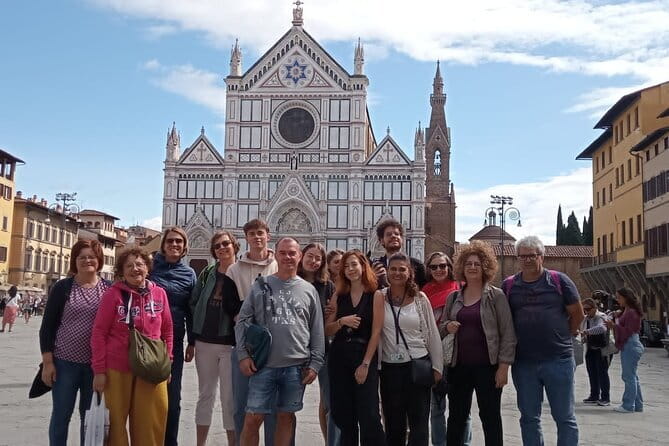
The final named stop is Santa Croce Square. It gives the tour a fitting finish, with another major church façade and a large public space that feels different from the Duomo area.
By this point, you have crossed a sizeable portion of central Florence. You should have a clearer sense of how the main sights relate to one another, which is one of the strongest reasons to take the walk early in your visit.
The exact end location is not specified in the available details, and it differs from the starting point. Before booking something immediately afterward, allow a little flexibility. You may also want to ask your guide for help finding your next destination. Guides have been praised for giving directions, dining suggestions, and advice about what to see next.
What the guides add to the experience
The guide quality appears to be the biggest strength of this tour. Armando is repeatedly described as funny, patient, enthusiastic, and generous with practical information. He has helped people with restaurant ideas, public restroom locations, opening and closing times, and sightseeing choices.
Alessandro has been praised for his local experience and for recommending a sandwich shop and gelato place that became food highlights for one visitor. Gino has been described as passionate about Florence and helpful with food, shopping, and sightseeing. Manuel, Barbara, Simone, Elizabeth, Deb, and Samona have also been singled out for friendly delivery, local perspective, humor, or detailed explanations.
You should not assume you will receive a particular guide. Still, these names show the range of personalities you might encounter. Some guides focus on facts and stories. Others add personal experience, dining advice, or small local details such as a former school or favorite food stop.
The tour works best when you treat it as a conversation. Ask where to eat, which sights need more time, and what is practical for the rest of your visit. The guide’s advice may be as useful as the formal history.
Value, comfort, and who should take it
For $3.63, this is hard to beat as a first look at Florence. The route covers enough ground to save you time later, and the voluntary tip system lets you reward a guide whose work you value.
It is especially suitable for:
- First-time visitors who want to understand the city’s layout quickly
- People arriving in Florence who want useful ideas for the rest of the stay
- Budget-conscious visitors who prefer an outdoor introduction
- Anyone who enjoys history, local stories, and restaurant suggestions
- Visitors deciding which museums and churches to enter later
It is less suitable if you want interior access, a slow photography walk, or a specialist art lecture. You also need to be comfortable walking for about two and a half hours and listening in outdoor city settings.
Most people can participate, and service animals are allowed. The activity is near public transportation. It requires good weather, and if poor weather cancels the walk, you are offered another date or a full refund. A minimum number of participants is also required, with a similar choice of another date, another experience, or a refund if that minimum is not reached.
Free cancellation is available up to 24 hours before the start time. A cancellation later than that is not refunded, and late changes are not accepted.
Should you book this Florence walking tour?
I would book this tour early in a Florence stay, ideally on your arrival day or the next morning, if you want a fast and inexpensive orientation. The route covers the essential outdoor sights, and the best guides add the details you cannot get from a map: where to eat, what to revisit, and how the city fits together.
Book it with realistic expectations. You are paying for a guided city overview, not museum entry, a private art seminar, or a guaranteed guide named Armando or Alessandro. Check the time carefully, prepare for outdoor walking, and stay close enough to hear.
If you want Florence to make sense before you tackle its museums, this is a smart buy. If your main goal is going inside the Duomo, Uffizi, or Medici Chapel, use this walk as a preview and plan separate admission for the places that catch your interest.
FAQ
How long does the Florence Walking Tour last?
The tour lasts approximately 2 hours and 30 minutes.
How much does the tour cost?
The listed price is $3.63 per person. A voluntary tip is given at the end of the tour.
Where does the tour start?
The meeting point is Piazza dell’Unità Italiana, 50123 Florence, Italy.
Does the tour end where it starts?
No. The activity ends at a different location, and the available details do not provide the exact final address.
Which Florence sights are included?
The route includes the Medici Chapel, San Lorenzo Market, Medici Riccardi Palace, San Lorenzo Church, Duomo Cathedral, Baptistery, Repubblica Square, Orsanmichele Church, Porcellino, Signoria Square, the exterior of the Uffizi, Ponte Vecchio, and Santa Croce Square.
Are admission tickets included?
The tour itself has no admission ticket charge, but the route is an outdoor overview. The Uffizi is specifically viewed from outside, and the information does not indicate interior admission to the other sights.
Is the tour offered in English?
Yes. The tour is offered in English and uses a mobile ticket.
How many people can join the tour?
The activity lists a maximum of four travelers.
Can I cancel for a full refund?
Yes, if you cancel at least 24 hours before the experience start time. Cancellations or changes made less than 24 hours before the start are not accepted for a refund.
Just added around Florence
- Palazzo Vecchio guided experience with entrance ticket★ 4.5 · 249 reviews
- Lucca Bikes and Bites with food tastings for Small Groups or Private★ 5.0 · 249 reviews
- Perfume Masterclass in Florence: Make your Own Personal Fragrance★ 4.5 · 253 reviews
- Florence Oltrarno Neighborhood Food & Wine Dine Around★ 5.0 · 253 reviews
- Florence: Cathedral, Dome and Terraces Guided Tour★ 4.5 · 253 reviews
- Florence: 1.5-hour Santa Croce Guided Experience★ 4.8 · 254 reviews
- Florence: Pitti Palace and Palatina Gallery Ticket and Tour★ 4.9 · 255 reviews
- Private Florence Tour by Golf Cart ETukTuk with Audio Guide★ 4.0 · 256 reviews
Walking Tours, compared.

Guided Walking Tour & Last Supper Visit with Ticket
Read our review →

Rialto Bridge & Offbeat Unusual Venice Walking Tour
Read our review →

Private 3 hrs Venice Tour: St Mark’s, Walking tour & Boat tour
Read our review →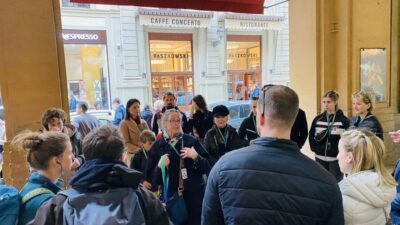

Skip the line: Uffizi and Accademia Small Group Walking Tour
Read our review →Browse the lists this tour appears in