Review · TICKETS
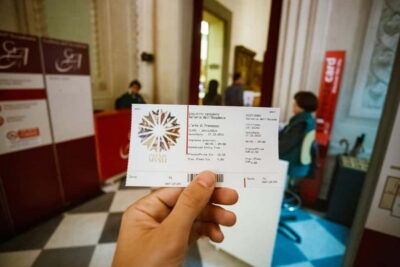
Florence: Museo Galileo Entry Ticket
Science gets its own Florence spotlight. The Museo Galileo offers a welcome change from the city’s famous paintings and churches, with original instruments, enormous globes, telescopes, clocks, microscopes, and tools that helped shape modern science. I like the museum’s calm atmosphere and its clear connection to the Medici and Lorraine rulers, who supported scientific study alongside the arts.
I also like the freedom of a one-day entry ticket. You can move at your own pace, spend an hour on the highlights, or stay three hours studying the displays. The main consideration is that this is a self-guided museum visit, not a guided tour, and some visitors find the app and exhibit labels less clear than they would like.
In This Review
- Key Things To Know Before You Go
- Why Museo Galileo Deserves Time in Florence
- Entering With the One-Day Ticket
- The Medici Collection on the First Floor
- Galileo’s Original Instruments
- The Lorraine Rooms and the Growth of Technology
- How Long Should You Spend Inside?
- Audio Guide, Labels, and Self-Guided Touring
- Crowds, Families, and the Museum’s Atmosphere
- Location and Pairing It With Other Sights
- Who Will Get the Most From This Ticket?
- Should You Book Museo Galileo?
- FAQ
- How much does the Museo Galileo entry ticket cost?
- How long is the ticket valid?
- Is a guided tour included?
- Can I cancel the booking?
- Can I reserve now and pay later?
- Is Museo Galileo wheelchair accessible?
- What time does the museum close on Tuesdays?
- Should I bring earbuds?
Key Things To Know Before You Go
- Galileo’s real instruments are here: See original thermometers, microscopes, astronomical tools, and meteorological equipment linked to Galileo Galilei.
- Two floors cover far more than astronomy: The collection includes mathematics, navigation, mechanics, medicine, chemistry, clocks, weights, and measures.
- It is often quieter than Florence’s headline museums: This can make it a smart stop when the Uffizi and Accademia feel packed.
- Plan at least two hours: You can walk through in about an hour, but the displays reward a slower visit.
- Bring earbuds for the phone audio guide: The audio option can add useful context, though the app may take a little patience.
- Tuesday has shorter hours: The museum is open only until 1:00 PM on Tuesdays.
Why Museo Galileo Deserves Time in Florence
Florence is easy to experience as a parade of Renaissance paintings, marble saints, and grand churches. Museo Galileo gives you another way to understand the city. Here, you see the tools behind observation, measurement, navigation, medicine, and engineering.
The museum explains how scientific ideas developed over centuries. The story reaches back to Greek and Ptolemaic astronomy, then follows the work supported by the Medici and Lorraine families. Galileo is the star, but the collection is not limited to his life or his telescope work.
That wider focus is the museum’s greatest strength. You are not simply looking at old objects behind glass. You are following a chain of practical problems and clever solutions. How do you measure the stars? How do you calculate distance? How do you record temperature? How do you make a machine move with greater control?
The displays make clear that modern technology did not appear all at once. A better lens helped astronomy. Better measurements improved navigation. Advances in mechanics and mathematics opened doors for later inventions. If you enjoy seeing how one idea leads to another, this museum offers plenty to think about.
I would not reserve it only for serious science fans. Anyone curious about how people understood the natural world before computers, satellites, and digital sensors can find something worthwhile here. Families can enjoy the large instruments and unusual objects, though younger children may want more hands-on displays than the museum provides.
A few more reviews worth comparing before you book
- Florence: Skip-The-Line Uffizi Gallery Timed Entry Ticket
★ 4.5 · 27,832 reviews - Tuscany Day Trip from Florence: Siena, San Gimignano, Pisa and Lunch at a Winery
★ 5.0 · 21,634 reviews - Florence: Timed Entrance Ticket to Michelangelo’s David
★ 4.6 · 16,983 reviews
Entering With the One-Day Ticket
The entry process is simple. You show your confirmation voucher at the museum on the day of your visit, and the ticket includes the booking fee. Several ticket holders have reported exchanging the voucher at the entrance and walking in without a separate pickup step.
The ticket is valid for one day. The information provided for this visit says to check availability for starting times, while multiple ticket holders found they could enter at any point during the museum’s opening hours. I would check the conditions shown when you book, especially if your day in Florence is tightly planned.
At about $20 per person, the ticket is not the cheapest museum admission in town. The value depends on your interests. If you spend only 45 minutes looking at a few famous objects, the cost may feel high. If you give the museum two or three hours, the price becomes easier to justify because the collection is unusually broad.
Pre-booking can also help you protect a place in a busy Florence schedule. That said, one ticket holder found that buying at the museum could be cheaper, and another reported no queue on a Saturday morning. Prices and crowd levels can change, so consider convenience more than guaranteed savings.
Free cancellation up to 24 hours before the visit and the option to reserve now and pay later add useful flexibility. They matter most when you are arranging several Florence attractions around changing plans.
The Medici Collection on the First Floor
Start with the rooms devoted to the Medici collections. These objects were first displayed in a mathematics room at the Uffizi Gallery, which tells you something about the family’s priorities. For the Medici, scientific instruments were not dull workshop equipment. They were part of court culture, artistic production, education, and power.
The first-floor displays include quadrants, astrolabes, meridians, dials, compasses, and armillary spheres. Many are finely made objects, with careful decoration and polished surfaces. You may find yourself admiring them first as works of art, then realizing that each one had a serious job to do.
An astrolabe, for example, could help with astronomical calculations and navigation. A quadrant helped measure angles. Armillary spheres presented the structure of the heavens in a form you could see and study. Even if you do not remember the technical terms from school, the instruments show how much patience and skill earlier scientists needed.
The collection also includes instruments made by well-known Tuscan and European artists and craftsmen. Their appearance is not accidental. In this period, accurate scientific equipment and beautiful design often belonged together.
This section works best when you slow down. A quick walk gives you the shapes and colors, but not the purpose. Use the written labels or phone audio when available, and stop whenever an instrument looks especially strange. The odd-looking objects are often the ones that reveal the most about older methods of study.
Galileo’s Original Instruments
The Galileo section gives the museum its name and its strongest emotional pull. You can see original instruments connected with Galileo’s work, including thermometers, microscopes, and meteorological equipment.
The point is not simply that these objects belonged to a famous scientist. It is the reminder that Galileo worked with tools far less advanced than anything in a modern classroom. His observations required careful setup, repeated testing, and a willingness to challenge accepted ideas.
Some displays include copies of Galileo instruments that help explain motion and mass. These replicas are especially useful because the original objects must be protected. Being able to see how an instrument operates gives you a better sense of the thinking behind it than a label alone.
The museum also includes the famous preserved finger associated with Galileo. It is an odd and slightly comic object, but it gives the visit a human edge. You are not just dealing with an abstract name from a textbook. You are looking at the remains and working tools of a real person whose ideas caused trouble as well as progress.
One important expectation check: the museum is not only a biography of Galileo. If you arrive expecting every room to focus on his life, you may be disappointed. The broader Medici and Lorraine collections take up much of the visit. If you want a full personal story, you may need additional reading or a separate guided visit.
A different sort of day out around Florence:
- Florence: Michelangelo’s David Skip-the-Line Entry Ticket
★ 4.5 · 12,764 reviews - The Best tour in Florence: Renaissance & Medici Tales – guided by a STORYTELLER
★ 5.0 · 12,316 reviews - Florence: Leonardo Interactive Museum Entry Ticket
★ 4.5 · 11,763 reviews - The Best Tour in Florence: Renaissance and Medici Tales
★ 5.0 · 10,810 reviews
The Lorraine Rooms and the Growth of Technology
The second floor shifts attention toward instruments associated mostly with the Lorraine family. Here, the subject becomes more mechanical and experimental.
You will see equipment connected with mechanical, electrostatic, and pneumatic applications. These categories can sound dry, but the objects make them more approachable. They show how scientists tried to understand force, air, electricity, and movement by building things that could test an idea.
Other displays cover mechanical clocks, sextants, octants, pharmaceutical and chemical equipment, weights, and measures. This wider range is one reason I would allow more than the advertised quick visit. A sextant or octant connects the museum to navigation. Weights and measures connect it to trade and daily life. Pharmaceutical and chemical equipment shows science moving into medicine and practical production.
The collection is also a lesson in precision. Before digital readouts, scientists depended on carefully marked scales, balanced weights, polished lenses, calibrated dials, and reliable clocks. Small errors could change a result. Looking at the instruments helps you understand why measurement was such a major step in scientific progress.
The museum is well organized, but there is a lot of information. Some displays are dense, and you may need to choose where to concentrate. I would not try to read every label. Pick a few themes that interest you, then move on before the details blur together.
How Long Should You Spend Inside?
An hour is enough for a brisk look at the major rooms. Two hours is a better minimum if you want to understand the collection. Three hours is reasonable for anyone who enjoys science, astronomy, engineering, mathematics, or the history of technology.
One ticket holder wished for three hours after spending two inside. Another said the museum could justify several separate visits. That makes sense because the objects cover so many subjects and periods.
I would plan the visit like this:
- Spend the first 15 minutes getting your bearings and learning the layout.
- Give about 45 minutes to the Medici instruments and astronomical displays.
- Allow at least 30 minutes for Galileo’s original instruments and related models.
- Use the remaining time on the Lorraine collection, clocks, medicine, chemistry, and navigation.
- Leave a few minutes to revisit objects you rushed past at the beginning.
There are not always many places to sit, which can matter if you need assistance while walking. One ticket holder specifically wanted more seating. The museum is wheelchair accessible and has an elevator, but you may still want to pace yourself on a longer visit.
Audio Guide, Labels, and Self-Guided Touring
The visit is self-guided. That gives you control, but it also puts more responsibility on you to create a useful route.
A phone-based audio guide is available. Bring your own earbuds, since they make listening easier and more discreet. The audio can add helpful explanation, but the app has not always been easy to follow. Some people also found that the front desk did not clearly explain the need to download it or bring earphones.
Labels are generally useful in English, but a few displays may leave you wanting more explanation. If you prefer detailed interpretation, take your time with the written material and consider asking at the front desk what audio options are available before you begin.
The lack of a guide is not a serious problem for a casual visit. You can still appreciate the instruments and follow the main story. A guide would be more valuable if you want technical detail, a stronger biography of Galileo, or help connecting the objects across the two floors.
Crowds, Families, and the Museum’s Atmosphere
Museo Galileo is often a quieter stop than Florence’s best-known museums. Several ticket holders found it nearly empty, even during periods when the city’s main sights were busy. That calmer setting lets you examine large globes and delicate instruments without being pushed along.
I would consider visiting early in the day, particularly if you are bringing children or want a peaceful look around. One family found the museum especially successful with children, and a 10-year-old interested in STEM was fascinated by the displays.
Still, this is not a hands-on science center. A few more interactive models would improve the visit for children and for anyone who learns best by doing. Some replica instruments can help explain motion and mass, but most objects are there to look at rather than operate.
For adults, couples, and curious older children, that quieter format can be a plus. You can read, pause, and discuss what you are seeing. It also makes Museo Galileo a useful change of pace after the visual overload of the Uffizi.
Location and Pairing It With Other Sights
The museum’s location makes it easy to combine with other central Florence visits. It is close enough to the Uffizi area to work as a stop before or after your time with Botticelli, Leonardo, or Michelangelo.
That pairing is more meaningful than it may first appear. The Uffizi shows the artistic achievement of the Renaissance, while Museo Galileo helps explain the scientific and mathematical thinking that supported that period. You get a fuller picture of Florence by seeing both.
I would avoid placing the museum at the end of an exhausting day if you want to read the labels. The instruments need attention, and the amount of information can feel heavy when you are already tired. A morning visit or a planned mid-day pause is likely to work better.
On Tuesdays, remember that the museum closes at 1:00 PM. Check the opening information for your date before building the rest of your schedule around it.
Who Will Get the Most From This Ticket?
I recommend Museo Galileo most strongly if you like:
- Astronomy and the history of space observation
- Mathematics and measurement
- Mechanical design and engineering
- The development of medicine and chemistry
- Navigation and mapmaking tools
- The connection between Renaissance art, politics, and science
- Museums where you can set your own pace
It is also a good choice if you have already seen Florence’s major religious and art museums and want a different subject. The collection offers a needed change from paintings and sculpture.
I would be more cautious if you want a short, highly interactive family attraction or a museum devoted only to Galileo’s biography. You may find the technical labels demanding, and the limited hands-on material may not hold the attention of very young children.
Should You Book Museo Galileo?
Book it if you are curious about how science and technology developed, especially if you enjoy astronomy, instruments, clocks, navigation, or engineering. The original Galileo objects, the beautiful Medici collection, and the wide range of later equipment make this one of Florence’s most rewarding less-famous museums.
The $20 ticket is fair if you stay two hours or more, though you may want to compare the price with buying directly at the museum. Bring earbuds, check the hours carefully, and do not treat the museum as a one-hour filler stop unless you are prepared to miss much of its story.
Skip it only if your Florence schedule is already overloaded and science museums are not your thing. For everyone else, I would give Museo Galileo a serious place on the itinerary, particularly as a quieter companion to the Uffizi.
FAQ
How much does the Museo Galileo entry ticket cost?
The listed price is $20 per person, including the booking fee.
How long is the ticket valid?
The ticket is valid for one day.
Is a guided tour included?
No. The ticket includes entry to Museo Galileo but does not include a guided tour.
Can I cancel the booking?
Yes. You can cancel up to 24 hours in advance for a full refund.
Can I reserve now and pay later?
Yes. The booking option allows you to reserve your place and pay later.
Is Museo Galileo wheelchair accessible?
Yes. The museum is wheelchair accessible and has an elevator.
What time does the museum close on Tuesdays?
On Tuesdays, Museo Galileo is open only until 1:00 PM.
Should I bring earbuds?
Yes. Bring earbuds if you want to use the audio guide on your phone. The audio option may require downloading an app, and the app can take some time to understand.
Just added around Florence
- Palazzo Vecchio guided experience with entrance ticket★ 4.5 · 249 reviews
- Lucca Bikes and Bites with food tastings for Small Groups or Private★ 5.0 · 249 reviews
- Perfume Masterclass in Florence: Make your Own Personal Fragrance★ 4.5 · 253 reviews
- Florence Oltrarno Neighborhood Food & Wine Dine Around★ 5.0 · 253 reviews
- Florence: Cathedral, Dome and Terraces Guided Tour★ 4.5 · 253 reviews
- Florence: 1.5-hour Santa Croce Guided Experience★ 4.8 · 254 reviews
- Florence: Pitti Palace and Palatina Gallery Ticket and Tour★ 4.9 · 255 reviews
- Private Florence Tour by Golf Cart ETukTuk with Audio Guide★ 4.0 · 256 reviews
Tickets, compared.

Vatican: Museums & Sistine Chapel Entrance Ticket
Read our review →
Cathedral and Duomo’s Terraces Entrance Ticket
Read our review →

Skip-The-Line Uffizi Gallery Timed Entry Ticket
Read our review →
Naples Underground Entry Ticket and Guided Tour
Read our review →
Pantheon Fast-Track Ticket and Official Audio Guide
Read our review →
Pompeii: Entry Ticket and Guided Tour with an Archaeologist
Read our review →