
Review · WALKING TOURS
Experience Florence’s Art and Architecture on a Walking Tour
Florence reveals itself best on foot. This 2-hour-15-minute walking tour links the city’s great churches, squares, palaces, and public sculptures in one useful morning. You begin at Santa Maria Novella and finish at Santa Croce, crossing Florence’s compact historic center with an English-speaking guide.
I like the route for two clear reasons: it gives first-time visitors a quick sense of direction, and it connects famous sights with smaller details such as Florence’s old wine windows. I also like the low advertised price of $3.63 per person, which makes this an easy way to stretch a travel budget.
The main concern is sound. Most groups are meant to be no larger than 20, but one reported outing grew beyond 40, and the guide was difficult to hear. There is also no time to tour the major interiors, so you should see this as an orientation walk, not a substitute for the Uffizi or the cathedral museums.
In This Review
- Key Points to Know Before You Go
- Why This Florence Walk Works So Well
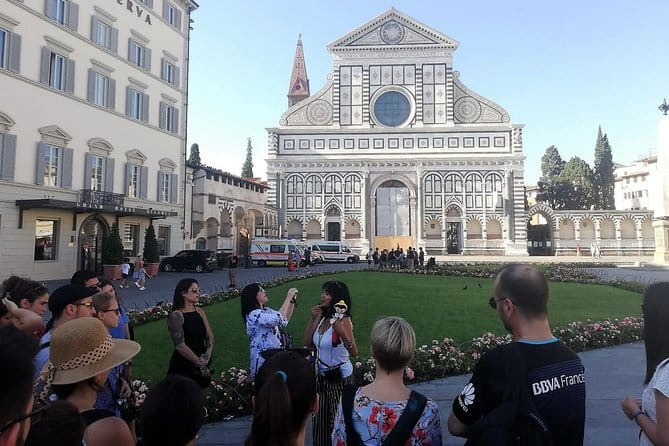
- Starting at Santa Maria Novella
- Via de’ Tornabuoni and Florence’s Polished Side
- Piazza della Repubblica and Roman Florence
- The Duomo: Florence’s Great Architectural Lesson
- Orsanmichele and the Sculptures of Florence
- Piazza della Signoria and Medici Power
- Finishing at Santa Croce
- The Real Value of a $3.63 Tour
- Timing, Group Size, and Sound
- Who Should Book This Florence Walk?
- Should You Book It?
- FAQ
- Where does the walking tour start?
- Where does the tour finish?
- How long does the tour last?
- What language is the tour offered in?
- What sights are included on the route?
- Are admission tickets included?
- How large is the group?
- Can I cancel for a refund?
Key Points to Know Before You Go
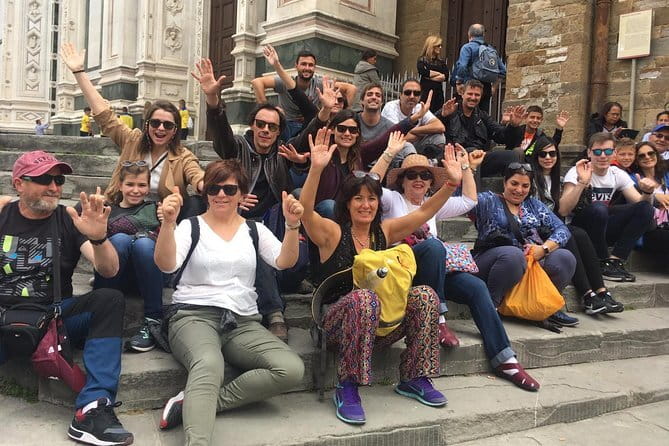
- A compact route through central Florence: You cover Santa Maria Novella, Via de’ Tornabuoni, Piazza della Repubblica, the Duomo, Orsanmichele, Piazza della Signoria, and Santa Croce.
- A strong first-day introduction: The walk helps you understand how Florence’s churches, civic buildings, Medici landmarks, and shopping streets fit together.
- Guides make the difference: Ludi, Ludovica, Natalia, and Ryan are praised for clear English, local advice, patience, and lively storytelling.
- Look for the wine windows: These small openings in old buildings are easy to miss on your own and add a distinctly Florentine touch.
- Expect a tip-based format: The very low booking price is excellent value, but the guide’s income depends on the tip you choose to leave.
- Hearing can be an issue: Ask to stand close to the guide, especially in crowded squares or with a larger-than-expected group.
Why This Florence Walk Works So Well
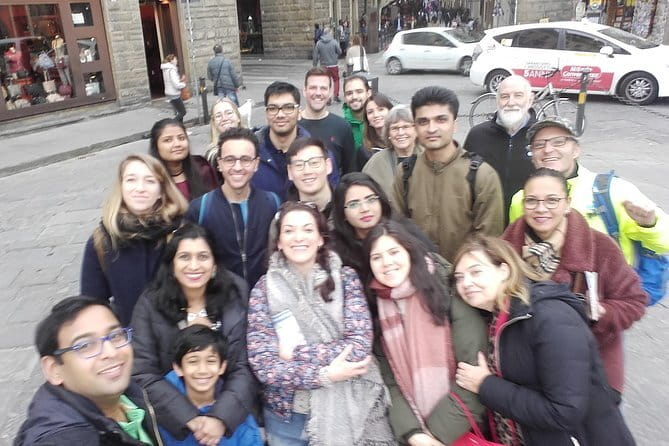
Florence is compact, but it can feel confusing at first. A church may sit behind a grand square, a palace may now serve a completely different purpose, and a famous sculpture may be a copy while the original is displayed elsewhere. This walk gives you a basic map in your head, which is often more useful than a paper one.
You move from the western side of the old center toward the Duomo, then continue to the political heart of Florence and finish east at Santa Croce. The route is simple enough to follow later on your own. I like that progression because each stop adds a different layer: religious power, banking wealth, Medici politics, Renaissance art, and civic identity.
The guides appear to be the strongest part of the experience. Ludi is praised for her passion and practical suggestions, including food, toilets, viewpoints, and less obvious places to explore. Natalia is described as patient, engaging, and especially good with Florence’s art, history, and Medici connections. Ludovica is noted for taking a less predictable path through the center, while Ryan is praised for keeping a group together at a comfortable pace.
The exact guide is not guaranteed, so the style may vary. Still, the repeated praise for the guides suggests that this is not simply a walk from one monument to another. The value comes from how well your leader explains what you are seeing.
More Walking Tours in Florence
- Florence: Guided Walking Tour
★ 4.5 · 3,334 reviews - Skip the line: Uffizi and Accademia Small Group Walking Tour
★ 4.5 · 3,135 reviews - Florence: Guided Walking Tour
★ 4.6 · 1,602 reviews
Starting at Santa Maria Novella
Meet at 10:30 a.m. in front of the Basilica of Santa Maria Novella on Piazza di Santa Maria Novella. This is a convenient starting point near public transportation, and the square gives the group room to gather before setting off.
Santa Maria Novella is an excellent place to begin because the church combines architecture, painting, and the story of Florence’s religious life. The planned stop lasts about 10 minutes, enough for an introduction to the basilica and its place in the city.
You should not expect an extended interior visit here. The stop is listed as free, but the tour focuses on explanation and orientation rather than a full museum-style visit. If the church is high on your list, return later with time to look around at your own pace.
The opening stop also helps you settle into the walking rhythm. Bring water and wear sensible shoes. Florence’s central streets are easy to cover, but standing on stone paving for more than two hours can be tiring, especially on a hot day.
Via de’ Tornabuoni and Florence’s Polished Side
From Santa Maria Novella, the route continues along Via de’ Tornabuoni. This is Florence’s well-known shopping street, but the guide uses it to explain more than fashion.
The 10-minute stop includes Piazza Antinori, Palazzo Strozzi, and Piazza Santa Trinita. Here you get a quick look at the city’s grand urban spaces and the wealth that helped shape them. Palazzo Strozzi is especially useful for understanding the rivalry and ambition of Florence’s powerful families.
I like this part because it keeps the walk from becoming a string of churches. Florence’s story also belongs to merchants, bankers, designers, and wealthy households. The street shows how historic buildings still sit beside modern shops, making the city feel lived in rather than sealed inside a museum.
Because the stop is short, you will receive the broad picture rather than a detailed architectural lesson. Take a moment to look upward at the façades and notice how the scale changes as the route moves from one square to another.
Piazza della Repubblica and Roman Florence
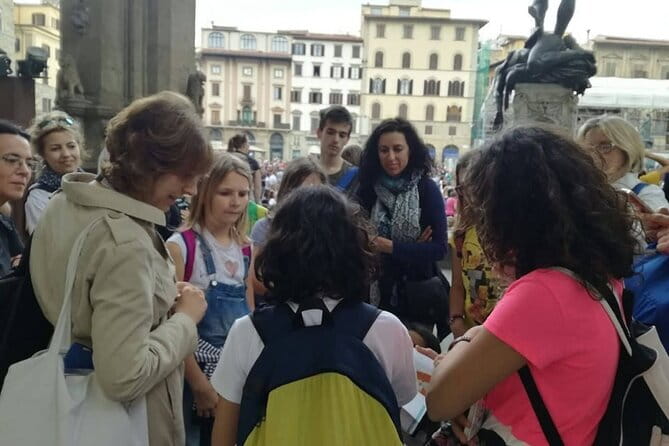
The next stop is brief, about five minutes in Piazza della Repubblica. The subject here is Firenze Romana, or Roman Florence.
This large square feels different from the narrower streets around it. Your guide can use the open space to explain how the city developed from its ancient Roman beginnings and how later changes altered the center. The stop is short, so treat it as a historical marker rather than a full lecture.
Piazza della Repubblica is also a helpful orientation point. It sits close to several major routes, and knowing where it is can make later walks much easier. You may find the square more modern in appearance than the medieval streets nearby, which makes the contrast useful.
More guided walks:
- Florence: Renaissance and Medici Tales Guided Walking Tour
★ 4.8 · 1,549 reviews - Florence: Uffizi & Accademia Small Group Walking Tour
★ 4.7 · 1,380 reviews - Lucca: 2-Hour City Center Walking Tour
★ 4.7 · 1,314 reviews - Skip-the-Line Florence Highlights and David Walking Tour
★ 5.0 · 1,127 reviews
The Duomo: Florence’s Great Architectural Lesson
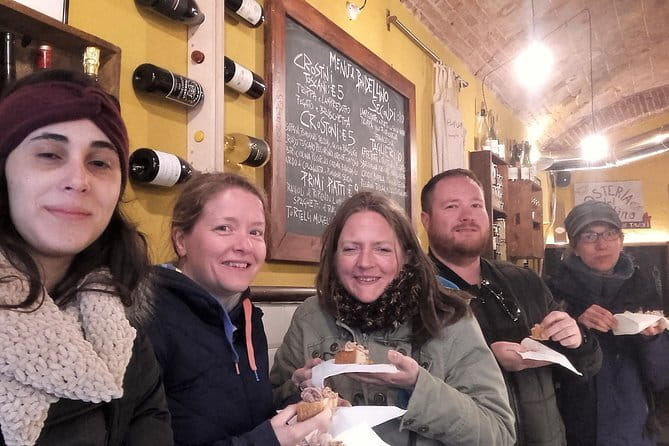
The cathedral stop is one of the main reasons to book the walk. You spend about 10 minutes around the Cathedral of Santa Maria del Fiore, the Baptistery, Giotto’s Campanile, and Brunelleschi’s dome.
Even if you already know the names, seeing these buildings together makes their relationship clearer. The cathedral complex is not one monument but a group of structures built and altered over time. The Baptistery, bell tower, cathedral, and dome each tell part of Florence’s architectural story.
The guide can point out the role of Brunelleschi’s dome and explain why it remains central to Florence’s identity. This is also a useful moment to ask practical questions about returning for an interior visit, although admission to the cathedral complex is not included in the tour.
That last point matters. You will see the buildings from outside, but you should budget separately if you want to enter the cathedral or climb a tower or dome. A 10-minute stop cannot cover the interiors, ticket rules, security, and queues.
The Duomo area can be noisy and crowded. One person specifically found it difficult to hear the guide, despite a small speaker. Stay near the leader and tell the guide at once if you cannot follow the explanation. If the group is larger than expected, this becomes even more important.
Orsanmichele and the Sculptures of Florence
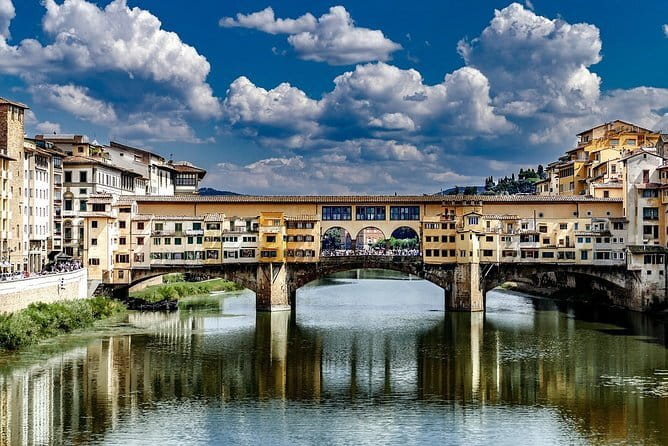
The Church and Museum of Orsanmichele gives the route a welcome change of pace. The stop lasts about 10 minutes and introduces sculpture associated with artists including Donatello, Ghiberti, Giambologna, Brunelleschi, Verrocchio, Sangallo, and Orcagna.
This building is valuable because it connects religion with the working life of the city. Florence’s public art was not created only for palaces and churches. Guilds and civic groups also used sculpture to show their importance, skill, and devotion.
The outdoor sculptures are part of what makes this stop practical for a short tour. You can learn how to look at the figures, their poses, and their placement without needing to spend an hour inside a museum. The museum admission is listed as free, but the tour still does not provide a long interior visit.
If you return later, you can give Orsanmichele more attention. During the walk, focus on the guide’s explanation and the way the building fits into the narrow street around it.
Piazza della Signoria and Medici Power
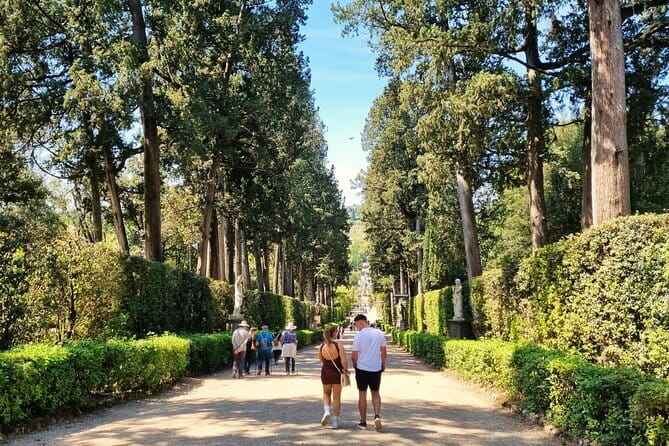
At Piazza della Signoria, the tour slows down for about 15 minutes. This is the route’s richest single stop for political history and public art.
You see Palazzo Vecchio, the Uffizi, the Loggia dei Lanzi, and the Torre di Arnolfo. The guide also points out references to Michelangelo’s David, Marzocco, Cosimo de’ Medici, and Cellini’s Perseus. Some works may be represented by copies or seen from outside, so use this section as a preview for later museum visits.
This square explains how Florence presented power in public. Palazzo Vecchio represents government and Medici rule, while the nearby Uffizi connects administration with art. The Loggia dei Lanzi works almost like an open-air sculpture gallery, allowing you to see major works without buying a ticket.
I find this part especially useful if you plan to visit the Uffizi or Palazzo Vecchio later. The guide gives you a visual framework, so the museum rooms make more sense when you return. You will know which names and subjects to watch for instead of wandering through a long sequence of paintings.
The square can also be one of the hardest places to hear. Stand close, avoid drifting behind the group, and save photographs for the pauses. The walk allows time for pictures, but it keeps moving.
Finishing at Santa Croce
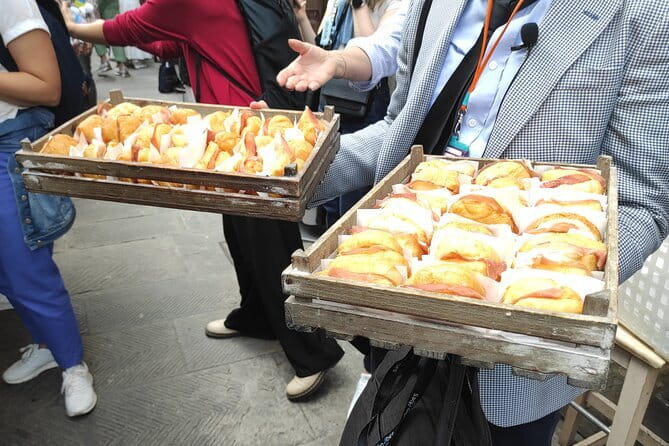
The final stop is the Basilica of Santa Croce, where the tour ends after roughly 10 minutes. The guide covers the basilica’s story and points out the monument to Dante.
Ending here is practical. Santa Croce is far enough from the starting point to make the walk feel like a real introduction, but the historic center remains compact enough for you to continue exploring afterward. The end point is in front of the Basilica di Santa Croce at Piazza di Santa Croce, 18R.
Santa Croce also gives the tour a fitting final note. The church is tied to Florence’s religious, artistic, and literary identity, and Dante’s monument adds a reminder that the city’s story is not limited to the Medici or Renaissance painters.
As with the other churches, the stop is mainly exterior orientation. Admission to the tour stops is not included as an interior experience, even where the stated attraction entry is free. If you want to visit Santa Croce properly, plan a separate visit.
The Real Value of a $3.63 Tour
At $3.63 per person, this is an unusually inexpensive way to spend a morning in Florence. The price covers access to a guide, not paid entry to the Duomo, Uffizi, Santa Croce, or other major interiors.
The format is essentially tip-based. The low fee gets you into the group, while you decide what the guide’s work was worth at the end. You should understand that before booking. A tip is not a hidden admission charge, but it is an important part of the arrangement.
For me, the value is strongest when you use the walk as a launchpad. You get a city map, a list of places to revisit, practical suggestions about food and toilets, and clues such as the wine windows. You then choose where to spend your museum money.
The cost is less attractive if you want a quiet, highly controlled tour with headsets and extensive time inside monuments. In that case, a conventional paid tour may suit you better, even though it will cost more.
Timing, Group Size, and Sound
The experience lasts approximately two hours and 15 minutes and begins at 10:30 a.m. That timing works well for a first morning in Florence or for a later day when you want a quick review of the center.
The stated maximum is 20 people. That is a reasonable size for a walking tour, but group numbers can matter greatly in Florence’s crowded squares. One particularly poor experience involved more than 40 people, with the guide’s mini-speaker unable to carry across the group. The provider acknowledged that this was not the normal plan and said groups should generally remain around 20 to 25.
You cannot control the final group size, but you can protect your experience. Arrive early, stay near the guide, and speak up if you cannot hear. This is not a minor detail. A brilliant explanation is useless if it reaches only the first few rows.
The walk requires good weather and a minimum number of bookings. If poor weather cancels it, you are offered another date or a full refund. If the minimum is not met, you are offered another option or a refund. Normal cancellation is free up to 24 hours before the start time.
Who Should Book This Florence Walk?
I would recommend it most strongly to first-time visitors who want a fast introduction before choosing museums and churches for deeper visits. It also suits anyone on a tight budget, since the cost is small and the route covers many of Florence’s major outdoor sights.
It works well for curious walkers who enjoy stories, architecture, and practical local suggestions. The guides have been praised for speaking English clearly and for adding useful advice beyond the official route. Ask about less obvious sights, food stops, viewpoints, and details such as the wine windows.
You should think twice if you have hearing difficulty, dislike group walking, or want long periods inside monuments. The route is brisk, and each stop is measured in minutes. It is designed to cover the city’s main points, not to examine every church or sculpture in detail.
Service animals are allowed, the route is near public transportation, and most people can participate. The information provided does not give a detailed accessibility assessment, so contact the provider directly if you need specific help with mobility or hearing.
Should You Book It?
Book this tour if you want a cheap, energetic introduction to Florence and understand that the real reward is orientation, storytelling, and practical advice. The route is well chosen, the guides can add warmth and useful local knowledge, and the price leaves room in your budget for the museums you will discover along the way.
Skip it if you need guaranteed headphones, a very small group, or substantial interior access. For everyone else, it is a sensible first step into Florence, especially if you arrive without a firm plan and want to learn how the city’s great sights fit together.
FAQ
Where does the walking tour start?
The tour starts at 10:30 a.m. in front of the Basilica di Santa Maria Novella at Piazza di Santa Maria Novella, 4n, Florence.
Where does the tour finish?
It ends in front of the Basilica di Santa Croce at Piazza di Santa Croce, 18R, Florence.
How long does the tour last?
The walking tour lasts approximately two hours and 15 minutes.
What language is the tour offered in?
The tour is offered in English.
What sights are included on the route?
The route includes Santa Maria Novella, Via de’ Tornabuoni, Piazza della Repubblica, the Cathedral of Santa Maria del Fiore, Orsanmichele, Piazza della Signoria, and Santa Croce.
Are admission tickets included?
The walking tour does not include paid admission to the cathedral complex or other interiors. The listed stops are mainly outdoor visits and explanations.
How large is the group?
The maximum stated group size is 20 people. The provider notes that groups normally should not exceed about 20 to 25 people.
Can I cancel for a refund?
Yes. You can cancel up to 24 hours before the start time for a full refund. Poor weather or failure to meet the minimum number of bookings may also result in another date or a full refund.
Just added around Florence
- Palazzo Vecchio guided experience with entrance ticket★ 4.5 · 249 reviews
- Lucca Bikes and Bites with food tastings for Small Groups or Private★ 5.0 · 249 reviews
- Perfume Masterclass in Florence: Make your Own Personal Fragrance★ 4.5 · 253 reviews
- Florence Oltrarno Neighborhood Food & Wine Dine Around★ 5.0 · 253 reviews
- Florence: Cathedral, Dome and Terraces Guided Tour★ 4.5 · 253 reviews
- Florence: 1.5-hour Santa Croce Guided Experience★ 4.8 · 254 reviews
- Florence: Pitti Palace and Palatina Gallery Ticket and Tour★ 4.9 · 255 reviews
- Private Florence Tour by Golf Cart ETukTuk with Audio Guide★ 4.0 · 256 reviews
Walking Tours, compared.

Guided Walking Tour & Last Supper Visit with Ticket
Read our review →

Rialto Bridge & Offbeat Unusual Venice Walking Tour
Read our review →

Private 3 hrs Venice Tour: St Mark’s, Walking tour & Boat tour
Read our review →

Skip the line: Uffizi and Accademia Small Group Walking Tour
Read our review →Browse the lists this tour appears in