Review · TICKETS
Ticket to Piazza Navona Undergrounds Stadium of Domitian
Rome has another story beneath its streets. The Stadium of Domitian gives you a close look at the ancient masonry arena hidden under Piazza Navona, with an audio guide, display panels, and a short route that fits neatly into a day of sightseeing. I like the low $12.10 price and the chance to see a UNESCO-listed archaeological site without committing half a day. I also like the self-guided format, which lets you pause, read, and move at your own speed.
The main caution is scale. This is a small underground museum, not a second Colosseum. You descend about five metres below street level, see exposed walls, arches, columns, and fragments, then finish in roughly 40 to 50 minutes. If you want a major monument with grand views and huge remains, this may feel limited.
In This Review
- Quick reasons to consider the underground stadium
- What lies beneath Piazza Navona
- Finding the entrance at Via di Tor Sanguigna 3
- Descending five metres into the excavation
- Following the audio guide at your own speed
- Seeing Roman sports through the surviving walls
- The photos, displays, and optional 3D experience
- How long the visit takes and when it fits best
- Is $12.10 good value?
- Who will enjoy this visit most
- Booking, timing, and cancellation details
- Should you book the Stadium of Domitian?
- FAQ
- Where is the Stadium of Domitian entrance?
- How far underground is the site?
- How long does the visit take?
- Is an audio guide included?
- Is the experience offered in English?
- What does the ticket cost?
- Is the 3D or AI experience included?
- What are the opening hours?
- Can I cancel for a full refund?
- Are food and drinks included?
Quick reasons to consider the underground stadium
- Five metres below Piazza Navona: You see how modern Rome was built over an ancient sports venue.
- The first and only masonry stadium in Roman history: The site explains how the arena was used for athletic contests and public events.
- A useful audio guide: The handheld device gives background on the stadium, Piazza Navona, and Roman sports as you walk.
- A cool break from the Roman heat: The underground rooms offer a welcome change during a hot afternoon.
- Extra visual material: Displays include unpublished photographs, videos, and a paid AI or 3D experience showing how the stadium may have looked.
- A short, flexible stop: Plan on about 40 to 50 minutes, though a quick visit can take closer to 30 minutes.
What lies beneath Piazza Navona
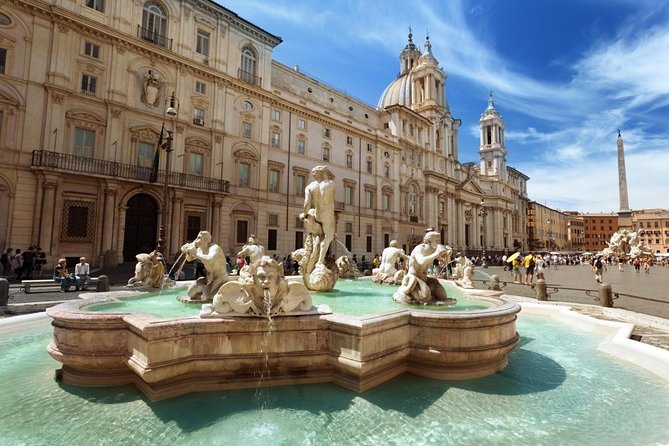
Piazza Navona is one of Rome’s most famous public spaces, known today for its fountains, church, artists, cafés, and open-air atmosphere. Far below the pavement is an older layer: the remains of the Stadium of Domitian, built during the Roman Empire.
The stadium was the first and only Roman stadium constructed entirely in masonry. That fact gives the site its importance. You are not simply looking at a few old stones beneath a famous square. You are seeing the remains of a purpose-built arena designed for athletic contests and public spectacles.
The excavation sits about five metres below street level. That vertical separation helps explain Rome’s layered character. Modern streets, medieval buildings, Renaissance façades, and ancient foundations all share the same city. One useful way to think about the visit is as a small lesson in Rome’s lasagna-like construction, with each period stacked over the last.
The archaeological area first opened to the public in 2014. It remains less familiar than the Colosseum, Roman Forum, or Pantheon, which can make it a calmer stop. You will not get the same monumental scale, but you may get a clearer look at how a specific ancient building worked.
A few more reviews worth comparing before you book
- Vatican: Museums & Sistine Chapel Entrance Ticket
★ 4.5 · 144,003 reviews - Vatican Museums & Sistine Chapel Tour with Optional Basilica
★ 4.3 · 67,413 reviews - Colosseum, Roman Forum & Palatine Guided Tour
★ 4.7 · 63,148 reviews
Finding the entrance at Via di Tor Sanguigna 3
The entrance is at Via di Tor Sanguigna, 3, near Piazza Navona. It is conveniently placed for a walking route around central Rome, and the site is close to public transportation.
Give yourself a few extra minutes to locate the doorway. The entrance can be easy to miss, and older directions referring to the nearby Raphael Hotel may be confusing because that hotel has closed. Look for the Stadium of Domitian entrance at street level rather than expecting a large monument or obvious gateway.
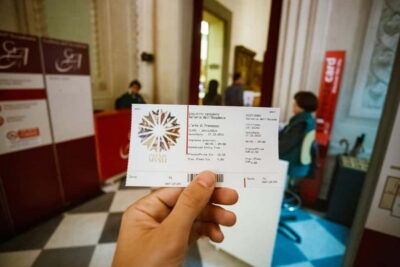
Your mobile ticket is accepted, and confirmation is provided at booking. The activity ends where it begins, so you can continue around Piazza Navona afterward. Since the visit is short, it works well between the Pantheon, Campo de’ Fiori, the Trevi Fountain, or another central Rome stop.
Opening hours are listed as 10 a.m. to 6 p.m., Monday through Sunday, for the stated operating period ending February 16, 2027. Because a private event once caused a booked visit to be disrupted, I would still check the current operating status close to your visit.
Descending five metres into the excavation
The first physical moment of the visit is the descent below the piazza. At five metres underground, the setting immediately changes. You leave the busy surface of Piazza Navona and enter a compact archaeological display arranged around the surviving stadium remains.
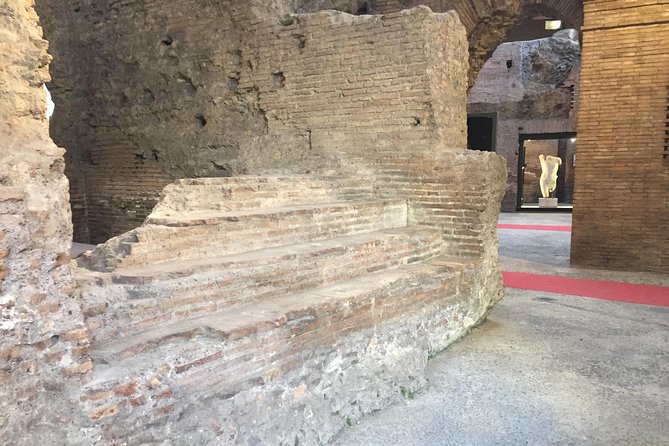
Expect a site built from fragments rather than a fully preserved arena. You may see sections of ancient masonry, brick columns, arches, broken statues, and structural remains that require some imagination. The stadium’s original size is difficult to grasp from the surviving pieces alone.
That is where the signs, photographs, videos, and audio guide help. They connect the partial walls in front of you with the larger building that once occupied the area. The displays also explain how Piazza Navona developed from the earlier stadium.
I would not rush through the ruins. Pause at the points where the walls curve or where the structure’s arrangement becomes easier to understand. The visit is not long, but the value comes from connecting the physical remains with the explanations.
Following the audio guide at your own speed
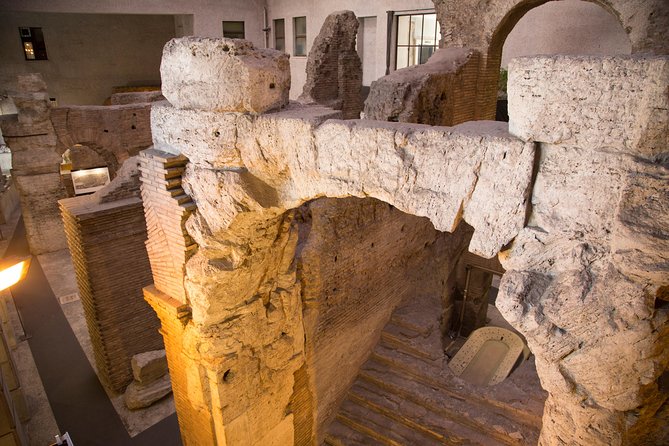
The audio guide is included in the admission price, and a children’s version is available for ages six and above. You receive a handheld device and follow the route through the exhibition.
At its best, the guide gives the ruins a clear purpose. It explains the Stadium of Domitian, the later story of Piazza Navona, and the role of sports in ancient Rome. Several sections also use reading panels and visual displays, so you are not dependent on sound alone.
The self-guided format is a good match for this site. You can stop the narration while examining a wall, skip ahead, or spend extra time with a display. I especially like this arrangement for families and mixed-interest groups, since nobody has to keep pace with a formal guide.
There is one practical weakness: audio equipment can fail. One visitor reported that a battery died early and staff did not offer a replacement. Another found the narration too long and repetitive, preferring the written panels. Most of the comments describe the audio as clear and informative, but it is sensible to check the device before setting off and ask for help immediately if it does not work.
The narration may feel slower than reading the signs. If you prefer a brisk visit, skim the panels and use the audio only for the sections that interest you. If you like stories and context, let the recording lead you through the site.
A different sort of day out around Rome:
- Vatican Museums, Sistine Chapel & St Peter’s Basilica Guided Tour
★ 4.5 · 39,149 reviews - Rome: Colosseum, Palatine Hill and Roman Forum Guided Tour
★ 4.8 · 32,814 reviews - Rome: Guided Tour of Colosseum, Roman Forum & Palatine Hill
★ 4.7 · 27,897 reviews - Rome: Colosseum & Forum with Audio Guide App -Optional Arena
★ 4.2 · 24,770 reviews
Seeing Roman sports through the surviving walls
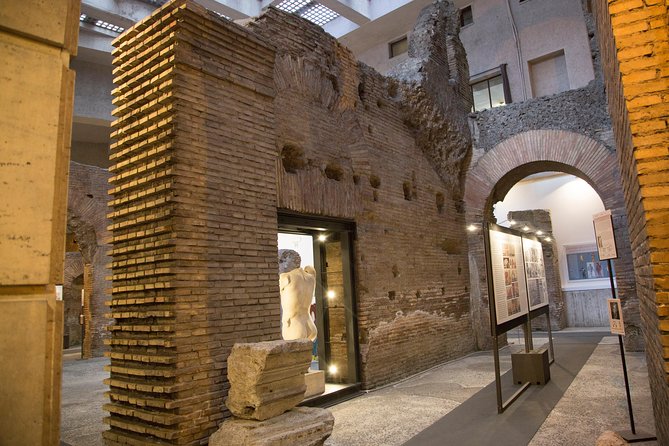
The stadium’s subject is more specific than the general story of ancient Rome. The focus is Roman sports and the use of a large public arena.
The audio guide and displays explain the stadium’s function, while the remains show how a masonry structure could support a large public venue. The site helps you picture a different kind of Roman spectacle, not simply the gladiatorial world most visitors associate with the Colosseum.
This distinction makes the visit worthwhile for anyone interested in architecture, public entertainment, or urban planning. You see how the stadium occupied the same ground now taken by one of Rome’s grandest piazzas.
The site cannot show every part of the original arena. Preservation and excavation are limited, so you will need to use the reconstructions and explanations to fill in the gaps. For some people, the broken remains are the point. For others, the limited amount of visible material may feel disappointing.
The photos, displays, and optional 3D experience
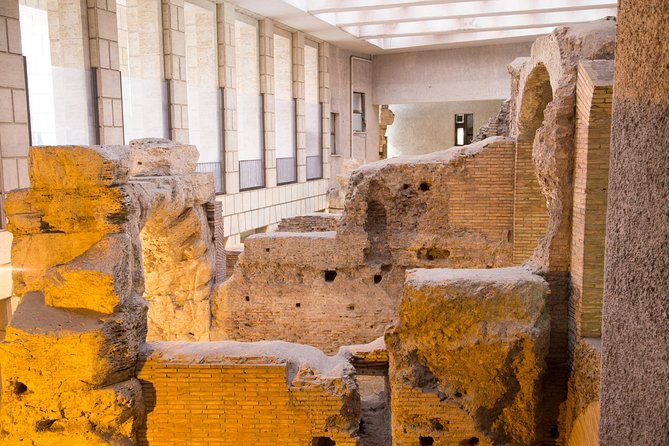
The exhibition includes unpublished photos, information panels, and multimedia material. These additions matter because the physical remains are incomplete. A photograph or reconstruction can make the relationship between the surviving foundation and the full stadium easier to understand.
A particularly useful feature is the 3D or AI experience, which costs about €4 extra. It shows how the stadium changed and how different parts may have looked in their original form. Several comments praise this visual element, especially the way it connects the small excavation with the full ancient building.
The extra charge is not included in the $12.10 admission. Signage about the additional cost may not be obvious, so ask before purchasing. The experience can add useful context, but you do not need it to visit the ruins or use the standard audio guide.
The on-site library and shop also carry art and history books, antique prints, postcards, artistic crafts, souvenirs, and multimedia DVDs. There is a children’s section. DVDs, souvenir photos, food, and drinks are not included in the ticket.
How long the visit takes and when it fits best
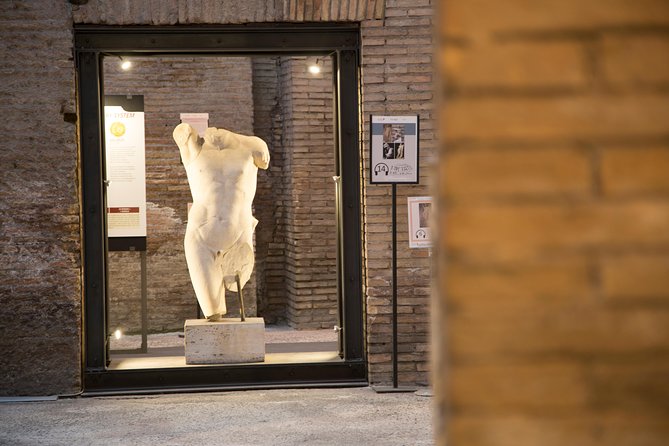
The advertised duration is about 40 to 50 minutes. A careful visit may take close to an hour, while a fast visit can take about 30 minutes.
That short length is one of the site’s strongest features. You can add it to a full day without losing time needed for Rome’s larger monuments. It also gives you an indoor, cooler stop during hot weather.
I would schedule it before or after a walk through Piazza Navona rather than treat it as a stand-alone destination across the city. The location makes it easy to combine with nearby sights, and the visit ends back at the same entrance.
The site is generally suitable for most people, and service animals are allowed. Comfortable walking shoes are recommended. The information provided does not specify detailed accessibility arrangements, so contact the venue directly if you need particular assistance.
Although the maximum capacity is listed as 150 people, the experience can feel quiet and uncrowded. That is a real advantage in central Rome, where the surface sights often fill quickly.
Is $12.10 good value?
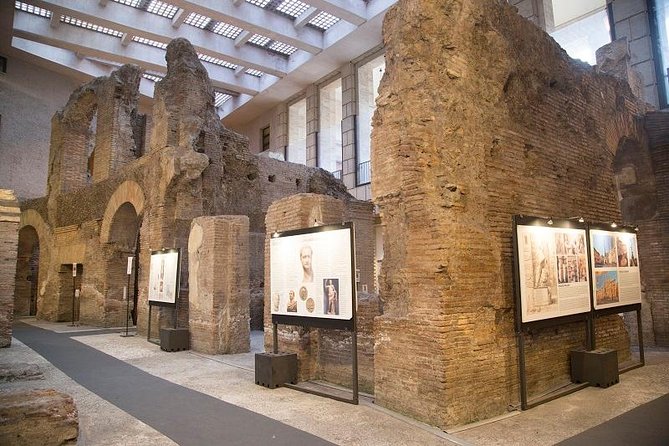
At $12.10 per person, this is an inexpensive archaeological stop by Rome standards. Admission includes the underground ruins, taxes, and the audio guide, with a child version for ages six and above.
The value depends on what you want from ancient sites. If you measure value by size and spectacle, the Colosseum and Roman Forum offer much more to see. If you value a focused explanation of one lesser-known place, this ticket works well.
I see it as a strong add-on rather than a replacement for Rome’s major monuments. The visit gives you a distinct subject, a cooler setting, and a manageable time commitment. It is also inexpensive enough that you do not need a perfect archaeological collection to feel satisfied.
The extra €4 visual experience changes the calculation slightly. I would consider it if you learn best from reconstructions or if the surviving walls are hard to picture. I would skip it if you are content with the panels and standard audio tour.
Who will enjoy this visit most
This experience suits you if you enjoy ancient architecture, archaeological layers, and self-guided museums. It is also a good choice for repeat visitors who have already seen the better-known monuments and want something new near Piazza Navona.
Families can benefit from the child audio guide, the short length, and the indoor setting. The visit does not require a full morning, and children who like models, reconstructions, or Roman sports may find the visual material helpful.
It also works well for solo visitors. You can move at your own pace without waiting for a group, and the compact route is easy to manage.
I would be more cautious if this is your first and only ancient Roman site. The visible remains are limited, and the experience depends on reading, listening, and imagining. Start with the Colosseum, Roman Forum, or another major site if you want Rome’s biggest visual impact, then add the underground stadium if time allows.
Booking, timing, and cancellation details
The experience is offered in English and uses a mobile ticket. It is often booked about 22 days ahead, so advance planning is sensible during busy periods, though the visit itself may not feel crowded.
Free cancellation is available up to 24 hours before the scheduled start time. Cancellations or changes made inside that 24-hour window are not accepted for a refund, and the cut-off follows local Rome time.
Because the venue has occasionally had scheduling problems connected with private events, confirm the opening details before you set out. This is especially important if your Rome itinerary leaves no spare time.
Should you book the Stadium of Domitian?
Book it if you want a short, affordable archaeological stop beneath one of Rome’s most famous squares. The audio guide, clear displays, and optional 3D material make the surviving ruins easier to understand, and the underground setting gives you a welcome break from heat and crowds.
Skip it if you expect a huge monument, broad excavated grounds, or a dramatic substitute for the Colosseum. The remains are modest, the audio narration may feel long, and the entrance can be hard to spot.
My advice is simple: add it to a Piazza Navona walking day, allow an hour, wear comfortable shoes, and check the audio device before you begin. At $12.10, it offers enough history and context to earn its place on the itinerary, especially for repeat visitors and anyone curious about what lies below Rome’s streets.
FAQ
Where is the Stadium of Domitian entrance?
The entrance is at Via di Tor Sanguigna, 3, 00186 Rome, near Piazza Navona. It can be difficult to spot, so allow extra time to find the doorway.
How far underground is the site?
The excavations are about five metres below street level.
How long does the visit take?
The expected duration is about 40 to 50 minutes. A shorter visit may take around 30 minutes, while a slower visit can last close to an hour.
Is an audio guide included?
Yes. An audio guide is included with admission, and a child audio guide is available for children aged six and above.
Is the experience offered in English?
Yes. The experience is offered in English.
What does the ticket cost?
The listed price is $12.10 per person. Taxes and the standard audio guide are included.
Is the 3D or AI experience included?
No. The optional visual experience costs about €4 extra and is not included in the admission price.
What are the opening hours?
The listed hours are 10 a.m. to 6 p.m., Monday through Sunday, during the stated operating period ending February 16, 2027.
Can I cancel for a full refund?
Yes, if you cancel at least 24 hours before the scheduled start time. Changes or cancellations made less than 24 hours before the start are not accepted for a refund.
Are food and drinks included?
No. Food and drinks are not included. Hotel pickup and drop-off are also not included.
Just added around Rome
- Rome City, Pantheon, and Trevi Fountain Walking Tour★ 5.0 · 249 reviews
- Rome: Skip the line Vatican Museums & Sistine Chapel Tour★ 4.2 · 251 reviews
- Rome: Tivoli Day Trip with Villa d’Este and Villa Adriana★ 4.5 · 251 reviews
- Transfer Rome center – Ciampino Airport★ 4.5 · 251 reviews
- Rome: Cannondale E-Bike Evening Tour with Optional Dinner★ 4.9 · 251 reviews
- VIP Colosseum, Roman Forum & Palatine Hill & Special Access Sites★ 4.5 · 252 reviews
- Private Vatican Museums Hidden Gems Tour with Optional Pick-Up★ 5.0 · 253 reviews
- Vatican Museums & Sistine Chapel Skip-the-Line Guided Tour★ 4.6 · 254 reviews
Tickets, compared.

Vatican: Museums & Sistine Chapel Entrance Ticket
Read our review →
Cathedral and Duomo’s Terraces Entrance Ticket
Read our review →

Skip-The-Line Uffizi Gallery Timed Entry Ticket
Read our review →
Naples Underground Entry Ticket and Guided Tour
Read our review →
Pantheon Fast-Track Ticket and Official Audio Guide
Read our review →
Pompeii: Entry Ticket and Guided Tour with an Archaeologist
Read our review →