
Review · WALKING TOURS
Rome: Jewish Ghetto Walking Tour
Rome keeps its oldest stories close. This 2.5-hour Jewish Ghetto walking tour moves from Trajan’s Column through ancient ruins, Jewish history, and Tiber Island, showing how different eras share the same few city blocks. I like the clever route, especially the Theater of Marcellus and Portico d’Ottavia, and I like the human stories that give the neighborhood meaning. The kosher gelato stop is a welcome treat, too.
I also like the guides’ ability to make a long stretch of history easy to follow. James, Angela, Daniel, Tom, and others have been praised for clear storytelling, patience, and good answers to questions. The main limitation is that the tour does not include a visit inside the Great Synagogue, so you see this important building from outside rather than exploring its interior.
In This Review
- Key points
- Starting at Trajan’s Column in the heart of Rome
- The Theater of Marcellus and Rome’s older stage
- Piazza Mattei and the Turtle Fountain
- Entering the Jewish Ghetto with context
- Portico d’Ottavia and the surviving ancient neighborhood
- The Great Synagogue and what you do not see inside
- Kosher gelato, with a useful pause
- Crossing to Tiber Island
- The guides make or break this experience
- Is $65 a fair price?
- Who should book this walking tour?
- Should you book it?
- FAQ
- Where does the Rome Jewish Ghetto walking tour begin?
- How long does the tour last?
- What language is the tour conducted in?
- What sites are included on the route?
- Does the tour enter the Great Synagogue?
- Is food included?
- What should I bring?
- Can I join if I arrive late?
- Can I cancel the booking?
Key points
- Ancient Rome before the Colosseum: See the Theater of Marcellus, an older Roman performance venue still woven into the modern city.
- A small fountain with a large story: Hear the tale of unrequited love at the Turtle Fountain in Piazza Mattei.
- Jewish Rome across centuries: Learn how the community lived through restriction, persecution, survival, and renewal.
- Kosher gelato included: Pause at a gelateria for homemade kosher gelato or coffee.
- A moving finish on Tiber Island: Cross Rome’s oldest functioning bridge and hear about wartime rescue at the island hospital.
- Strong guiding is central: The best part of this experience is the guide’s storytelling, with names such as James, Angela, Daniel, Tom, and Maria receiving especially warm praise.
Starting at Trajan’s Column in the heart of Rome

The tour begins at Foro Traiano 84, near Trajan’s Column. Look for the orange Roman Vacations sign. This is a useful central meeting point, but Rome’s historic center can be confusing, so arrive early rather than trying to find the group at the last minute.
You are not starting in the Jewish Ghetto itself. That is a strength. The opening walk places the neighborhood within the larger story of Rome, beginning with imperial monuments and moving toward the river. You get a sense of how the city grew in layers instead of treating the Jewish quarter as an isolated stop.
The guide leads in English, and the pace is generally suited to sightseeing on foot. Several guides have adjusted their speed for people who needed to walk slowly, and small groups have made it easier to hear and ask questions. Still, this is a walking tour over ancient streets and bridges, so comfortable shoes matter more than stylish ones.
Arrive on time. The group cannot wait for late arrivals, and missed tours are not refunded. That rule is worth taking seriously in Rome, where a wrong turn or crowded pavement can cost you several minutes.
More Walking Tours in Rome
- Rome: Trastevere & Campo de Fiori Street Food Walking Tour
★ 4.9 · 2,768 reviews - Rome: Paranormal Night Walking Tour & Secret Backstreets
★ 4.9 · 1,921 reviews - Rome by Night Walking Tour – Legends & Criminal Stories
★ 4.5 · 1,003 reviews
The Theater of Marcellus and Rome’s older stage
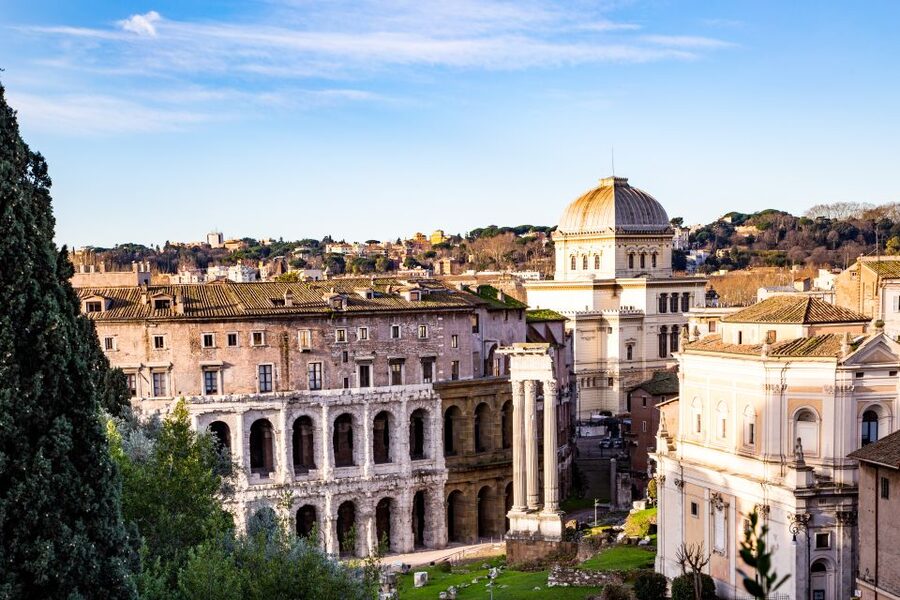
The first substantial stop is the Theater of Marcellus, with about 20 minutes for explanation. Many people arrive in Rome thinking the Colosseum is the city’s great ancient theater. The Theater of Marcellus is older, and it offers a quieter way to understand Roman public life.
The structure is especially interesting because it has been used and reused over time. Ancient masonry forms the base, while later buildings sit above and around it. Your guide can help you read those layers, which is difficult to do alone when all you see at first is a weathered curve of stone.
This stop also sets the tone for the rest of the walk. You are not simply checking off famous monuments. You are looking at how Rome’s old structures survived by becoming part of later neighborhoods.
The drawback is that this is a guided exterior visit, not a long archaeological exploration. If you want extended time inside ancient sites, this tour is not designed for that. Its value comes from context and connection, not from spending an hour at one monument.
Piazza Mattei and the Turtle Fountain
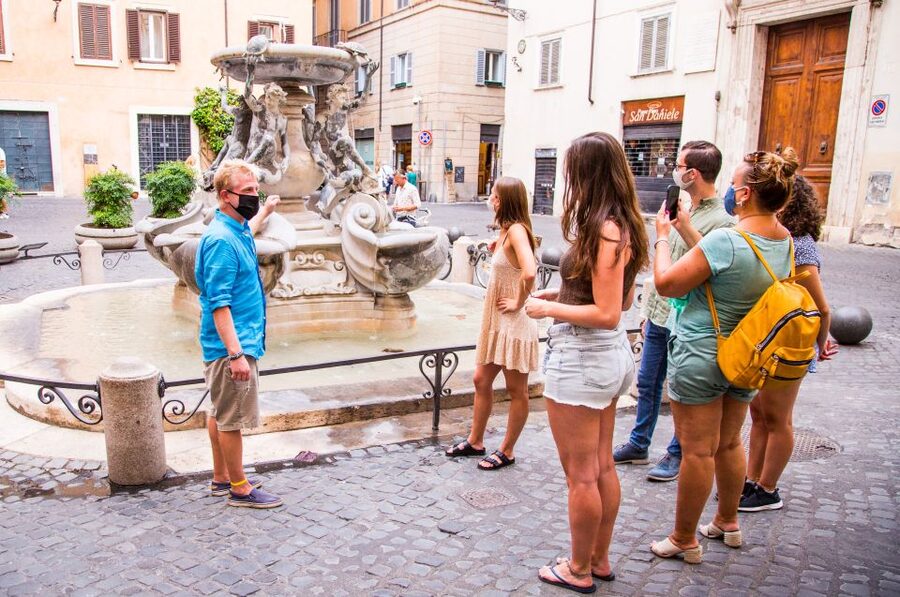
The walk continues to Piazza Mattei, home to the Fontana delle Tartarughe, or Turtle Fountain. The guide spends around 20 minutes here, explaining the fountain and the story of unrequited love connected with it.
This is the sort of stop that benefits from a guide. The fountain is relatively small, and you could easily pass through the square without realizing that its figures and turtles carry a local tale. The story gives the piazza a personal touch after the grand scale of imperial Rome.
I like this change of mood. The tour moves from state power and public entertainment to romance, family ambition, and neighborhood life. These smaller stories help keep the walk from becoming a string of dates and rulers.
Piazza Mattei is also a good place to pause and look around. The square helps you notice the intimate scale of the quarter, where fountains, doorways, restaurants, and worn stone surfaces sit close together. The guide’s storytelling is important here. Angela has been praised for her energy and humor, while James is known for adding small anecdotes that make the setting easier to remember.
Entering the Jewish Ghetto with context

The central portion of the tour focuses on the Jewish Ghetto of Rome. You spend roughly 20 minutes in the neighborhood itself, but the Jewish history continues through the later stops at Portico d’Ottavia, the Great Synagogue, and Tiber Island.
The word ghetto carries a heavy meaning here. The tour explains the wall that confined Rome’s Jewish community for centuries, including the last remaining piece of that barrier. Seeing a surviving section makes the policy of separation more concrete than a lecture alone can do.
This part of the walk deals with a difficult past, including restrictions and atrocities. The strongest guides handle the subject with care while keeping the story clear. Angela has been singled out for presenting the community’s experience with passion, and Daniel has been praised for bringing the streets to life through stories rather than a dry list of facts.
You do not need to be Jewish to find this worthwhile. The tour connects Jewish life in Rome with the broader story of Italy, and it shows how a community maintained its identity through centuries of pressure. Several guides also connect ancient Roman events with later periods, giving you a clearer sense of how Rome’s political and religious changes affected ordinary people.
This is also the point where the tour becomes more than sightseeing. Memorial markers and small signs can be easy to overlook while walking around Rome. After the tour, you may recognize them elsewhere in the city and understand why they matter.
More guided walks:
- Rome: Guided City Center Evening Sightseeing Walking Tour
★ 4.4 · 953 reviews - Best of Rome Walking Tour including Trevi Fountain
★ 4.5 · 923 reviews - Rome: Under the Moonlight Evening Walking Tour
★ 4.8 · 852 reviews - Rome: Forbidden History Walking Tour & Pub Crawl with Drinks
★ 4.9 · 688 reviews
Portico d’Ottavia and the surviving ancient neighborhood
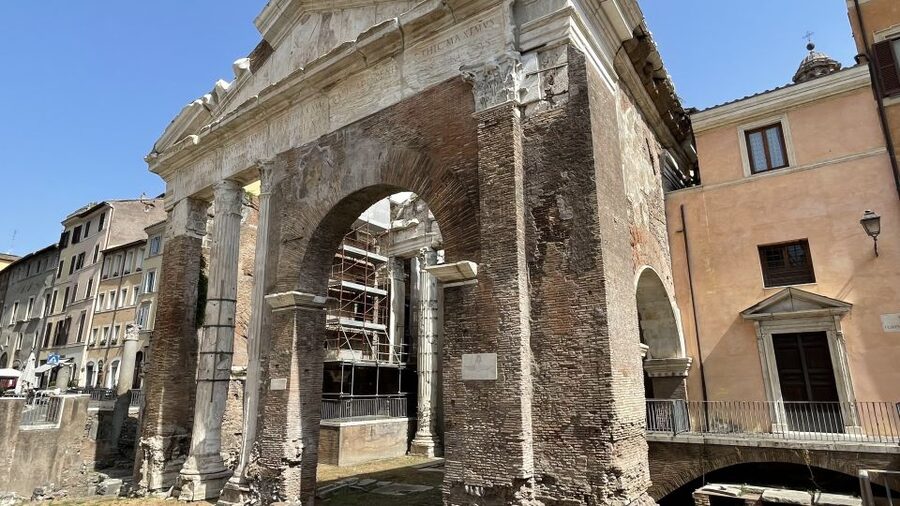
The Portico d’Ottavia receives about 15 minutes of guided attention. This ancient structure is one of the tour’s best links between Roman antiquity and Jewish Rome.
The remains are not displayed in isolation. They sit beside streets and buildings tied to the Jewish quarter, showing how one community lived among monuments created long before it arrived. Your guide explains how the ancient portico was used and how the surrounding area changed over time.
That physical closeness is the point. In Rome, a two-thousand-year-old ruin may be beside a working restaurant, a residence, or a religious building. The Portico d’Ottavia helps you see the Jewish Ghetto as a living neighborhood built around older remains, not as a museum frozen in one period.
A guide such as Tom can add useful background here. He has been praised for explaining several thousand years of Roman history in clear, manageable pieces. That skill matters because this part of Rome can become confusing quickly. Ancient temples, medieval changes, Jewish traditions, and modern memorials all overlap.
You should not expect a full archaeological tour of the portico. The stop is short, and the purpose is to understand its place in the neighborhood. If you want detailed architectural measurements or a long excavation visit, you may want to return on your own.
The Great Synagogue and what you do not see inside
The route passes the Great Synagogue of Rome, one of the most important buildings in the neighborhood. Its exterior gives the tour a clear focal point as the guide explains the modern Jewish community and the long path that led to this place.
The synagogue is more than a photo stop. It represents survival and continuity after centuries of confinement and upheaval. The guide’s explanation helps you connect the building with the people and events discussed earlier.
Be aware that the walking tour does not include entry inside the synagogue. That is the clearest missing piece for readers hoping for an interior visit. Several people have wished for a synagogue visit, so check separate opening arrangements if seeing the inside is important to you.
If you are visiting on a Friday afternoon, plan carefully. The Sabbath begins around that time, and one guide specifically advised against scheduling this tour just before it starts. Religious sites and local activity may affect what you can see and how comfortably the walk proceeds.
If you enter any church during the experience, bring something to cover bare shoulders. This is a simple requirement, but it is easy to forget during Rome’s hot months.
Kosher gelato, with a useful pause
The tour includes homemade kosher gelato or coffee at a gelateria. Extra food and drinks are not included, so the included refreshment is a modest but welcome part of the price.
I like this pause because it breaks up a serious subject without turning the tour into a food crawl. You get a taste associated with the neighborhood while keeping the main focus on history and people. Some tour experiences can feel relentlessly academic. A short food stop makes the afternoon more relaxed.
The gelato should not be the reason you book. The information about kosher food traditions and Jewish life is the real value. Also, the provided details do not promise a full meal, and the experience can vary between gelato and coffee, so eat beforehand if you need something substantial.
Crossing to Tiber Island
The final section leads across Rome’s oldest functioning bridge to Tiber Island. You spend about 15 minutes on the island, where the guide explains both the hospital’s role during World War II and the story of Asclepius connected with the temple that is now a church.
This ending works well because it carries the Jewish story beyond the official boundaries of the Ghetto. The hospital’s wartime actions show how people in and around Rome responded during a dangerous period. The story of Asclepius adds another layer, linking ancient healing traditions with the Christian building that occupies the site today.
Tiber Island also gives the walk a natural sense of completion. You have moved from Trajan’s Column toward the river, through ancient theaters, fountains, confinement walls, religious buildings, and memorials. The route is not just a tour of one neighborhood. It is a compact lesson in how Rome’s political, religious, and cultural past continues to occupy the present city.
The island stop is brief, so do not expect a full tour of every feature there. The guide uses it as a final place to connect the main themes and answer questions.
The guides make or break this experience
The strongest praise for this tour is directed at the guides. James is repeatedly described as an excellent storyteller who can explain Roman and Jewish history in a way that keeps teenagers interested. Angela is praised for warmth, humor, enthusiasm, and her clear connection to the subject. Daniel receives high marks for patience and for keeping a comfortable pace, while Tom is valued for turning huge stretches of history into understandable sections.
Maria has also been praised for encouraging thoughtful discussion and linking past events with present concerns. Paul E is described as especially good at weaving past and present together. These comments point to the tour’s real advantage: the quality of the person leading it matters as much as the route.
Group size can vary. Some departures have been small enough to feel almost private, while other groups may be larger. A small group makes it easier to hear, ask questions, and adjust the pace. You should also remember that a private-feeling departure is not guaranteed.
Is $65 a fair price?
At $65 per person, this is not the cheapest way to walk through the Jewish Ghetto. You can see many exterior sights without paying for a guide. The question is what you want from the visit.
I think the price is fair if you want the history explained properly. In 2.5 hours, you cover ancient Rome, the Jewish Ghetto, the Portico d’Ottavia, the Great Synagogue area, kosher food, and Tiber Island. The guide adds meaning to places that otherwise may look like attractive ruins and pleasant squares.
The value is strongest for first-time visitors, families, and anyone who wants a clear story rather than scattered facts. It is also useful if you have limited time in Rome and want several connected sights in one walk.
The price is less convincing if you expect inside access to the Great Synagogue, a full meal, or extended time at each site. You are paying for a guided overview and historical interpretation, not entry tickets or a food tour.
Free cancellation up to 24 hours before the start and the option to reserve now and pay later make the booking less rigid. The tour operates in all weather, so your clothing and timing matter.
Who should book this walking tour?
I would choose this tour if you want to understand the Jewish Ghetto as part of Rome’s larger story. It suits curious first-time visitors, families with older children or teenagers, history fans, and anyone who prefers local streets to another large museum.
It is also a good choice for non-Jewish visitors. The subject is presented as an important part of Rome’s civic and cultural history, not as a specialist topic reserved for one audience.
You should think twice if you dislike walking, need frequent indoor breaks, or want to spend most of your time inside monuments. Wear comfortable shoes, carry water, use sunscreen, and bring a hat in hot weather. An umbrella and weather-appropriate clothing are sensible because the tour continues in rain or shine.
Should you book it?
Book this tour if you want Rome explained through people and places, not just monuments. The combination of the Theater of Marcellus, Turtle Fountain, Jewish Ghetto, Portico d’Ottavia, Great Synagogue, kosher gelato, and Tiber Island gives you a strong two-and-a-half-hour introduction.
I would especially recommend it if you can join a small group or if you enjoy asking questions. Just arrive early, avoid Friday afternoon before the Sabbath, and do not book it expecting to enter the synagogue. With those limits understood, this is a thoughtful and well-paced way to see one of Rome’s most important neighborhoods.
FAQ
Where does the Rome Jewish Ghetto walking tour begin?
The meeting point is Foro Traiano 84, near Trajan’s Column. Look for an orange Roman Vacations sign.
How long does the tour last?
The tour lasts 2.5 hours.
What language is the tour conducted in?
The live guided tour is conducted in English.
What sites are included on the route?
The route includes the Theater of Marcellus, the Turtle Fountain in Piazza Mattei, the Jewish Ghetto, the Portico d’Ottavia, the Great Synagogue area, and Tiber Island.
Does the tour enter the Great Synagogue?
No. The tour passes the Great Synagogue and discusses its importance, but entry inside is not included.
Is food included?
The tour includes kosher gelato or coffee at a gelateria. Additional food and drinks are not included.
What should I bring?
Bring comfortable shoes, a sun hat, sunscreen, a reusable water bottle, an umbrella, and clothing suited to the weather. Bring a cover for bare shoulders if you enter a church.
Can I join if I arrive late?
No. The tour cannot be delayed for late arrivals, and missed tours or late arrivals are not refunded.
Can I cancel the booking?
You can cancel up to 24 hours before the tour for a full refund. You can also reserve now and pay later.
Just added around Rome
- Rome City, Pantheon, and Trevi Fountain Walking Tour★ 5.0 · 249 reviews
- Rome: Skip the line Vatican Museums & Sistine Chapel Tour★ 4.2 · 251 reviews
- Rome: Tivoli Day Trip with Villa d’Este and Villa Adriana★ 4.5 · 251 reviews
- Transfer Rome center – Ciampino Airport★ 4.5 · 251 reviews
- Rome: Cannondale E-Bike Evening Tour with Optional Dinner★ 4.9 · 251 reviews
- VIP Colosseum, Roman Forum & Palatine Hill & Special Access Sites★ 4.5 · 252 reviews
- Private Vatican Museums Hidden Gems Tour with Optional Pick-Up★ 5.0 · 253 reviews
- Vatican Museums & Sistine Chapel Skip-the-Line Guided Tour★ 4.6 · 254 reviews
Walking Tours, compared.

Guided Walking Tour & Last Supper Visit with Ticket
Read our review →

Rialto Bridge & Offbeat Unusual Venice Walking Tour
Read our review →

Private 3 hrs Venice Tour: St Mark’s, Walking tour & Boat tour
Read our review →

Skip the line: Uffizi and Accademia Small Group Walking Tour
Read our review →Browse the lists this tour appears in