
Review · WALKING TOURS
Rome: Fountains and Squares Small-Group Walking Tour
Rome rewards walking slowly. This tour links the Spanish Steps, Pantheon, Piazza Navona, and Trevi Fountain in one clear route, while a licensed English-speaking guide adds the stories that are easy to miss on your own. I like the sensible two-and-a-half-hour length and the chance to step inside the Pantheon and Sant’Ignazio Church, not just admire them from the street.
I also like the small-group format, capped at 20 people, though groups of around 10 are likely to feel more comfortable when the guide is explaining something in a crowded square. The main drawback is simple: this is a walking tour with no indoor shelter built into most of the route, so rain, cold, heat, and tired feet can affect your experience. Wear proper church-covering clothing, and arrive early.
In This Review
- Key points at a glance
- Why this Rome walking tour works well
- Meeting at the Spanish Steps
- Bernini’s half-sunken boat in Piazza di Spagna
- Piazza Navona and the Stadium of Domitian
- Inside the Pantheon, Rome’s ancient survivor
- The Column of Marcus Aurelius and a movie connection
- Sant’Ignazio and the painted dome illusion
- Ending at the Trevi Fountain
- What the $45.55 price gives you
- Pace, clothing, and weather
- Who should book it
- Should you book this Rome fountains and squares tour?
- FAQ
- How long does the Rome fountains and squares tour last?
- Where does the tour start?
- How will I recognize the guide?
- What language is the tour conducted in?
- What sights are included?
- Can I enter the Pantheon?
- Are food and drinks included?
- Can I bring a stroller or wheelchair?
- What happens if I need to cancel?
Key points at a glance
- Start beneath the Spanish Steps: Meet by the Keats and Shelley Museum, in front of the Acqua di Parma store.
- See Bernini’s Fontana della Barcaccia: The half-sunken boat gives Piazza di Spagna its theatrical Roman touch.
- Enter the ancient Pantheon: This is more than a photo stop, since you go inside the remarkably intact Roman temple.
- Explore Baroque Piazza Navona: Bernini’s Fountain of the Four Rivers anchors one of Rome’s most impressive public spaces.
- Look up inside Sant’Ignazio: The church’s painted dome uses trompe l’oeil to create an illusion of architecture where there is no real dome.
- Finish with the Trevi Fountain: Bring a coin and make the traditional wish to return to Rome.
Why this Rome walking tour works well
The route is a good introduction to central Rome because it connects famous sights without wasting time on transport. You move through several centuries in a compact area: ancient Roman engineering, Renaissance church design, Baroque sculpture, and modern Roman street life all appear within a few minutes of one another.
I would consider booking it early in your stay. One strong benefit of a guided first walk is orientation. You get a feel for the historic center, hear suggestions for other places to visit, and begin to understand how Rome’s major sights fit together. One traveler specifically described the tour as a useful way to get your bearings, then recommended adding the Colosseum and Forum, along with Villa Borghese, on other days.
The guides receive the most consistent praise. Stefano is repeatedly singled out for his humor, energy, patience, and ability to make facts easy to follow. Bruno is praised for being warm and flexible, and even treating one group to tiramisu. Matteo, Andrea, and Paolo also receive strong praise for keeping the walk informative without making it dull.
That matters here. Rome can overload you with dates, emperors, popes, artists, and competing claims about who designed what. A good guide gives you a thread to follow. The best feedback describes guides who kept the pace comfortable, made sure everyone could hear, and added humor without turning the tour into a comedy act.
More Walking Tours in Rome
- Rome: Trastevere & Campo de Fiori Street Food Walking Tour
★ 4.9 · 2,768 reviews - Rome: Paranormal Night Walking Tour & Secret Backstreets
★ 4.9 · 1,921 reviews - Rome by Night Walking Tour – Legends & Criminal Stories
★ 4.5 · 1,003 reviews
Meeting at the Spanish Steps
Your starting point is easy to recognize if you use the Keats and Shelley Museum as your marker. Meet the guide by the entrance at the bottom of the Spanish Steps, in front of the Acqua di Parma store. Look for a GETYOURGUIDE badge or sign.
Arrive 10 minutes before the stated start time. This is not a suggestion to ignore. One detailed account warns that arriving even a couple of minutes late may mean missing the group, so allow extra time to reach Piazza di Spagna and locate the meeting point.
The Spanish Steps give the tour a dramatic opening. You can follow the staircase upward toward Trinità dei Monti, the late Renaissance church at the top. The steps themselves are a famous Roman gathering place, but the guide helps shift your attention from the crowds and photographs to the way the staircase links the lower piazza with the church above.
Because the tour starts at street level and immediately involves stairs, it is not suitable for wheelchair users. Strollers are also not permitted because of the route. Children under 10 cannot join, so this experience is aimed at older children, teenagers, and adults who can manage a steady city walk.
Bernini’s half-sunken boat in Piazza di Spagna
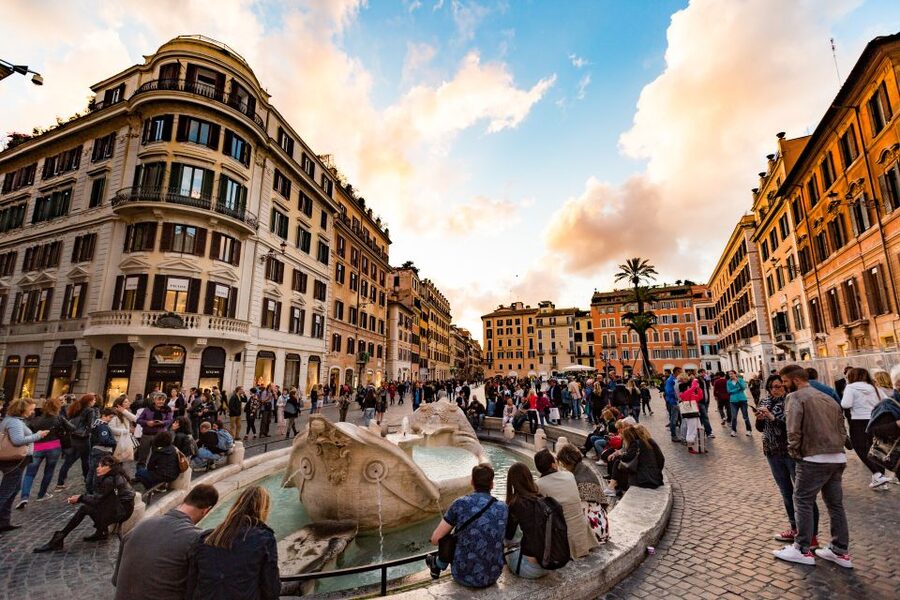
At the foot of the Spanish Steps, you see Gian Lorenzo Bernini’s Fontana della Barcaccia, the fountain shaped like a partly submerged boat. It looks playful at first, but its low design also reflects the practical problem of water pressure in this part of Rome.
This is an excellent early stop because it introduces the Baroque taste for movement, surprise, and theatrical design. The boat seems to be settling into the water rather than sitting formally above it. I like this kind of explanation because it gives you something to look for beyond the usual quick photograph.
The area can be crowded, and the fountain is surrounded by people moving in several directions. Stay close to the guide and listen carefully. A group of 10 may gather around the fountain without much trouble, while the maximum group of 20 can make the presentation harder to hear.
Piazza Navona and the Stadium of Domitian
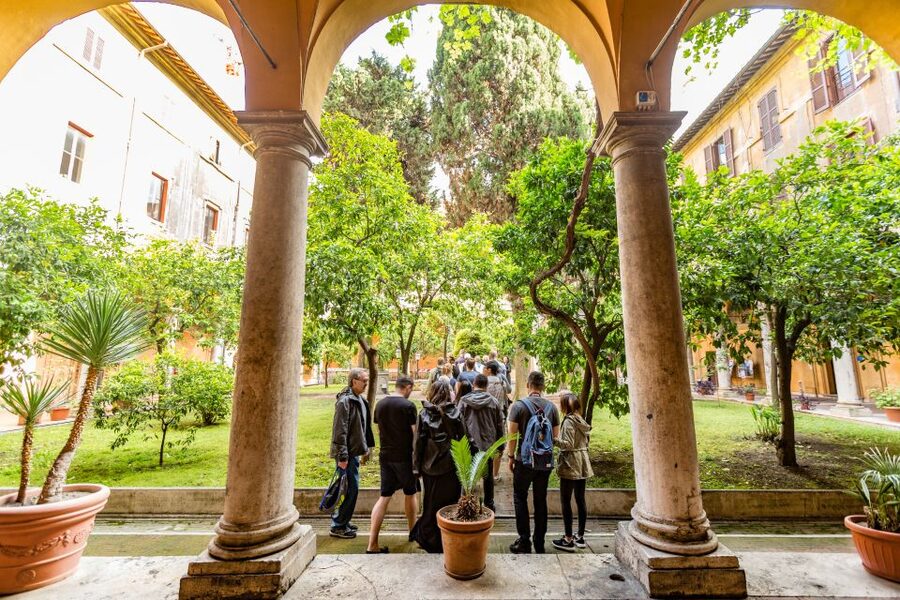
The route continues to Piazza Navona, one of Rome’s grandest squares. Its long, open shape is not accidental. The piazza follows the footprint of the Stadium of Domitian, built in 85 A.D. for athletic games.
This is one of the tour’s most useful historical connections. You are not just looking at a Baroque square. You are seeing how later Rome reused the outline of an ancient Roman sporting venue. The changing layers are part of what makes central Rome so rewarding: modern cafés and street activity occupy a space shaped by an ancient stadium and transformed by Renaissance and Baroque patrons.
Piazza Navona is also the tour’s main showcase for Bernini and Francesco Borromini. Bernini’s Fountain of the Four Rivers sits at the center, with monumental figures representing four major rivers. The fountain is full of motion and detail, so a guide can point out features you might otherwise pass without understanding.
Allow yourself time to look beyond the fountain. The surrounding buildings and churches form a grand stage, and the square works best when you compare its open space with the tighter streets that lead into it. The downside is that this is one of the stops where crowd noise can interfere with explanations. Stand near the guide rather than drifting to the edge for a better photograph.
More guided walks:
- Rome: Guided City Center Evening Sightseeing Walking Tour
★ 4.4 · 953 reviews - Best of Rome Walking Tour including Trevi Fountain
★ 4.5 · 923 reviews - Rome: Under the Moonlight Evening Walking Tour
★ 4.8 · 852 reviews - Rome: Forbidden History Walking Tour & Pub Crawl with Drinks
★ 4.9 · 688 reviews
Inside the Pantheon, Rome’s ancient survivor
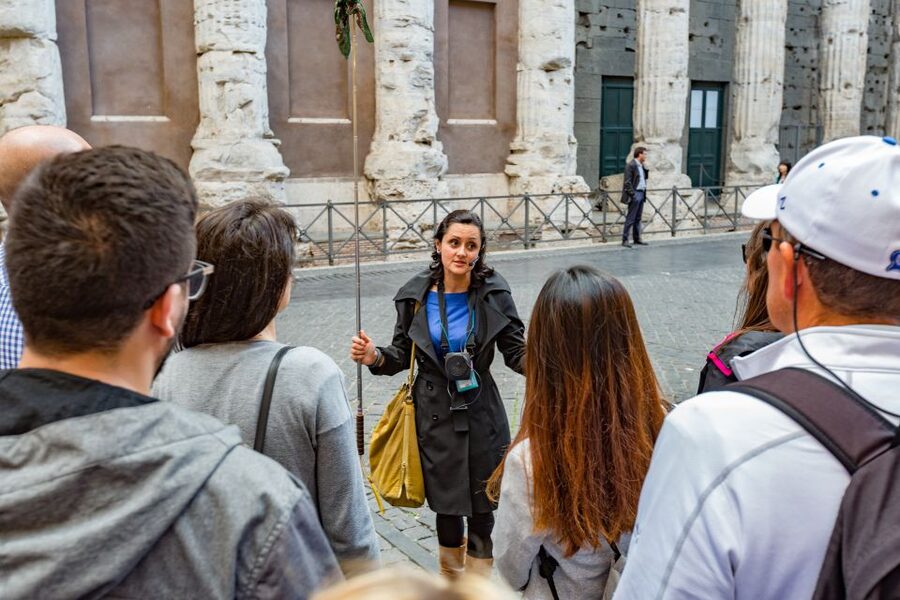
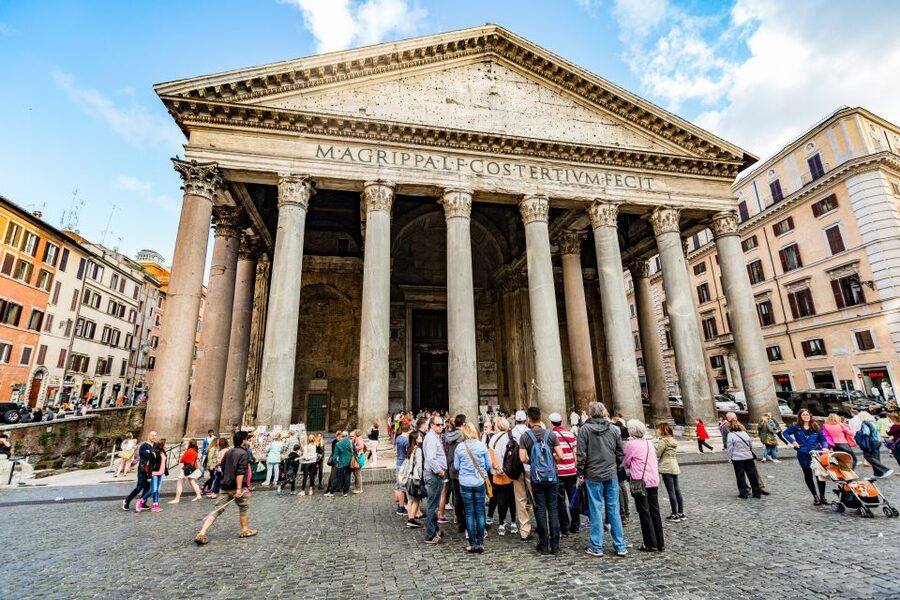
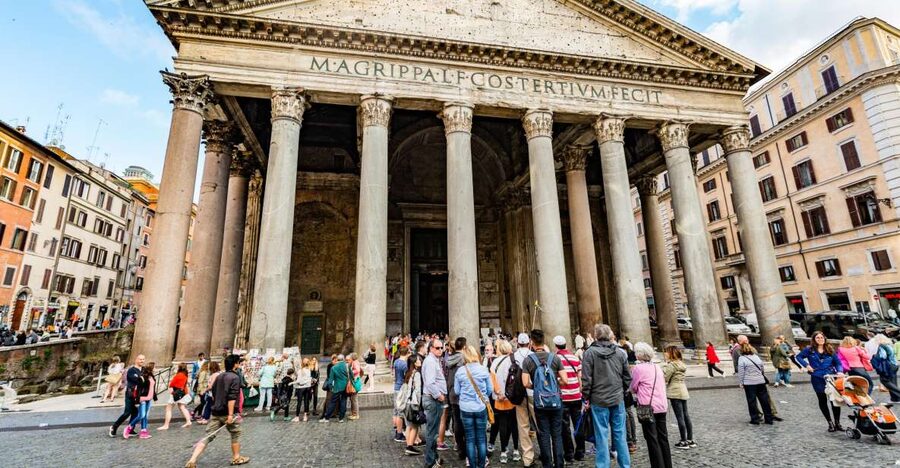
The Pantheon is a major reason to choose this walk over a simple outdoor orientation tour. You go inside a remarkably intact Greek-Roman temple, a rare chance to experience an ancient building as an interior rather than as a ruined shell.
From the outside, the familiar columns and pediment can look almost too perfect. Inside, the scale makes more sense. The Pantheon was designed to impress through proportion and geometry, and the guide can help you read the building rather than simply take a picture at the doorway.
The visit is also a welcome pause from the streets. Much of the tour takes place outdoors, so stepping inside gives your feet and attention a short break. Church and monument rules still apply, so dress modestly and carry something that covers your shoulders and knees.
Entry conditions can change at historic sites, and the supplied details do not promise a reserved time or priority access. Treat the Pantheon visit as an included part of the route, but do not expect a private or extended visit. The purpose is to see the interior and understand its place in the city’s story.
The Column of Marcus Aurelius and a movie connection
After the Pantheon, the walk reaches the carved Column of Marcus Aurelius. Its reliefs show scenes from military campaigns, spiraling upward around the column in the same general tradition as Trajan’s Column.
The tour also connects the column’s carved scenes with the film Gladiator. That makes this stop useful for anyone who enjoys seeing how ancient Roman imagery continues to shape modern popular culture. You will not be watching film locations as such, but you can consider how Rome’s monuments have supplied visual material for historical movies.
This is a good example of the tour’s range. It does not focus only on fountains or only on churches. Instead, it uses central Rome’s monuments to show how the city’s ancient, religious, artistic, and cinematic identities overlap.
Sant’Ignazio and the painted dome illusion
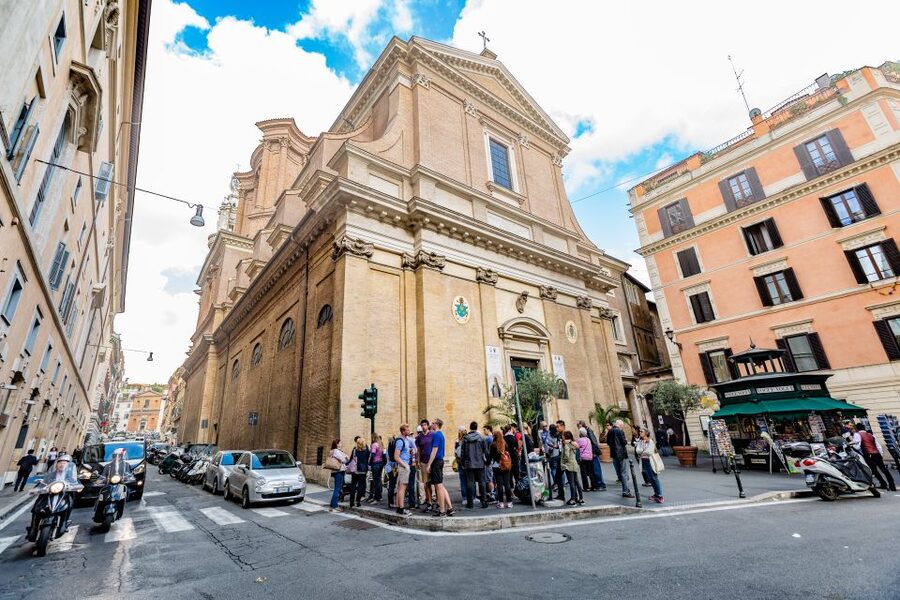
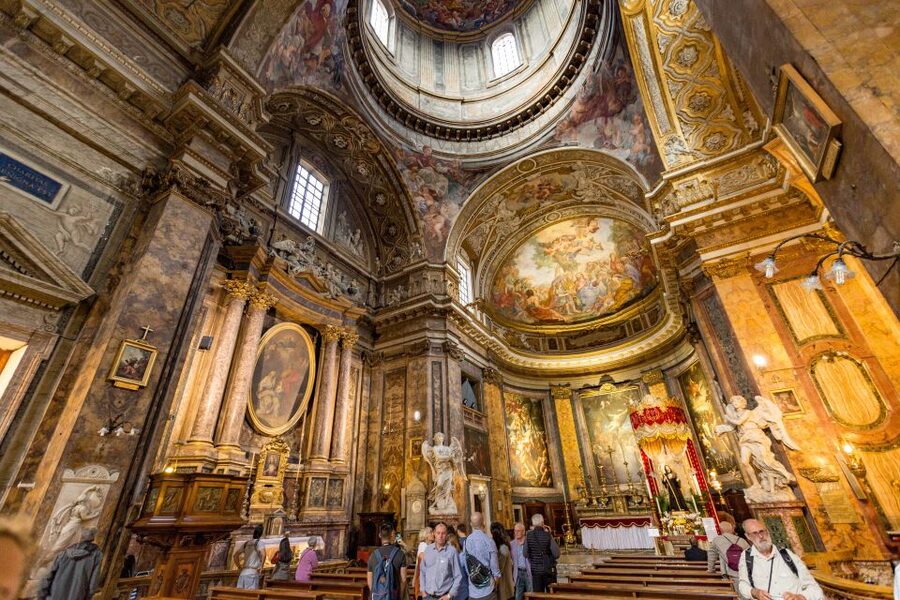
Sant’Ignazio Church is one of the more surprising stops. Inside, you can see a celebrated trompe l’oeil effect, a painted illusion that makes the ceiling appear to open into a grand architectural dome.
Look up slowly. From the right position, painted perspective turns a flat surface into something that seems to rise above you. This is a clever lesson in Baroque spectacle, when artists used painting, architecture, and light to challenge your sense of what was solid and what was illusion.
I especially like the inclusion of Sant’Ignazio because it is less obvious than the Pantheon or Trevi Fountain. You might pass the church without knowing why the interior matters. The guide gives you a reason to enter and a specific detail to seek out.
The church also explains why clothing rules matter. Shorts, short skirts, and sleeveless shirts are not allowed on the tour, and you should have a cover for your shoulders and knees. Food, drinks, smoking, alcohol, and drugs are prohibited during the walk.
Ending at the Trevi Fountain
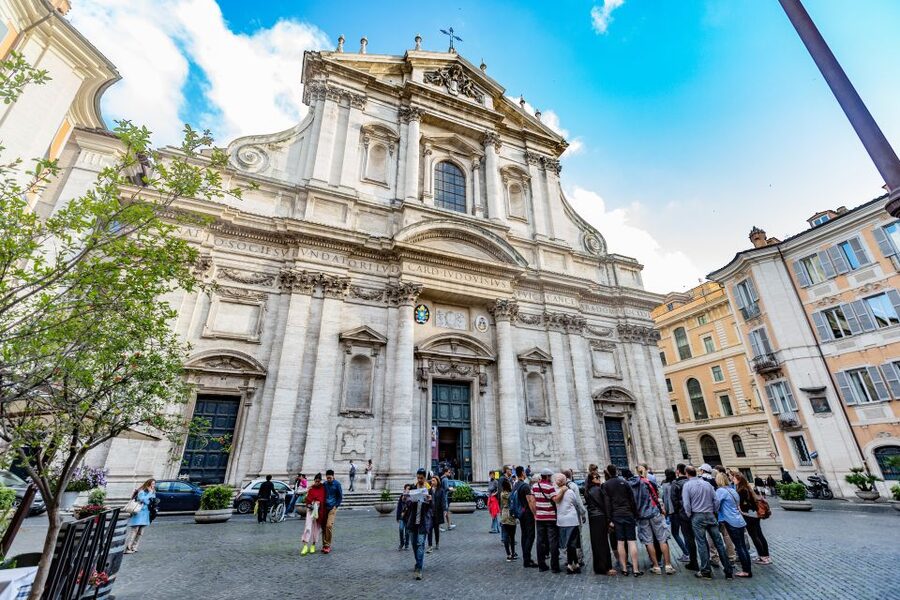
The itinerary finishes at the Trevi Fountain, Rome’s great Baroque water spectacle. The traditional coin toss gives the stop a light, participatory ending: throw a coin into the fountain and wish to return to Rome.
The fountain can be extremely crowded, especially around its central viewing area. The guide will provide context, but you may have limited time to find a quiet spot for photographs or linger at the basin. One otherwise very positive account felt the Trevi stop was rushed, possibly because of rain or limited time. Keep that in mind if the fountain is your main priority.
The route description says the walk ends at Trevi Fountain, while the activity details also state that the activity ends back at the meeting point. Because those details do not fully match, confirm the ending point when you book or ask the guide at the start. Either way, plan your next activity with a little flexibility rather than scheduling an immediate appointment.
What the $45.55 price gives you
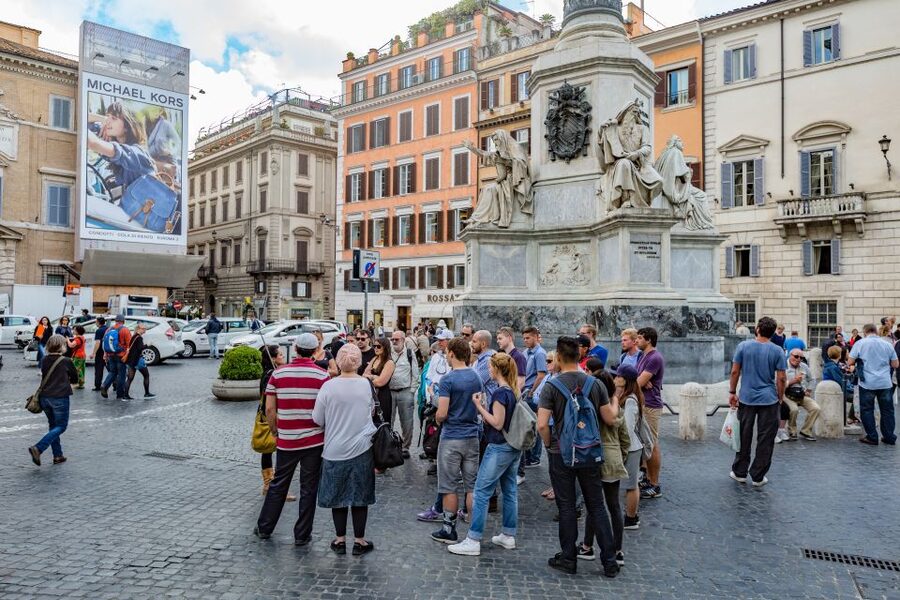
At $45.55 per person, the value rests mainly in the guide and the efficient route. You are paying to connect major sights with explanations, not for meals, drinks, transport, or a private entry arrangement.
For a first visit, that can be good value. The Pantheon, Piazza Navona, Spanish Steps, Sant’Ignazio, Marcus Aurelius Column, and Trevi Fountain would take time to organize on your own. A guide also helps you notice the details behind Bernini’s boat, Bernini’s river fountain, and the painted dome.
The group limit is 20. That is smaller than a large coach excursion, but it is not an intimate private tour by definition. The strongest accounts describe especially good experiences when only two people or a few participants attended. A group of about 10 was also described as comfortable because everyone could stay close enough to hear.
Food and drinks are not included. One guide reportedly offered tiramisu, and another group ended up having a beer with the guide, but those are personal touches, not promised inclusions. Budget separately for gelato or a drink, and pay the guide a tip if the tour earns it.
You can reserve now and pay later, and cancellation is free up to 24 hours before the tour for a full refund. That flexibility helps if your Rome schedule is still shifting.
Pace, clothing, and weather
Although the experience is advertised as lasting 2.5 hours, parts of the description call it a two-hour walk. Allow the full two-and-a-half hours, plus time to find the meeting point and continue afterward.
The tour is entirely on foot. Comfortable shoes matter more than stylish ones, and comfortable clothing will make the route easier. Rome’s paving can be uneven, and the itinerary includes stairs and crowded public spaces.
Weather can change the mood considerably. A group completed almost the entire route during a cold, pouring December morning because Stefano kept the explanations lively and the pace moving. That is encouraging, but you should still dress for the forecast. There is no promise of indoor shelter beyond the churches and Pantheon.
The route does not allow strollers or wheelchairs. Large bags, oversize luggage, and baby strollers are not permitted. The tour also asks you not to eat, drink, smoke, or use alcohol during the activity. Church access requires suitable clothing, so pack a light shoulder covering if your outfit is otherwise too bare.
Who should book it
I would choose this tour if you want a lively introduction to central Rome, prefer walking to bus transfers, and enjoy hearing the story behind famous monuments. It suits first-time Rome visitors especially well, since the route helps you organize the historic center in your mind.
It is also a good fit for older children and teenagers who can walk for several hours and appreciate art, architecture, or Roman history. The humor praised in the guide feedback may help younger participants stay interested, though children under 10 cannot join.
I would skip it if you need a wheelchair-accessible route, want a private tour guaranteed for your own party, or dislike walking in poor weather. I would also avoid scheduling it immediately before a timed Vatican visit or another fixed appointment, since the group may run close to its full duration.
Should you book this Rome fountains and squares tour?
Yes, if you want a focused first look at Rome’s central monuments and value a guide who can make art and history feel manageable. The strongest part is the combination of major sights with less obvious details, especially Sant’Ignazio’s painted dome and the Stadium of Domitian beneath Piazza Navona.
Book it for an early day in Rome, arrive 10 minutes ahead, wear church-appropriate clothing, and leave room in your schedule afterward. At $45.55, it is a fair choice for a compact guided introduction, particularly if you are likely to walk past these places without knowing what to look for.
FAQ
How long does the Rome fountains and squares tour last?
The activity is listed as lasting 2.5 hours. Some of the route description calls it a two-hour tour, so you should allow the full two-and-a-half hours.
Where does the tour start?
Meet by the entrance of the Keats and Shelley Museum at the bottom of the Spanish Steps, in front of the Acqua di Parma store.
How will I recognize the guide?
The guide will wear a GETYOURGUIDE badge or hold a sign with the same logos.
What language is the tour conducted in?
The live tour is conducted in English. Translation during the tour is not allowed.
What sights are included?
The route includes the Spanish Steps, Trinità dei Monti, Piazza Navona, the Stadium of Domitian, the Pantheon, the Column of Marcus Aurelius, Sant’Ignazio Church, and the Trevi Fountain.
Can I enter the Pantheon?
Yes. The tour includes going inside the Pantheon, subject to the site’s operating conditions.
Are food and drinks included?
No. Food and drinks are not included in the price.
Can I bring a stroller or wheelchair?
No. The route is not suitable for wheelchairs, and strollers cannot join the tour.
What happens if I need to cancel?
You can cancel up to 24 hours in advance for a full refund. You can also reserve now and pay later.
Just added around Rome
- Rome City, Pantheon, and Trevi Fountain Walking Tour★ 5.0 · 249 reviews
- Rome: Skip the line Vatican Museums & Sistine Chapel Tour★ 4.2 · 251 reviews
- Rome: Tivoli Day Trip with Villa d’Este and Villa Adriana★ 4.5 · 251 reviews
- Transfer Rome center – Ciampino Airport★ 4.5 · 251 reviews
- Rome: Cannondale E-Bike Evening Tour with Optional Dinner★ 4.9 · 251 reviews
- VIP Colosseum, Roman Forum & Palatine Hill & Special Access Sites★ 4.5 · 252 reviews
- Private Vatican Museums Hidden Gems Tour with Optional Pick-Up★ 5.0 · 253 reviews
- Vatican Museums & Sistine Chapel Skip-the-Line Guided Tour★ 4.6 · 254 reviews
Walking Tours, compared.

Guided Walking Tour & Last Supper Visit with Ticket
Read our review →

Rialto Bridge & Offbeat Unusual Venice Walking Tour
Read our review →

Private 3 hrs Venice Tour: St Mark’s, Walking tour & Boat tour
Read our review →

Skip the line: Uffizi and Accademia Small Group Walking Tour
Read our review →Browse the lists this tour appears in