
Review · POMPEII & HERCULANEUM TOURS
Pompeii: Guided Walking Tour with Entrance Ticket
Pompeii still feels startlingly close. This two-hour walk brings the buried Roman town into focus through the Forum, Thermal Baths, and Lupanare, with an English, French, Spanish, or Italian guide explaining how people lived before Mount Vesuvius erupted in 79 A.D. I like the included €20 entrance ticket and the headsets, which make it easier to follow the guide across Pompeii’s broad streets. The main drawback is organization at the meeting point, where some groups have had trouble finding the guide or have started late.
The price is $50 per person. That is fair if you want the site’s major sights explained rather than simply wandering among walls and pavement. Pompeii is enormous, and a good guide gives you a useful route through the public buildings, shops, houses, and streets without requiring you to study a guidebook at every corner.
You meet at 10:50 a.m. in the garden of Hotel Vittoria, outside the Cellini coral shop on Via Mare. Look for a guide holding a sign with your name. Give yourself extra time, keep your phone available, and do not assume the group will be obvious in the busy entrance area.
In This Review
- Key points at a glance
- Why a guide helps at Pompeii
- Meeting at Hotel Vittoria at 10:50 a.m.
- Entering the archaeological area
- The Forum: Pompeii’s public heart
- Thermal Baths and the rhythm of daily life
- The Lupanare and Pompeii’s less polished story
- Shops, signs, streets, and ordinary Pompeii
- What two hours can realistically cover
- Heat, rain, and walking conditions
- Language and guide quality
- Is $50 a good value?
- Who should book this Pompeii walk?
- Should you book it?
- FAQ
- How long is the Pompeii guided walking tour?
- What is included in the price?
- How much does the tour cost?
- Where is the meeting point?
- Which languages are available?
- Do I need to buy a Pompeii entrance ticket separately?
- What should I bring?
- Is the tour suitable for wheelchair users?
- Can I cancel the booking?
Key points at a glance
- See Pompeii’s civic center: The Forum provides the clearest picture of how public life was organized in the Roman town.
- Walk through everyday Roman spaces: Baths, shops, streets, houses, and the Lupanare show more than grand monuments ever could.
- Hear the guide clearly: Headsets are included and have been especially useful when the group spreads out.
- Skip the ticket queue: Your entrance to the Pompeii Archaeological Site is included, with a stated ticket value of €20.
- Expect a focused visit: Two hours covers important highlights, but only a small part of the whole excavation.
- Plan for uneven walking: Comfortable shoes, weather protection, and a reasonable level of mobility are important.
Why a guide helps at Pompeii
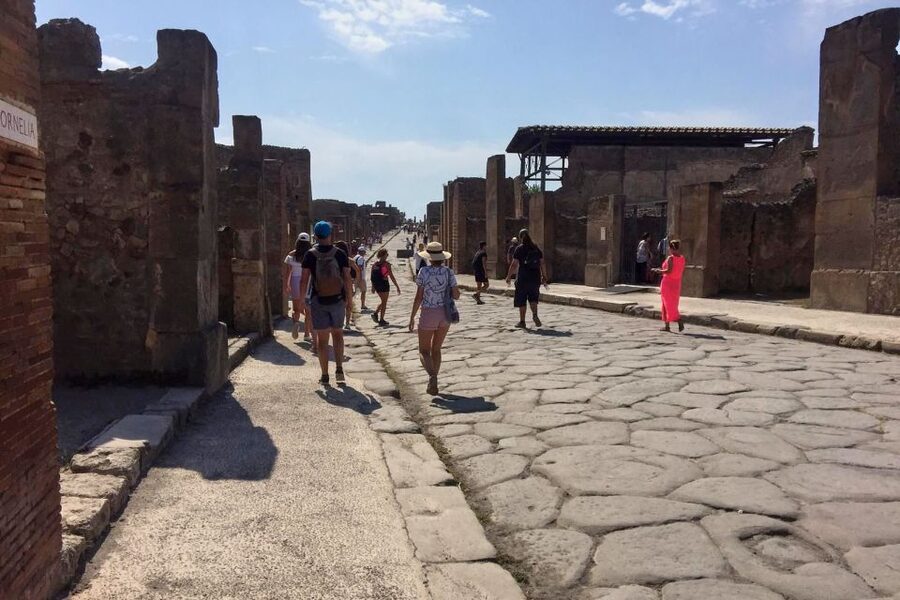
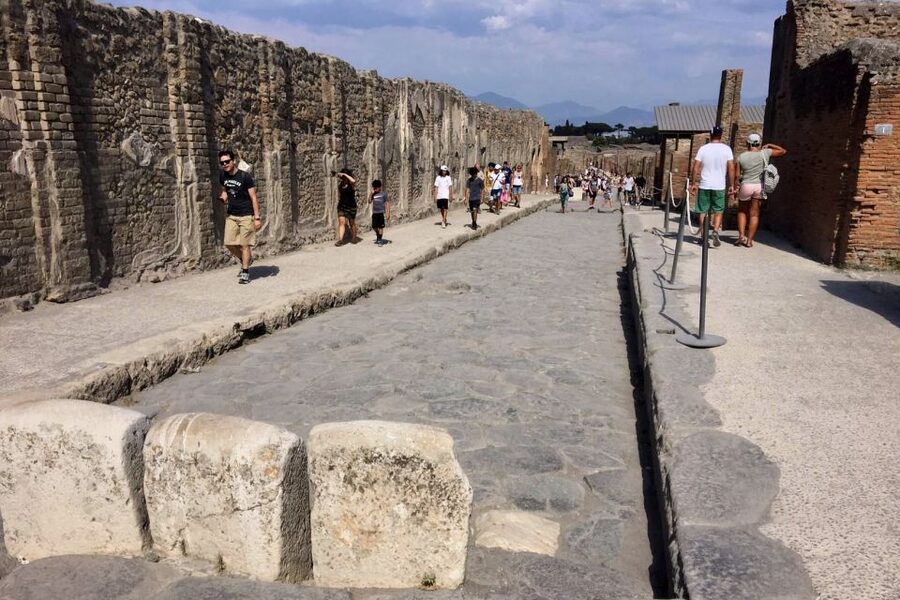
Pompeii can look simple at first glance. You see broken walls, old paving stones, columns, and open rooms. Then someone explains that a doorway was a shop, a painted counter sold food or wine, and a narrow street carried daily traffic, and the place starts to read like a town instead of an archaeological site.
That is the real value of this tour. The guide connects physical remains to ordinary Roman life. You learn how people used public buildings, where they washed, how commerce worked, and what the town may have felt like before the eruption.
I would not choose a guided visit because Pompeii is difficult to enter. I would choose it because the site is so large and its details are easy to miss. One guide can point out a shop sign, a wall painting, or a domestic space that you might otherwise walk past.
The guides receive the warmest praise for being lively and clear. Elisa, Salvatore, Maria, Francesca, Miguel, Imma, Mattia, and other guides are singled out for making the walk funny, engaging, and easy to follow. The quality can vary by person, of course, but the repeated pattern is encouraging: visitors generally find the guides well prepared, friendly, and willing to answer questions.
More Walking Tours in Naples
- Naples: Street Food Walking Tour with Local Guide
★ 4.8 · 4,256 reviews - Naples Spanish Quarters Walking Tour Street Art, Folklore & Sweet
★ 5.0 · 797 reviews - Naples: Old Town Guided Walking Tour
★ 4.8 · 553 reviews
Meeting at Hotel Vittoria at 10:50 a.m.
The official meeting place is specific: the garden of Hotel Vittoria in Pompeii, directly outside the Cellini coral shop at Via Mare, 80045 Pompei. The guide should be holding a sign with the name used for the booking.
This sounds simple, but the entrance area can be confusing. Some people have struggled to identify the group, especially when several tour companies gather nearby. In a few cases, the operator called or sent a representative to search for late arrivals. That help is useful, but it is better not to depend on it.
I suggest arriving early and checking the exact location before the start time. Keep your booking details handy. If you are coming by train, allow a generous margin, since a missed train, a strike, traffic, or a wrong exit can put you behind schedule.
The tour has sometimes waited for late arrivals, including delays of 20 to 30 minutes. That shows a helpful attitude, but it also means the published start time is not always the actual departure time. If you have a tight train connection afterward, this matters. One late start reached roughly 40 to 45 minutes, while most other experiences began on time or close to it.
Entering the archaeological area
The tour includes entrance to Pompeii’s Archaeological Site, listed at €20, so you do not need to purchase a separate admission ticket for the basic entry covered here. Skip-the-ticket-line access is designed to save time at the main queue.
Do not read skip-the-line as skip-all-waiting. The group still needs to meet, gather, and enter together. Busy periods can create confusion around the gates, and the guide may need to account for everyone before beginning the commentary.
The included headsets are a practical advantage. Pompeii has wide streets and open spaces, so the guide may be several steps away while you look at a building or take a photograph. Most people find the audio equipment helpful, though one person found the headset uncomfortable and preferred an earbud-style design.
The equipment is especially useful for families and larger groups. It lets you look around without crowding directly beside the guide. If your headset does not fit well, say so early rather than struggling with it for two hours.
The Forum: Pompeii’s public heart

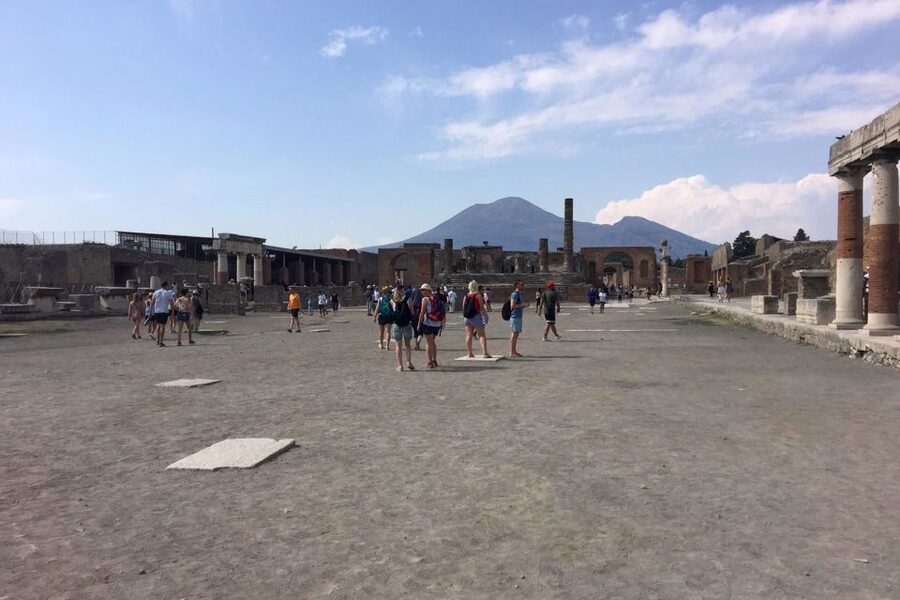
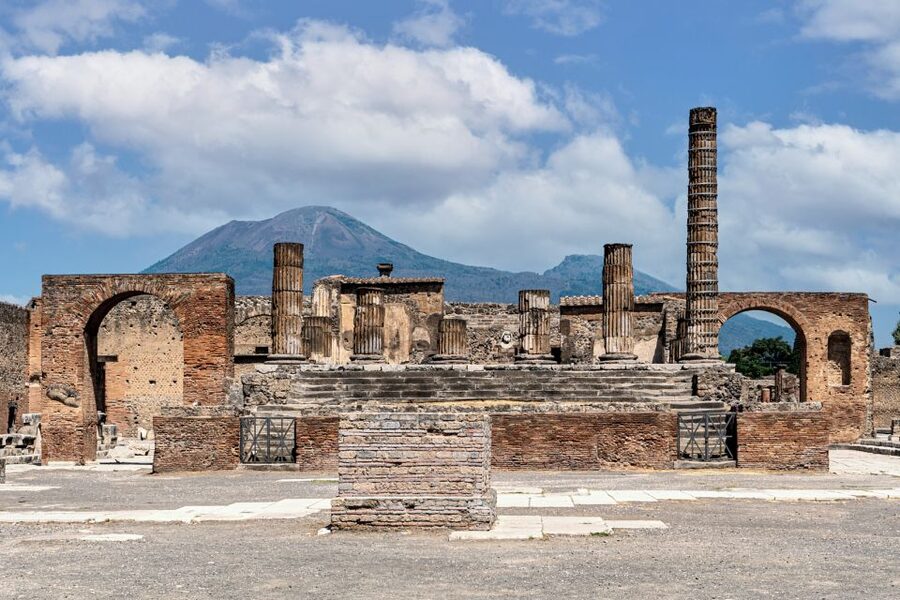
The Forum is one of the essential stops. This broad public area helps you understand Pompeii as a functioning city, not simply a collection of ruined homes.
Your guide explains how civic, religious, and commercial life came together here. The Forum also gives you a useful orientation point, since many routes through the archaeological area connect back to this central space.
The Forum is most valuable when you pause to imagine the scale of public life around it. People came here for business, ceremonies, politics, worship, and ordinary errands. The stones alone cannot tell you all of that. The guide’s explanation supplies the missing structure.
This is also a good place to ask questions. If you want more detail about Roman government, religion, town planning, or the eruption, ask while the group is gathered. The most effective guides make the visit interactive rather than delivering one long speech.
More Pompeii and Herculaneum visits:
- Pompeii: Entry Ticket and Guided Tour with an Archaeologist
★ 4.8 · 19,459 reviews - Pompeii: Entry Ticket with Optional Audio Guide
★ 4.2 · 12,360 reviews - Pompeii: Small Group Tour with an Archaeologist
★ 4.8 · 12,264 reviews - From Naples: Pompeii Ruins & Mount Vesuvius Day Tour
★ 4.3 · 11,459 reviews
Thermal Baths and the rhythm of daily life
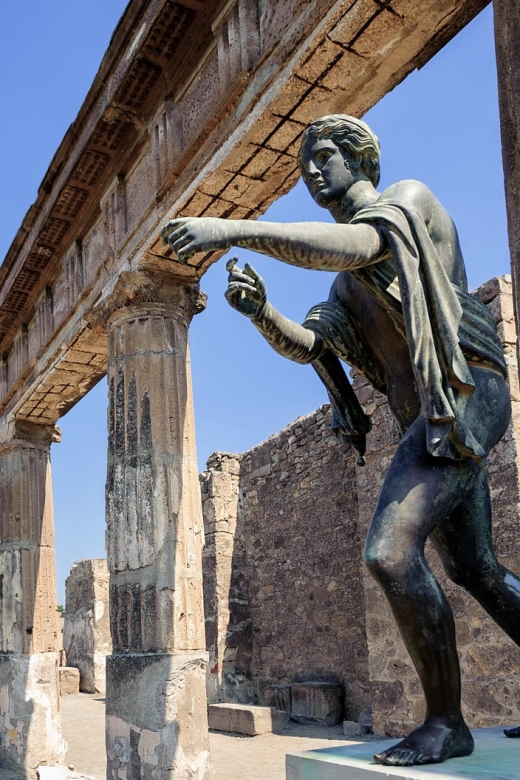
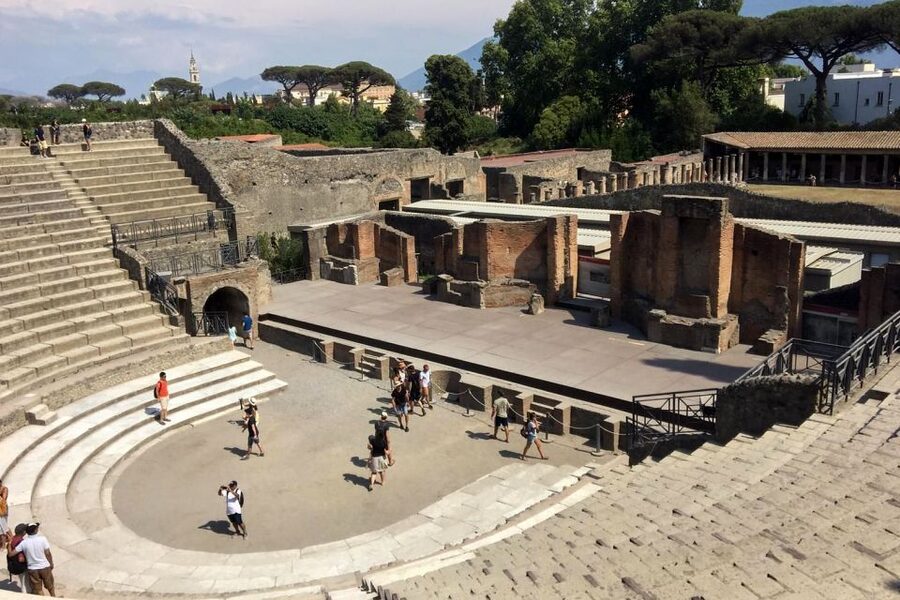
The Thermal Baths reveal an everyday side of Roman culture. These were not simply places to get clean. They were part of social life and show how much attention Roman towns gave to bathing and communal routines.
The tour uses the baths to explain daily habits and the way public buildings served the local population. You may see different rooms and architectural details, but the exact route can change according to access and site conditions.
I like this stop because it moves the story away from emperors and disasters. A bath complex tells you about time spent with neighbors, the design of public facilities, and the practical systems needed to run a Roman town.
The pavement around Pompeii can be uneven, and the two-hour route involves steady walking. Wear shoes with good support. In warm weather, the exposed streets can become surprisingly hot, even when the air temperature does not seem extreme.
The Lupanare and Pompeii’s less polished story
The Lupanare is one of Pompeii’s most talked-about buildings. It offers a direct look at an aspect of Roman commercial and social life that is often softened in broad history lessons.
A good guide handles this stop without awkwardness or unnecessary drama. The commentary can help you understand the building in its period rather than judging it only by modern standards. Guides have been praised for explaining sensitive subjects openly and with humor, though the tone depends on the individual guide.
This is a useful stop for adults and older children who are comfortable with frank historical discussion. Families with young children may prefer to decide in advance how much context they want. The tour does not promise a separate family route.
Shops, signs, streets, and ordinary Pompeii
The smaller details may be the most memorable part of the walk. You can see streets lined with buildings, shops, and signs connected with products such as wine and produce.
These details make the city feel unusually readable. You are not only looking at a temple or a public monument. You are following the same basic pattern of movement that once carried residents to shops, baths, homes, and public spaces.
The tour also includes domestic and community areas. One person described the experience as a moving look at domesticity, public life, and different communities within the excavated town. That range is important. Pompeii is not just a disaster site frozen in time. It was a place where people cooked, traded, worshipped, socialized, worked, and raised families.
Some objects have been moved to museums, including collections in Naples, so you should not expect every famous artifact to remain in its original room. What remains on site is still powerful: streets, walls, paintings, building plans, and the shape of a city that can be understood with your own eyes.
What two hours can realistically cover
Two hours is enough for an introduction, not a complete exploration. Guides aim to cover the main highlights and usually leave room for photographs and questions, but you will see only a fraction of the archaeological area.
That limit is not a flaw if you are visiting Pompeii for the first time and want a clear overview. It becomes a limitation if you already know the site well or want to inspect many separate houses and outlying areas.
One guide explained that the excavation is only about two thirds complete and that it could take a week to see everything. The exact time you need depends on your pace and interests, but the broader point is sound: Pompeii is much larger than a two-hour walking tour suggests.
After the guided portion, you may be able to remain inside and explore areas not included in the route, subject to the site’s operating rules and access on that day. Treat the tour as your orientation, then continue independently if you have the time and energy.
Heat, rain, and walking conditions
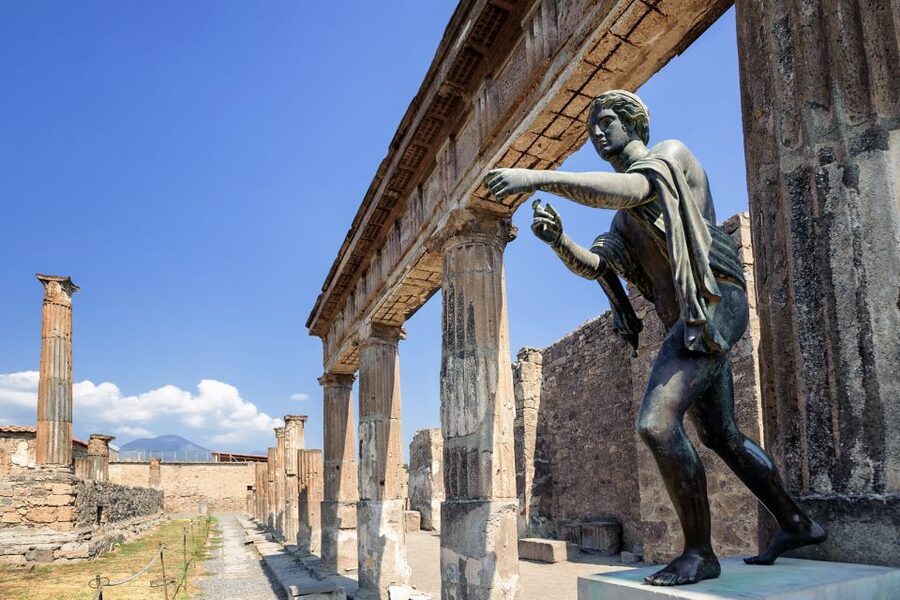
The tour operates in all weather. That makes clothing a real planning issue, not a minor note at the bottom of a booking page.
In sunshine, Pompeii’s stone streets and open spaces can feel hot. Bring water, wear a hat if useful, and choose light clothing that still protects you from the sun. In rain, use a waterproof layer and shoes that can cope with slick or uneven surfaces.
The site is not suitable for wheelchair users or people with mobility impairments. The route requires walking through an ancient urban area with uneven ground and changing surfaces. If you have limited stamina or balance, ask the operator about the current route before paying.
Children can enjoy the tour when the guide keeps the explanation lively. Alex was praised for involving children, and several guides have been described as funny and good at answering questions. Still, two hours of walking in heat may test younger children, so bring what they need for the conditions.
Language and guide quality
Live commentary is offered in English, French, Spanish, and Italian. The tour may be led by a multilingual guide, and the requested language is not guaranteed if only one person in the group speaks that language.
That condition matters if you are booking for a small party or selecting a less commonly requested language. Confirm the available language if it is central to your plans.
English-speaking guides have generally been easy to understand, with Francesca, Elisa, Maria, Miguel, and others praised for clear delivery. A small number of people found a guide’s English difficult to follow, so no company can promise the same communication style every time.
The headsets help, but they cannot fix every language issue. I would treat the audio system as a strong practical feature, not a guarantee that every explanation will suit every listener.
Is $50 a good value?
At $50 per person, this is not the cheapest way to enter Pompeii. The included €20 admission reduces the gap, leaving roughly $30 for the guide, tour organization, skip-the-line service, and headsets.
For a first visit, I think that is reasonable. You get a planned route through major sights and a live explanation of Roman culture, architecture, commerce, and the eruption. The value is highest if you want context and do not plan to spend a full day studying the site alone.
The value falls if you prefer complete freedom, already have strong knowledge of Pompeii, or want to move slowly through rooms and photograph every detail. A two-hour group walk cannot give you the same control as an independent visit.
The overall rating of 4.3 from 1,423 ratings suggests a strong but not flawless experience. The guiding itself earns the most consistent praise. The weak point is usually the beginning: finding the group, dealing with a late start, or managing a large gathering.
The flexible cancellation policy also reduces some booking risk. You can cancel up to 24 hours in advance for a full refund, and the reserve-now, pay-later option lets you hold a place without paying immediately. The operator requires at least two participants overall, so a cancellation is possible if that minimum is not met. In that case, you should be offered an alternative or a full refund.
Who should book this Pompeii walk?
I would choose it for a first visit, especially if you have only a morning or a short stop in Pompeii. It suits people who want the major buildings explained in plain language and who appreciate a guide that adds humor to difficult or unfamiliar subjects.
It also works well for families with older children, couples, and small groups who want a shared introduction before exploring alone. The strongest guides make the history accessible without requiring prior study.
I would think twice if you use a wheelchair, have a mobility impairment, need a guaranteed start time, or want a highly academic archaeological lecture. I would also avoid scheduling a tight onward train immediately after the tour, since occasional delays at the meeting point have occurred.
Should you book it?
Book this tour if you want Pompeii to make sense quickly. The Forum, baths, Lupanare, shops, and streets become far more meaningful when someone explains how they fitted into Roman life, and the included ticket and headsets add practical value.
Go independently if you have most of the day, prefer your own pace, or want to focus on less visited sections. For everyone else, this is a useful and fairly priced introduction, with excellent guide potential and some avoidable meeting-point uncertainty.
FAQ
How long is the Pompeii guided walking tour?
The tour lasts two hours. That is enough to see major highlights, but not the whole archaeological area.
What is included in the price?
The price includes entrance to the Pompeii Archaeological Site, a professional guide, skip-the-ticket-line access, and headsets to hear the guide.
How much does the tour cost?
The listed price is $50 per person. The included Pompeii entrance ticket is valued at €20.
Where is the meeting point?
Meet at 10:50 a.m. in the garden of Hotel Vittoria, outside the Cellini coral shop at Via Mare, 80045 Pompei. The guide should have a sign with the booking name.
Which languages are available?
Live guiding is available in English, French, Spanish, and Italian. The tour may use a multilingual guide, and a requested language is not guaranteed if only one person speaks it.
Do I need to buy a Pompeii entrance ticket separately?
No. Entrance to the Pompeii Archaeological Site is included in this experience.
What should I bring?
Bring comfortable shoes, weather-appropriate clothing, and a passport or identity card for children using the child fare.
Is the tour suitable for wheelchair users?
No. The experience is not suitable for wheelchair users or people with mobility impairments.
Can I cancel the booking?
You can cancel up to 24 hours in advance for a full refund. You can also reserve now and pay later, subject to the booking terms.
More Guided Walks
- Naples: Panoramic Walking Tour with Funicular
★ 4.8 · 543 reviews - Naples Walking Tour with Underground Roman Ruins Ticket
★ 4.5 · 510 reviews - Herculaneum: 3D Walking Tour with Skip-the-Line Ticket
★ 4.3 · 313 reviews - Naples Panoramic Walking Tour: From the Hills to the Center
★ 5.0 · 298 reviews
Just added around Naples
- From Naples/Salerno: Pompeii, Sorrento, and Positano Tour★ 4.5 · 250 reviews
- Pompeii: Day Tour of Pompeii and Vesuvius with Bus Transfer★ 4.2 · 250 reviews
- Ischia: Island Boat Tour with Neapolitan Lunch & Snorkeling★ 4.9 · 253 reviews
- Explore Naples & Pompeii in One Day – Guided Half-Day Tour★ 4.5 · 253 reviews
- Discover Pompeii: French Walking Tour of the Buried City★ 4.8 · 253 reviews
- Private Transfer from Naples to Sorrento or from Sorrento to Naples★ 5.0 · 254 reviews
- From Pompeii: Mount Vesuvius Guided Tour with Transfer★ 4.8 · 255 reviews
- Private Transfer from Naples to Positano or Amalfi or vice versa★ 5.0 · 265 reviews
Pompeii & Herculaneum Tours, compared.

Pompeii: Entry Ticket and Guided Tour with an Archaeologist
Read our review →
Pompeii: Entry Ticket with Optional Audio Guide
Read our review →
Pompeii: Small Group Tour with an Archaeologist
Read our review →


Pompeii Small Group Tour with an Archaeologist
Read our review →
Pompeii, Amalfi Coast and Positano Day Trip from Rome
Read our review →Browse the lists this tour appears in