
Review · SKIP THE LINE
Palazzo Vecchio: Skip-the-Line Entry and Secret Passage Tour
Secrets hide behind Florence’s grandest walls. This 75-minute tour takes you beyond Palazzo Vecchio’s famous public rooms and into narrow stairways, concealed doors, Medici rooms, and spaces normally closed to general admission. I especially like the small group of no more than four people, which makes it easier to hear the guide and see cramped rooms without a crowd pressing in. I also like that the tour finishes in the Hall of the Five Hundred, so you can continue exploring the main palace afterward. The main caution is physical: twisting stairs, narrow passages, and warm, confined rooms make this a poor fit for anyone with limited mobility or claustrophobia.
The price is $37 per person. That is a fair deal if you want more than a standard palace visit, particularly because skip-the-line admission and the guided tour are included. The tour itself does not cover the palace tower, which requires a different ticket, and you should allow another hour afterward if you want to see the rest of Palazzo Vecchio at a relaxed pace.
In This Review
- Key Details Before You Book
- Why Palazzo Vecchio’s Secret Route Is Worth Your Time
- Arriving at Piazza della Signoria
- Entering the Palace Through Its Less-Used Corners
- Francesco I’s Small Study and the Medici Taste for Secrecy
- Cosimo I’s Tesoretto and Private Power
- Secret Doors, Concealed Cabinets, and the Palace’s Private Side
- Vasari’s Ceiling Structure in the Hall of the Five Hundred
- What the Guides Add to the Experience
- Is $37 a Fair Price?
- Who Should Skip This Tour?
- Practical Tips for a Better Visit
- Should You Book Palazzo Vecchio’s Secret Passage Tour?
- FAQ
- How long is the Palazzo Vecchio secret passage tour?
- What is included in the price?
- Is the palace tower included?
- Where do I meet the guide?
- Is the tour conducted in English?
- How large is the group?
- Are the secret passages suitable for people with limited mobility?
- Can I cancel the tour?
Key Details Before You Book
- Real secret spaces: You pass through concealed doors, narrow corridors, wall stairways, and rooms not open during a normal visit.
- Medici power behind the scenes: The route includes Francesco I de’ Medici’s small study and Cosimo I’s Tesoretto, a private desk room filled with rare objects.
- A very small group: With a maximum of four participants, this feels far more personal than a large museum tour.
- Seventy-five minutes underground and above: The entire guided portion focuses on the special-access route, then ends in the Hall of the Five Hundred.
- Excellent English guides: Guides including Francesco, Francesca, Julia, Marta, Sara, Roberta, and Giulia have been praised for clear explanations and lively storytelling.
- Stairs are part of the experience: The route includes narrow, curving steps and may feel hot or tight in summer.
Why Palazzo Vecchio’s Secret Route Is Worth Your Time
Palazzo Vecchio can seem like a conventional civic museum from the outside. It is a fortress-like palace on Piazza della Signoria, filled with imposing halls, political art, and Medici decoration. The secret passage tour changes the mood completely.
Instead of simply walking from one grand room to another, you begin thinking about how people moved through the building unseen. Doors disappear into walls. Staircases run inside the thick masonry. Private rooms feel less polished and more personal than the palace’s public halls.
I like this format because the hidden spaces give the palace a human story. You are not only looking at art. You are considering who controlled access, who needed privacy, and how a powerful family could move around its own building without appearing in public.
The tour has earned a 4.7 rating from 1,076 reviews, with especially strong praise for the guides. That matters here. The passages are not large, open galleries where you can easily understand everything by yourself. The guide explains what each space was for and connects the rooms to the Medici family, the palace’s changing role, and Florence’s political life.
More Skip-the-Line Tickets in Florence
- Florence: Skip-The-Line Uffizi Gallery Timed Entry Ticket
★ 4.5 · 27,832 reviews - Florence: Michelangelo’s David Skip-the-Line Entry Ticket
★ 4.5 · 12,764 reviews - Florence: Skip-the-Line Uffizi Small Group Tour
★ 4.6 · 5,926 reviews
Arriving at Piazza della Signoria
The meeting point is Palazzo Vecchio’s entrance from Piazza della Signoria. This sounds simple, but the practical detail is important: after entering the courtyard, go to the ticket office and head directly to the InfoPoint counter to exchange your voucher for the tour ticket.
The counter is inside the building, not out on the square. At least one visitor had trouble finding it because the instructions were not immediately clear. If the palace is crowded or a civic event is taking place in the Hall of the Five Hundred, ask the staff where to wait. The staff have been described as helpful when the reception area becomes busy.
The skip-the-line benefit is useful in Florence, where popular sights can develop long queues. It does not mean you can ignore the voucher exchange. Give yourself time to enter the courtyard, find the InfoPoint, and collect the tour ticket before the start time.
The tour is offered in English with a live guide. Reserve-and-pay-later booking is available, and you can cancel up to 24 hours before the experience for a full refund. Starting times vary, so check availability for your date.
Entering the Palace Through Its Less-Used Corners
The route begins with an introduction to Palazzo Vecchio and its place in Florence. Guides have used this opening to explain the building’s past and the Medici family before taking the group into the restricted areas.
Then the tone shifts. Rather than following the ordinary museum flow, you enter through a secret door and head into spaces most people miss. The exact sequence can vary, but the common thread is clear: this is a behind-the-scenes route, not simply a shortened tour of the main rooms.
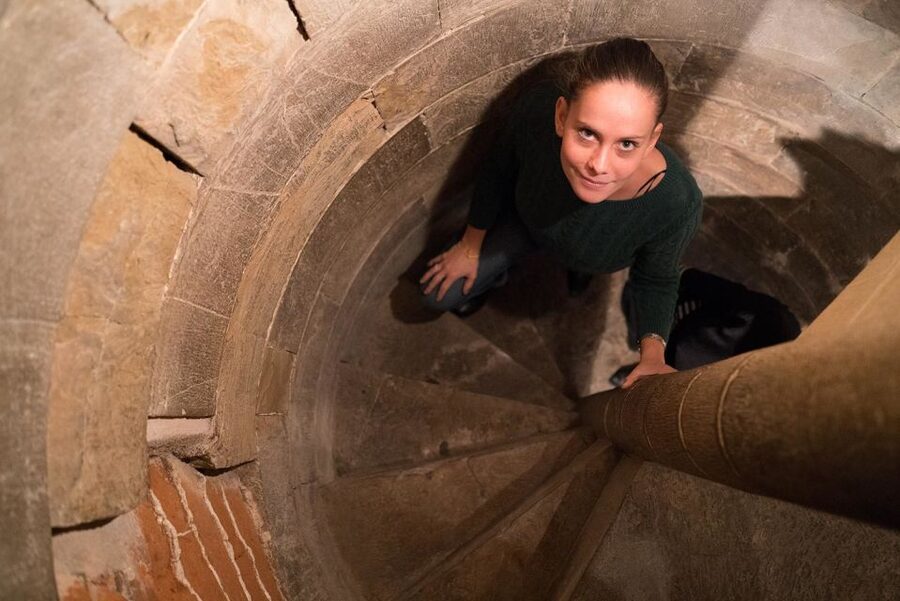
One of the most striking features is a mysterious stairway built inside the palace’s thick walls. It was created at the request of Gualtieri di Brienne, and its position makes it feel like an architectural trick. You are walking through the substance of the building rather than around it.
This section is exciting because it is easy to picture the practical use of such spaces. A hidden stairway could allow movement without crossing a public hall. It could also offer privacy, protection, or a discreet route between rooms. The guide supplies the meaning, while the physical setting provides the surprise.
The stairways are narrow and twisting. People with large feet may find some steps awkward, and anyone uneasy in confined spaces should think carefully before booking. One person left a tour early because of claustrophobia. That is not a minor footnote: the tight spaces are central to the experience, not an occasional detail.
Francesco I’s Small Study and the Medici Taste for Secrecy
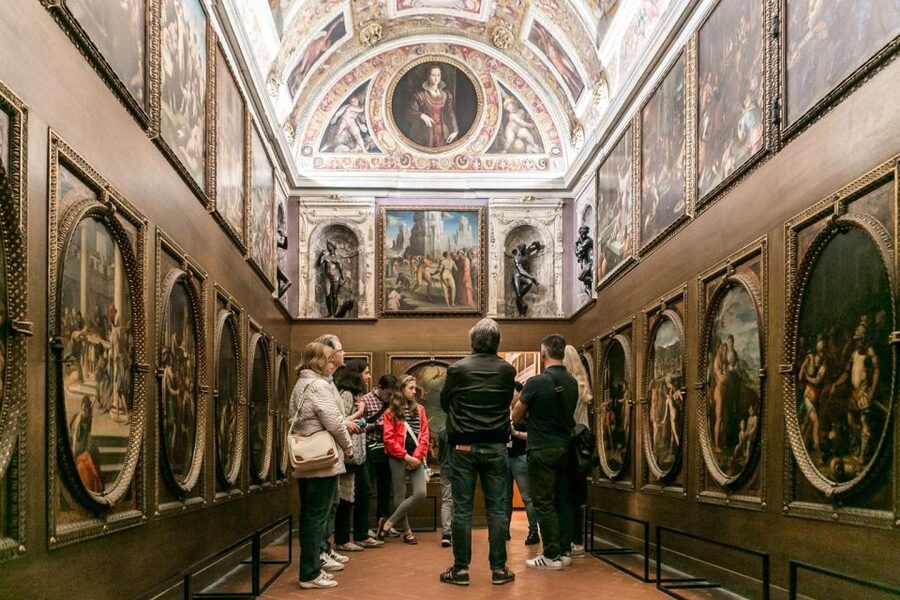
The Studiolo of Francesco I de’ Medici is one of the tour’s main rewards. This small study was designed as a private treasure room for rare and precious objects. Compared with the giant public halls, it feels intimate and intensely personal.
The room helps explain Francesco I’s interests and the Medici habit of using art, science, collecting, and symbolism to display status. You are seeing a space made for private thought and possession, not for public ceremonies.
The size of the study is part of its appeal. A large room can impress you through scale alone. Here, the effect comes from detail and enclosure. The guide points out the room’s purpose and the objects associated with it, helping you understand why this small space mattered within such a huge palace.
This is also where the small group works best. Four people can gather around the guide without the bottleneck that often forms in a compact room. You have a better chance of seeing details and asking questions.
Guides have been particularly praised for connecting objects and decoration to Medici personalities. Marta, for instance, has been praised for making the family’s characters feel vivid, while Sara and Julia have been singled out for their energy and clear explanations. Guides vary, but the recurring strength is their ability to turn a room into a story.
More fast-track entries:
- Skip the line: Uffizi and Accademia Small Group Walking Tour
★ 4.5 · 3,135 reviews - Florence: Skip-the-Line Accademia Guided Tour
★ 4.5 · 2,327 reviews - Florence: Accademia Gallery & David Skip-the-Line Ticket
★ 4.6 · 1,905 reviews - Florence: Skip-the-Line Duomo, Baptistery, Giotto Bell Tower
★ 4.7 · 1,721 reviews
Cosimo I’s Tesoretto and Private Power
Another important stop is Cosimo I de’ Medici’s desk, known as the Tesoretto. The name suggests a small treasury, and the room gives you another glimpse of how Medici power operated away from the formal spectacle of government.
The public palace presents authority on a huge scale. The private rooms show the more controlled side of that authority: collecting, planning, storing, and making decisions away from the crowd.
I find this contrast more useful than a tour that only points out grand decoration. The Hall of the Five Hundred tells you that power was public and theatrical. The Tesoretto suggests that power was also private, concentrated, and carefully managed.
Your guide explains the family connections and the role of the room. Several guides have been praised for answering questions, so this is a good place to ask about the Medici family, the palace’s former residents, or how the hidden spaces fit into the building’s daily life.
Secret Doors, Concealed Cabinets, and the Palace’s Private Side
The route includes secret doors, hidden corridors, and concealed storage or cabinet spaces. Some doors may be disguised behind pictures or built into the room’s decoration. The pleasure comes from guessing where the next opening might be.
This is not a theatrical mystery show. The appeal is historical and architectural. These features were built into a working palace, and the guide explains why discreet access mattered to people with political enemies, private collections, and strict control over their surroundings.
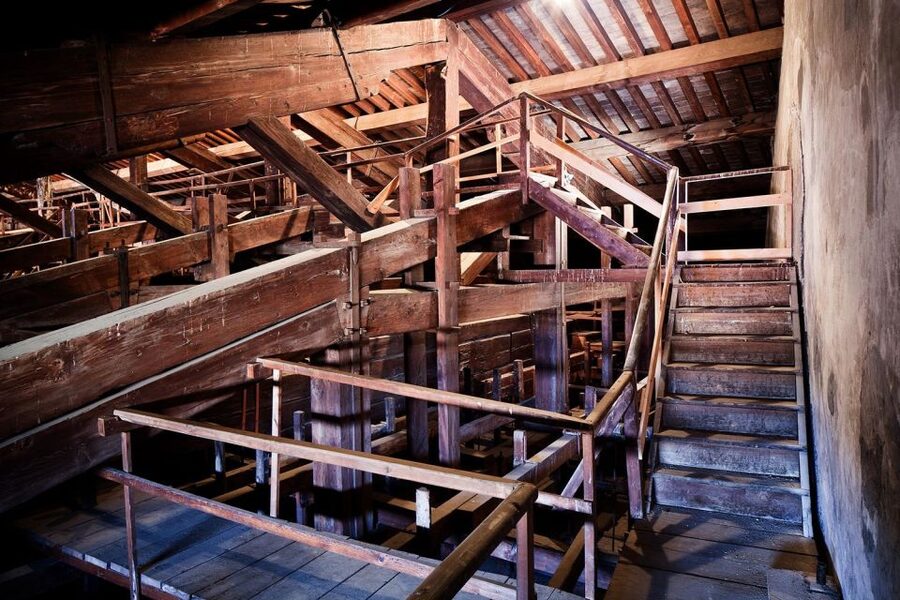
You may also see an attic-like area and additional restricted corners. The precise stops can depend on access and palace operations, so do not expect every tour to follow an identical script. What you can reasonably expect is a series of private rooms and passageways beyond the standard public route.
The experience is especially effective for families with older children and teenagers. One parent described it as a welcome change after several days of churches and museums, and an engineer reportedly enjoyed the explanation of how the building worked. That makes sense: the tour has a puzzle-like quality. You are looking at structure, access, weight, concealment, and design, not just paintings.
Vasari’s Ceiling Structure in the Hall of the Five Hundred
The tour ends with an explanation of the enormous trussed structure designed by Giorgio Vasari to support the paneled ceiling of the Salone del Cinquecento, or Hall of the Five Hundred.
This detail adds welcome engineering to the art and politics. The hall is famous for its scale and decoration, but looking upward without context can leave you admiring the surface without understanding how the room was built.
The guide explains the structure that carries the ceiling and may also discuss how the design allowed paintings to be changed. That practical detail has been a highlight for visitors who enjoy architecture and mechanics as much as art.
The ending is well chosen. You finish in one of Palazzo Vecchio’s grandest public rooms, moving from cramped passages into a vast hall. The contrast gives the entire tour a clear shape: private and concealed at first, public and ceremonial at the end.
Your guided time ends there, but your palace admission continues. Plan to spend another hour exploring the rest of Palazzo Vecchio if you want to study its paintings, frescoed rooms, sculpture, and public spaces. The tower is not included and requires a separate ticket.
What the Guides Add to the Experience
The guide is the key variable in any museum tour, and here the evidence is strongly positive. Francesco has been praised for being friendly and well prepared. Francesca has been described as particularly effective at making visitors feel like VIPs. Marta, Julia, Sara, Roberta, Martina, Simone, and Giulia have also received warm praise for their storytelling, humor, and explanations.
The best guides do more than identify rooms. They explain the reasons behind the secret routes and bring out the personalities of the Medici family. That turns a series of locked doors into a connected story.
The group size helps. A maximum of four participants means you can usually hear the guide in a narrow stairwell and ask questions without interrupting a large crowd. It also makes it easier to stay together as the route bends through small spaces.
There has been at least one report of a late guide, so punctuality may not be perfect every time. That appears to be an exception rather than the main pattern, but I would still arrive early and keep the meeting instructions handy.
Is $37 a Fair Price?
At $37 per person, this is not the cheapest way to enter Palazzo Vecchio. It is better judged as a specialist tour with admission included.
If you only want to see the major public rooms, a standard palace ticket may be enough. If you want access to the Studiolo, Tesoretto, wall stairway, secret doors, and other restricted places, the added cost is easier to justify.
The small group is another part of the value. A large tour can cover the same general facts, but it cannot offer the same ease in narrow rooms. You are paying for access, interpretation, and a more focused route.
I would book it for anyone already interested in the Medici, Renaissance architecture, palace politics, or the practical design of old buildings. Families can also get strong value from it because the secret passages provide a change of pace from conventional art viewing.
Who Should Skip This Tour?
You should reconsider if you have limited mobility. The tour includes narrow, twisting stairs and passageways, and the experience is not recommended for people with mobility limitations.
You should also avoid it if confined spaces make you anxious. Some rooms can feel tight and warm, especially in summer. The passages are not an optional side feature. They are the reason to book the tour.
This is also not the right choice if you want a leisurely, independent museum visit from the first minute. The 75-minute route is guided and focused. You can explore independently afterward, but the secret sections are experienced with the group.
Practical Tips for a Better Visit
- Arrive at the Piazza della Signoria entrance with enough time to find the InfoPoint inside the courtyard.
- Exchange your voucher at the InfoPoint counter, then follow instructions for the tour ticket.
- Wear comfortable shoes suited to narrow stairs. Large feet may make some steps awkward.
- Expect the route to feel warm in summer, particularly in enclosed rooms.
- Tell yourself that the secret tour is 75 minutes, not the entire palace visit. Add about an hour afterward for the main museum.
- Do not assume the tower is included. It requires a separate ticket.
- Use the small group to ask questions. The guides are a major part of the experience.
- If a civic event makes the Hall of the Five Hundred reception area crowded, ask staff where your group should wait.
Should You Book Palazzo Vecchio’s Secret Passage Tour?
I would book it if you want to see Florence from behind the official doors. The best parts are not only the secret stairways and concealed rooms, but also the way the guide explains what those spaces reveal about Medici power, privacy, collecting, and palace design.
The $37 price is reasonable for skip-the-line admission, a 75-minute English tour, and access to areas outside the usual visit. The small group makes the cost more attractive.
Skip it if stairs, heat, or enclosed spaces will spoil your day. Otherwise, this is one of the more distinctive ways to visit Palazzo Vecchio, especially if the public halls alone sound too familiar. Finish in the Hall of the Five Hundred, then stay on to see the rest of the palace at your own speed.
FAQ
How long is the Palazzo Vecchio secret passage tour?
The guided tour lasts 75 minutes. You can explore the rest of Palazzo Vecchio afterward, and you may want to allow about another hour for the main palace areas.
What is included in the price?
The $37 price includes skip-the-line admission to Palazzo Vecchio and a guided tour in English.
Is the palace tower included?
No. The tower requires a separate ticket and is not included in this experience.
Where do I meet the guide?
Enter Palazzo Vecchio from Piazza della Signoria. Inside the courtyard, go to the ticket office and proceed to the InfoPoint counter to exchange your voucher for the tour ticket.
Is the tour conducted in English?
Yes. The listed tour language is English, with a live English-speaking guide.
How large is the group?
The tour is limited to four participants, making it a small-group experience.
Are the secret passages suitable for people with limited mobility?
No. The tour is not recommended for people with limited mobility because it includes narrow, twisting stairs and confined passageways.
Can I cancel the tour?
Yes. You can cancel up to 24 hours in advance for a full refund. Reserve-and-pay-later booking is also available.
Just added around Florence
- Palazzo Vecchio guided experience with entrance ticket★ 4.5 · 249 reviews
- Lucca Bikes and Bites with food tastings for Small Groups or Private★ 5.0 · 249 reviews
- Perfume Masterclass in Florence: Make your Own Personal Fragrance★ 4.5 · 253 reviews
- Florence Oltrarno Neighborhood Food & Wine Dine Around★ 5.0 · 253 reviews
- Florence: Cathedral, Dome and Terraces Guided Tour★ 4.5 · 253 reviews
- Florence: 1.5-hour Santa Croce Guided Experience★ 4.8 · 254 reviews
- Florence: Pitti Palace and Palatina Gallery Ticket and Tour★ 4.9 · 255 reviews
- Private Florence Tour by Golf Cart ETukTuk with Audio Guide★ 4.0 · 256 reviews
Skip the Line, compared.

Skip-The-Line Uffizi Gallery Timed Entry Ticket
Read our review →
Vatican Museums & Sistine Chapel Skip-the-Line Entry Ticket
Read our review →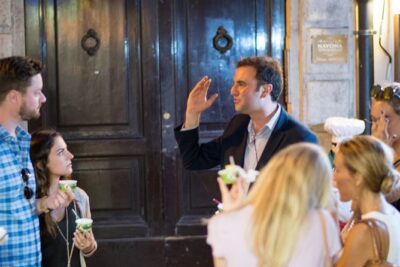
Skip-the-Line Group Tour of the Vatican, Sistine Chapel & St. Peter’s Basilica
Read our review →
Michelangelo’s David Skip-the-Line Entry Ticket
Read our review →
Vatican Museums & Sistine Chapel Skip-The-Line Ticket
Read our review →
Vatican, Sistine Chapel & St. Peter’s Skip-the-Line Tour
Read our review →
Skip-the-Line Vatican, Sistine Chapel & St. Peter’s | Small Group
Read our review →
Vatican: Vatican Museums Sistine Chapel Skip-the-Line Ticket
Read our review →Browse the lists this tour appears in