
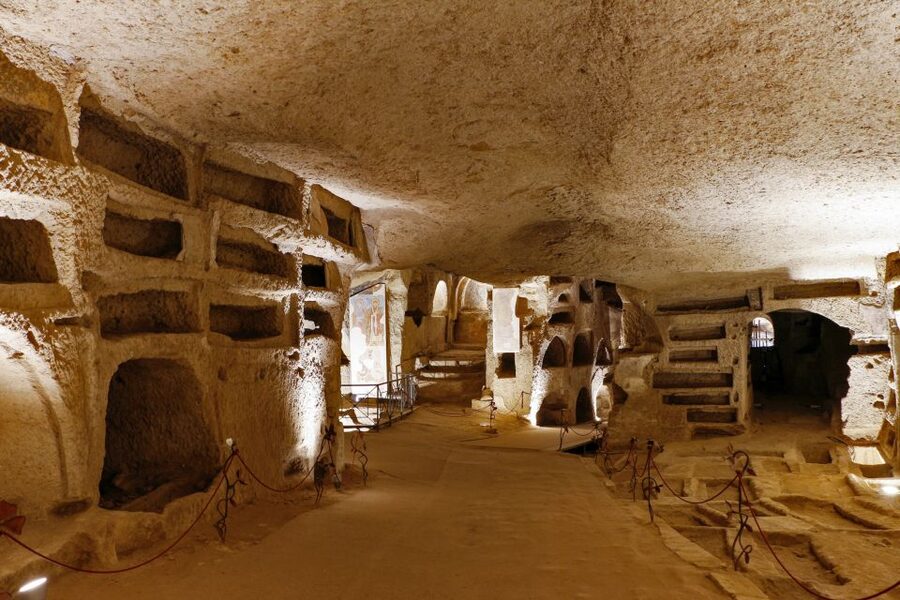
Review · CATACOMBS & APPIAN WAY TOURS
Naples: Catacombs of San Gennaro Entry Ticket & Guided Tour
The best stories are often underground. The Catacombs of San Gennaro offer a quiet, powerful look at Naples through ancient Christian art, burial customs, and the city’s lasting bond with its patron saint. I especially like the grand underground spaces and the chance to see early paintings and mosaics in their original setting. The ticket also includes entry to San Gaudioso and the Basilica di Santa Maria della Sanità, which makes the $15 price unusually good. The main drawback is the strict timing and the many steps, so this is not the easiest outing for anyone with mobility limits.
This is more than a quick look at old tombs. A lively guide such as Nello, Emmanuel, Antonia, or Valentina can connect the catacombs to Naples today, including the renewal of the Rione Sanità district. Photography is not allowed, which may disappoint anyone hoping for a visual record, but it also keeps the visit calm and focused.
In This Review
- Key points at a glance
- Why the Catacombs of San Gennaro matter
- Meeting at Via Capodimonte 13
- The upper catacomb and its Pompeian-style paintings
- Basilicas, burial chambers, and the scale below Naples
- The Crypt of the Bishops and fifth-century mosaics
- The baptismal font and the catacombs as a refuge
- What your guide adds to the experience
- The bonus visit to San Gaudioso and Santa Maria della Sanità
- Price, timing, and practical limits
- Who will enjoy this most
- Should you book the Catacombs of San Gennaro?
- FAQ
- Where does the Catacombs of San Gennaro tour begin?
- How long does the guided tour last?
- What languages are available?
- What does the ticket include?
- How long is the pass for San Gaudioso and Santa Maria della Sanità valid?
- Do I need to arrive before the scheduled time?
- Is photography allowed inside the catacombs?
- Is hotel transportation included?
Key points at a glance
- Fourth-century expansion: The underground complex grew after the remains of St. Agrippinus were moved to a basilica below the city.
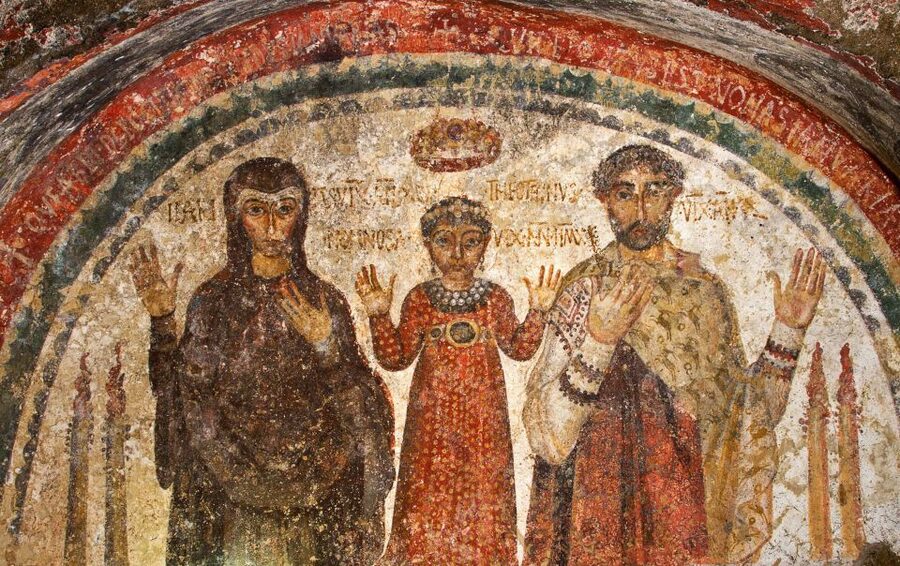
- Ancient Christian art: See frescoes from the third century, Byzantine paintings from the ninth and tenth centuries, and fifth-century mosaics.
- A second site included: Your ticket also covers the Catacombs of San Gaudioso and Basilica di Santa Maria della Sanità for up to 12 months.
- A community-minded visit: Ticket income supports cultural work and the redevelopment of the Rione Sanità district.
- Short but substantial: The guided visit lasts about 45 minutes, with some itinerary information listing 50 minutes.
Why the Catacombs of San Gennaro matter
Naples is famous for churches, street life, food, and noisy energy above ground. Below the streets, the Catacombs of San Gennaro reveal another Naples: early Christian, ceremonial, artistic, and closely tied to local identity.
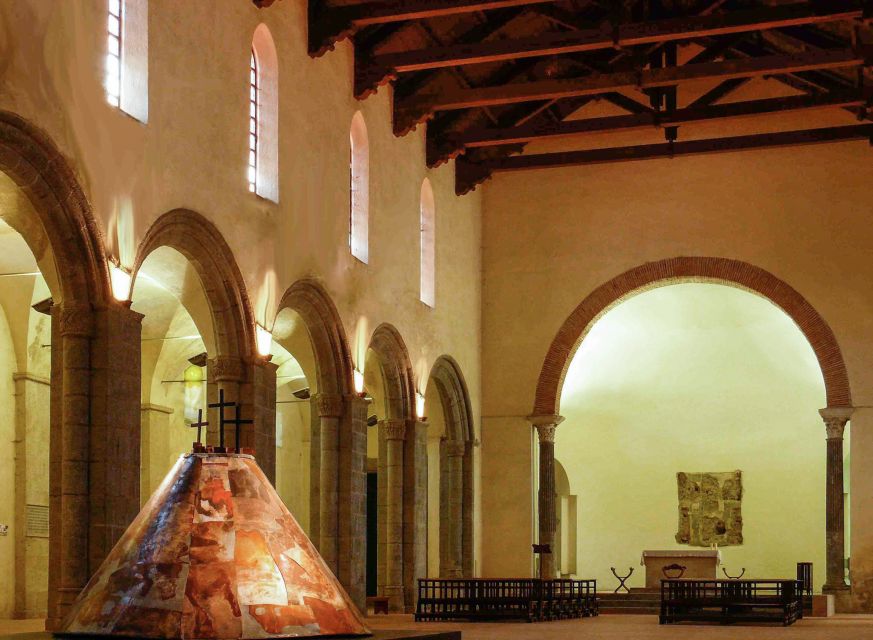
The site began as a paleo-Christian burial area and developed over many centuries. Its name comes from San Gennaro, the patron saint of Naples, but the complex also reflects the importance of St. Agrippinus, an early bishop whose basilica became part of the underground site.
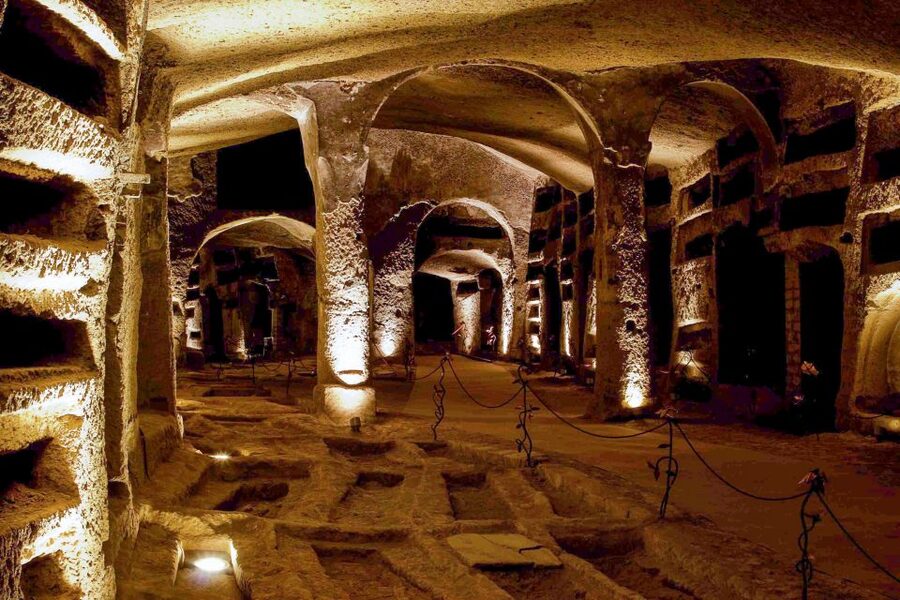
I like this setting because it gives religious history a physical shape. You are not simply looking at dates on a museum label. You are walking through chambers shaped into the rock, seeing burial spaces, painted walls, mosaics, and places of worship where Christian communities gathered long before Naples became the city you see today.
The story also reaches into the Middle Ages. Bishop Paul II took refuge in the catacombs during the eighth-century iconoclastic struggles, a period when religious images faced attack in parts of the Christian world. The baptismal font connected with him is one of the tour’s most memorable objects because it shows that these chambers were not only burial places. They also served as active religious spaces.
More catacombs and Appian Way trips:
- Naples: San Gaudioso Catacombs Guided Tour
★ 4.7 · 1,105 reviews - Rome: Crypts and Catacombs Underground Tour with Transfers
★ 4.6 · 5,341 reviews - The Original Roman Crypts and Catacombs Tour with Transfers
★ 4.5 · 4,896 reviews
Meeting at Via Capodimonte 13
The meeting point is the reception at the Catacombs of San Gennaro, Via Capodimonte, 13, 80136 Naples. You need to arrive at the ticket office 15 minutes before your booked start time.
That advice matters. The ticket is tied to the day and time purchased, and arriving after the group has left does not mean you can simply join the next tour. The ticket office opens at 9:30 AM, so check the available starting times before planning your morning.
Getting to the site can take more effort than the short tour duration suggests. From Naples’ old town, the route is uphill, and one practical account describes a long walk from the port. If you are walking, allow extra time and energy for the climb. If you are driving, parking information from one visit points to free spaces near the meeting point, though you should still confirm conditions on the day.
The entrance is beside the Basilica of Madre del Buon Consiglio, near the Capodimonte area. Map apps may not always choose the easiest route back down. One visitor found Apple Maps sent them up hundreds of steps toward a dead end, so pay attention to staff directions before leaving.
The upper catacomb and its Pompeian-style paintings
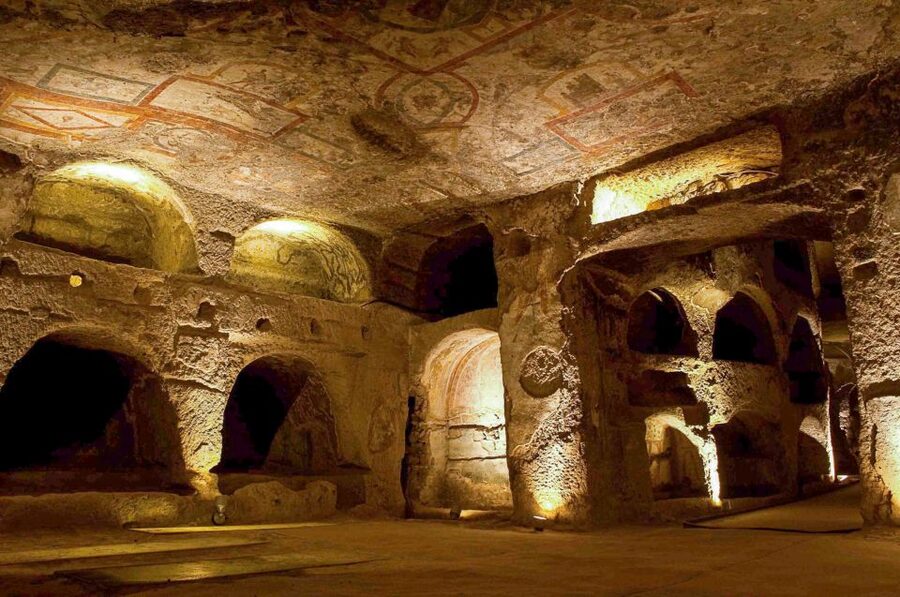
The tour begins with the upper catacomb, where some of the earliest Christian paintings in Italy can be seen. These works date to the third century and are decorated in what is described as the Pompeian style.
That detail helps place the paintings in context. Early Christian art did not appear in isolation. It developed within the wider Roman artistic world, borrowing forms, colors, and decorative habits while expressing new religious ideas.
The underground setting adds weight to what you are seeing. The walls are not arranged like a modern gallery, and the art is not presented as a polished collection. You see it as part of the burial and worship spaces that gave it meaning.
A guide makes a real difference here. The paintings can be easy to miss if you do not know where to look or what symbols matter. Guides such as Antonia and Nello have been praised for explaining the site with humor and a clear pace, without burying the group under too many dates.
The route has a carpet-like surface in places, which makes walking easier. Still, expect a descent by steps before reaching the main tour area. Wear sensible shoes and avoid treating this as a quick, effortless stop between bigger sights.
Basilicas, burial chambers, and the scale below Naples
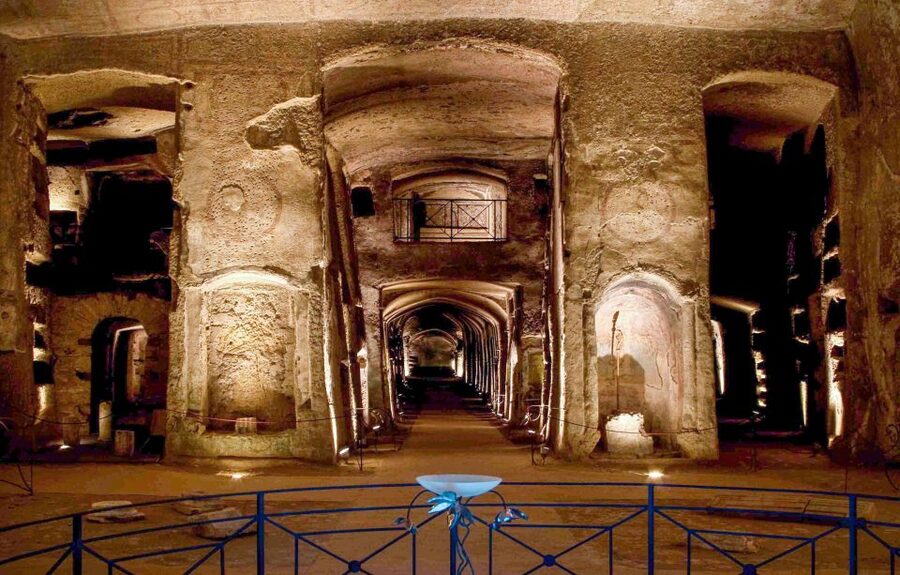
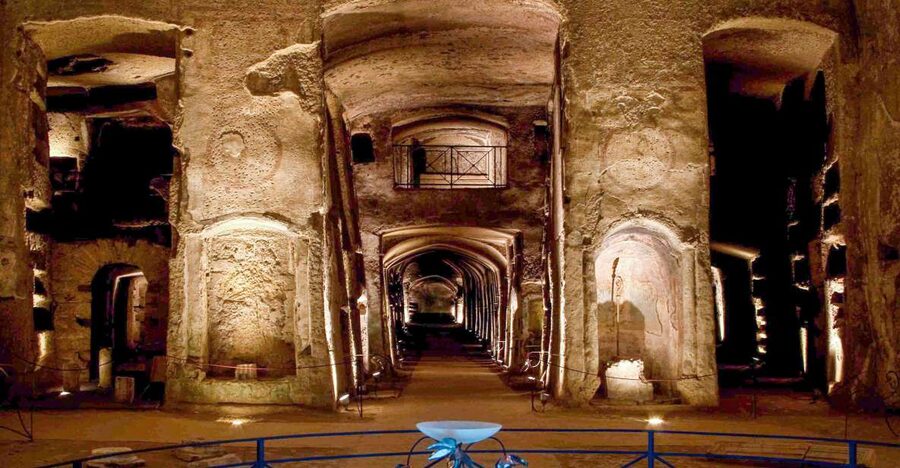
The Catacombs of San Gennaro are larger than many people expect. The word catacombs can suggest narrow tunnels and cramped passages, but this site includes broad chambers and grand underground basilicas.
That scale is one of the strongest parts of the visit. You get a sense that this was not merely a place to hide bodies away. It was a carefully used religious complex, with enough space for worship, commemoration, and the movement of a community.
The fourth-century expansion followed the transfer of St. Agrippinus’ remains to the underground basilica dedicated to him. The guide explains how the site grew and changed, helping you understand why the complex feels like a layered record rather than one single monument.
The tour lasts around 45 minutes, although the itinerary may describe the guided portion as 50 minutes. Either way, it is short enough to fit into a busy Naples day but long enough to cover the main rooms and key objects.
The pace has been described as steady and well judged. You have time to see the art and ask questions, yet you are not left standing in one chamber while the guide recites an endless lecture. That balance suits most people, especially if this is your first visit to an early Christian site.
A few more reviews worth comparing before you book
- Naples: Naples Underground Entry Ticket and Guided Tour
★ 4.4 · 21,781 reviews - Pompeii: Entry Ticket and Guided Tour with an Archaeologist
★ 4.8 · 19,459 reviews - Pompeii: Entry Ticket with Optional Audio Guide
★ 4.2 · 12,360 reviews - Pompeii: Small Group Tour with an Archaeologist
★ 4.8 · 12,264 reviews
The Crypt of the Bishops and fifth-century mosaics
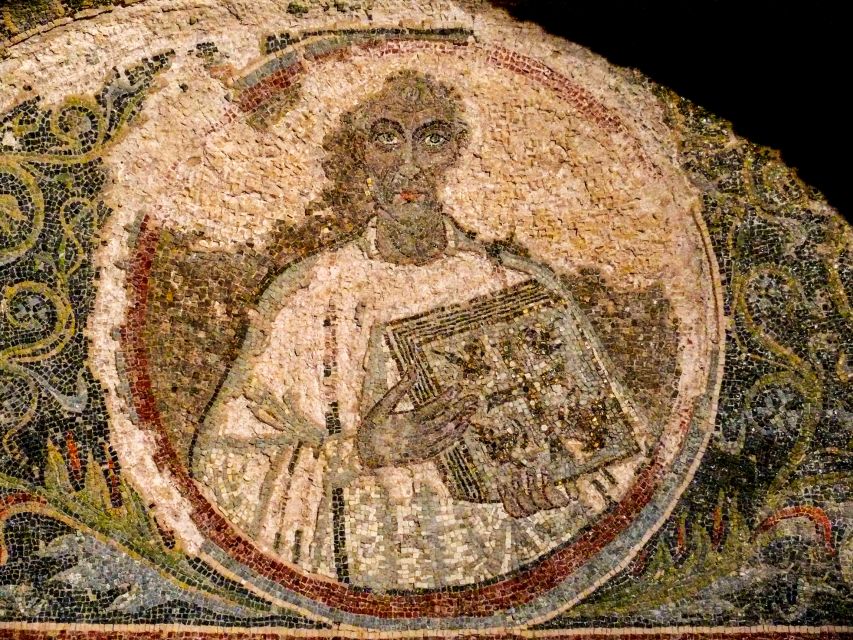
The Crypt of the Bishops is one of the most important stops. Its fifth-century mosaics include an image of St. Quodvultdeus, the Bishop of Carthage.
This is where the tour moves beyond local Naples. The catacombs connect the city with the wider Christian world of late antiquity, showing how religious networks reached across the Mediterranean.
Mosaics can be hard to appreciate without help. From a distance, you may notice color and pattern first. A guide can point out the figures, explain who they represent, and show how the work fits the period. Antonio has been praised for explaining ancient material with sensitivity and clarity, which is especially useful in a place where the art is old, fragile, and emotionally charged.
The Crypt of the Bishops also gives the tour a strong sense of ceremony. You are looking at a place linked to church leaders and important religious figures, not just anonymous underground burials. The effect is solemn without becoming gloomy.
The baptismal font and the catacombs as a refuge
The baptismal font commissioned by Bishop Paul II adds another layer to the visit. During the eighth-century iconoclastic struggles, Paul II took refuge in the catacombs.
This story helps you see the site as a living refuge during periods of danger. The catacombs were used over time for burial, worship, shelter, and the preservation of religious traditions.
I find this one of the most useful parts of the tour because it breaks the common idea that catacombs are simply cemeteries. They were places where religious life continued underground when the world above became unsafe.
The font itself is a reminder of ordinary religious practice. Baptism is a rite of entry into the Christian community, while the surrounding chambers are connected with death and remembrance. Seeing both functions in the same complex gives the site unusual depth.
The guide’s tone matters here. The best tours treat the material with respect but do not make every moment heavy. Nello, Emmanuel, and several other guides have been praised for adding warmth and occasional humor while still handling the history carefully.
What your guide adds to the experience
This ticket is for a live guided tour in English or Italian. You are not left to work out the site alone, and that is important because much of the value comes from connections between rooms, people, and periods.
A good guide explains not only what you are looking at but why it matters. The strongest guide accounts describe clear English, friendly welcomes, good humor, and plenty of room for questions. Some groups have been very small, which can make the visit feel personal, though group size can vary.
Nello receives especially warm praise for his engaging style and his explanation of both the catacombs and modern Naples. Emmanuel is also noted for making the material accessible and lively. Antonia, Antonio, Valentina, Serena, and other guides have been described as clear, friendly, and open to questions.
No guide is guaranteed, so book this for the site itself rather than for one named person. Still, the consistent praise for the guiding team is a strong sign that the explanations are central to the experience.
The tour also places the catacombs within the Rione Sanità district. Ticket sales help support redevelopment, local cultural work, and younger people working in the area. That gives your visit a practical local benefit, not just a sightseeing purpose.
The bonus visit to San Gaudioso and Santa Maria della Sanità
Your ticket includes entry to the Catacombs of San Gaudioso and the Basilica di Santa Maria della Sanità. The pass is valid for 12 months, so you do not have to rush through both sites on the same day.
This is a major part of the value. At $15 per person, the San Gennaro tour is already fairly priced for a guided cultural visit. The extra admission makes it especially attractive if you have enough time to see the second catacomb.
San Gaudioso lies farther down the hill toward the city. That makes it possible to plan the two sites as part of one walk, starting at San Gennaro and continuing toward Santa Maria della Sanità. The exact visiting arrangements and available tour times should be checked locally, but the long validity gives you a useful backup if your schedule changes.
The Basilica di Santa Maria della Sanità is included with the pass as well. A short stop there can help you connect the underground religious world with the grand churches of Naples above ground.
Do not assume the second site is a minor extra. The combined visit gives you a broader picture of how Naples used underground spaces, churches, art, and local religious traditions. If you have only one free hour, do San Gennaro first. If you have a half day in the district, use the pass and see both catacombs.
Price, timing, and practical limits
At $15, this is a strong-value activity. You receive a guided visit, entry to San Gennaro, and access to San Gaudioso and Santa Maria della Sanità for up to 12 months.
The cost is even easier to justify if you care about local projects. Your ticket helps fund the work connected with Rione Sanità, an area whose reputation and public life have been changing over the past decade or so.
There are a few practical limits. The ticket office opens at 9:30 AM, you must arrive 15 minutes early, and the ticket applies only to the date and time purchased for San Gennaro. The activity information also says you can cancel up to 24 hours ahead for a full refund, while the important information says tickets are not refundable. Because those terms conflict, check the exact conditions shown at checkout before paying.
Hotel pickup and drop-off are not included. You make your own way to Via Capodimonte, 13.
Photography is not allowed inside the catacombs. If taking pictures is important to you, this will feel restrictive. I think the rule does help keep the visit quiet and protects attention around fragile art, but it is still worth knowing before you arrive.
Who will enjoy this most
I would choose this tour if you like archaeology, early Christianity, art, or the less polished side of Naples. It is also a good pick if you have already seen the Duomo and major churches and want the earlier story beneath them.
The visit suits adults, older children, and anyone who enjoys a guide who can explain rather than simply point. Several guides use humor, so the tone is not strictly formal.
Very young children may struggle with the quiet setting and the historical subject. One account found small children disruptive, even when they were behaving normally for their age. The steps also make the route a poor choice for people with mobility problems.
You should also be comfortable with a place connected to death and burial. The catacombs are not a horror attraction, but the subject is unavoidable. If you want a light sightseeing stop, choose a church or viewpoint instead.
Should you book the Catacombs of San Gennaro?
Yes, if you want a thoughtful, well-priced look at Naples beneath its noisy surface. The art, basilicas, baptismal font, mosaics, and long connection with San Gennaro make this far more interesting than a simple walk through tombs.
I would book it early enough to protect the time slot, arrive 15 minutes ahead, and wear shoes suited to steps. Leave room afterward for San Gaudioso and Santa Maria della Sanità, either on the same day or later within the 12-month validity period.
Skip it if you cannot manage stairs, need to take photographs, or prefer completely independent sightseeing. For most history-minded visitors, though, this is one of the best uses of $15 in Naples, especially because the ticket also supports cultural renewal in Rione Sanità.
FAQ
Where does the Catacombs of San Gennaro tour begin?
It begins at the reception of the Catacombs of San Gennaro, Via Capodimonte, 13, 80136 Naples.
How long does the guided tour last?
The activity is listed as lasting 45 minutes. The itinerary describes the guided portion as 50 minutes, so allow roughly an hour for the visit itself.
What languages are available?
Live guided tours are available in English and Italian.
What does the ticket include?
It includes a guide, entry to the Catacombs of San Gennaro, and entry to the Catacombs of San Gaudioso and Basilica di Santa Maria della Sanità.
How long is the pass for San Gaudioso and Santa Maria della Sanità valid?
The additional entry pass is valid for 12 months.
Do I need to arrive before the scheduled time?
Yes. You should arrive at the ticket office 15 minutes before your booked time.
Is photography allowed inside the catacombs?
No. Photography is not allowed during the visit.
Is hotel transportation included?
No. Hotel pickup and drop-off are not included, so you must arrange your own transportation to Via Capodimonte, 13.
Just added around Naples
- From Naples/Salerno: Pompeii, Sorrento, and Positano Tour★ 4.5 · 250 reviews
- Pompeii: Day Tour of Pompeii and Vesuvius with Bus Transfer★ 4.2 · 250 reviews
- Ischia: Island Boat Tour with Neapolitan Lunch & Snorkeling★ 4.9 · 253 reviews
- Explore Naples & Pompeii in One Day – Guided Half-Day Tour★ 4.5 · 253 reviews
- Discover Pompeii: French Walking Tour of the Buried City★ 4.8 · 253 reviews
- Private Transfer from Naples to Sorrento or from Sorrento to Naples★ 5.0 · 254 reviews
- From Pompeii: Mount Vesuvius Guided Tour with Transfer★ 4.8 · 255 reviews
- Small Group from Naples: Sorrento, Positano, Amalfi & Ravello★ 4.5 · 265 reviews
Catacombs & Appian Way Tours, compared.
Crypts and Catacombs Underground Tour with Transfers
Read our review →
The Original Roman Crypts and Catacombs Tour with Transfers
Read our review →
Catacombs of St. Callixtus Entry Ticket & Guided Tour
Read our review →

Rome EBike Tour: Appian Way, Catacombs & Roman Aqueducts
Read our review →
Catacombs and Capuchin Crypt Guided Tour with Transfer
Read our review →
Appian Way, Catacombs, & Roman Aqueducts E-bike Tour
Read our review →Browse the lists this tour appears in