
Review · POMPEII & HERCULANEUM TOURS
Herculaneum Small Group Tour and Ticket With an Archaeologist
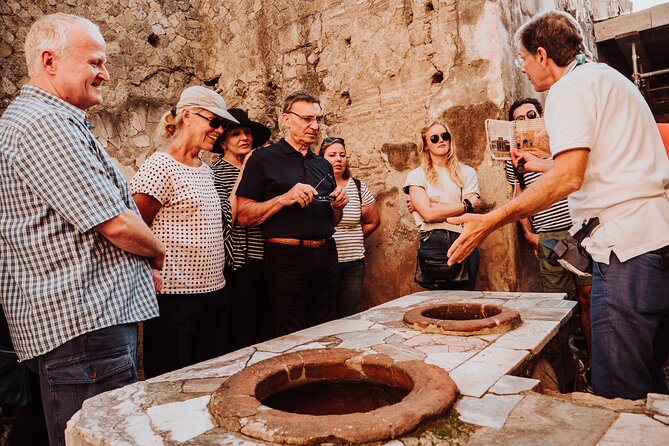
Ancient wood survives here. That alone makes Herculaneum a remarkable stop near Naples, but this two-hour walking tour adds the human stories and archaeological context that are easy to miss on your own. I especially like the working archaeologist guides, including Luciano Leone, Paulo, Julia, and Michele, and the included entry ticket with a headset.
The tour also keeps things simple: you meet at the ruins’ ticket office, skip the main ticket queue, and follow a planned route through important houses, baths, and public buildings. The main drawback is time. Two hours goes quickly, and one guide reportedly ran over, leaving less time for the onsite museum. You will also spend much of the visit standing and walking.
In This Review
- Key points to know before booking
- Why Herculaneum feels different from Pompeii
- Meeting at the ruins in Ercolano
- House of the Deer and the terrace of M. Nonius Balbus
- The College of the Augustales and the House of the Telephus Relief
- The wooden partition and the House of the Skeleton
- The Central Thermae and daily Roman routines
- The Black Salon and Casa Sannitica
- Casa del Bel Cortile and the Grand Portal
- What the archaeologist guide adds
- Is $53.81 a fair price?
- Weather, dogs, and practical comfort
- Should you book this Herculaneum tour?
- FAQ
- Where does the Herculaneum tour begin?
- Where does the tour end?
- How long does the tour last?
- What is included in the price?
- Does the tour include transportation?
- How can I reach the meeting point by train?
- Can I bring a dog?
- Can I cancel for a full refund?
Key points to know before booking
- The preserved wooden details are the star: See carbonized doorposts, a wooden partition, and other remains that make ancient domestic life feel unusually close.
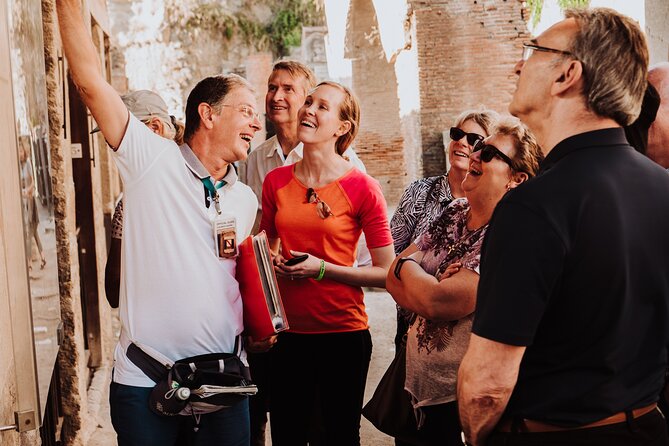
- The guide is the real value: An archaeologist can explain construction, decoration, religion, and daily life rather than simply point out walls.
- The route covers 11 major locations: Expect famous houses, the baths, the College of the Augustales, and the terrace of M. Nonius Balbus.
- Groups can reach 20 people: Headsets help, though a smaller group of six or twelve will feel more personal than a full departure.
- The museum may need extra time: The tour ends inside the ruins, so plan to stay afterward if you want to see recovered jewelry, furniture, and other objects.
- The price includes the €16 adult admission: At $53.81 per person, the guide and organized entry account for most of the added cost.
Why Herculaneum feels different from Pompeii
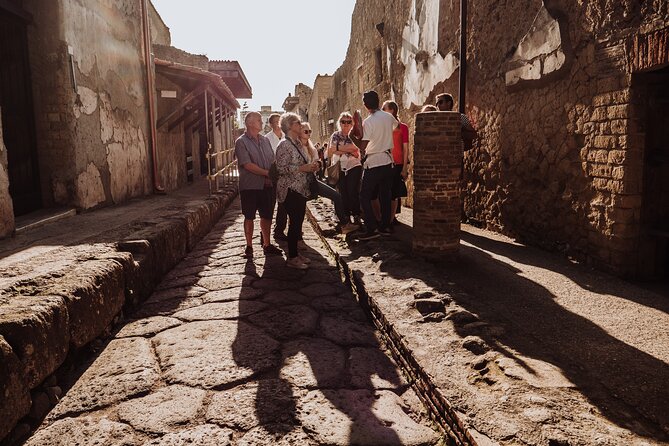
Herculaneum is often treated as Pompeii’s smaller cousin. That comparison is useful, but it can also undersell the site. The ancient town is more compact, and its preserved details can be startling: frescoes, tiled floors, carbonized wood, private homes, and household objects survived in ways that make the place feel personal rather than merely monumental.
The eruption of Mount Vesuvius in AD 79 buried both Herculaneum and Pompeii, but the material preserved at Herculaneum gives you a different kind of window into Roman life. The tour focuses on homes and public spaces, showing how rooms connected, how people bathed, how religion shaped civic life, and how wealthy families displayed status.
I like this approach because it moves beyond dates and rulers. A good guide can explain why a house has a courtyard instead of a traditional atrium, what a wooden screen tells us about privacy, or how a public benefactor was honored after death. Those details help you picture people using the buildings instead of seeing them as empty ruins.
More Pompeii and Herculaneum visits:
- Pompeii: Entry Ticket and Guided Tour with an Archaeologist
★ 4.8 · 19,459 reviews - Pompeii: Entry Ticket with Optional Audio Guide
★ 4.2 · 12,360 reviews - Pompeii: Small Group Tour with an Archaeologist
★ 4.8 · 12,264 reviews
Meeting at the ruins in Ercolano
The meeting point is the Herculaneum ticket office at Corso Resina, 187, near the entrance to the archaeological area. The tour begins there and finishes inside the ruins, so you do not need to return to the starting point at the end.
By train, use the Circumvesuviana station at Corso Resina 1. It is about a 10-minute walk from the meeting point. By car, the access route is via Pignalver, with an unguarded parking area very close to the meeting location.
The arrangement is practical, but you should arrive with enough time to find the ticket office and identify the guide. The experience includes guidance, assistance, entrance admission, and headsets. It does not include meals, drinks, or private transportation.
The maximum group size is 20 people per guide. That is still a manageable number for a historic site, but the feel can vary. A group of six allows more room for questions and easier movement around busy rooms. At 12 people, the headsets were reported to work well. At a full 20, stay close and keep your headset volume comfortable.
House of the Deer and the terrace of M. Nonius Balbus
The route begins with the House of the Deer, named for the marble deer statues found in its peristyle. A peristyle is a courtyard surrounded by columns, often used as a pleasant open area within an elite Roman home.
This is a good first stop because it introduces the relationship between architecture, decoration, and status. You are not simply looking at a large residence. You are seeing how owners used sculpture and garden-like spaces to present wealth to visitors.
Next comes the terrace of M. Nonius Balbus, one of Herculaneum’s major benefactors. Balbus restored and built public structures, and the city honored him after his death with a funeral altar and a long inscription describing his honors.
This stop gives the tour a civic angle. The ancient town was not only a collection of private homes. It had patrons, public funding, religious offices, and a system of honoring people who supported the community. The guide’s explanation is especially useful here because an inscription can be easy to overlook without context.
The College of the Augustales and the House of the Telephus Relief
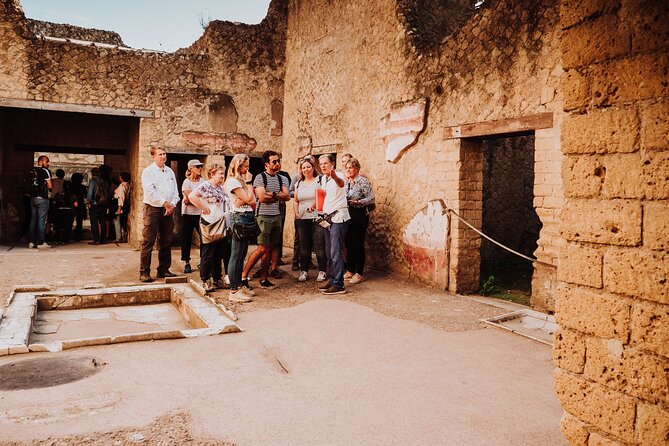
The College of the Augustales is thought to have been connected to the cult of Emperor Augustus. It may also have served as the local curia, or civic meeting place. The uncertainty is worth noting. Archaeology often involves careful interpretation rather than tidy answers, and a good guide will explain what is known and what remains debated.
The building helps show how imperial politics and local religion were linked. Worship of the emperor was not only a private matter. It was part of public life and civic identity.
The House of the Telephus Relief may have belonged to Marcus Nonius Balbus, the same benefactor honored at the earlier terrace. The house is unusual because it had private access to the nearby Suburban Baths.
That private connection hints at the habits of an affluent household. It also lets the guide explain how domestic and public spaces could overlap in a Roman town. The house is not memorable only for its possible owner. Its layout reveals how comfort and convenience shaped elite life.
A few more reviews worth comparing before you book
- Naples: Naples Underground Entry Ticket and Guided Tour
★ 4.4 · 21,781 reviews - From Naples: Pompeii Ruins & Mount Vesuvius Day Tour
★ 4.3 · 11,459 reviews - From Naples: Sorrento, Positano and Amalfi Full-Day Tour
★ 4.6 · 10,988 reviews - From Naples: Sorrento, Positano & Amalfi Coast – Small Group Tour
★ 5.0 · 8,643 reviews
The wooden partition and the House of the Skeleton
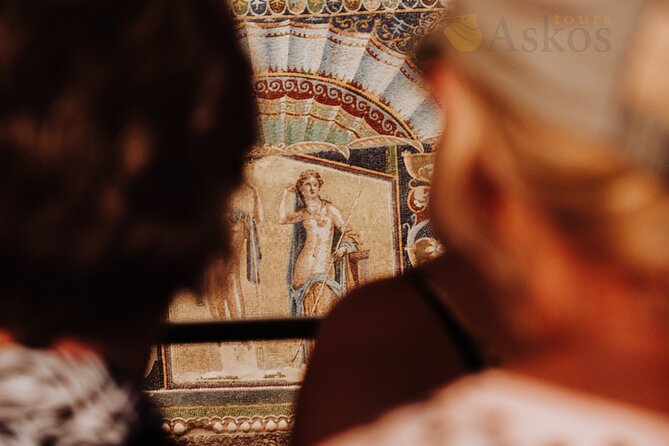
The House of the Wooden Partition, also known as Casa del Tramezzo di Legno, is one of the most important stops because its elegant wooden partition survived in carbonized form.
Wood is normally the first thing to vanish at an ancient site. Here, the eruption preserved it in a darkened, fragile state. The partition gives you a rare look at interior design and room division. It also makes the ancient house easier to picture because you can see an actual household feature rather than only stone foundations.
Next is the House of the Skeleton, probably formed by combining three smaller buildings. Its name comes from human remains found in an upstairs room in 1831.
This stop may be difficult for some people, but it also helps explain the human cost of the eruption. The tour is not only about elegant frescoes and wealthy homes. The site contains evidence of ordinary lives interrupted suddenly. Ask the guide about what is certain and what remains a reconstruction, since archaeological evidence can be incomplete.
The Central Thermae and daily Roman routines
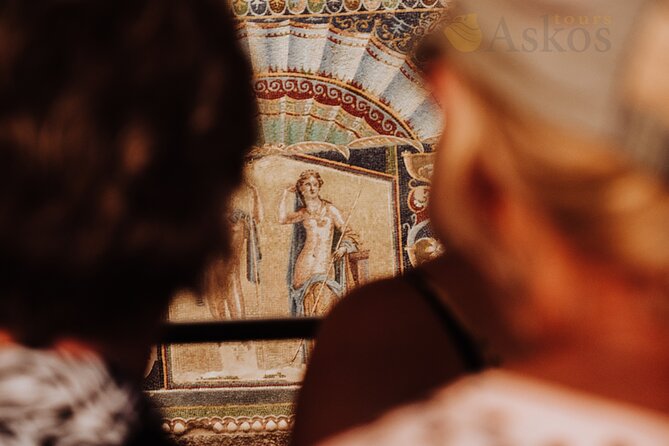
The Central Baths, or Central Thermae, were built around the beginning of the first century AD. As was common at the time, the facilities were divided into men’s and women’s sections, each with separate entrances.
Baths were central to Roman social life. They were places for washing, exercise, conversation, and routine contact with neighbors. The remains also show the level of planning required for heated public buildings.
This is one of the stops where an archaeologist’s background matters. A guide can connect the surviving rooms with the practical systems behind them, while also explaining how public baths fit into the rhythm of town life.
The tour includes plenty of standing, and there are limited chances to sit. If you have trouble standing for long periods, keep that in mind before booking. The route is described as suitable for most people, but the pace and ground conditions still call for sensible shoes and water.
The Black Salon and Casa Sannitica
The House of the Black Salon, also called the House of the Black Hall, is one of Herculaneum’s more luxurious homes. Its monumental entrance still has carbonized doorposts and a lintel, an unusually direct reminder that these were once functioning buildings with doors, rooms, and private boundaries.
The dark interior decoration gives the house a strong visual identity. It is also a useful place to think about Roman taste. Color, scale, painted walls, and formal entrances all helped communicate the standing of the owner.
The Samnite House has an arrangement associated with the Samnites, an ancient people linked with this mountainous part of central Italy. Its atrium is surrounded by a gallery with Ionic columns, and the rooms retain fresco decoration.
The house shows that Herculaneum’s identity was not formed in one simple period. Older local traditions, later Roman influence, architectural fashion, and personal wealth all appear in the buildings. You may hear different interpretations of the house’s name and design, so this is another stop where the guide’s explanation adds real value.
Casa del Bel Cortile and the Grand Portal
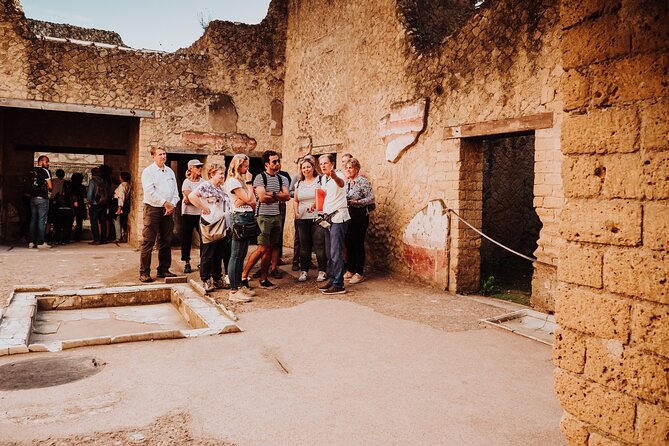
The House of the Beautiful Courtyard is unusual because it has a courtyard with a staircase and stone balcony instead of the atrium arrangement more commonly seen in Roman houses.
That difference is small on a map but striking on site. It reminds you that ancient homes did not all follow one fixed template. Families adapted buildings to their needs, the available space, and local customs.
The final stop is the House of the Grand Portal, a handsome domus in the center of the archaeological area. Expect columns, frescoes, multiple rooms, and carbonized remains of wooden parts.
By this point, the sequence of houses begins to make sense. You have seen grand entrances, private courtyards, religious buildings, baths, decorative rooms, and practical household features. The guide can pull these threads together, helping you compare the homes rather than treating each one as an isolated stop.
What the archaeologist guide adds
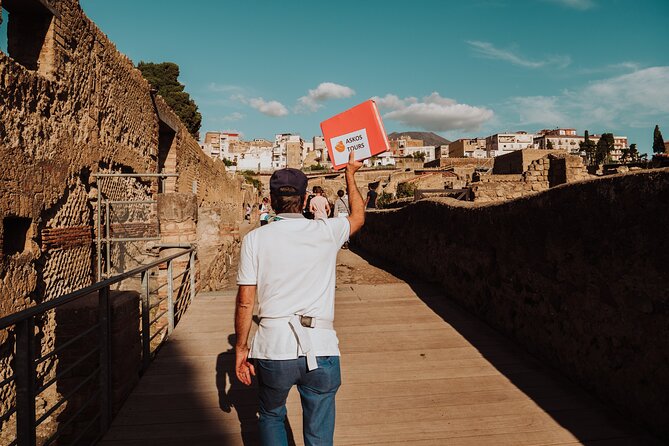
The strongest reason to book this tour is the guide. Several guides receive especially warm praise, with Luciano Leone mentioned for his energy, visual reconstructions, and ability to explain how buildings may once have looked. He reportedly carries a book of images, including reconstructions he created, which can make damaged walls and open courtyards easier to understand.
Other praised guides include Paulo, Julia, Michele, Antonella, Sergio, Gennaro, Diego, Marie, Michael, and Luciano. The consistent strength is not a single scripted performance. It is the combination of archaeological training, clear explanations, humor, and attention to the group.
A good moment from the tour may be a tiny feature you would walk past alone: a door frame, a floor pattern, a wall painting, or the way one room opens onto another. One guide was praised for making sure a visitor with hearing aids could follow the explanation. Another kept the pace brisk enough to cover a great deal of the site.
There is one caution. One guide reportedly spoke at length and ran overtime, which meant less time for parts of the site and the museum. Another guide spoke a little quickly. If you want a leisurely visit with long pauses for photography, an audio guide may give you more control. This tour is better suited to people who want interpretation and a clear route.
Is $53.81 a fair price?
The adult Herculaneum entrance ticket costs €16, and that admission is included. EU citizens aged 18 to 25 pay €2 for entry, although the tour price may not change accordingly, so check the booking terms before relying on the reduced museum admission.
At $53.81 per person, you are paying roughly the cost of admission plus a substantial fee for the archaeologist-led tour, headsets, assistance, and skip-the-line access. I consider that fair if Herculaneum is important to you and you want to understand what you are seeing.
The value is strongest for first-time visitors, families, and anyone who would otherwise spend time reading signs or using an audio guide without knowing which details matter. It is less compelling for repeat visitors who already understand Roman domestic architecture and prefer to set their own pace.
The tour is frequently booked well ahead, with an average booking lead time of 42 days. That suggests you should reserve early if your Naples dates are fixed, especially if you want a particular departure.
Weather, dogs, and practical comfort
The tour operates in all weather, so dress for rain or strong sun. One group completed the visit in pouring rain, and another encountered a short shower. Good shoes are important because the experience involves walking over an ancient archaeological site, with substantial standing and little opportunity to rest.
Dogs are allowed in the Herculaneum Archaeological Park without breed or size restrictions. They must be kept on a leash or muzzle, and you must carry bags for waste. In the Antiquarium, Boat Pavilion, and houses with mosaic floors, dogs must be carried or placed in a suitable carrier.
Service animals are allowed, and the site is near public transportation. Most people can participate, but the walking and standing should be considered carefully for anyone with limited mobility.
Free cancellation is available up to 24 hours before the start time for a full refund. Cancellations or changes made within 24 hours are not accepted for a refund. The experience also requires a minimum number of participants, so a cancellation by the operator may result in another date, another experience, or a full refund.
Should you book this Herculaneum tour?
I would book it if you have about two hours, this is your first visit, and you want the site to make sense rather than simply look impressive. The preserved wood, frescoes, baths, and private homes deserve explanation, and the archaeologist guides are the main reason this tour earns its high rating.
Choose it with realistic expectations. A group of up to 20 is not a private tour, the route involves standing, and two hours does not allow unlimited wandering. If possible, stay inside the ruins afterward for the onsite museum, especially to see recovered jewelry and furniture.
For the best experience, arrive early, wear sturdy shoes, bring weather protection, and ask the guide where to continue after the formal tour ends. If your ideal visit means quiet photography and complete freedom, visit independently. If you want ancient Herculaneum brought into focus by someone who understands how the site was built and excavated, this is a strong use of your Naples sightseeing budget.
FAQ
Where does the Herculaneum tour begin?
It begins at the Herculaneum ruins ticket office at Corso Resina, 187, 80056 Ercolano, Italy.
Where does the tour end?
The tour ends inside the Herculaneum ruins at Scavi di Ercolano. You do not return to the starting point.
How long does the tour last?
The guided visit lasts approximately two hours.
What is included in the price?
The price includes Herculaneum entry tickets, guidance and assistance, a licensed guide with an archaeological background, a small group of up to 20 people, and headsets.
Does the tour include transportation?
No. Private transportation, meals, and drinks are not included.
How can I reach the meeting point by train?
The Circumvesuviana station is at Corso Resina 1, about a 10-minute walk from the meeting point.
Can I bring a dog?
Yes. Dogs are allowed in the archaeological park without breed or size restrictions, but they must be kept on a leash or muzzle, and you must carry bags for waste. In certain areas, dogs must be carried or placed in a suitable carrier.
Can I cancel for a full refund?
Yes. You can cancel at least 24 hours before the experience start time for a full refund. Cancellations or changes made less than 24 hours before the start time are not accepted for a refund.
Just added around Naples
- From Naples/Salerno: Pompeii, Sorrento, and Positano Tour★ 4.5 · 250 reviews
- Pompeii: Day Tour of Pompeii and Vesuvius with Bus Transfer★ 4.2 · 250 reviews
- Ischia: Island Boat Tour with Neapolitan Lunch & Snorkeling★ 4.9 · 253 reviews
- Explore Naples & Pompeii in One Day – Guided Half-Day Tour★ 4.5 · 253 reviews
- Discover Pompeii: French Walking Tour of the Buried City★ 4.8 · 253 reviews
- Private Transfer from Naples to Sorrento or from Sorrento to Naples★ 5.0 · 254 reviews
- From Pompeii: Mount Vesuvius Guided Tour with Transfer★ 4.8 · 255 reviews
- Private Transfer from Naples to Positano or Amalfi or vice versa★ 5.0 · 265 reviews
Pompeii & Herculaneum Tours, compared.

Pompeii: Entry Ticket and Guided Tour with an Archaeologist
Read our review →
Pompeii: Entry Ticket with Optional Audio Guide
Read our review →
Pompeii: Small Group Tour with an Archaeologist
Read our review →


Pompeii Small Group Tour with an Archaeologist
Read our review →
Pompeii, Amalfi Coast and Positano Day Trip from Rome
Read our review →Browse the lists this tour appears in