
Review · POMPEII & HERCULANEUM TOURS
From Naples: Pompeii & Herculaneum with Archaeologist Guide
Pompeii and Herculaneum tell different disaster stories. This seven-hour small-group tour makes a strong case for seeing both, pairing skip-the-line entry with an archaeologist who can explain details you would likely miss alone. I especially like the comfortable minibus transfers and the way the route includes Herculaneum first, when your attention is fresh. The main drawback is time: two hours at each site gives you the essential sights, but not every street, house, or museum room.
The meeting point is simple, in front of Starhotels Terminus opposite Naples Central Station. I also like that the group is capped at 20 people, with headsets used on many departures so you can hear the guide among the ruins. Just be ready for uneven paving, slopes, stairs, and a long day on your feet.
In This Review
- Key points at a glance
- Why seeing both sites makes sense
- Starting at Starhotels Terminus in Naples
- Herculaneum reveals the finer details
- The transfer to Pompeii and the lunch break
- Pompeii’s public spaces and private homes
- The archaeologist guide is the real value
- What the $168.79 price really covers
- Who should book this day trip
- Final verdict: should you book it?
- FAQ
- Where does the tour start?
- Where does the tour end?
- How long does the experience last?
- Is transportation included?
- Are entrance tickets included?
- Is lunch included?
- What should I bring?
- Is the tour suitable for people with limited mobility?
Key points at a glance

- Herculaneum first: See carbonized wood, bright wall paintings, mosaics, baths, and the waterfront area where more than 300 skeletons were found.
- Pompeii’s essential circuit: The roughly two-hour walk includes the Marina Gate, Basilica, Forum, bakery, brothel, plaster casts, and several famous houses.
- Archaeologist-led explanations: Guides such as Raphael, Roberta, Michele, Vito, and Gennaro have been praised for turning walls and ruins into scenes from Roman daily life.
- Skip-the-line tickets included: The Pompeii and Herculaneum admissions save valuable time, especially on crowded days.
- Shared minibus transport: A modern vehicle handles the road transfers from Naples, with a professional English-speaking driver.
- Bring stamina, not luggage: Large bags are not allowed, and the route is unsuitable for wheelchair users or people with limited mobility.
Why seeing both sites makes sense
Pompeii and Herculaneum were Roman towns caught in the eruption of Mount Vesuvius in 79 AD, but they were not preserved in the same way. Pompeii was covered mainly by volcanic ash and pumice. Herculaneum was buried under a roughly 20-meter-deep landslide of mud and volcanic material.
That difference matters. At Pompeii, you get the broad sweep of an entire ancient city: streets, public buildings, shops, villas, baths, and political spaces. At Herculaneum, you often get sharper domestic details. Carbonized wooden objects, painted walls, and mosaics can look startlingly immediate.
I find the pairing more useful than visiting Pompeii alone. Pompeii shows how a large Roman town functioned. Herculaneum brings you closer to the rooms and objects of private life. The two sites help explain each other, rather than feeling like duplicate stops.
The guide is a big part of the value. A good archaeologist can point out why a building mattered, how a space was used, and what a surviving object tells you about Roman society. Several guides have been praised for adding small but significant observations, answering questions patiently, and keeping the history clear without turning the walk into a lecture.
More Pompeii and Herculaneum visits:
- Pompeii: Entry Ticket and Guided Tour with an Archaeologist
★ 4.8 · 19,459 reviews - Pompeii: Entry Ticket with Optional Audio Guide
★ 4.2 · 12,360 reviews - Pompeii: Small Group Tour with an Archaeologist
★ 4.8 · 12,264 reviews
Starting at Starhotels Terminus in Naples
The day begins outside the entrance of Starhotels Terminus, opposite Naples Central Station. Look for the guide holding an ASKOS TOURS sign. This is a practical meeting point if you are staying near the station or arriving by train, but you should allow enough time to find the hotel entrance and group.
A driver waits for only up to five minutes if you are late. That is not much grace, so arrive early rather than trying to cut it close with a Naples train connection. The tour returns to the same meeting point, which helps if you have an onward departure from the station.
The first road transfer takes about 45 minutes. You travel in a shared modern minibus with an English-speaking driver. The vehicle removes the need to work out local connections between Naples, Herculaneum, and Pompeii, and it gives you a place to rest between the walking portions.
One small limitation is seating space. The minibus has been described as clean, air-conditioned, and comfortable, though one assessment found the seating area a little tight. If you are tall or carrying anything beyond a small personal item, keep that in mind. Large luggage is not permitted.
Herculaneum reveals the finer details
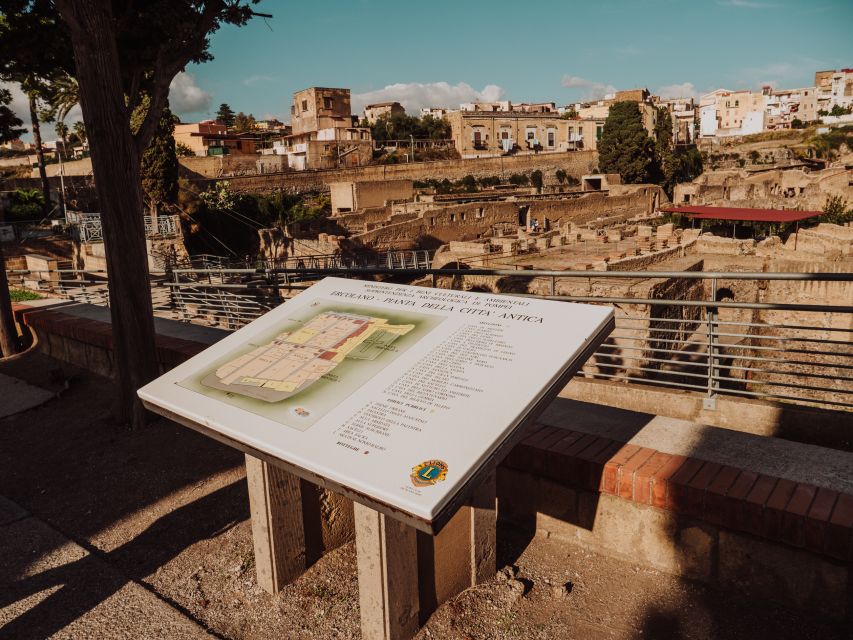
After the drive, the first guided visit lasts about two hours. Skip-the-line entry means you can move past the ticket queue and begin exploring without spending part of your morning waiting outside.
Herculaneum rewards close attention. The site was smaller than Pompeii, but the deep burial helped preserve details that are rare at ancient Roman sites. You can see carbonized wooden objects, intact paintings, and mosaics. These are not just decorative leftovers. They help you picture the materials and color that once filled Roman homes.
The route includes the Temple of the Augustali, a religious building connected with the imperial cult. You also visit the ancient thermal baths, where the arrangement of rooms shows how bathing worked as both a daily routine and a social activity.
The Forum, Samnite House, Gymnasium, and House of the Deer add different pieces to the picture. The House of the Deer is especially useful for understanding the scale and decoration of a wealthy residence. The Samnite House shows an earlier architectural style within the town.
One of the most sobering places is the waterfront area. More than 300 skeletons were found there, where people had gathered while trying to escape the eruption. The remains give Herculaneum a human weight that can be difficult to process. Your guide’s explanation helps place the discovery in context without reducing it to a quick photo stop.
Two hours is a good introduction, but it is still an introduction. You will see the main areas selected by the guide, not every corner of the excavation. If you like reading every inscription or lingering over each mosaic, the pace may feel brisk.
The transfer to Pompeii and the lunch break

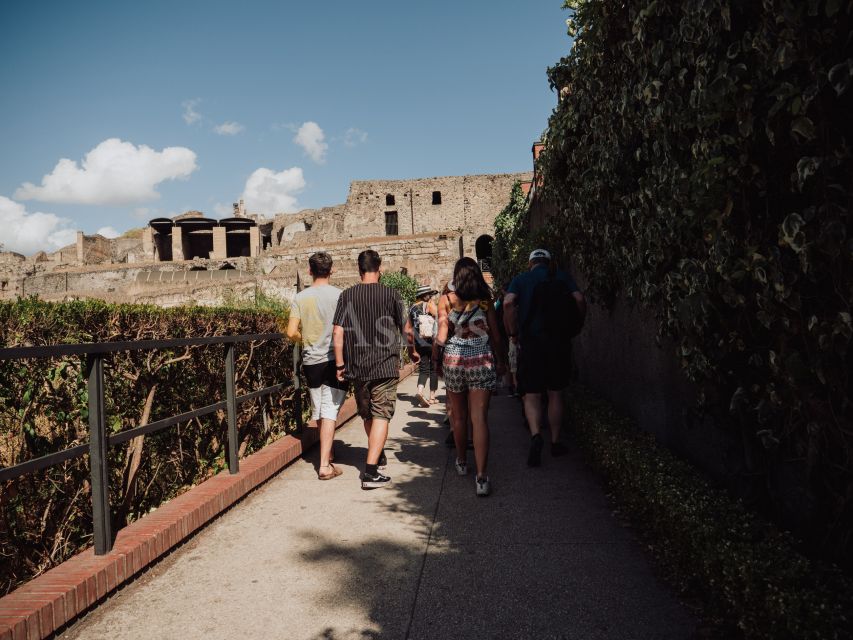
The ride from Herculaneum to Pompeii takes about 30 minutes. Once there, you have a break of roughly 40 to 45 minutes before the second guided walk.
Meals are not included. One practical warning is worth taking seriously: a meal at the stop can cost around €30 per person, so bring your own food if you prefer a cheaper option. The available break is short enough that you should not plan an elaborate meal. A quick lunch keeps the day moving and gives you time to use facilities and prepare for another two hours of walking.
This pause is useful, but it also creates a tradeoff. You do not have a long, leisurely restaurant visit, and the schedule leaves little room for delays. On the other hand, the break prevents the two archaeological visits from running together in one exhausting stretch.
A few more reviews worth comparing before you book
- Naples: Naples Underground Entry Ticket and Guided Tour
★ 4.4 · 21,781 reviews - From Naples: Pompeii Ruins & Mount Vesuvius Day Tour
★ 4.3 · 11,459 reviews - From Naples: Sorrento, Positano and Amalfi Full-Day Tour
★ 4.6 · 10,988 reviews - From Naples: Sorrento, Positano & Amalfi Coast – Small Group Tour
★ 5.0 · 8,643 reviews
Pompeii’s public spaces and private homes
The Pompeii visit lasts about two hours and begins after skip-the-line entry. The guide leads you through a selected route covering the city’s key public buildings and private houses.
You start around the Marina Gate and Basilica before reaching the Forum. The Forum was the center of civic and religious life, so it gives you a useful orientation to the city. From there, the Forum Baths show how public bathing was organized, while the surrounding streets reveal the scale of Pompeii as a working town rather than simply a collection of grand villas.
The route includes the Lupanar, the famous brothel, and a bakery. These stops are valuable because they shift the focus away from emperors and wealthy families. You get a sense of ordinary commerce, food preparation, and the practical business of a Roman city.
The House of the Faun is one of Pompeii’s major residences. The House of the Tragic Poet offers another look at domestic life and decoration. The Termopolium Capuano, a Roman food and drink counter, helps connect the ruins with familiar modern habits. Ancient residents bought prepared food and drink outside the home, much as people still do in busy towns.
The plaster casts are among the most memorable and difficult sights. They preserve the forms of people caught in the eruption, making the catastrophe personal in a way that the buildings alone cannot. Your guide can help you understand what the casts represent and how they fit into the evidence from the eruption.
Pompeii is enormous. You could spend several days covering all the excavated areas, so two hours cannot provide complete coverage. The advantage is that the route stays focused. You see the main landmarks and receive an explanation of how Romans lived, instead of wandering through a vast site without knowing what you are looking at.
The pace has earned strong praise, but not everyone will find it slow. Some people will wish for extra time to study objects, take photographs, or return to a favorite house. I would treat this as a highlights tour with expert interpretation, not as a full archaeological survey.
The archaeologist guide is the real value
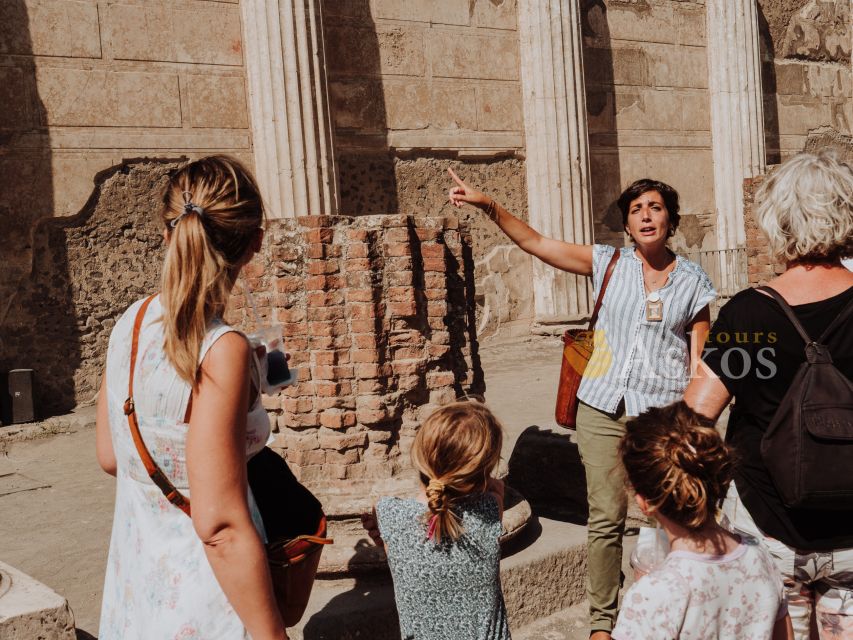
The guide can make or break a site like Pompeii. Without context, a wall is a wall, a doorway is a doorway, and a row of stones can blur into the next row. With an expert guide, the same remains can reveal household routines, religious practice, commerce, class differences, and the final hours of the town.
The strongest praise has gone to guides including Raphael, Roberta, Michele, Vito, Gennaro, Julia, and Alfredo. Raphael is repeatedly described as engaging, funny, and quick to notice small details. Michele has worked at Herculaneum and has been praised for knowing where to take the group and how to explain the excavation.
Roberta has been noted for patient answers and a warm manner. Gennaro is praised for handling many questions while keeping the group moving. Julia is described as thorough and accurate. These comments point to a consistent strength of the experience: the human explanation, not simply the transportation and admission tickets.
Guide assignments can vary, of course. You cannot choose a particular person unless the operator confirms it. Still, the repeated praise for several members of the team suggests that the guiding service is central to the tour’s appeal.
Headsets are another practical advantage. At busy archaeological sites, it is easy to lose a sentence when the group spreads out or another guide passes nearby. A headset lets you look at the ruins while continuing to hear the explanation.
What the $168.79 price really covers
At $168.79 per person, this is not the cheapest way to visit Pompeii and Herculaneum. The price includes shared minibus transportation, Pompeii admission, the €16 Herculaneum ticket, an archaeologist guide, tolls, and parking expenses.
The value depends on how much structure you want. If you are comfortable arranging trains, finding the entrances, buying tickets, and researching each building in advance, you can spend less independently. You would also have more control over how long you stay at each site.
I think the price is easier to justify if you have only one day in the Naples area, are visiting from a cruise or train itinerary, or want the sites explained in English. The skip-the-line access matters on busy days, when standing in queues can cost you a meaningful part of a short visit. The driver also removes the stress of switching between transport networks.
A group limit of 20 keeps the cost below that of a private tour while allowing a more personal experience than a large coach group. It is not a bargain tour, but it covers several expenses and gives you a specialist guide for both sites.
Who should book this day trip
You are a good match for this tour if you want the major sights at both sites without handling the logistics yourself. It suits first-time visitors, history fans, cruise passengers, and anyone who prefers explanations to wandering with a guidebook.
You should also be comfortable walking for much of the day. Expect uneven Roman paving, grades, and significant stairways. The experience is not recommended for wheelchair users or people with limited mobility. Baby seats are available upon request, but the route can still be tiring for young children.
Wear sturdy, comfortable walking shoes. Bring a raincoat because the tour operates in wet weather as well as fair conditions. Carry your passport or ID card, and leave large bags behind. Water and a light meal are sensible additions, especially since food is not included and the lunch break is limited.
The full schedule is about seven hours, including road transfers. It is a substantial commitment, but the return to Starhotels Terminus makes it workable for a day based around Naples Central Station. Check the starting time carefully if you have a train or flight afterward, and avoid booking a tight connection.
Free cancellation is available up to 24 hours in advance, and you can reserve now and pay later. Those terms help if your Naples plans are still shifting, though they do not change the need to arrive on time once the tour begins.
Final verdict: should you book it?
I would book this tour if my priority were seeing both Pompeii and Herculaneum in one well-organized day. The combination of an archaeologist guide, skip-the-line admission, and direct minibus transport solves the three main problems of an independent visit: limited time, confusing logistics, and a lack of context.
I would not book it if I wanted several hours to explore Pompeii at my own pace or if stairs and uneven ground would be a serious concern. The schedule is focused, not leisurely.
For most physically able visitors with only one day, the tour offers strong practical value. Pack lunch if you want to avoid the expensive restaurant stop, arrive early at Starhotels Terminus, and expect the best parts to be the guide’s small observations rather than simply checking off famous ruins. That is what turns two ancient sites into a connected story.
FAQ
Where does the tour start?
Meet in front of the Starhotels Terminus entrance, opposite Naples Central Station. Look for the guide holding an ASKOS TOURS sign.
Where does the tour end?
The tour ends back at the same meeting point at Starhotels Terminus.
How long does the experience last?
The total duration is about seven hours. The schedule includes road transfers, roughly two hours at Herculaneum, a lunch break of about 40 to 45 minutes, and roughly two hours at Pompeii.
Is transportation included?
Yes. Shared minibus transportation is included, along with tolls and parking expenses. The driver is a professional English-speaking driver.
Are entrance tickets included?
Yes. Pompeii entry and the Herculaneum entrance ticket, listed as €16, are included. Skip-the-line access is provided at both sites.
Is lunch included?
No. Meals are not included. You can bring your own food if you prefer not to buy lunch during the break.
What should I bring?
Bring a passport or ID card, comfortable walking shoes, and a raincoat if wet weather is possible. Large bags and luggage are not allowed.
Is the tour suitable for people with limited mobility?
No. The tour is not recommended for people with limited mobility and is not suitable for wheelchair users. Expect uneven surfaces, slopes, and significant stairs at the archaeological sites.
Just added around Naples
- From Naples/Salerno: Pompeii, Sorrento, and Positano Tour★ 4.5 · 250 reviews
- Pompeii: Day Tour of Pompeii and Vesuvius with Bus Transfer★ 4.2 · 250 reviews
- Ischia: Island Boat Tour with Neapolitan Lunch & Snorkeling★ 4.9 · 253 reviews
- Explore Naples & Pompeii in One Day – Guided Half-Day Tour★ 4.5 · 253 reviews
- Discover Pompeii: French Walking Tour of the Buried City★ 4.8 · 253 reviews
- Private Transfer from Naples to Sorrento or from Sorrento to Naples★ 5.0 · 254 reviews
- From Pompeii: Mount Vesuvius Guided Tour with Transfer★ 4.8 · 255 reviews
- Private Transfer from Naples to Positano or Amalfi or vice versa★ 5.0 · 265 reviews
Pompeii & Herculaneum Tours, compared.

Pompeii: Entry Ticket and Guided Tour with an Archaeologist
Read our review →
Pompeii: Entry Ticket with Optional Audio Guide
Read our review →
Pompeii: Small Group Tour with an Archaeologist
Read our review →


Pompeii Small Group Tour with an Archaeologist
Read our review →
Pompeii, Amalfi Coast and Positano Day Trip from Rome
Read our review →Browse the lists this tour appears in