
Review · AUDIO TOURS
Florence: Michelangelo’s David Entrance Ticket and Audio App
David is even more powerful in person. This timed Accademia Gallery ticket gives you a practical way to see Michelangelo’s famous statue, skip the ticket-office line, and explore the museum at your own pace with an audio app. I especially like the reserved entry and the chance to see more than just David, including unfinished Michelangelo sculptures, Botticelli paintings, Medici instruments, and medieval altarpieces. The main drawback is that the audio app can be uneven, and the museum may still make you wait 15 to 20 minutes when the galleries are crowded.
The $38 price is easiest to justify when official tickets are sold out or when Florence’s street queues are long. I also like the simple setup: meet a host near Carrefour Express, collect a physical ticket, and enter through a separate access point. Just remember that this is not a live guided tour. You need a charged phone, your own headphones, and a punctual arrival for your timed slot.
In This Review
- Key points to know before booking
- Why the Accademia Gallery deserves a place in your Florence plans
- Meeting the host and entering through the timed entrance
- Seeing David in the main hall
- Michelangelo’s unfinished sculptures and the power of the stone
- The Gipsoteca and nineteenth-century Florentine sculpture
- Medici instruments, including three Stradivarius pieces
- Medieval and Renaissance paintings by Giotto, Botticelli, and others
- Medieval altarpieces on the top floor
- How good is the Pop Guide audio app?
- Is $38 a fair price?
- Practical advice for a smooth visit
- Who will enjoy this experience most?
- Should you book the David ticket?
- FAQ
- Where is the meeting point?
- Do I receive a physical museum ticket?
- Is this a live guided tour?
- What do I need for the audio guide?
- Can I enter late?
- Are children eligible for a discounted ticket?
- Can I cancel the booking?
Key points to know before booking
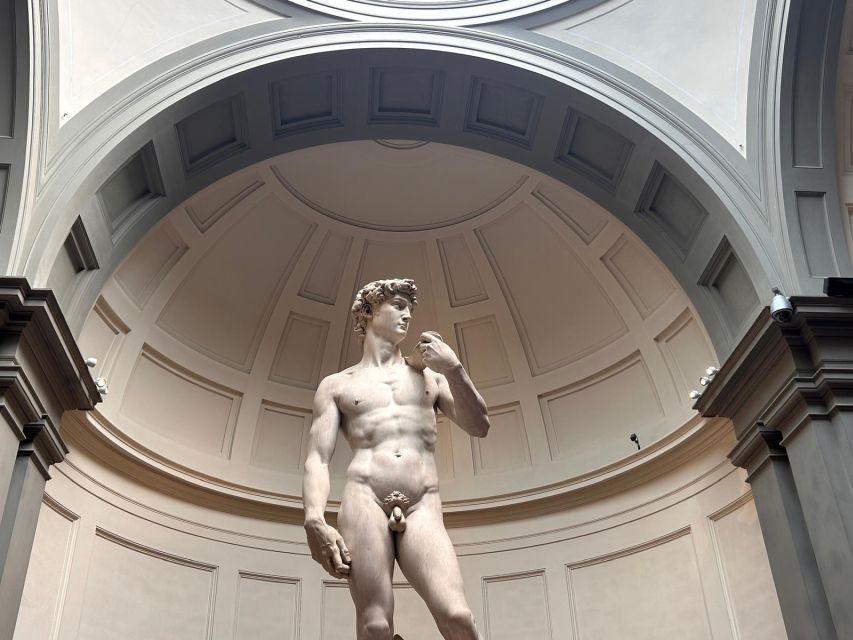
- Michelangelo’s David is the star: The 17-foot marble statue is far more impressive in person than in photographs, especially when you can walk around it and study the details.
- Timed entry saves real time: You skip the ticket-office line, although security and museum capacity can still cause a short wait.
- The meeting point is easy to identify: Look for a staff member holding a white flag marked ENJOY ROME in front of the Carrefour Express Supermarket.
- The audio guide is self-guided: The Pop Guide app lets you move freely, but some artwork locations may be hard to match with the commentary.
- There is more than David: The museum includes unfinished Michelangelo works, plaster models, Medici musical instruments, paintings, and medieval altarpieces.
- Bring the essentials: You need your voucher, a charged smartphone, headphones, and identification for children aged 6 to 17.
Why the Accademia Gallery deserves a place in your Florence plans
Florence has no shortage of famous art, but the Accademia is unusually focused. You can see its most celebrated object, David, within minutes of entering, then spend another hour or two with paintings and sculpture that many people rush past.
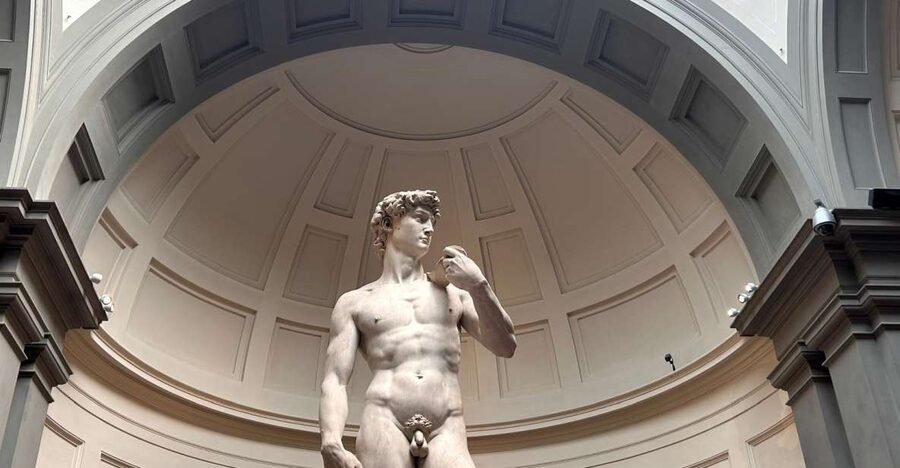
Michelangelo completed David in 1504, and the statue was first displayed in Florence as a symbol of strength and independence. The Accademia gives you a close look at the sculpture from several angles. You can study the tension in David’s hands, the alert expression, and the way Michelangelo adjusted the proportions so the statue would look right when viewed from below.
The scale is part of the surprise. Photographs often flatten the statue into a familiar image, but the real work is about 17 feet tall. The marble figure fills the central hall, and the first sight of it can stop your conversation cold. Even people who do not usually respond strongly to famous art often find this encounter unexpectedly moving.
I would not treat the museum as a one-object stop, though. David is the reason most people come, but the surrounding works explain Michelangelo’s approach and place him within Florence’s larger artistic story.
More Audio Tours in Florence
- Florence: Cathedral & Brunelleschi’s Dome Ticket & Audio App
★ 4.4 · 6,973 reviews - Florence: Michelangelo’s David Priority Ticket & Audio App
★ 4.4 · 6,812 reviews - Florence: Uffizi Priority Ticket & Masterpieces Audio App
★ 4.2 · 6,402 reviews
Meeting the host and entering through the timed entrance
The meeting point is in front of the Carrefour Express Supermarket. Look for the person holding a white ENJOY ROME flag, then exchange your voucher for the physical museum ticket.
This part is designed to be quick, but you should not arrive at the last second. The ticket is timed, and late arrivals are not guaranteed entry or a refund. A short wait is possible even with reserved entry, especially when the museum has reached its visitor limit. The stated wait can be 15 to 20 minutes, and additional delays may occur because of gallery organization.
The important distinction is that you skip the ticket-office queue, not every possible queue. You still need to follow the museum’s entry process and may wait for space inside. That is still a useful advantage in Florence, where the line for the Accademia can become long, hot, and frustrating.
The host or greeter speaks English and helps direct you to the correct entrance. Several people have found the pickup process clear and well organized. One useful detail is that the group may be directed into the timed-entry lane together, which can make the process easier than trying to work out the lines alone.
Seeing David in the main hall
Once inside, head toward the main hall and give yourself time before reaching for your phone. David deserves a quiet first look.
The statue shows the biblical hero before his battle with Goliath. Michelangelo chose the moment of preparation rather than victory. David’s face is watchful, his body is poised, and the raised veins in his hand help create the feeling that this is a living person caught in a tense moment.
Walk around the statue if the crowd allows. From the front, the face and posture dominate. From the side and rear, you can appreciate the balance of the body and the careful handling of the marble. The museum can be crowded, so you may need patience if you want a clear view from every angle.
The central hall is also where the audio guide should be most useful. It can explain the statue’s subject, Michelangelo’s technique, and the visual details that are easy to miss. Still, the app is not a replacement for a live art specialist. Its commentary is brief, and some users have found it difficult to identify the exact artwork connected with each track.
My advice is simple: look first, listen second. If you spend the whole time staring at your screen, you will miss the direct impact of the marble.
Michelangelo’s unfinished sculptures and the power of the stone
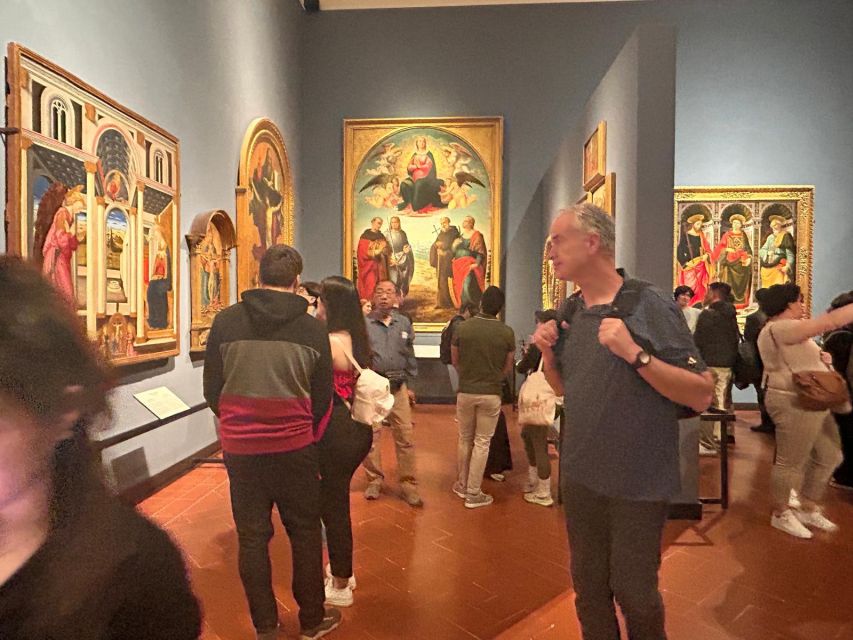
Near David, you can see several unfinished Michelangelo works. These sculptures are valuable because they reveal the carving process rather than only the polished result.
Figures appear to push their way out of the marble. You can see how the artist worked gradually into the block, leaving sections incomplete. The effect is not merely rough or unfinished. It gives you a rare sense of the original stone and the physical labor behind a finished sculpture.
This is one of the strongest parts of the visit for anyone interested in sculpture. David can seem almost impossibly complete. The unfinished works remind you that Michelangelo had to find the figure inside a stubborn block of marble, one cut at a time.
The audio app may help with this section, but do not worry if you decide to explore without it. The visual contrast between the unfinished figures and David is clear enough to appreciate on your own.
More Self-Guided Tours in Florence
- Siena: Cathedral Complex Pass with Audio Guide (OPA SI PASS)
★ 4.4 · 2,773 reviews - Florence: Uffizi & Accademia Priority Tickets with Audio App
★ 4.4 · 1,253 reviews - Florence: Eco-Friendly Golf Cart City Tour with Audio Guide
★ 4.6 · 1,094 reviews - Florence: Uffizi Skip-the-Line Ticket & Digital Audio Guide
★ 4.2 · 1,044 reviews
The Gipsoteca and nineteenth-century Florentine sculpture
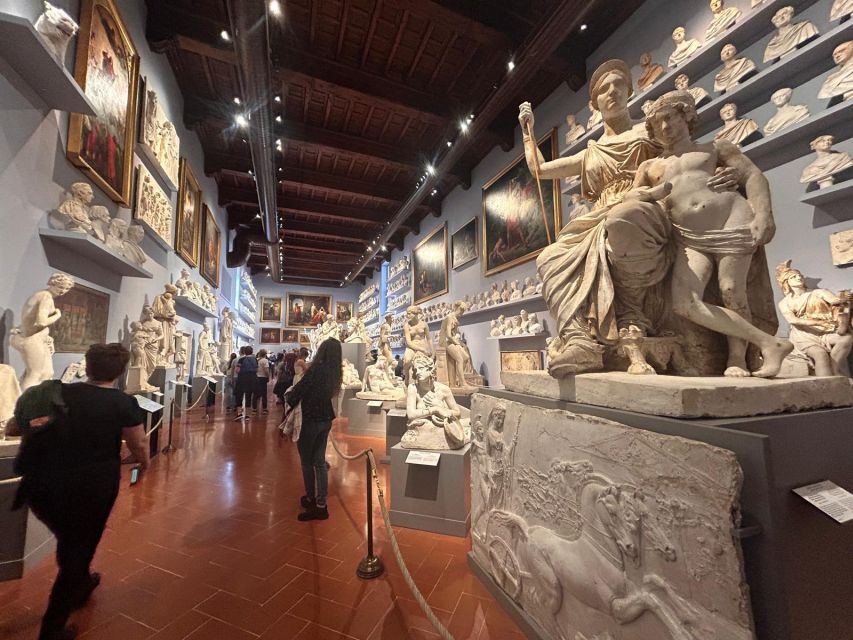
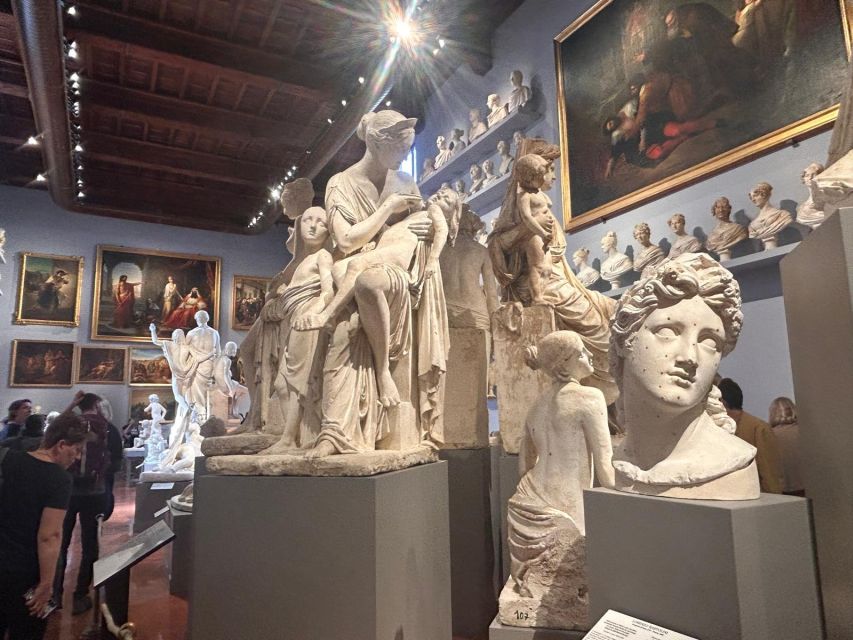
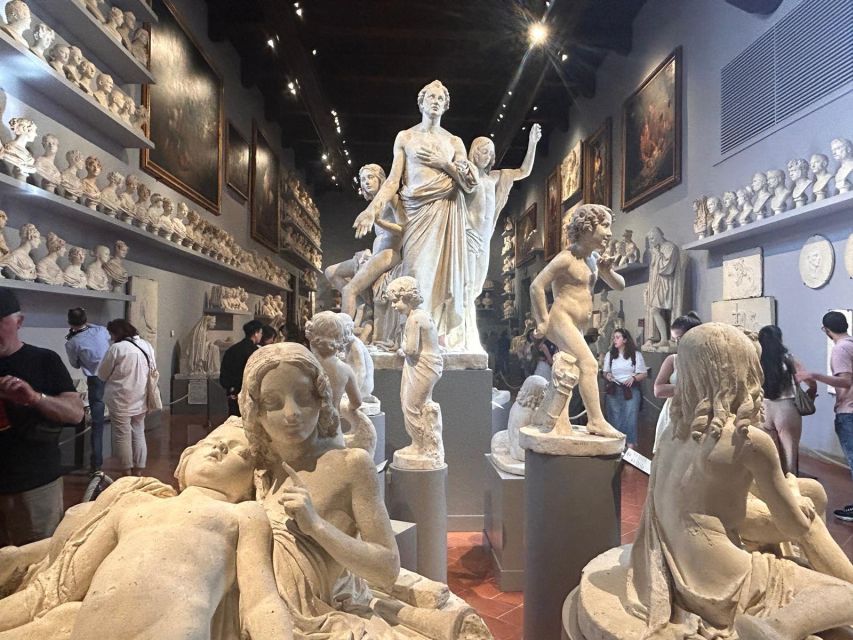
After the Michelangelo rooms, continue to the Gipsoteca. This gallery contains original plaster models made by nineteenth-century Florentine sculptors.
Plaster models are working objects. They show how sculptors developed a composition before producing a final marble or bronze version. Compared with David, these works feel less instantly famous, but they give the museum a wider time range and help you see how Florence’s sculptural tradition continued after the Renaissance.
This is also a good place to slow down if David’s main hall feels packed. The Gipsoteca offers a different mood and a chance to look at sculpture without focusing on one celebrity masterpiece.
The drawback is that the plaster works may not hold your attention as strongly as Michelangelo’s marble. If your schedule is tight, you can move through this gallery fairly quickly. If you have allowed the full three hours, it is worth giving the room a proper look.
Medici instruments, including three Stradivarius pieces
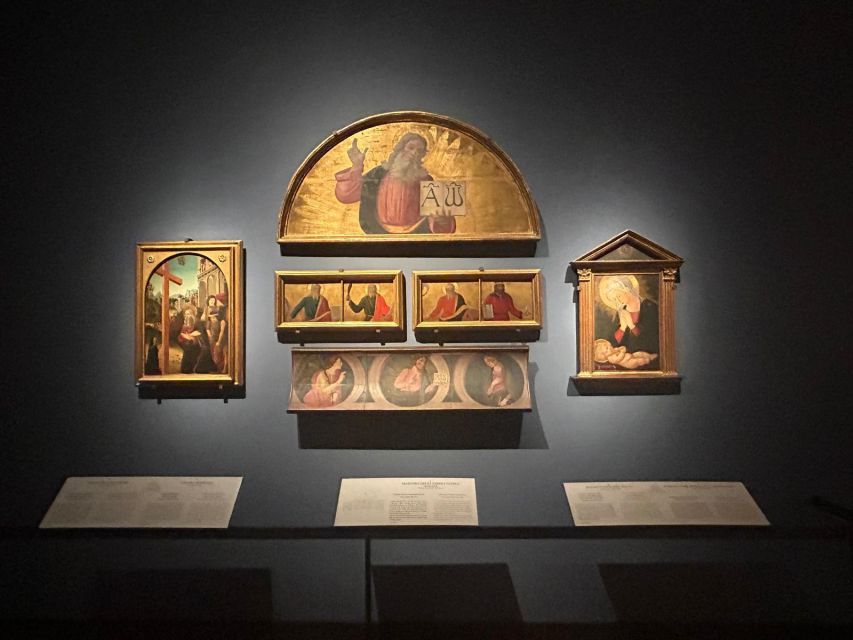
The museum also displays original musical instruments from the Medici collection. Among them are three instruments made by Stradivarius.
This section adds an unexpected note to the visit. The Medici were not only patrons of painting and sculpture. Their collection reflects the court’s interest in music, performance, craft, and fine materials. The instruments are smaller and more intimate than David, so they provide a pleasant change after the huge central statue.
You may find this room especially worthwhile if you enjoy music or decorative arts. It is easy to miss when everyone heads directly to David, but it helps make the Accademia feel like a museum rather than a single-statue viewing hall.
Medieval and Renaissance paintings by Giotto, Botticelli, and others
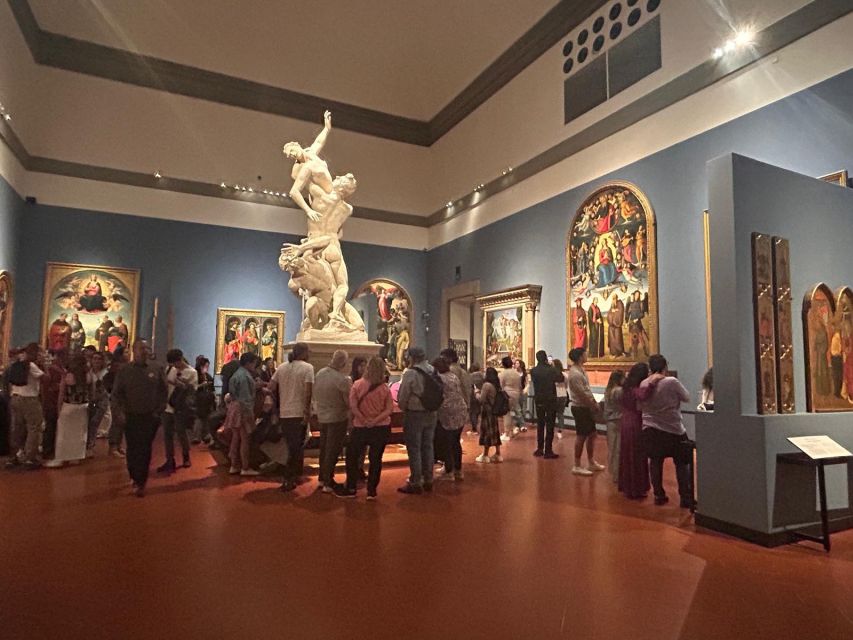
The painting galleries take you beyond Michelangelo and into the medieval and Renaissance art of Florence.
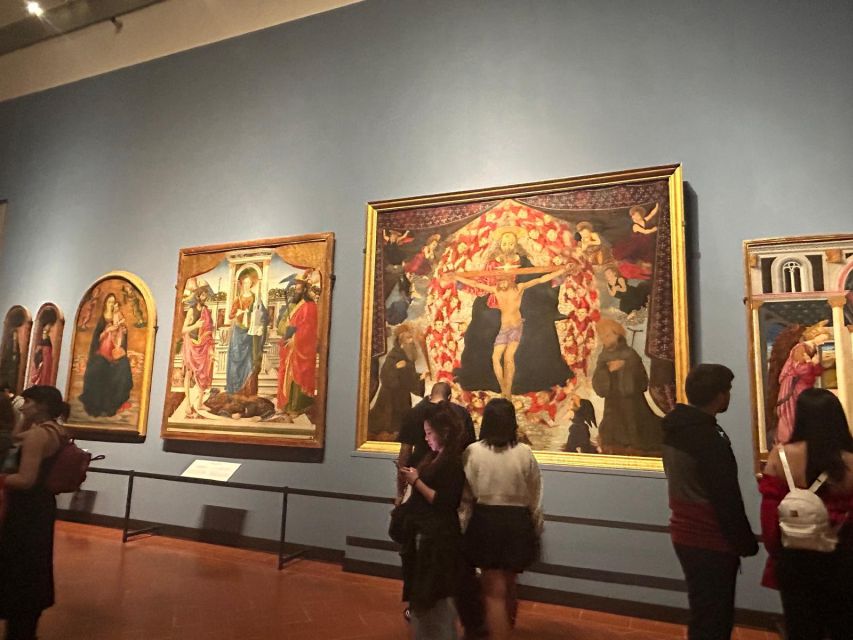
Works connected with artists such as Giotto and Botticelli show changing approaches to religious subjects, human figures, color, and space. You can see how earlier medieval images tend to feel more formal and symbolic, while later Renaissance art gives greater attention to bodies, faces, architecture, and natural detail.
The galleries are a useful counterweight to David. The statue is so famous that it can dominate your memory of the visit, but these paintings explain the artistic setting in which Michelangelo worked. They also show why Florence is best understood as a city of artistic development rather than a collection of isolated masterpieces.
The Pop Guide app includes commentary for parts of the painting collection, but locating the correct work may take some effort. If you use it, keep the museum map and the app open together when possible. You may prefer to listen to only the major stops and examine the rest independently.
Medieval altarpieces on the top floor
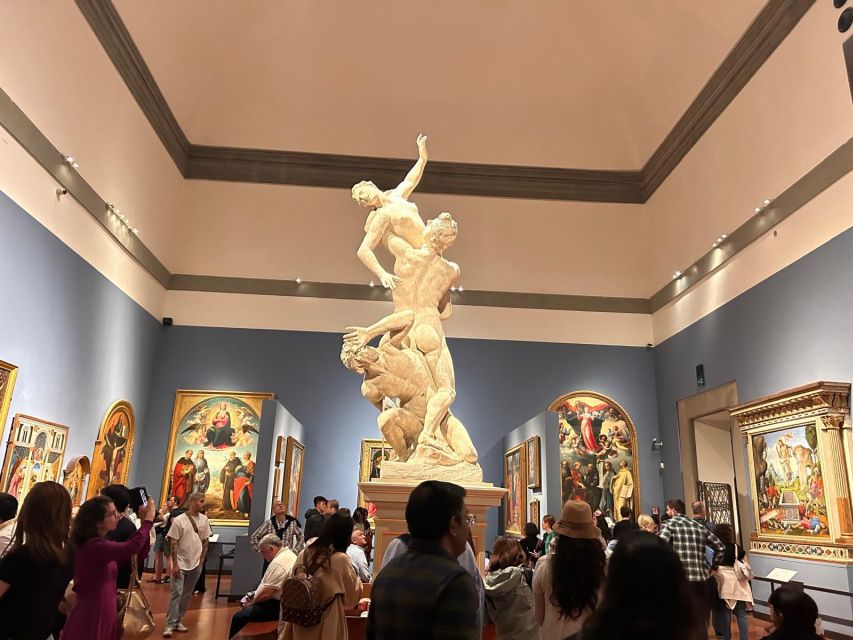
Finish on the top floor, where the museum displays medieval altarpieces.
These large religious panels can be easy to overlook after the excitement of David, yet they are an important final chapter. Altarpieces were designed for churches, and their scale, gold details, and formal arrangements make more sense when you imagine their original religious setting.
The top-floor galleries also help you understand how much the museum covers. You begin with Michelangelo’s monumental sculpture, pass through nineteenth-century plaster models and Medici instruments, then finish among earlier devotional paintings.
If you are visiting with children, this is probably the section where attention fades first. You can keep the visit moving and focus on the works that interest your group most. The three-hour duration is an allowance rather than a requirement, so you are free to leave once you have seen what matters to you.
How good is the Pop Guide audio app?
The audio app is included, but you need to do some preparation. Download the Pop Guide application before arriving, then use the login credentials provided at the meeting point. Bring your own headphones and make sure your smartphone is charged.
The app works best as a flexible companion. You can pause it, skip stops, and walk through the museum at your own speed. This is a strong choice if you dislike being tied to a group or if different people in your party want to spend different amounts of time in each room.
Its limits are worth knowing. Some commentary may not correspond clearly to the artwork in front of you, and a few people have found that the app did not work well. Other users found it informative and easy to use, especially after downloading it in advance.
I would treat the audio guide as a useful bonus, not the main reason to buy the ticket. If it works well for you, it adds context. If it does not, the museum visit can still succeed because the ticket and timed entry are the core services.
Is $38 a fair price?
At $38 per person, this is more expensive than a basic museum ticket. The value depends on your timing and the availability of official tickets.
If the Accademia is sold out through the museum’s own booking system, paying a few extra euros for a third-party timed ticket may be the practical choice. Some bookings have cost only about two to eight euros more than the basic admission, although the listed price here is $38 and exchange rates can change the comparison.
The price includes:
- Timed entry to the Accademia Gallery
- A physical admission ticket
- Help from an English-speaking host or greeter
- Access to the Pop Guide audio app
It does not include a live guide. If you want a detailed art lesson, this is not the right format. If you mainly want reliable entry and the freedom to explore alone, the package makes more sense.
For a family, the cost adds up quickly. For a first visit to Florence during a busy period, saving hours in a street queue can be worth more than the difference in ticket price. I would check the official museum availability first, then compare the total cost and convenience.
Practical advice for a smooth visit
Arrive early enough to find the Carrefour Express meeting point without rushing. The host may be easy to spot, but Florence’s streets can still make a short walk take longer than expected.
Download Pop Guide before you leave your hotel or apartment. Do not wait until the meeting point, where phone data, battery life, or crowded conditions could slow you down.
Bring:
- Your charged smartphone
- Personal headphones
- Your voucher
- A passport or photo ID for children
- A valid photo ID with date of birth for visitors aged 6 to 17 seeking the discounted fare
Large bags and luggage are not allowed, and pets are not permitted. The museum is wheelchair accessible, but the timed admission rules still apply.
Most important, protect your entry time. Late arrival may mean no admission and no refund. Even after you reach the correct queue, the museum can delay entry when too many people are already inside.
Who will enjoy this experience most?
I recommend this for first-time Florence visitors who want to see David without spending hours in a ticket line. It also suits independent museumgoers who prefer a phone app to a live group tour.
Families may appreciate the short transfer from host to entrance and the ability to move at their own pace. Art lovers will enjoy the unfinished Michelangelo works, Giotto and Botticelli paintings, musical instruments, and medieval altarpieces.
You may want another option if you need a full explanation from an art historian. The audio commentary is brief and can be hard to match with individual works. You should also think twice if your budget is strict and official tickets are still available at a much lower price.
Should you book the David ticket?
Book it if David is a priority and official tickets are unavailable or inconvenient. The timed entrance is the strongest part of the package, and skipping the ticket-office line can save valuable Florence time. The museum has enough art beyond David to justify a visit of roughly two hours, though you can stay for up to the stated three-hour duration.
I would not buy it solely for the audio app. That feature is useful but inconsistent, and you must bring your own headphones. Buy this for the combination of a guaranteed time slot, simple host assistance, and the freedom to explore one of Florence’s essential museums on your own terms.
FAQ
Where is the meeting point?
Meet the activity provider’s staff in front of the Carrefour Express Supermarket. Look for a person holding a white flag with ENJOY ROME written on it.
Do I receive a physical museum ticket?
Yes. You exchange your voucher with the provider’s staff and receive a physical entry ticket.
Is this a live guided tour?
No. The package includes an audio guide app, not a live guide. An English-speaking host or greeter helps with the ticket exchange and entry process.
What do I need for the audio guide?
Download the Pop Guide app, bring a charged smartphone, and use your own headphones. Login details are provided at the meeting point.
Can I enter late?
Late arrival is not guaranteed entry and is not eligible for a refund. This is a timed ticket, so allow enough time to find the meeting point and join the correct queue.
Are children eligible for a discounted ticket?
Visitors aged 6 to 17 need valid photo identification showing their date of birth to qualify for the discounted ticket. Without it, they must purchase the full adult ticket.
Can I cancel the booking?
You can cancel up to 24 hours in advance for a full refund. The reserve-now-and-pay-later option also lets you hold a place without paying immediately.
More Audio-Guided Visits
- Florence: Accademia Gallery David Entry & Audio Guide App
★ 4.2 · 406 reviews - Timed Entrance to Leaning Tower Pisa & Cathedral with Audio
★ 4.1 · 385 reviews - Florence: Duomo Cathedral Priority Entry Ticket & Audio App
★ 3.8 · 384 reviews - Florence: Timed Entry to Uffizi with Optional Audio Guide
★ 4.6 · 375 reviews
More Self-Led Routes
- Private Self-Guided E-Bike Ride in Tuscany with Vineyard Visit
★ 5.0 · 775 reviews - Florence Duomo Cathedral with Host & Audio Guide (Interior Only)
★ 3.5 · 702 reviews - Florence: Accademia Gallery Ticket with Optional Audio Guide
★ 4.3 · 586 reviews - Florence: Uffizi Gallery Tickets with Optional Audio Guide
★ 4.1 · 503 reviews
Just added around Florence
- Palazzo Vecchio guided experience with entrance ticket★ 4.5 · 249 reviews
- Lucca Bikes and Bites with food tastings for Small Groups or Private★ 5.0 · 249 reviews
- Perfume Masterclass in Florence: Make your Own Personal Fragrance★ 4.5 · 253 reviews
- Florence Oltrarno Neighborhood Food & Wine Dine Around★ 5.0 · 253 reviews
- Florence: Cathedral, Dome and Terraces Guided Tour★ 4.5 · 253 reviews
- Florence: 1.5-hour Santa Croce Guided Experience★ 4.8 · 254 reviews
- Florence: Pitti Palace and Palatina Gallery Ticket and Tour★ 4.9 · 255 reviews
- Private Florence Tour by Golf Cart ETukTuk with Audio Guide★ 4.0 · 256 reviews
Audio Tours, compared.
Colosseum & Forum with Audio Guide App -Optional Arena
Read our review →
Pantheon Fast-Track Ticket and Official Audio Guide
Read our review →
Pompeii: Entry Ticket with Optional Audio Guide
Read our review →
La Fenice Opera House Entry Ticket with Audio Guide
Read our review →
St. Peter’s Basilica & Dome Entry Ticket & Audio Tour
Read our review →
Cathedral & Brunelleschi’s Dome Ticket & Audio App
Read our review →
Michelangelo’s David Priority Ticket & Audio App
Read our review →
Uffizi Priority Ticket & Masterpieces Audio App
Read our review →Browse the lists this tour appears in