

Review · WALKING TOURS
Catacombs and Roman Countryside Half-Day Walking Tour
Ancient Rome reaches beyond the city center. This half-day outing takes you by bus or van to the Catacombs of San Callisto, the Appian Way, and huge aqueduct remains, giving you a useful change of pace from Rome’s packed historic core. I like the mix of underground history and open countryside, and I like that transport connects sites that are awkward to visit together on your own. The main caution is timing: traffic, group arrangements, or a hot vehicle can stretch the outing well beyond its advertised three hours.
The guides are a major part of the experience. Marcelo, Francesca, Mario, Mariah, Tatia, Anna, Cathia, and others have been praised for clear explanations, humor, patience, and personal attention. Wear clothing covering your shoulders and knees, since the catacombs enforce that rule strictly.
In This Review
- Key points at a glance
- Why leave central Rome for the Appian Way?
- San Callisto: Rome beneath the ground
- Circus of Maxentius and the Cecilia Metella stop
- Walking the Queen of Roads
- The aqueducts: the tour’s grandest view
- How the bus transfer affects the experience
- The guides make the difference
- Is $78.44 a fair price?
- What to bring and how to prepare
- Who should book this countryside morning?
- Should you book the Catacombs and Roman Countryside Tour?
- FAQ
- Where does the tour start?
- What time does the tour begin?
- Where does the tour end?
- How long does the tour last?
- Which catacombs does the tour visit?
- Is catacomb admission included?
- What clothing is required?
- Is transportation included?
- Are headsets available?
- Is hotel pickup included?
- Can I bring luggage?
- What happens if I cancel?
Key points at a glance
- The Catacombs of San Callisto come first, with about an hour underground and admission included.
- The Appian Way gives you a short walk on one of Rome’s oldest roads, built for trade, military movement, and communication.
- The aqueduct stop is the visual high point, with time to walk close to the ancient arches and take photographs.
- A coach or van saves you from sorting out transport between scattered sites, especially useful for a first visit to Rome.
- The group can reach up to 25 people, with headsets available if needed.
- The tour starts and ends at Via Cavour 224, near public transportation, but allow extra time to identify the correct meeting spot.
Why leave central Rome for the Appian Way?
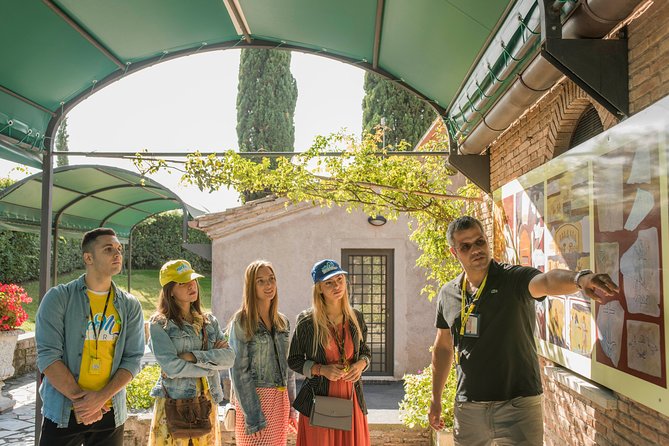
Rome’s center gives you temples, fountains, churches, and grand imperial ruins packed close together. This tour shows a quieter side of the city. Once the vehicle heads south, the streets give way to open spaces, old ruins, and long views across the Roman countryside.
I find that contrast valuable. You are not simply adding three more ancient sites to an already crowded sightseeing day. You are seeing how Rome connected to the wider Italian world, how it buried its dead, and how it brought water across miles of countryside.
The road itself dates to 312 BC, when the Roman Republic needed a dependable route south from Rome. The Appian Way eventually reached Brindisi, linking the capital with southern Italy and routes toward Greece and the East. Its importance was practical first: armies, officials, merchants, and messages all used it.
The tour combines driving and walking, so you do not need to cover the entire archaeological park on foot. That is a good compromise for a three-hour outing, though the day may feel longer in hot weather or heavy traffic.
More Walking Tours in Rome
- Rome: Trastevere & Campo de Fiori Street Food Walking Tour
★ 4.9 · 2,768 reviews - Rome: Paranormal Night Walking Tour & Secret Backstreets
★ 4.9 · 1,921 reviews - Rome by Night Walking Tour – Legends & Criminal Stories
★ 4.5 · 1,003 reviews
San Callisto: Rome beneath the ground
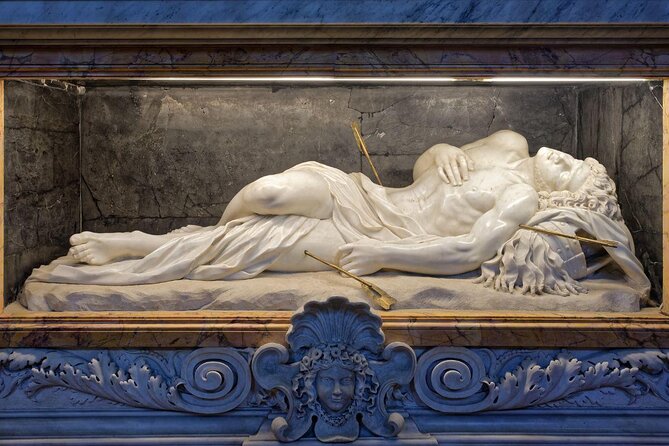
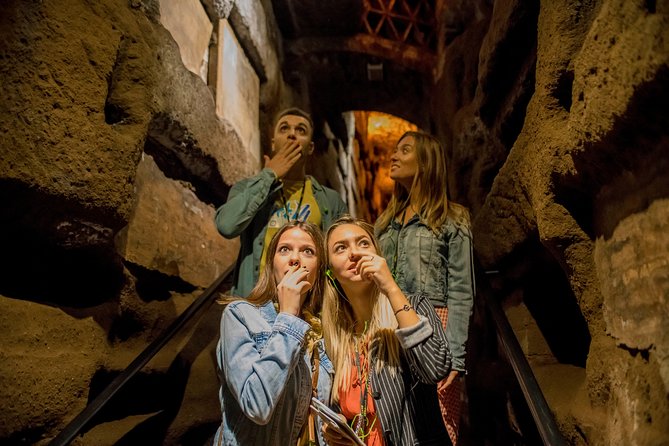
The Catacombs of Saint Callixtus are the first major stop, and the visit lasts about an hour. This underground cemetery is associated with roughly 500,000 Christian burials, including martyrs and popes. The site is divided into areas including the Crypt of Saint Cecilia and the Crypt of the Popes.
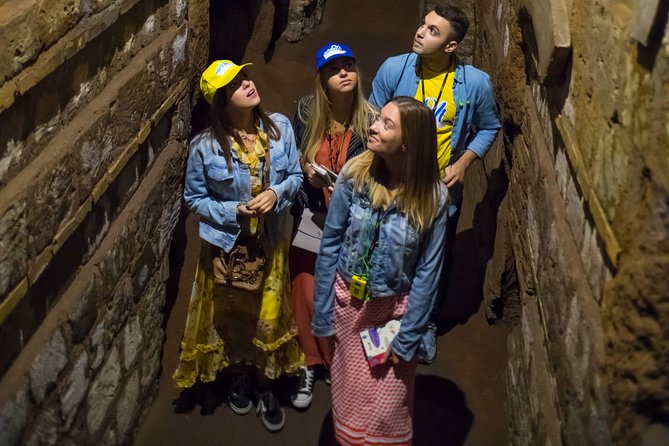
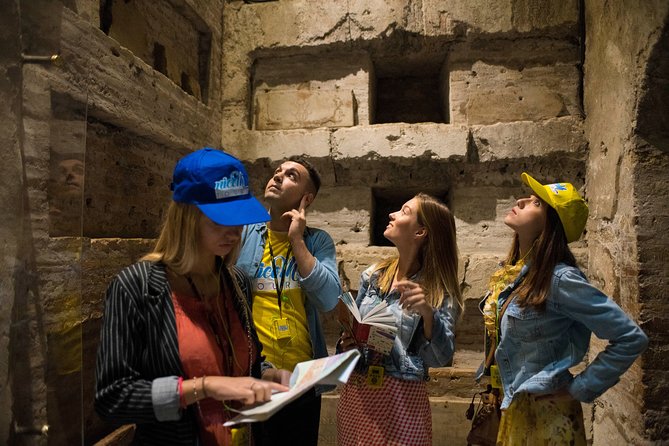
Your guide explains how these burial tunnels worked and introduces the symbols and practices connected with early Christian burials. The value here is not a dramatic display of bones. In fact, there are no piles of bones on view. The interest comes from the tunnels, the organization of the cemetery, and the chance to understand an early Christian community within the Roman world.
One particularly useful touch is the guide’s explanation before going underground. Mariah, Anna, and Marcelo have been praised for making the history easy to follow, while one guide helped a visitor who felt uneasy about enclosed spaces. That kind of calm preparation matters in a dark underground setting.
The catacombs can become crowded, especially around major holiday periods such as Easter. If several groups are moving through the same passages, you may find it hard to hear every word. Headsets are available upon request, but audio quality is not guaranteed in every vehicle or group setup.
The dress code is not a suggestion. Men and women must cover both shoulders and knees, and entry can be refused if you arrive dressed otherwise. Pack a light layer or longer trousers if your Rome wardrobe is built around summer clothing.
Circus of Maxentius and the Cecilia Metella stop
The route continues through the Roman countryside toward the Circus of Maxentius. It is less famous than Circus Maximus, but the remains are well preserved and sit within the Caffarella Park area.
The stop helps place Roman entertainment in its rural setting. Instead of seeing an isolated ruin surrounded by modern streets, you get a sense of the open territory that once surrounded Rome. The visit is part of the drive between the catacombs and the Appian Way, so the amount of time spent here may feel brief.
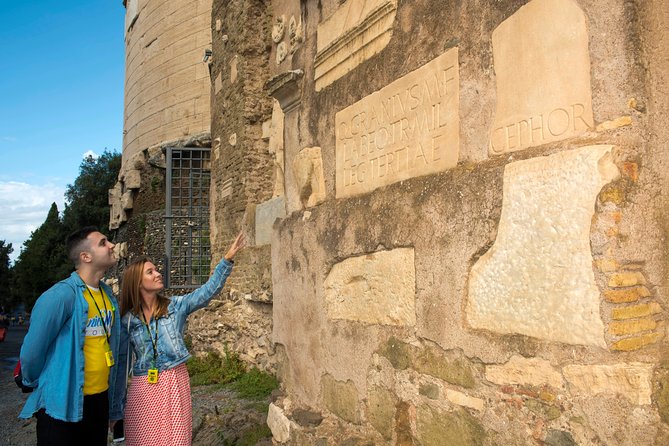
The tour also makes an external visit to the Mausoleum of Cecilia Metella. This large first-century BC tomb was built for a Roman noblewoman and sits on a hill beside the Appian Way. Its scale tells you something about status in ancient Rome: even a single tomb could be designed to dominate the road.
You do not enter the mausoleum on this excursion. The stop lasts about 30 minutes and focuses on the outside, the setting, and the explanation from your guide. I would treat it as a strong photo and context stop rather than a full archaeological visit.
Walking the Queen of Roads
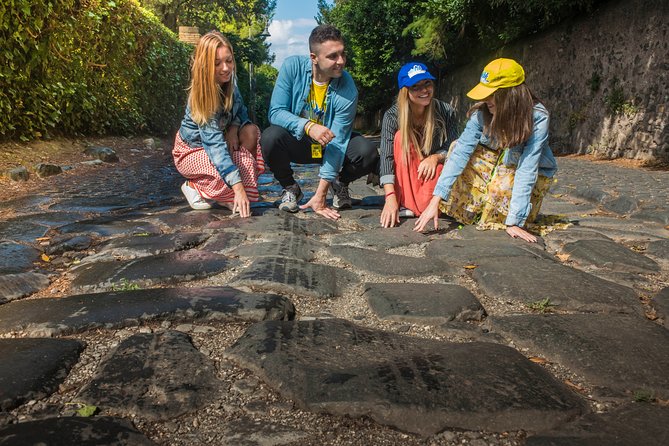
The Appian Way is the heart of the outdoor portion. Romans called it the Queen of Roads, and its surviving route remains one of the most meaningful places to walk outside the city center.
The tour includes about 30 minutes on foot. That is enough to experience the old road and hear why Roman engineers considered it such a major achievement, but it is not an extended hike through the entire archaeological park.
This short walk also explains why the tour works well for people who want some exercise without signing up for a strenuous day. Several comments describe the walking as manageable, while another advises preparing for several hours in the sun. Both points can be true. The walking itself may be moderate, but the full outing includes standing, boarding vehicles, moving between stops, and time outdoors.
Bring water, sun protection, and practical shoes. The tour information calls for moderate physical fitness, and the countryside stops offer less shelter than central Rome. Rain does not necessarily ruin the experience, but wet weather will make the outdoor portions less comfortable.
More catacombs and Appian Way trips:
- Rome: Crypts and Catacombs Underground Tour with Transfers
★ 4.6 · 5,341 reviews - The Original Roman Crypts and Catacombs Tour with Transfers
★ 4.5 · 4,896 reviews - Rome: Catacombs of St. Callixtus Entry Ticket & Guided Tour
★ 4.6 · 3,037 reviews - Rome: Guided Roman Catacombs Tour with Transfers
★ 4.6 · 1,830 reviews
The aqueducts: the tour’s grandest view
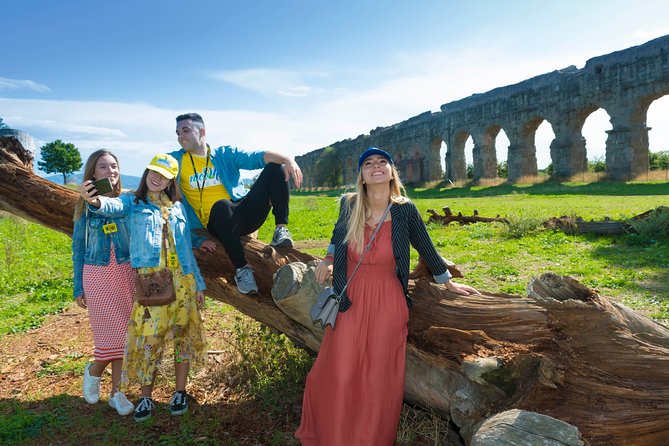
The ancient aqueducts provide the biggest visual payoff. Their tall arches show how Roman engineers carried water toward the city using carefully planned channels and a steady gradient.
Your guide explains why this area was chosen for the aqueducts and gives you time to walk near the remains and take photographs. The setting makes the engineering easier to appreciate than a small fragment tucked into a city wall. You can see the scale of the arches and the open ground they cross.
Some people may find the aqueduct stop less thrilling than the catacombs or the Appian Way. That is fair. It is not a museum visit with rooms full of objects. The appeal is the structure itself, the setting, and the thought of an ancient water system still visible after so many centuries.
I would place this stop high on the list for anyone interested in Roman engineering or photography. If your ideal Rome day means famous interiors and detailed artifacts, the aqueducts may feel quieter. If you enjoy seeing how infrastructure shaped a city, they are excellent.
How the bus transfer affects the experience
The included coach or van transfer is one of the tour’s most useful features. The catacombs, Appian Way, Circus of Maxentius, Cecilia Metella, and aqueducts are spread across a large area. Visiting them independently would require planning around public transport, walking distances, and opening arrangements.
The vehicle also gives you a break between walks. One account describes a clean, comfortable coach with plenty of room, while another reports a hot, stuffy van and poor headset reception. Group size can reach 25, and larger groups may be split between two vehicles.
That split is worth understanding. If the guide rides in one van while you sit in another, you may miss parts of the commentary, especially if the headset connection fails. This is not a small issue on a tour where the guide supplies much of the historical value.
The start point is Via Cavour 224, near public transportation. Give yourself time to find the precise meeting area. One person had trouble identifying the correct side of the street near the bus stop and metro. The tour begins at 9:45 am and ends back at the same meeting point.
Traffic can add 30 to 60 minutes. I would not schedule a timed museum entry, train, or important dinner immediately after the advertised finish. The published duration is about three hours, but a four-hour morning is possible.
The guides make the difference
The strongest part of this experience is often the person leading it. Marcelo has been praised for combining humor with solid explanations of the catacombs, Appian Way, and aqueducts. Mariah was noted for speaking several languages, talking with people individually, and helping with restaurant suggestions after the tour.
Tatia brought a history background and patient narration. Cathia and Mario were especially helpful with a family traveling with a young toddler. Francesca and Mario were also praised for making the day memorable.
These details matter because the sites do not explain themselves. The catacombs need context, the Appian Way needs a sense of scale, and the aqueducts need engineering background. A good guide turns a sequence of ruins into a connected story.
The experience is offered in English. Headsets can be requested when needed, though you should stay alert to the possibility of weak audio in a split vehicle or a crowded catacomb passage.
Is $78.44 a fair price?
At $78.44 per person, the tour is not the cheapest way to see a Roman road and some ruins. Its value comes from the combination: a professional guide, catacomb admission, and transport between several sites outside central Rome.
You are paying to avoid the fiddly parts of the day. The vehicle handles the long connections, the guide organizes the route, and the catacomb entry is included. For a first visit, that convenience can be worth more than saving a little money.
The value is weaker if you only want the Appian Way. You may prefer a longer, more focused archaeological visit, or you may find the 30-minute road walk too short. It is also less appealing if you dislike group transport or want complete control over how long you spend at each ruin.
The best match is someone who wants a guided introduction to the Roman countryside, not a specialist archaeological expedition. Families, history-minded visitors, teenagers, and anyone who needs a break from the city center should find the format useful.
What to bring and how to prepare
Keep your packing simple. Luggage storage is not available, so bring only what you can carry comfortably.
Use this checklist:
- Clothing covering your shoulders and knees
- Comfortable walking shoes
- Water and sun protection
- A phone or camera for the Appian Way and aqueducts
- A light layer for the catacombs
- Extra time after the stated end of the tour
The route is not presented as a demanding hike, but you should be comfortable walking for short periods and standing at archaeological sites. A young child may be accommodated, as one family found, though the tour operator does not provide a detailed stroller or child-equipment policy in the supplied information.
Free cancellation is available up to 24 hours before the start time. Changes or cancellations inside that window are not accepted for a refund. The tour also requires a minimum number of participants, so an operator cancellation for that reason comes with another date, another experience, or a full refund.
Who should book this countryside morning?
I would book this tour if you have already seen some of central Rome and want a different setting. It is especially useful if you want the catacombs but do not want to arrange the transport yourself.
It also suits visitors who like history explained in plain language. The guides add the meaning that makes these places worthwhile, and the combination of burial tunnels, roads, tombs, and aqueducts gives the morning a clear theme: how Romans moved, buried, and supplied people across a vast city.
I would hesitate if you need a precise three-hour schedule, dislike enclosed spaces, require flawless audio, or want long independent visits at every stop. The catacombs are underground, the outdoor sites can be sunny, and the vehicle portion may take longer than planned.
Should you book the Catacombs and Roman Countryside Tour?
Book it if you want an efficient introduction to Rome beyond the center, with transport and guiding included. The catacombs and aqueducts provide the strongest reasons to go, while the Appian Way adds a meaningful walk and a link to Rome’s wider story.
Go in with realistic expectations. This is a compact overview, not a full-day archaeological tour. Allow extra time, dress correctly for the catacombs, and confirm the meeting point carefully. With those details handled, the $78.44 price is reasonable for the transport, admission, and guide-led access to several scattered sites.
FAQ
Where does the tour start?
It starts at Via Cavour, 224, 00184 Rome, Italy, near public transportation.
What time does the tour begin?
The scheduled start time is 9:45 am.
Where does the tour end?
The tour ends back at the original meeting point on Via Cavour.
How long does the tour last?
The advertised duration is approximately three hours, but traffic and group arrangements may make it 30 to 60 minutes longer.
Which catacombs does the tour visit?
The route describes the Catacombs of San Callisto. The general tour information also notes that the visit may use either the Catacombs of San Sebastiano or San Callisto.
Is catacomb admission included?
Yes. Admission to the Catacombs of San Callisto is included in the tour price.
What clothing is required?
Both men and women must cover their shoulders and knees to enter the catacombs. The rule is strictly enforced.
Is transportation included?
Yes. Bus or van transportation between the sites is included.
Are headsets available?
Headsets are available upon request if required.
Is hotel pickup included?
No. Hotel pickup and drop-off are not included.
Can I bring luggage?
No luggage storage is available, so you should not arrive with bags that need to be stored.
What happens if I cancel?
You can receive a full refund if you cancel at least 24 hours before the local start time. Cancellations or changes made less than 24 hours before the start are not accepted for a refund.
More Guided Walks
- Rome: Guided City Center Evening Sightseeing Walking Tour
★ 4.4 · 953 reviews - Best of Rome Walking Tour including Trevi Fountain
★ 4.5 · 923 reviews - Rome: Under the Moonlight Evening Walking Tour
★ 4.8 · 852 reviews - Rome: Forbidden History Walking Tour & Pub Crawl with Drinks
★ 4.9 · 688 reviews
Just added around Rome
- Rome City, Pantheon, and Trevi Fountain Walking Tour★ 5.0 · 249 reviews
- Rome: Skip the line Vatican Museums & Sistine Chapel Tour★ 4.2 · 251 reviews
- Rome: Tivoli Day Trip with Villa d’Este and Villa Adriana★ 4.5 · 251 reviews
- Transfer Rome center – Ciampino Airport★ 4.5 · 251 reviews
- Rome: Cannondale E-Bike Evening Tour with Optional Dinner★ 4.9 · 251 reviews
- VIP Colosseum, Roman Forum & Palatine Hill & Special Access Sites★ 4.5 · 252 reviews
- Private Vatican Museums Hidden Gems Tour with Optional Pick-Up★ 5.0 · 253 reviews
- Vatican Museums & Sistine Chapel Skip-the-Line Guided Tour★ 4.6 · 254 reviews
Walking Tours, compared.

Guided Walking Tour & Last Supper Visit with Ticket
Read our review →


Rialto Bridge & Offbeat Unusual Venice Walking Tour
Read our review →

Private 3 hrs Venice Tour: St Mark’s, Walking tour & Boat tour
Read our review →

Skip the line: Uffizi and Accademia Small Group Walking Tour
Read our review →Browse the lists this tour appears in