
Review · E-BIKES
Appian Way, Catacombs and Aqueducts Park Tour with Top E-Bike
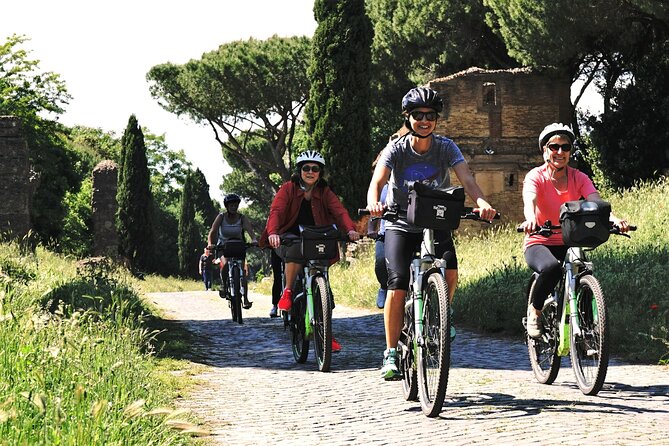
Rome has an ancient road worth pedaling. This 17-mile e-bike tour links the Appian Way, catacombs, Imperial ruins, and Aqueducts Park in one half-day outing. I like the electric assistance, which makes a wide stretch of countryside reachable without draining your legs, and I like the small groups of no more than 10 people. The main catch is that this is not a casual bike ride: some city traffic, tight paths, rough ground, and 27 kilometers in the saddle call for solid bike confidence.
The six-hour option gives you the fullest route, including a guided catacomb visit, Villa dei Quintili, and the Baths of Caracalla. The four-hour version is a better fit if you want the main sights with less riding. Guides such as Arina, Bita, Claudia, Fabio, and Stefan have earned praise for making the ride both safe and interesting, but Sunday crowds and slow group riding can affect the experience.
In This Review
- Key points to know before you book
- Why an e-bike is the right tool for ancient Rome
- Leaving Rome through Porta San Sebastiano
- The Appian Way: ancient stones and open country
- Catacombs of San Callisto and San Sebastiano
- Circus of Maxentius and Cecilia Metella
- The six-hour route adds Villa dei Quintili
- Aqueducts Park and the Roman water system
- The six-hour finish at the Baths of Caracalla
- Four hours or six hours?
- Safety, pace, and physical effort
- What you get for $102.79
- Who should book this Rome e-bike tour?
- Should you book it?
- FAQ
- Where does the tour start and finish?
- How long does the tour last?
- How far do you ride?
- Is the tour suitable for beginners?
- Are electric bikes and helmets included?
- Are children allowed on the tour?
- Which catacombs does the tour visit?
- Is food included?
Key points to know before you book
- The electric bike covers a lot of Rome: You ride about 17 miles, with roughly 60 percent of the route away from traffic.
- The six-hour tour adds the best extras: It includes a 45-minute guided catacomb visit, Villa dei Quintili, and the Baths of Caracalla.
- The ride is intermediate, not effortless: E-bike assistance helps, but you still need to steer confidently over uneven paths and through selected city streets.
- The Appian Way feels far from central Rome: Ancient paving, open fields, sheep, ruins, and aqueducts provide a welcome change from crowded central sights.
- Small groups improve the day: The maximum is 10 people, giving you a better chance to hear the guide and stay together.
- Choose your day carefully: Sunday can bring heavy foot and bike traffic in the parks. Wednesdays use a different route and can add 30 minutes.
Why an e-bike is the right tool for ancient Rome
The Appian Way is not one compact monument. It is a long corridor of roads, burial sites, villas, parks, and waterworks spread across the southern edge of Rome. You can walk part of it, but reaching the catacombs, Circus of Maxentius, Aqueducts Park, and other sites on foot would take time and stamina.
That is where the electric bike earns its keep. The pedal assist reduces the effort on a route that covers about 27 kilometers, while still letting you move through the parks at a useful pace. You can focus on the scenery and the guide instead of wondering how far the next stop is.
The bikes are described as high-quality models with anti-puncture tires. A helmet is required and provided, along with a front bag and biodegradable water bottle. The e-bike is easy to operate for anyone who already rides a bicycle competently, but it does not turn the outing into a motorized sightseeing trip.
Expect some bumps. The unpaved sections and narrow bike paths can be uncomfortable for anyone with back or neck problems. The tour provider also says the equipment has a 300-pound, or 136-kilogram, weight limit.
More Bike Tours in Rome
- Rome EBike Tour: Appian Way, Catacombs & Roman Aqueducts
★ 5.0 · 1,766 reviews - Rome: Top Highlights & Hidden Gems Tour by Cannondale E-Bike
★ 4.9 · 1,760 reviews - Rome: Appian Way, Catacombs, & Roman Aqueducts E-bike Tour
★ 4.9 · 1,421 reviews
Leaving Rome through Porta San Sebastiano
The tour begins at Via Labicana 49, near public transportation, and heads toward Porta San Sebastiano. This large gate is part of the third-century Aurelian Walls, the defensive ring built around Imperial Rome.
The first stop is brief, about 10 minutes, but it sets the tone. You are leaving the city through a genuine ancient gateway, not simply riding from one modern street to another. The transition from dense Rome to the old road system happens gradually.
About 40 percent of the total route is in the city. The streets are selected with care, and the tour follows routes intended to limit traffic, but you should not expect a traffic-free ride from start to finish. Some riders found the city sections and narrow paths nerve-racking, especially when the group moved close together.
That point matters. You should be comfortable braking, balancing, and steering around other bikes and pedestrians. The tour is not recommended if you lack confidence on a bicycle.
The Appian Way: ancient stones and open country
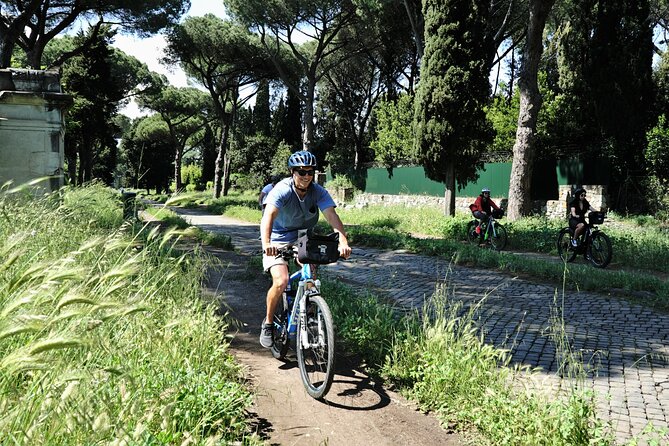
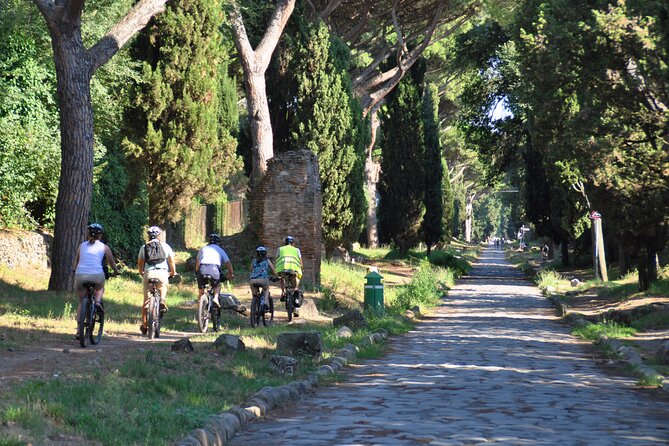
The Via Appia Antica begins almost quietly. A modern Roman street slowly gives way to one of the most evocative roads in the city, with old paving stones, archaeological remains, and open ground replacing apartment blocks and traffic.
The Appian Way Park is the heart of the ride. Instead of seeing ancient Rome only through crowded central monuments, you get a sense of how the city spread into the countryside. The route passes through fields and rolling ground where sheep graze, with ruins appearing along the road rather than behind a museum barrier.
This is one of the tour’s greatest strengths. The bike gives you access to a broad area that is awkward to cover by public transportation and tiring to walk. It also lets you feel the distance between the monuments. Ancient Rome was not just a collection of famous buildings. It was a network of roads, estates, tombs, water systems, and suburbs.
The tradeoff is that riding limits how long you can stop. One family enjoyed the scenery but wished for more photo pauses. You should take pictures at designated breaks rather than trying to use your phone while moving along uneven ground.
Catacombs of San Callisto and San Sebastiano
The catacomb portion changes depending on the duration and the day.
On the four-hour tour, you make a short pause to contemplate the burial complex associated with San Callisto. The underground cemetery held the remains of roughly half a million people, making it a powerful reminder of the scale of ancient Rome and early Christian burial practices.
The four-hour version does not include a full guided catacomb visit. On Wednesdays, the stop is not included at all on that shorter route.
The six-hour tour includes a 45-minute guided visit to the second-century catacombs. This is the better choice if the underground sites are a major reason for booking. The visit adds context and structure to what could otherwise be a quick look at an entrance or exterior.
On Wednesdays, the six-hour tour visits the Catacombs of San Sebastiano instead of San Callisto. The Wednesday route can last up to six and a half hours rather than six, so plan your afternoon with some flexibility.
The catacombs may not suit everyone. Underground passages can feel confined, and one poor experience involved arriving during a large queue at the park. The tour provider does not promise a private underground visit, so choose the six-hour option for the guided content, not for solitude.
More E-Bike Tours in Rome
- Rome City Small Group Bike Tour with quality Cannondale EBike
★ 5.0 · 1,380 reviews - Rome by Night – Ebike Small Group Tour – Food and Wine (Option)
★ 5.0 · 1,275 reviews - Rome:Appian Way E-bike Tour with Catacombs, Aqueducts & Food
★ 4.9 · 1,210 reviews - Rome: E-Bike Night Tour with Food and Wine Tasting
★ 4.9 · 1,131 reviews
Circus of Maxentius and Cecilia Metella
The ride continues to the Circus of Maxentius, part of a fourth-century Imperial complex that also included a villa and mausoleum. The circus was used for chariot racing, and its remains help you picture the scale of Roman entertainment beyond the Colosseum.
The stop is short, about five minutes, so think of it as a guided viewing point rather than a long archaeological visit. Your guide supplies the story while you take in the remains.
Nearby, the Mausoleum of Cecilia Metella is one of the most recognizable monuments along the Appian Way. This first-century funerary structure was built for a young woman from a patrician family and remains unusually well preserved.
The contrast between the massive tomb and the quiet road is part of the appeal. These monuments were meant to be seen by people arriving in Rome, and they still shape the route today. The stop is brief, but it gives the road a strong visual anchor.
The six-hour route adds Villa dei Quintili
If you have the time, the longer route includes Villa dei Quintili and Santa Maria Nova. This sprawling second-century villa belonged to two wealthy brothers connected to the Roman Imperial world.
The villa adds another side of ancient life. The Appian Way was not only a road for armies, merchants, and funerals. It also served as an address for powerful Romans with large private estates.
Again, the listed stop is short, around five minutes. You should not expect a full independent exploration of every ruin in the complex. The value comes from seeing the site as part of the wider route and hearing how elite Roman life extended beyond the city center.
This is one reason I would choose six hours if you have more than a day or two in Rome. The added stops make the outing feel like a full archaeological circuit rather than a quick ride to the Appian Way and back.
Aqueducts Park and the Roman water system
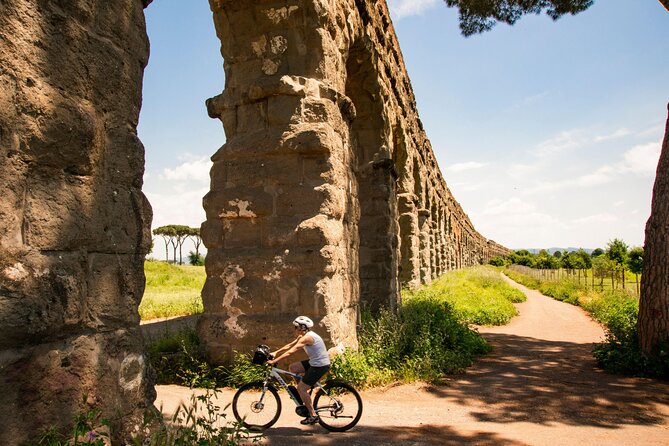
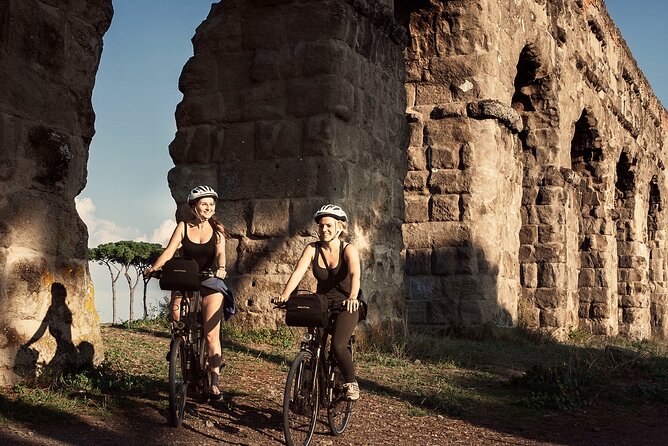
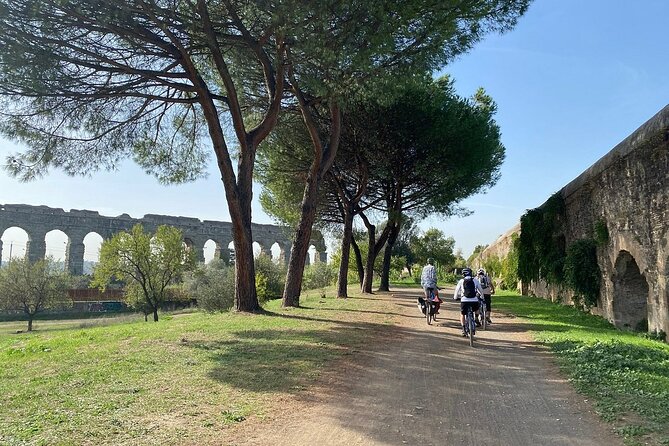
At Aqueducts Park, the scale changes again. Instead of tombs and villas, you see enormous arches carrying the remains of Rome’s ancient water network.
The guide explains the underground channels and elevated sections that supplied the city. The aqueducts are especially impressive because they make an invisible system visible. You can look across open ground and follow the engineering logic of a city that depended on water arriving from far beyond its walls.
This is one of the most scenic parts of the tour. The open park offers a clear break from central Rome, and the combination of grass, distant ruins, and towering arches creates excellent photo opportunities.
The park can be crowded on Sundays, especially with local walkers and cyclists. That can make narrow sections harder to manage and force you to stay alert. A weekday ride is the safer pick if you want a calmer outing.
The six-hour finish at the Baths of Caracalla
The longer tour ends with a view of the Baths of Caracalla. These vast public baths were much more than places to wash. Baths played a central role in Roman social life, and the size of the ruins gives you a sense of how many people could gather there.
The tour views the baths from a favorable vantage point rather than presenting a long interior visit. That is useful after several hours on a bike, since you can see the monument without adding another major walking circuit.
The stop also brings the ride back toward central Rome. After the open spaces of the Appian Way and Aqueducts Park, the Baths of Caracalla offer a fitting final reminder that this countryside was tied closely to the Imperial city.
Four hours or six hours?
The four-hour tour covers the main experience: Porta San Sebastiano, the Appian Way, the catacomb area, Circus of Maxentius, Cecilia Metella, and Aqueducts Park. It works well if you want to add another Rome sight later in the day or if four hours is your practical limit.
The six-hour tour costs more in time and demands more stamina, but it adds the guided catacomb visit, Villa dei Quintili, and Baths of Caracalla. If you have more than one or two days in Rome, I think the longer version offers better value.
Choose four hours if:
- You want a broad introduction to the parks and ancient road.
- Your schedule is tight.
- You are concerned about staying on a bike all day.
- The catacombs are interesting but not essential.
Choose six hours if:
- The catacombs are a priority.
- You want more archaeological sites in one outing.
- You prefer a full day outside the central crowds.
- You are comfortable with intermediate cycling.
On Wednesdays, add roughly 30 minutes to either option. The longer route may also feel more tiring because the extra stops do not remove any of the main riding.
Safety, pace, and physical effort
The provider limits groups to 10 people and uses planned routes with many traffic-free sections. That is a real advantage. A small group makes it easier for the guide to watch the riders, explain stops, and adjust the pace.
Still, the ride is not effortless. The route is intermediate, with about 60 percent off-road riding. Some streets carry traffic, and some paths are narrow. The e-bike motor helps with exertion, but it cannot steer for you or smooth out rough paving.
One complaint focused on a very slow group pace and riders following too closely. That may be an isolated pacing issue, but it is useful to know what can happen on a guided ride. You trade some freedom for a managed route, historical commentary, and group safety.
Children aged 9 and older can ride a properly sized e-bike independently. Children aged 5 to 8 can use a child extension, but the tour description calls the route difficult with a child seat or extension attached. Families with older children and teenagers are likely to get the most from it.
Weather can also affect the day. One group was caught in rain and still enjoyed the experience, but you should dress for changing conditions and accept that the ride takes place outdoors.
What you get for $102.79
At $102.79 per person, this is not the cheapest way to see the Appian Way. You are paying for the bike, helmet, water bottle, equipment, guide, route planning, and, on the six-hour version, the guided catacomb visit.
The value is strongest if you want to see several far-flung sites without arranging taxis or spending much of the day walking. A rental bike alone may cost less, but you would need to plan the route, handle city connections, find the parks, and supply your own context.
The tour also removes much of the guesswork. You ride from the meeting point at Via Labicana 49 and return there, rather than solving transportation between separate archaeological areas.
Food and drinks are not included. The route has some chances to buy refreshments, but bring a little planning for a suitable break. You should not assume a full meal is part of the schedule.
Free cancellation is available until 24 hours before the start time. The tour requires at least four participants, so a small booking may be canceled if the minimum is not reached. In that case, you are offered another option or a full refund.
Who should book this Rome e-bike tour?
I would recommend it to you if you want ancient sites with fresh air and movement. It is particularly good for families with teenagers, active couples, and anyone who has already seen the Colosseum and Vatican and wants a different side of Rome.
It is also a smart choice for a short visit. In four to six hours, you cover several places that are difficult to combine independently.
I would be cautious if you have back or neck problems, dislike uneven roads, or feel uneasy in traffic. Sunday riders should expect more pedestrians and bicycles in the parks. If you want to stop often for photographs or explore every ruin at your own pace, a self-guided rental may suit you better.
The strongest part of the experience is the mix of movement, scenery, and scale. Guides including David, Bita, Claudia, Fabio, Arina, and Stefan have been praised for explaining Roman history clearly while keeping groups safe and engaged. The e-bikes make the distance manageable, but your own riding ability still matters.
Should you book it?
Book the six-hour tour on a weekday if you want the fullest version and can handle an intermediate ride. It gives you the best combination of Appian Way scenery, catacombs, Imperial ruins, aqueducts, and public baths.
Choose the four-hour option if your schedule is tighter or you want the core route without committing most of a day. Either way, arrive ready to ride, wear practical clothing, and do not mistake electric assistance for a completely effortless outing.
For active visitors seeking a quieter, more spacious side of Rome, this is a strong value. For nervous cyclists, it may be better to choose a walking tour or private vehicle instead.
FAQ
Where does the tour start and finish?
The tour starts at Via Labicana 49, 00184 Rome, and ends back at the same meeting point.
How long does the tour last?
You can choose a four-hour or six-hour version. On Wednesdays, the route may take up to 30 minutes longer. The tours are also expected to be 30 minutes longer from January 14 through February 11, 2026.
How far do you ride?
The route covers approximately 17 miles, or 27 kilometers. About 60 percent of the route takes place off-road in parks.
Is the tour suitable for beginners?
The tour has an intermediate difficulty level and is not recommended for people who lack confidence on a bike. You ride through some city streets, narrow paths, and bumpy off-road sections.
Are electric bikes and helmets included?
Yes. A high-quality e-bike with anti-puncture tires, a mandatory helmet, a front bag, and a biodegradable water bottle are included.
Are children allowed on the tour?
Children aged 5 to 8 can use a child extension. Children aged 9 and above can ride an appropriately sized e-bike independently. The route is more difficult with a child seat or extension attached.
Which catacombs does the tour visit?
The six-hour tour normally includes a 45-minute guided visit to the Catacombs of San Callisto. On Wednesdays, it visits the Catacombs of San Sebastiano instead. The four-hour tour does not include the guided catacomb visit, and its catacomb stop is not included on Wednesdays.
Is food included?
No. Food and drinks are not included, though the route offers some opportunities to buy refreshments during a suitable break.
More Rides on Two Wheels
- Appian Way Aqueducts Bike Tour (Catacombs & Lunch Option)
★ 5.0 · 975 reviews - Rome: Appian Way E-Bike Tour Catacombs, Aqueducts & Picnic
★ 4.6 · 727 reviews - Rome: Appian Way Aqueducts Bike Tour (UPG Catacombs & Lunch)
★ 4.9 · 692 reviews - Rome: Appian Way & Catacomb Sunset E-bike Tour with Aperitif
★ 4.5 · 682 reviews
More Catacombs and Appian Way Trips
- Rome: Crypts and Catacombs Underground Tour with Transfers
★ 4.6 · 5,341 reviews - The Original Roman Crypts and Catacombs Tour with Transfers
★ 4.5 · 4,896 reviews - Rome: Catacombs of St. Callixtus Entry Ticket & Guided Tour
★ 4.6 · 3,037 reviews - Rome: Guided Roman Catacombs Tour with Transfers
★ 4.6 · 1,830 reviews
Just added around Rome
- Rome City, Pantheon, and Trevi Fountain Walking Tour★ 5.0 · 249 reviews
- Rome: Skip the line Vatican Museums & Sistine Chapel Tour★ 4.2 · 251 reviews
- Rome: Tivoli Day Trip with Villa d’Este and Villa Adriana★ 4.5 · 251 reviews
- Transfer Rome center – Ciampino Airport★ 4.5 · 251 reviews
- Rome: Cannondale E-Bike Evening Tour with Optional Dinner★ 4.9 · 251 reviews
- VIP Colosseum, Roman Forum & Palatine Hill & Special Access Sites★ 4.5 · 252 reviews
- Private Vatican Museums Hidden Gems Tour with Optional Pick-Up★ 5.0 · 253 reviews
- Vatican Museums & Sistine Chapel Skip-the-Line Guided Tour★ 4.6 · 254 reviews
E-Bikes, compared.

Rome EBike Tour: Appian Way, Catacombs & Roman Aqueducts
Read our review →
Top Highlights & Hidden Gems Tour by Cannondale E-Bike
Read our review →
Appian Way, Catacombs, & Roman Aqueducts E-bike Tour
Read our review →
Rome City Small Group Bike Tour with quality Cannondale EBike
Read our review →
Rome by Night – Ebike Small Group Tour – Food and Wine (Option)
Read our review →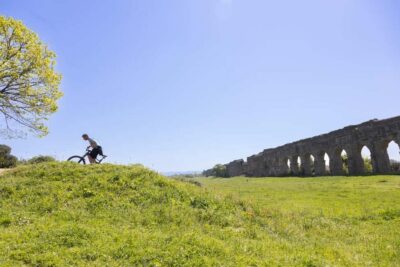
Appian Way E-bike Tour with Catacombs, Aqueducts & Food
Read our review →
Browse the lists this tour appears in