Review · ROME TOURS
Rome: Welcome To Rome Immersive Multimedia Show
Rome makes more sense from above. Welcome To Rome turns 2,700 years of history into a fast, visual lesson, using floor models, huge projections, sound, and narration to show how the city grew from ancient settlement to modern capital. I like the clear timeline, and I like how the show connects scattered ruins, churches, palaces, and streets into one understandable story.
The best time to go is near the start of your Rome visit, before you tackle the Colosseum, Roman Forum, Pantheon, or St. Peter’s Basilica. My main caution is the price: at $21 per person, it is not cheap for an experience lasting roughly an hour, and the central show itself runs only 27 minutes. You are paying for a polished orientation, not a full museum visit.
In This Review
- Key points to know before you go
- Why this short show helps you understand Rome
- Entering the former Cinema Augustus
- The opening displays and four historical models
- The 27-minute projection across Rome’s ages
- Ancient, medieval, Renaissance, and modern Rome
- Is Welcome To Rome good for children?
- The best time to fit it into your Rome plans
- What $21 gets you
- Access, languages, and practical comfort
- Who should book this experience?
- Should you book Welcome To Rome?
- FAQ
- How long does Welcome To Rome last?
- Can I visit at any time during opening hours?
- Where is Welcome To Rome located?
- Which audio-guide languages are available?
- Is the experience wheelchair accessible?
- Can I cancel my booking?
Key points to know before you go
- A 27-minute flight through 2,700 years: The main projection moves from ancient Rome through the imperial, medieval, Renaissance, and modern eras.
- Four hands-on historical models: Explore the Imperial Forum, Augustus Forum, Mausoleum of Hadrian, and St. Peter’s Basilica.
- Useful before sightseeing: The presentation gives you a timeline, making Rome’s ruins and later buildings easier to understand.
- Convenient central location: The entrance is at Corso Vittorio Emanuele II, 203, a few hundred meters from Piazza Navona.
- Flexible timing: You can begin during opening hours because the show runs continuously, but the last show starts one hour before closing.
- Nine audio-guide languages: Choose from Italian, English, Spanish, French, German, Russian, Chinese, Croatian, and Japanese.
Why this short show helps you understand Rome
Rome can be hard to read at street level. You see a column beside a church, a ruin below a busy road, or fragments of a forum surrounded by modern buildings. Without a basic timeline, the city can feel like a pile of unrelated monuments.
This presentation fixes that problem quickly. It shows Rome as a city built in layers. Ancient imperial structures were altered, buried, reused, or built around. Medieval churches appeared among Roman ruins. Renaissance and Baroque architects reshaped old spaces. Modern Rome then grew over everything that came before.
I especially like the way the show gives you a sense of place, not just a list of dates. The projection lets you see the city from above and follow its physical growth. That matters because Rome’s history is tied closely to its geography, streets, hills, forums, river, and monumental centers.
The format also suits a first visit. You do not need to know much before entering. The story is presented in chronological order, and the visuals make complicated changes easier to follow than a wall of museum text.
A few more reviews worth comparing before you book
- Glass Blowing Show Visit Murano Glass Factory & Showroom OMG
★ 4.2 · 679 reviews
Entering the former Cinema Augustus
Welcome To Rome is housed inside the former Cinema Augustus on Corso Vittorio Emanuele II. The address is a few hundred meters from Piazza Navona, so it fits neatly into a walk through central Rome.
The location is useful on a hot afternoon or during a gap between major sights. Several people have used it as a cool indoor break, and that practical benefit should not be overlooked. Rome sightseeing involves plenty of walking, standing, and sun. An air-conditioned multimedia show gives you a chance to sit for the main presentation while still doing something worthwhile.
The entrance process is designed to be simple. You can skip the ticket line with a reserved entry, and the show continues throughout the opening period rather than starting just once at a fixed hour. That gives you more freedom to fit it around lunch, a church visit, or an afternoon reservation.
The exact total time depends on how long you spend with the displays before and after the film. Plan about an hour for the whole visit. The main projection lasts 27 minutes, while the other sections let you move at your own pace.
The opening displays and four historical models
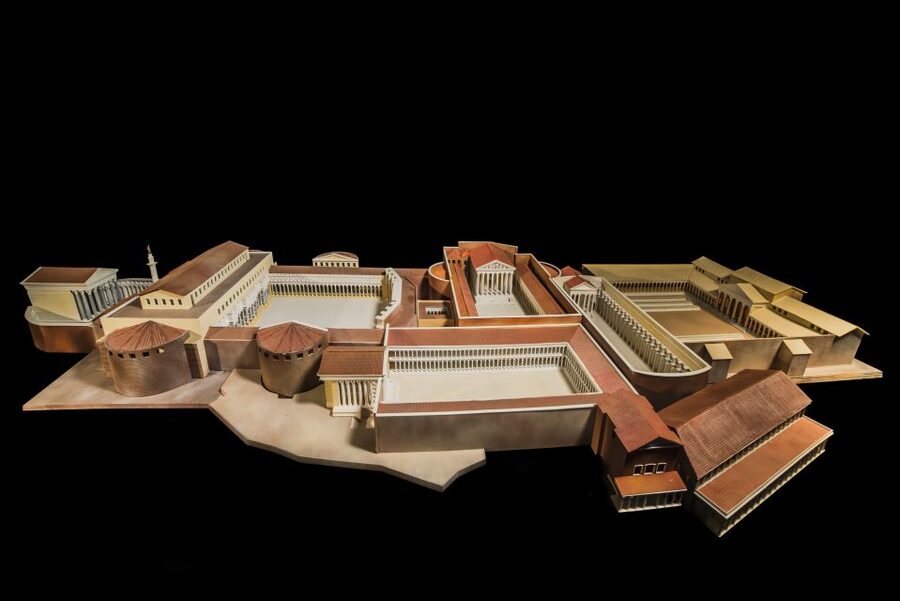
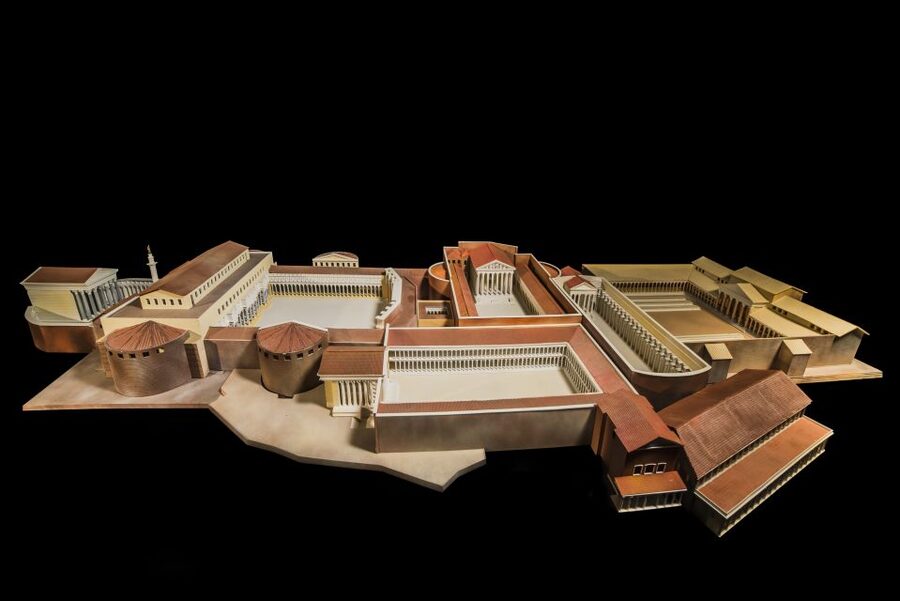
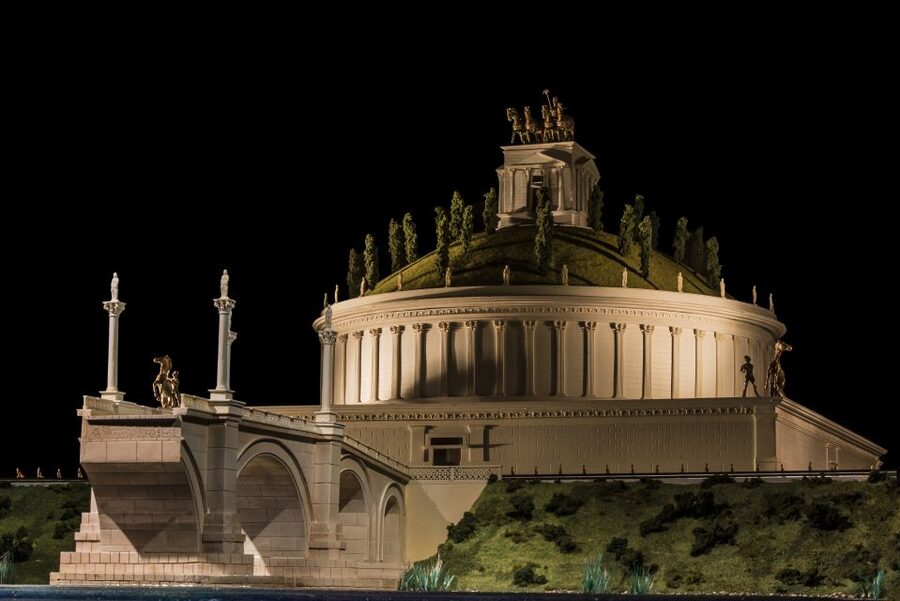
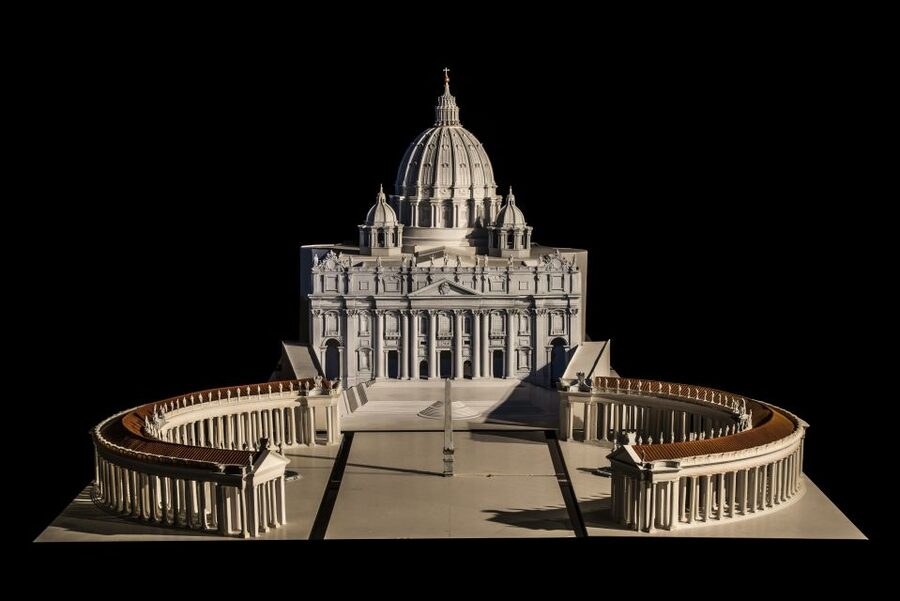
Before or around the main presentation, you can examine four large interactive models. These focus on the Imperial Forum, Augustus Forum, Mausoleum of Hadrian, and St. Peter’s Basilica.
These models are important because they show buildings as complete structures rather than as the partial remains you see today. At the Roman Forum, for example, modern visitors often encounter broken columns, foundations, and scattered stones. A model helps you picture the original scale and purpose.
The Augustus Forum and Imperial Forum also show how Roman rulers used architecture to express power. The buildings were not simply practical public spaces. They were carefully planned statements about leadership, religion, military success, and Rome’s place in the world.
The Mausoleum of Hadrian adds another useful example of change over time. Its identity and appearance developed across different periods, which helps explain why Roman monuments do not always have one fixed story.
St. Peter’s Basilica brings the timeline into the Christian and modern eras. Placing it beside the ancient forums makes the city’s long development easier to grasp. Rome did not stop being important when the empire changed. Its religious and political roles shifted, and its grand buildings changed with them.
The displays are especially helpful if you learn best through shapes and spatial layouts. You can see where structures stood, how they related to one another, and what has survived. The main weakness is that some of the other exhibit areas may require standing, and seating is not provided everywhere. If you or someone in your group cannot stand for long, ask staff for help and plan your visit around the main seated show.
The 27-minute projection across Rome’s ages
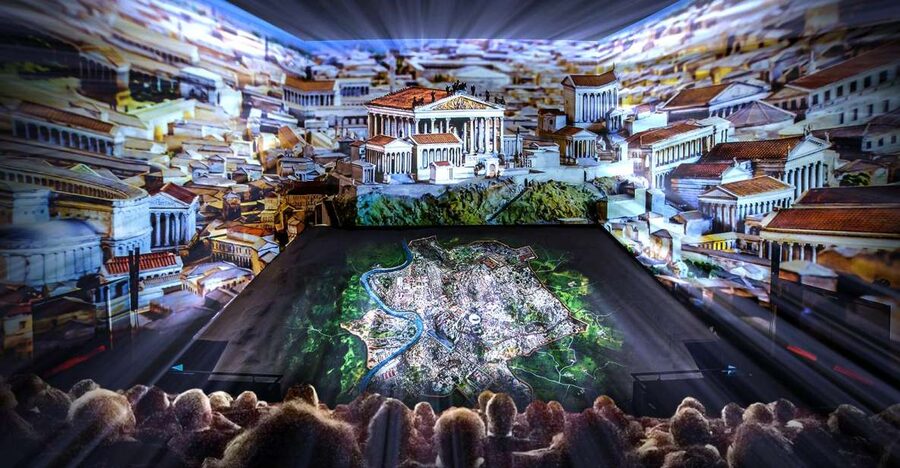
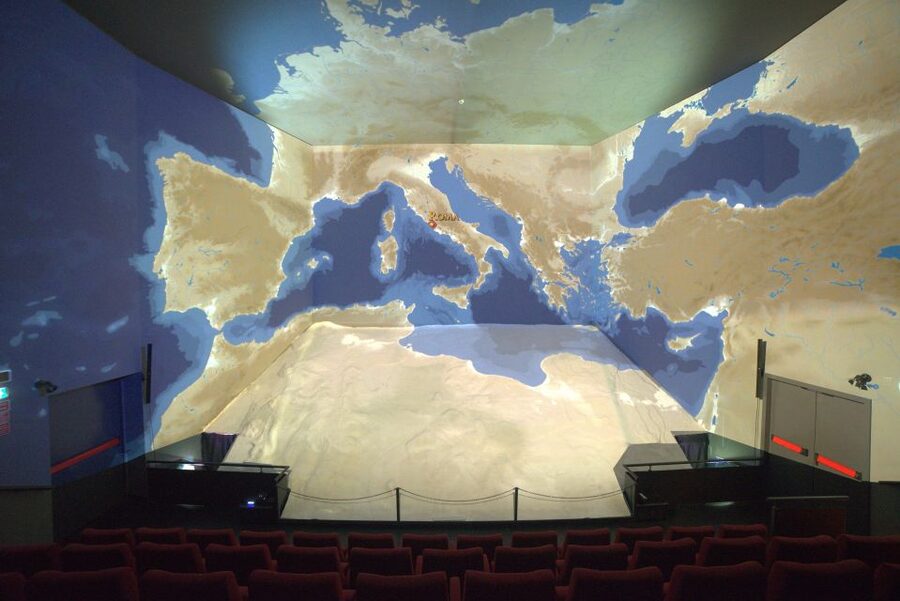
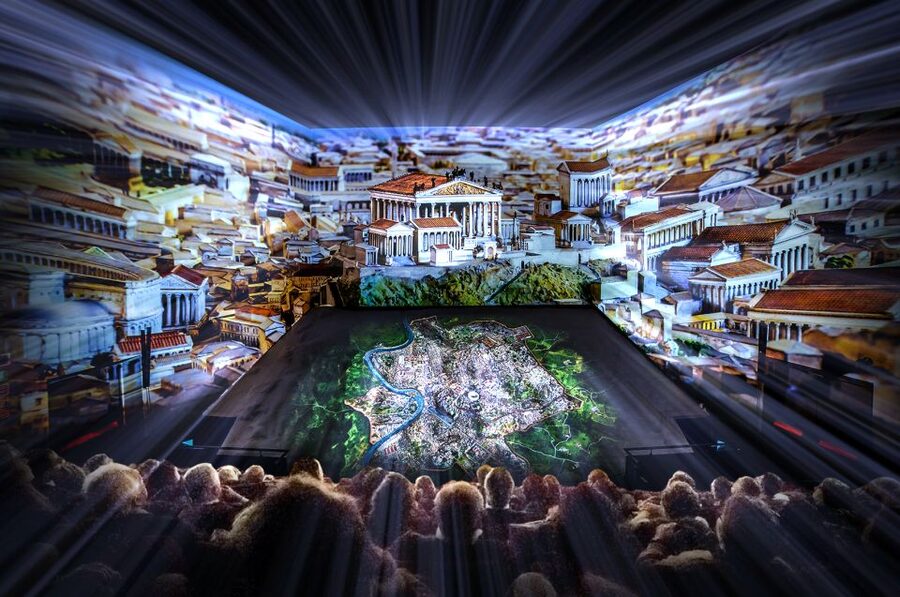
The central presentation is the heart of the experience. Walls and ceilings come alive with large-scale images, while a model of Rome on the floor lights up to show how the city changed over the centuries.
The effect is not a traditional lecture. You watch the city grow around you, with narration explaining the major periods that shaped Rome. The presentation creates the feeling of flying above the city, then moving through monuments, palaces, churches, and public squares.
That visual movement is more than a special effect. It helps you connect the map with the monuments. You begin to understand why the Colosseum, forums, churches, and later civic buildings occupy the places they do. You also get a better sense of how much of ancient Rome is hidden beneath the modern city.
The 27-minute length works well. It is long enough to give you a real framework but short enough to hold the attention of most children and adults. You are not asked to sit through a two-hour historical lecture before reaching the sights you came to see.
The audio guide is available in nine languages: Italian, English, Spanish, French, German, Russian, Chinese, Croatian, and Japanese. This makes the show accessible to a wide range of visitors and lets you follow the story in the language you understand best.
The production uses 3D animation and large projections. The visuals are a major reason to go, but the technology serves the story rather than replacing it. The show works best when you watch for the changes in the city, not just the spectacle on the walls.
A different sort of day out around Rome:
- Vatican: Museums & Sistine Chapel Entrance Ticket
★ 4.5 · 144,003 reviews - Vatican Museums & Sistine Chapel Tour with Optional Basilica
★ 4.3 · 67,413 reviews - Colosseum, Roman Forum & Palatine Guided Tour
★ 4.7 · 63,148 reviews - Vatican Museums, Sistine Chapel & St Peter’s Basilica Guided Tour
★ 4.5 · 39,149 reviews
Ancient, medieval, Renaissance, and modern Rome
The presentation compresses a huge amount of time. You will not receive the detail of a private historian-led tour, and the narration cannot explain every emperor, conflict, artist, or architectural change. What it does well is establish the broad sequence.
You see the growth of Rome through its different ages and gain a clearer idea of how the city’s identity developed. Ancient imperial power gives way to later religious influence, artistic renewal, and the modern capital you see today.
That broad view is valuable before visiting the Roman Forum. The ruins can be confusing when you do not know which buildings belong to which period. After seeing the city develop on screen, you may find it easier to separate the remains of temples, basilicas, arches, and public spaces.
The same is true at the Colosseum. The amphitheater is powerful in person, but it is only one part of a much larger urban system. A visual presentation can show how it related to the surrounding imperial buildings and the city beyond.
You can also use the show after sightseeing. If you have already walked through Rome, familiar places suddenly appear in a new order. The projection can help connect what you saw in fragments during several days of exploring.
Is Welcome To Rome good for children?
The presentation is a strong choice for families with school-age children. The moving images, glowing models, and short central film are easier for many children to follow than a long museum visit.
Children around the age of nine, ten, eleven, and twelve have enjoyed the visual format, and the experience can work across a wide age range. It has also appealed to groups that include both children and older adults, which is not always easy to achieve with a history attraction.
Still, do not expect every very young child to remain interested. The presentation is educational, and some of the material may feel abstract if a child has no interest in buildings or the past. The models help, but this is not primarily a play space.
For families, I would put it near the beginning of the trip. Once children recognize the Colosseum, forums, churches, and other landmarks, the rest of Rome can feel like a connected story rather than a series of unrelated stops.
The best time to fit it into your Rome plans
I recommend going during your first day or two, especially if this is your first visit to Rome. It gives you a mental map before you spend time at the major sites.
A practical sequence would be:
- Welcome To Rome in the morning
- A walk toward Piazza Navona and nearby historic streets
- Major ancient sites later that day or the following day
You can also schedule it after the Colosseum or Roman Forum. In that order, it acts as a review and may help you make sense of details you have already seen.
The location near Piazza Navona makes it easy to combine with central Rome. You might place it before or after a walk through the piazza, depending on your reservations and energy. Since the show runs continuously, you do not need to build your entire day around a single performance time.
Keep the closing rule in mind. The last show begins one hour before closing, so do not arrive at the final minute and expect a full visit.
What $21 gets you
At $21, the price sits on the high side for a short attraction. Some people would find $12 to $15 more comfortable for an hour-long introduction. That concern is fair, especially if you are traveling with a large family.
The value improves if you use the show as a planning tool. One hour here can make several later sightseeing stops more rewarding because you already understand the broad timeline and layout of the city.
I also think the price is easier to justify for first-time visitors, families, and people with limited time. If you have only a few days in Rome, a clear orientation can prevent you from feeling lost among the monuments.
For repeat visitors, the decision depends on your interest in visual storytelling. The exhibition may not reveal the same level of detail as a specialist museum, but it offers a different way to see familiar places. If you enjoy architecture, urban development, or Roman history, the models and city projections may be worth the admission.
Free cancellation up to 24 hours before the visit and a reserve-now, pay-later option also make the booking less rigid. Those policies are useful when your Rome schedule includes timed museum entries and changing plans.
Access, languages, and practical comfort
The projection and interactive exhibits are wheelchair accessible. That makes the experience a practical option for people who find Rome’s uneven streets and long outdoor routes difficult.
The main projection provides a chance to sit, but seating may not be available in every exhibit area. If standing is a concern, allow extra time and speak with staff when you arrive. The staff are described as friendly and helpful, which is useful in a small attraction where the order of the displays may not always be obvious.
The audio guide language choices are unusually broad for a short city attraction. English, Italian, Spanish, French, German, Russian, Chinese, Croatian, and Japanese are available.
Who should book this experience?
I would choose Welcome To Rome for:
- First-time visitors who want a quick framework for the city
- Families with school-age children
- People visiting Rome for only a few days
- History and architecture fans
- Anyone needing a cool indoor break near Piazza Navona
- Repeat visitors who enjoy visual presentations and city models
I would skip it if you want an in-depth archaeological tour, a live guide, or hours of detailed museum exhibits. The show simplifies a huge subject, and the $21 admission may feel high if you only want a brief film.
Should you book Welcome To Rome?
Yes, if you want Rome to make sense before you start checking monuments off your list. The best reason to go is not the technology by itself. It is the way the projection and models connect ancient ruins, later churches, major palaces, and modern streets into one timeline.
Book it early in your trip if you can. You will likely get more from the Roman Forum, Colosseum, Pantheon, and other sights afterward. The cost is the main drawback, but for a short, clear, family-friendly introduction near Piazza Navona, I think it earns a place on many Rome itineraries.
FAQ
How long does Welcome To Rome last?
The main multimedia projection lasts 27 minutes. Allow about an hour for the full visit, including the interactive models and other displays.
Can I visit at any time during opening hours?
Yes. The show runs continuously, so you can begin your visit at any point during opening hours. The last show starts one hour before closing.
Where is Welcome To Rome located?
The entrance is at Corso Vittorio Emanuele II, 203, in Rome. It is a few hundred meters from Piazza Navona.
Which audio-guide languages are available?
Audio guides are available in Italian, English, Spanish, French, German, Russian, Chinese, Croatian, and Japanese.
Is the experience wheelchair accessible?
Yes. The multimedia projection and interactive exhibits are accessible to wheelchair users.
Can I cancel my booking?
You can cancel up to 24 hours in advance for a full refund. A reserve-now, pay-later option is also available.
Just added around Rome
- Rome City, Pantheon, and Trevi Fountain Walking Tour★ 5.0 · 249 reviews
- Rome: Skip the line Vatican Museums & Sistine Chapel Tour★ 4.2 · 251 reviews
- Rome: Tivoli Day Trip with Villa d’Este and Villa Adriana★ 4.5 · 251 reviews
- Transfer Rome center – Ciampino Airport★ 4.5 · 251 reviews
- Rome: Cannondale E-Bike Evening Tour with Optional Dinner★ 4.9 · 251 reviews
- VIP Colosseum, Roman Forum & Palatine Hill & Special Access Sites★ 4.5 · 252 reviews
- Private Vatican Museums Hidden Gems Tour with Optional Pick-Up★ 5.0 · 253 reviews
- Vatican Museums & Sistine Chapel Skip-the-Line Guided Tour★ 4.6 · 254 reviews
Rome Tours, compared.

Vatican: Museums & Sistine Chapel Entrance Ticket
Read our review →
Vatican Museums & Sistine Chapel Tour with Optional Basilica
Read our review →
Colosseum, Roman Forum & Palatine Guided Tour
Read our review →
Vatican Museums, Sistine Chapel & St Peter’s Basilica Guided Tour
Read our review →
Colosseum, Palatine Hill and Roman Forum Guided Tour
Read our review →
Guided Tour of Colosseum, Roman Forum & Palatine Hill
Read our review →
Colosseum & Forum with Audio Guide App -Optional Arena
Read our review →