
Review · MILAN TOURS
Rome: Leonardo Da Vinci Experience Entry Ticket
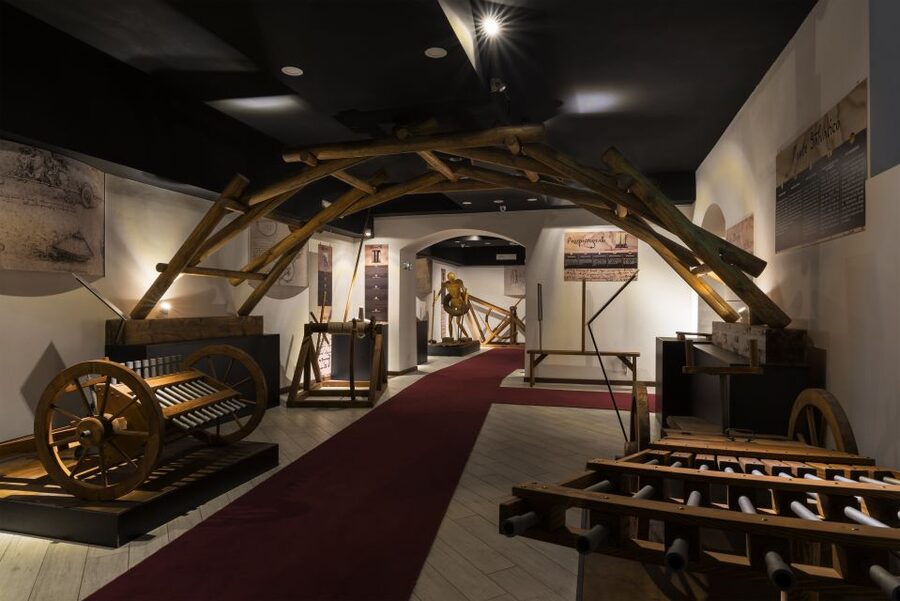
Leonardo’s wildest ideas come alive here. This small, hands-on museum near St Peter’s Square turns sketches into working models, from flying machines and armored vehicles to bridges and water equipment. I like the freedom to explore at your own pace, and the interactive inventions give children and adults something to do beyond simply looking at display cases.
I also like the excellent multilingual audio guide, which explains both the machines and the paintings. The air-conditioning is a real help during Rome’s hot months. The main drawback is size: you may expect a grand museum and finish in under an hour, although taking time with every audio stop and interactive model can stretch the visit to one and a half or even two hours.
In This Review
- Key points to know before you go
- A small museum with a big subject
- Finding the exhibition beside the Vatican
- Hall One: Leonardo the practical engineer
- Hall Two: Flying machines and the dream of flight
- Hall Three: War machines and hard-edged invention
- Hall Four: Water, energy, and machines ahead of their time
- Hall Five: Light and Leonardo’s Room of Mirrors
- The art gallery and famous Renaissance paintings
- Using the audio guide at your own pace
- How long should you allow?
- Best for families, curious adults, and Vatican-area visitors
- Is $18 a fair price?
- Should you book the Leonardo Da Vinci Experience?
- FAQ
- Where is the Leonardo Da Vinci Experience in Rome?
- How much does admission cost?
- How long is the ticket valid?
- Is an audio guide included?
- Should I bring headphones?
- Is a guided tour included?
- Can I cancel the booking?
Key points to know before you go
- Fifty working inventions: Try reconstructed designs linked to Da Vinci’s flying machines, bridge, bicycle, sewing machine, weapons, lifting tools, and more.
- Five exhibition halls: The displays cover engineering, flight, warfare, optics, water, and other areas of Leonardo’s work.
- Near St Peter’s Square: The entrance at Via della Conciliazione 19 is about 150 meters from the square, making this easy to add before or after the Vatican.
- Audio guide included: Choose from English, Italian, French, German, Spanish, Portuguese, Russian, or Chinese. Bring your own headphones.
- A full day ticket, but a short visit: Your ticket is valid for one day, yet most people spend about one to two hours inside.
- Good family value: Many models can be touched or operated, giving younger visitors a reason to stay engaged.
A small museum with a big subject
Leonardo da Vinci is often introduced through the Mona Lisa and The Last Supper. This exhibition widens the picture. It presents him as an artist, engineer, architect, sculptor, scientist, and tireless observer of the natural world.
That broader view is the real reason to come. Leonardo was sketching ideas for robots, submarines, underwater breathing equipment, solar-powered machines, suspension bridges, and flying devices more than 500 years ago. The displays let you see how those ideas worked rather than asking you to admire a page of tiny drawings behind glass.
The museum itself is not large. That is useful if you are building a busy Rome day, but it also explains the mixed reactions about value. At $18 per person, you are paying for a focused, interactive exhibition rather than several hours in a major national museum.
I think the price works best when you use the audio guide and try the machines. If you rush through the rooms, the visit can feel expensive for its size. If you listen carefully and let children experiment, the cost becomes easier to justify.
A few more reviews worth comparing before you book
- Milan: Cathedral and Duomo’s Terraces Entrance Ticket
★ 4.6 · 61,054 reviews - Milan: Da Vinci’s Last Supper Guided Tour
★ 4.7 · 10,143 reviews - Milan: Science and Technology Leonardo da Vinci Museum Entry
★ 4.5 · 7,169 reviews
Finding the exhibition beside the Vatican
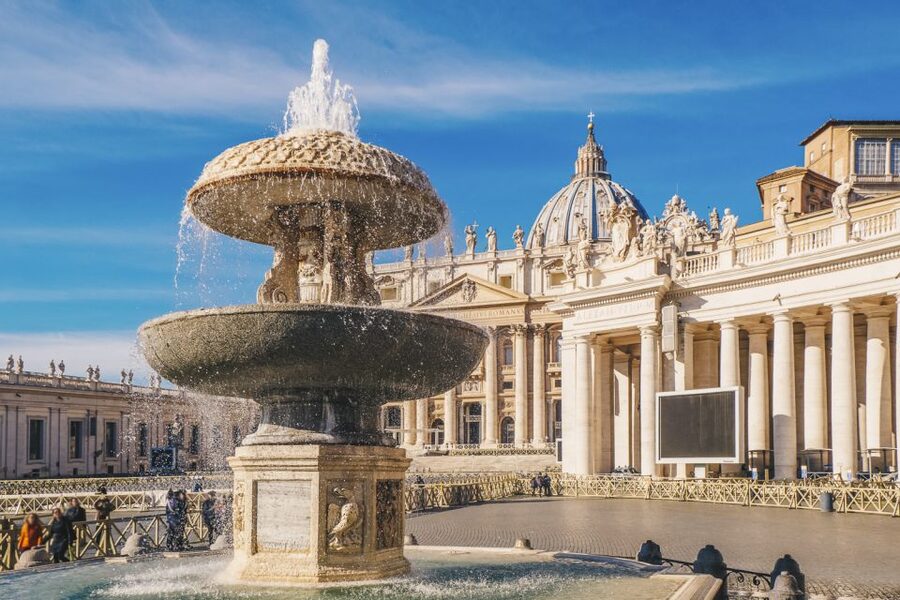
The museum is at Via della Conciliazione 19, roughly 150 meters from St Peter’s Square. You do not need a separate transfer or complicated meeting arrangement. It fits neatly into a Vatican-area plan, especially if you want an indoor stop during the hottest part of the day.
The location also makes this a useful backup activity. If your Vatican schedule leaves an open hour, you can fill it with something related to Renaissance Italy without committing to another large, tiring museum. The fully air-conditioned rooms are especially welcome in summer.
The entrance can be busier at some times. Arriving early may help you avoid waiting, particularly since the museum is compact and crowded displays can make the interactive sections less comfortable. The ticket gives you access for one day, with starting times shown when you check availability.
You receive an audio guide at entry. Bring your own headphones, since that is specifically recommended for using the equipment comfortably. Staff speak English, and the welcome is generally friendly and helpful.
Hall One: Leonardo the practical engineer
The invention displays are the heart of the experience. You will see models based on Leonardo’s drawings, with many built at full or useful working scale. This changes the visit from a simple art display into a demonstration of how a Renaissance thinker approached real problems.
The machines cover digging and lifting equipment, bridge construction, textile work, bicycles, water skis, and other practical ideas. Some can be touched or operated to a limited extent. You can move parts, test mechanisms, and see how force, balance, gears, and leverage fit together.
The unsupported suspension bridge is a particularly helpful example. A drawing can make an idea look obvious, but assembling or examining the bridge model shows why its design matters. One hands-on activity allows you to build a Leonardo bridge yourself, which is a nice way for children and adults to understand the structure.
The sewing machine and bicycle models help connect Leonardo’s work to familiar modern objects. You may not leave believing he invented every modern version directly, but you will see how closely he studied motion and mechanical systems.
This section rewards curiosity. You do not need an engineering background. The audio explanations give enough context to make the mechanisms understandable, while the physical models supply the part that words cannot.
Hall Two: Flying machines and the dream of flight
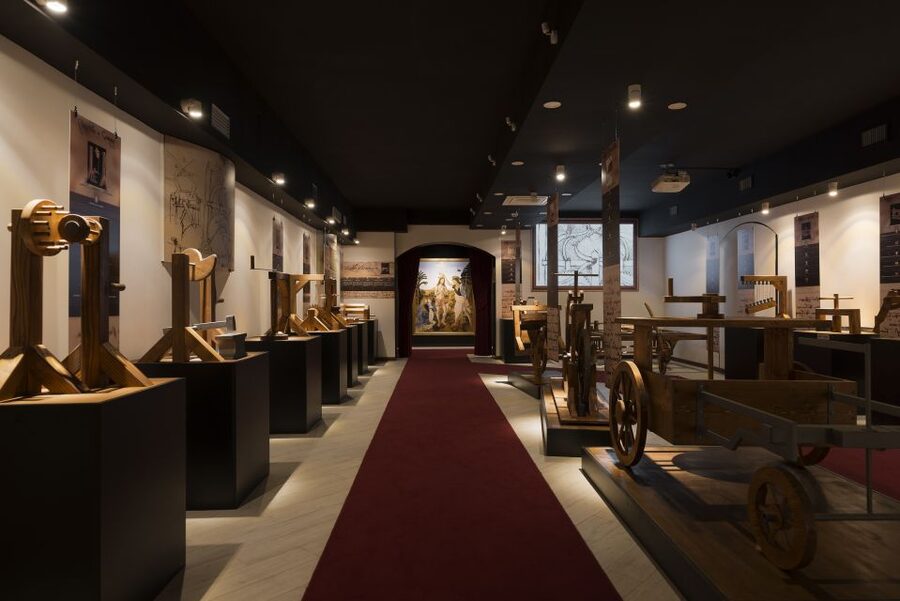
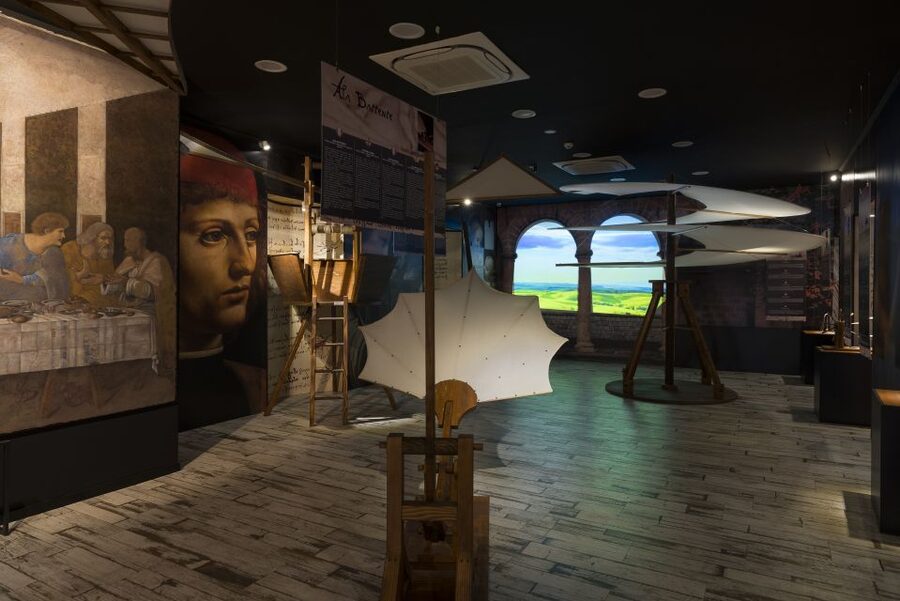
Leonardo’s flying machines are among the most photogenic displays. You can see designs inspired by birds, wings, and air movement, along with a model of his helicopter-like machine.
The important point is not that these inventions were ready to fly. They were proposals based on careful observation, and the exhibition helps you see Leonardo testing the limits of human flight with the tools available in his time.
The photo opportunity beside the helicopter is popular, especially with children. It gives you a physical sense of the scale of the design and makes the section more memorable than a flat reproduction of a sketch.
The audio guide is useful here because it explains the thinking behind the shapes. Without that help, several machines may look like unusual wooden frameworks. With it, you can follow the connection between Leonardo’s study of birds, rotating motion, and lift.
A different sort of day out around Milan:
- Milan: City Sightseeing Hop-On Hop-Off Bus with Audio Guide
★ 4.0 · 6,256 reviews - Milan Cathedral: Duomo Terraces Ticket (No Church Access)
★ 4.6 · 6,111 reviews - Milan: Milan Cathedral Direct Entrance – Terrace Excluded
★ 4.5 · 5,782 reviews - Milan: Guided Walking Tour & Last Supper Visit with Ticket
★ 4.7 · 5,409 reviews
Hall Three: War machines and hard-edged invention
Leonardo’s imagination was not limited to peaceful devices. The war-machine displays include an armored tank and a machine gun design, along with other military concepts.
These models can feel surprising beside his paintings. They show that Leonardo worked for powerful patrons who wanted fortifications and weapons as much as they wanted portraits. The exhibition does not present him only as a dreamy artist. It shows a practical Renaissance professional who applied drawing and engineering to the problems his employers placed before him.
The armored vehicle is one of the easiest models to appreciate visually. Its rounded shell and defensive form look familiar in outline, yet the design came from a very different age. You can take a photograph beside it, which adds a bit of fun to an otherwise technical section.
I would give this area extra time if you have older children or teenagers. The machines are more engaging when you ask how they might have been built, moved, or supplied with power. Some visitors may find the military material less appealing, but it is an important part of understanding Leonardo’s working life.
Hall Four: Water, energy, and machines ahead of their time
Leonardo’s interest in water appears in designs for submarines, underwater breathing equipment, water skis, and other devices. These models make clear how often he studied movement through water and the practical challenges of working below the surface.
You can also learn about ideas linked to solar energy. The museum presents these concepts as examples of Leonardo’s habit of looking for natural forces that could be put to work.
This is one of the better sections for showing how far his interests ranged. He was not producing isolated inventions. He was studying air, water, light, mechanics, and the human body, then connecting those subjects in unexpected ways.
The audio guide keeps the displays from becoming a collection of strange objects. You can choose the exhibits that interest you most, but I recommend listening to the explanations for the water and energy models even if you are mainly visiting for the art.
Hall Five: Light and Leonardo’s Room of Mirrors
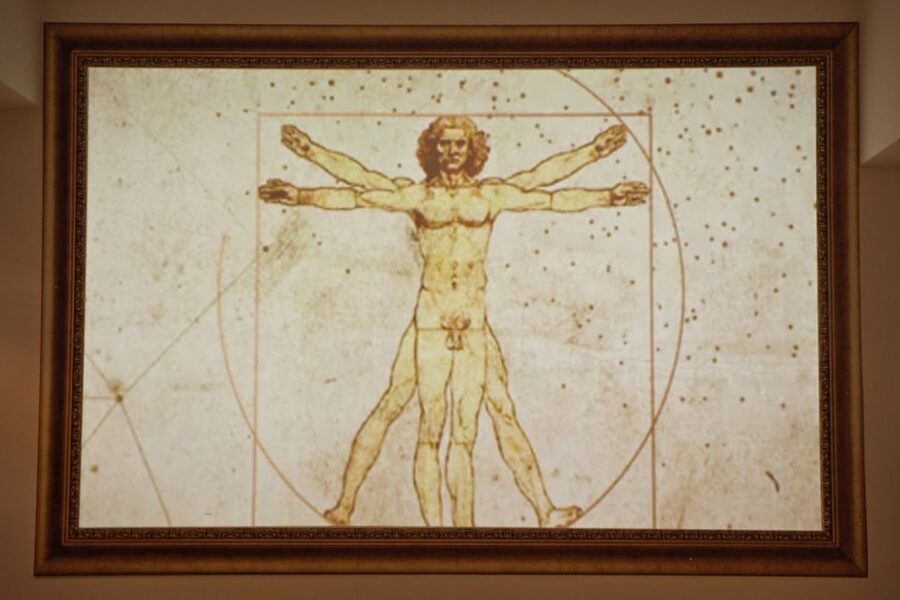
The Room of Mirrors is one of the most memorable spaces in the exhibition. It explores Leonardo’s study of light and how his ideas relate to later developments in photography and projection.
The room also offers a change of pace after the mechanical displays. Instead of pushing or turning a model, you are asked to notice how reflection and light alter what you see. It is a good stop for photographs, though the effect is likely to be more appealing to some visitors than others.
This section helps explain why Leonardo’s work feels modern. His curiosity moved freely between art and science. The same person who studied perspective for painting also examined light as a physical phenomenon.
If you are short on time, do not skip the mirror room. It takes little time and provides one of the clearest visual experiences in the museum.
The art gallery and famous Renaissance paintings
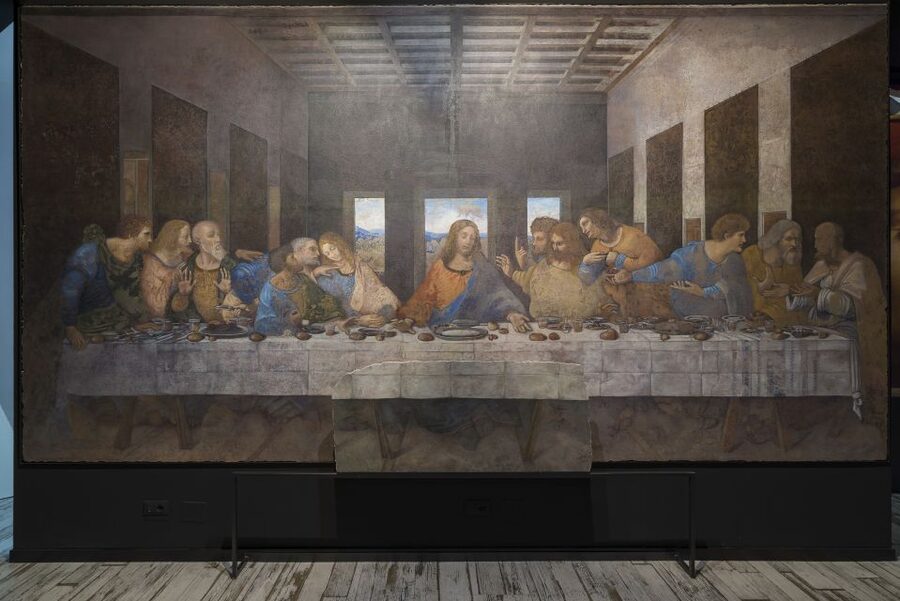
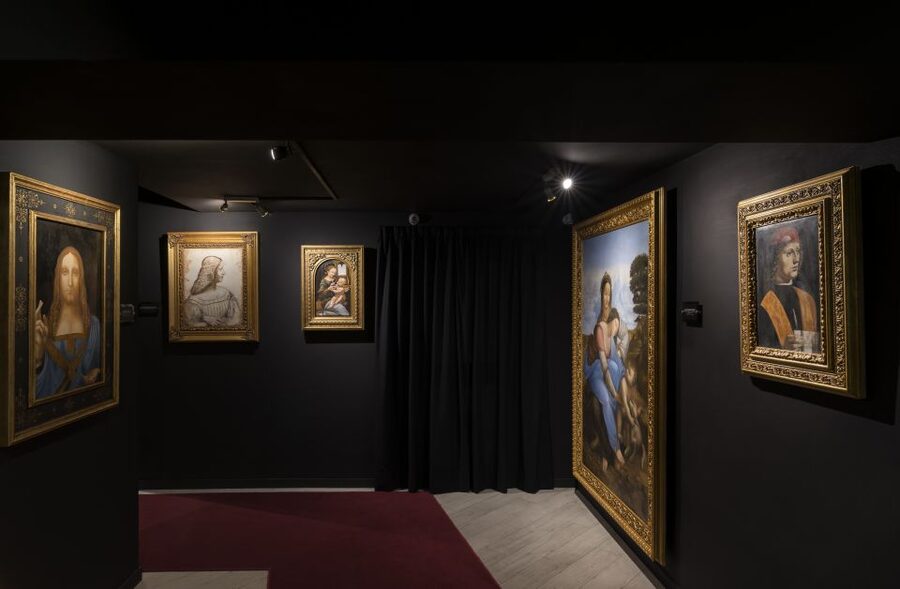
The exhibition includes 20 certified reproductions painted by prominent Vatican Museum restoration artists. These are not the original masterpieces, so you should set your expectations correctly. You are not seeing the original Last Supper, Virgin of the Rocks, or Lady with an Ermine.
Still, the gallery adds important balance. Without it, the museum could feel like an engineering show with Leonardo’s name attached. The paintings remind you that his mechanical thinking and artistic work came from the same habit of close observation.
The gallery includes both versions of the Virgin of the Rocks. The originals are held by the Louvre and London’s National Gallery, so the reproductions give you a chance to compare the subjects in one place. You can also see the Lady with an Ermine, a painting linked to Leonardo’s changes in classical portraiture.
A full-sized reproduction of The Last Supper is one of the main draws. Its fame has been boosted by Dan Brown’s The Da Vinci Code, but the painting is worth attention beyond its role in a modern mystery novel. The audio guide explains the art and story, helping you focus on Leonardo’s choices rather than only on speculation about hidden messages.
This gallery is especially helpful if someone in your group knows Leonardo mainly as the painter of the Mona Lisa. The reproductions provide a compact introduction to his technique and to the range of his artistic work.
Using the audio guide at your own pace
The audio guide is included and available in eight languages: English, Spanish, French, Italian, German, Portuguese, Russian, and Chinese. It is one of the strongest parts of the ticket because the machines need explanation.
You can move at your own speed rather than staying with a guide or waiting for a group. Stop for a longer look at a bridge or war machine, skip an explanation that does not interest you, and return to a painting when you are ready.
The audio system may take a little time to get used to. Once you understand how to select the displays, it becomes straightforward. Your own headphones are worth bringing, both for comfort and for a better listening experience in a compact museum.
A guided tour is not included. That is a limitation if you want to ask questions or have someone connect every exhibit into one story. It is also a benefit if you dislike fixed schedules and prefer to set the rhythm yourself.
How long should you allow?
Plan on one hour at minimum. That gives you time to see the main rooms and listen to a reasonable selection of explanations.
Allow one and a half hours if you want to try the interactive models, hear more of the audio guide, and spend time in the art gallery. Some people can spend two to three hours here, especially with children who want to test the bridge and mechanical displays repeatedly.
The ticket is valid for one day, but this does not mean the museum is designed as an all-day attraction. You cannot stretch a small exhibition into the scale of the Vatican Museums. Think of it as a focused stop that works well between larger sights.
Avoid scheduling it at the end of a long day if you want to absorb the information. Tired visitors can move through the rooms quickly and miss the point of the displays. A morning visit or a midday air-conditioned break makes better use of the museum.
Best for families, curious adults, and Vatican-area visitors
This experience suits families particularly well. Children can touch and test many of the reconstructions, while adults can listen to the historical and artistic explanations. Teenagers also have more reason to stay involved than they might in a gallery made entirely of paintings.
It works for adults who want a short introduction to Leonardo’s engineering. You do not need specialist knowledge, and the models make technical ideas easier to grasp.
Art lovers should come with clear expectations. The reproductions are interesting and well explained, but they do not replace seeing Leonardo’s originals in the Louvre, London’s National Gallery, or elsewhere. The same applies to The Last Supper: this is a full-sized reproduction, not the original in Milan.
This is less suitable if you want a large, quiet museum with a long sequence of original objects. The rooms can feel small, and the exhibition is built around models, reproductions, and interaction rather than rare original works.
Is $18 a fair price?
At $18, the ticket is reasonable if you want an accessible, self-guided activity near St Peter’s Square. The included audio guide adds real value, especially since it is available in eight languages. Air-conditioning, restrooms, WiFi, and the ability to explore independently also make the visit comfortable.
The price is harder to defend if you spend only 20 minutes inside. A few people may move quickly through the compact layout, particularly without using the audio guide. I would budget at least an hour and treat the museum as a learning experience rather than a quick photo stop.
The free cancellation option up to 24 hours before arrival and the reserve-now, pay-later choice are useful if your Rome schedule is still changing. These policies do not make the museum itself better, but they reduce the risk of fitting a short attraction into a crowded itinerary.
Should you book the Leonardo Da Vinci Experience?
I would book it if you are staying near the Vatican, have children with you, or want to understand Leonardo as an engineer as well as a painter. The hands-on machines and strong audio guide give the visit more substance than its modest size suggests.
I would skip it if your priority is original Renaissance art or if your schedule is already packed with major museums. At $18, you need to spend enough time with the models and explanations to get good value.
For most people, this is a pleasant one to two-hour addition to a Vatican-area day. Go early if possible, bring headphones, use the audio guide, and give the interactive inventions time to work their quiet magic.
FAQ
Where is the Leonardo Da Vinci Experience in Rome?
It is located at Leonardo da Vinci Experience, Via della Conciliazione 19, about 150 meters from St Peter’s Square.
How much does admission cost?
The listed price is $18 per person.
How long is the ticket valid?
The ticket is valid for one day. Check availability for the available starting times.
Is an audio guide included?
Yes. The audio guide is included with admission and is available in English, Spanish, French, Italian, German, Portuguese, Russian, and Chinese.
Should I bring headphones?
Yes. Headphones are specifically recommended for using the audio guide.
Is a guided tour included?
No. The ticket includes entry and an audio guide, but not a guided tour.
Can I cancel the booking?
You can cancel up to 24 hours in advance for a full refund. A reserve-now, pay-later option is also available.
Just added around Milan
- Milan Sights by Segway Small Group Tour★ 5.0 · 249 reviews
- Unveil the Masterpiece: Guided Tour of Da Vinci’s Last Supper★ 4.5 · 251 reviews
- Milan: Pasta & Tiramisu Cooking Class with Premium Products★ 5.0 · 255 reviews
- Milan Semi-Private Max 6 People Tour with Last Supper and Duomo★ 5.0 · 258 reviews
- Skip The Line: Best Of Milan Tour With Last Supper & Milan Duomo★ 4.5 · 260 reviews
- Milan: Duomo & Rooftop Tour with Optional Hop-On Hop-Off Bus★ 4.5 · 262 reviews
- Stresa: 1-Day 3 Borromean Islands Hop-On Hop-Off Boat Tour★ 4.0 · 262 reviews
- Milan Centre Food Tour of 7+ Italian Tastings with Risotto & Wine★ 5.0 · 264 reviews
Milan Tours, compared.
Cathedral and Duomo’s Terraces Entrance Ticket
Read our review →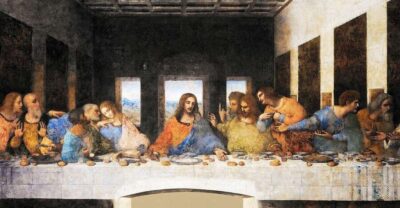
Science and Technology Leonardo da Vinci Museum Entry
Read our review →
City Sightseeing Hop-On Hop-Off Bus with Audio Guide
Read our review →
Milan Cathedral: Duomo Terraces Ticket (No Church Access)
Read our review →
Milan Cathedral Direct Entrance – Terrace Excluded
Read our review →
Guided Walking Tour & Last Supper Visit with Ticket
Read our review →
Fast-Track Milan Cathedral and Terraces Guided Tour
Read our review →Browse the lists this tour appears in