
Review · MUSEUMS
Leonardo Da Vinci Museum Entrance Ticket
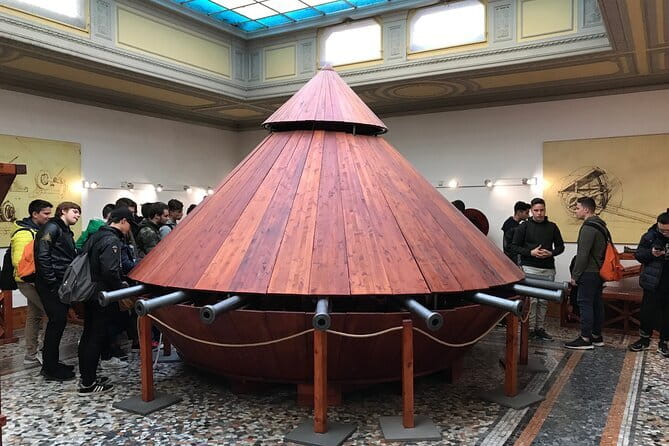
Leonardo’s inventions still feel startlingly modern. The Leonardo da Vinci Museum in central Florence turns his sketches into working models, giving you a clear look at the engineer, scientist, architect, anatomist, and military designer behind the famous paintings. I like the hands-on machines, which give children and adults a reason to stop and think, and I like the short visit length, usually about one to one and a half hours. The main drawback is clear: this is a museum of replicas and models, not a gallery of Leonardo’s original paintings or manuscripts.
The museum works best when you arrive knowing what it is. You will find more than 50 models in four rooms, many built to function as Leonardo intended. I also appreciate the flexible daytime entry, the central location near public transport, and the modest price of about $12.55 per person. Still, if you want original art, detailed historical interpretation, or a large museum with major artifacts, this may feel too basic.
In This Review
- Key Points Before You Go
- Finding the Museum in Central Florence
- Four Rooms That Make Leonardo Easier to Understand
- Civil Machines: Leonardo the Engineer
- Flying Machines: Dreams With Mechanical Logic
- War Machines: The More Surprising Side of Leonardo
- Anatomical Models: The Body as a Machine
- What the Working Replicas Add
- A Short Film and a Useful Break
- How Long Should You Allow?
- Is the $12.55 Ticket Good Value?
- Who Will Enjoy This Museum Most?
- Practical Advice Before Buying
- Should You Book the Leonardo da Vinci Museum?
- FAQ
- Where is the Leonardo da Vinci Museum located?
- What are the museum’s opening hours?
- How long does a visit usually take?
- What does the admission ticket include?
- Are food and drinks included?
- Is hotel pickup included?
- Is this a guided tour?
- Are Leonardo’s original paintings displayed?
- Can I cancel for a full refund?
Key Points Before You Go
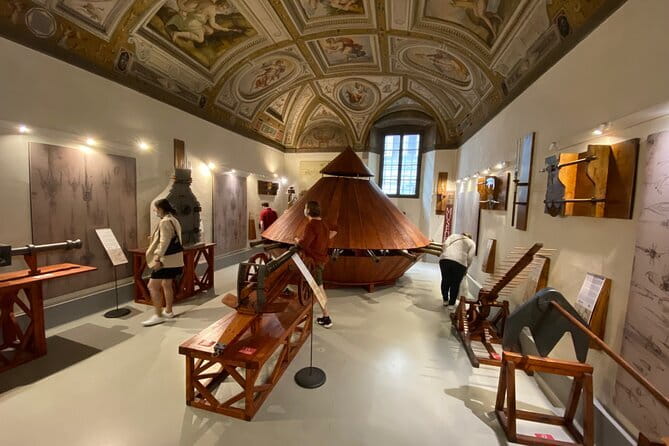
- Four rooms cover four sides of Leonardo: civil engineering, flight, warfare, and anatomy.
- Many machines actually work: hands-on displays help explain ideas that can look abstract in drawings.
- Plan on 60 to 90 minutes: the museum is easy to fit between Florence’s larger sights.
- A good family stop: children have interactive displays and a dedicated activity area.
- This is not an art museum: Leonardo’s inventions are the focus, not the Mona Lisa or other paintings.
- Check your city carefully: Florence, Rome, Venice, and Milan have separate Leonardo museums, and a wrong-city ticket may be difficult to fix.
Finding the Museum in Central Florence
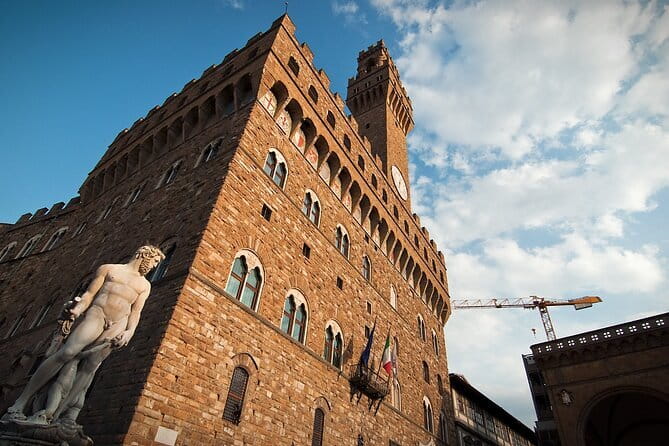
The museum occupies the Galleria Michelangelo on one of Florence’s best-known central streets. This is the same building where the Macchiaioli artists once met, adding a small piece of Florence’s artistic story before you even reach the machines.
The central setting makes this an easy addition to a day of sightseeing. The museum is near public transportation and close to major tourist attractions, so you can place it before or after other stops without giving up half a day. Its relatively small size is useful in Florence, where the Uffizi, Accademia, and cathedral complex can consume several hours.
The museum is open daily from 10:00 a.m. to 6:00 p.m. for the stated operating period, from June 29, 2023, through February 16, 2027. Check the current details before setting out, since opening information can change.
Prebooking is meant to save time and help you avoid a long ticket line. The experience is offered in English, and confirmation arrives at booking. Time slots are described as flexible across the day, while the museum operates as a self-guided visit. One practical point deserves attention: make sure your voucher clearly says Florence before you leave for the museum.
More Museum Tours in Florence
- Florence: Skip-The-Line Uffizi Gallery Timed Entry Ticket
★ 4.5 · 27,832 reviews - Florence: Leonardo Interactive Museum Entry Ticket
★ 4.5 · 11,763 reviews - Florence Accademia Gallery Tour with Entrance Ticket Included
★ 4.5 · 6,148 reviews
Four Rooms That Make Leonardo Easier to Understand
The exhibition is arranged in four rooms. That layout gives your visit a useful rhythm, moving from machines that serve daily life to ideas about flight, warfare, and the human body.
Civil Machines: Leonardo the Engineer
The largest room is devoted to civil machines. Here you see models linked to engineering, construction, mechanics, and practical problem-solving. Leonardo did not separate art from science in the way modern institutions often do. His careful drawings helped him study how things moved, held together, and could be improved.
This room is likely to take the most time because it contains the broadest group of models. You can look at the shapes, read the explanations, and consider the basic question behind many of Leonardo’s designs: how can a force be transferred, controlled, or made more useful?
The working models matter here. A drawing of gears or lifting equipment can seem remote, but a moving replica gives you a better sense of the idea. For younger children, that physical action can turn a historical subject into a puzzle. For adults, it helps show that Leonardo was not simply imagining strange machines. He was testing systems in his mind and on paper.
Flying Machines: Dreams With Mechanical Logic
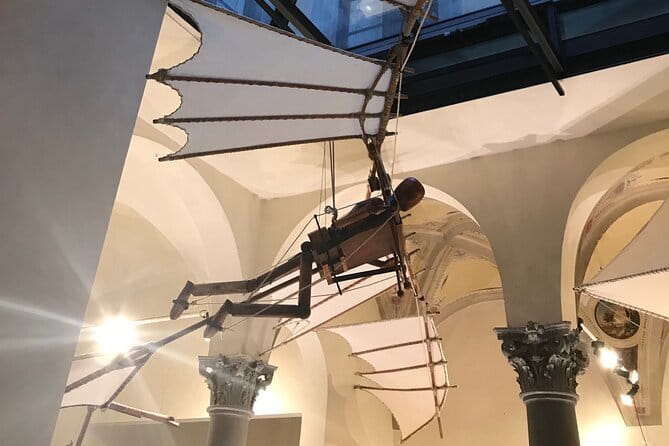
The second room presents flying machines. Leonardo’s attempts to understand flight are among his most familiar inventions, yet the models reveal more than a simple desire to copy birds. They show his interest in weight, balance, wings, and the movement of air.
You should not expect an aircraft museum or a modern science center here. Instead, the value comes from seeing the designs at a human scale and comparing them with the original concepts. The models let you ask which parts might work, which parts would fail, and how much testing would be needed to turn an idea into a working aircraft.
This room is especially useful for children who enjoy machines and construction. It also gives adults a quick lesson in the limits of technology during Leonardo’s lifetime. His imagination could move far ahead of the materials and power sources available to him.
More galleries and collections:
- Uffizi Gallery Small Group Tour with Guide
★ 4.5 · 4,923 reviews - Florence: Accademia Gallery Guided Tour
★ 4.6 · 4,156 reviews - Florence: Accademia Gallery Guided Tour with Entry Ticket
★ 4.6 · 2,253 reviews - Golf Cart Tour to Fiesole Roman Theatre and Museum
★ 4.5 · 2,039 reviews
War Machines: The More Surprising Side of Leonardo
The third room focuses on military machines. This can surprise visitors who know Leonardo mainly through portraiture and painting. His work included designs related to defense, weapons, and battlefield equipment, making this section a reminder that Renaissance artists often worked across several fields.
The military models are visually striking, but they also raise harder questions. Leonardo’s skills could serve art, anatomy, engineering, and warfare. The museum does not turn him into a single neat character. Instead, you see a man whose curiosity and talent could be directed toward very different needs.
This room may interest adults who want a wider view of Leonardo’s work. It also gives families something concrete to discuss, especially if children are fascinated by armor and machines. Some exhibits are interactive, but not every display is designed for touching, so you should follow the signs and staff instructions.
Anatomical Models: The Body as a Machine
The fourth room contains the newer collection of anatomical models. Leonardo’s study of the human body fits naturally beside his mechanical work. In both cases, he wanted to understand structure, movement, and function.
The anatomical models help connect his scientific curiosity with his drawings and observations. They also broaden the visit beyond gears and weapons. If you are mainly interested in art, this section may be one of the best reminders that Leonardo’s genius reached far beyond painting.
The information available does not suggest that this room contains original anatomical papers. Think of it as a presentation of models based on Leonardo’s studies, not a rare-document archive.
What the Working Replicas Add
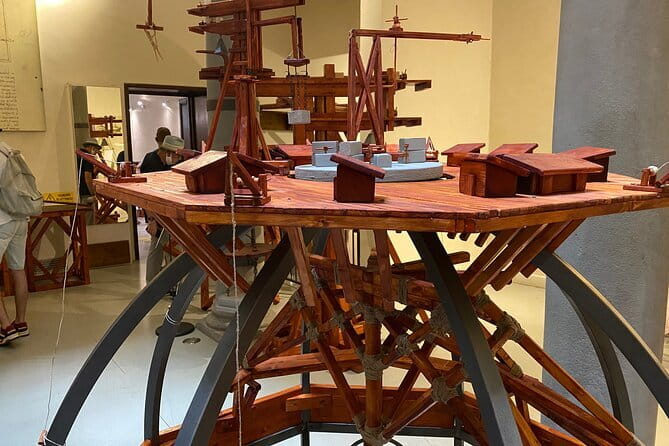
The museum’s strongest feature is its use of working replicas. Many models can be operated or examined in motion, though some displays are hands-off and some interactive elements may not always function perfectly.
That distinction matters. You are not looking at Leonardo’s original machines. You are looking at later models based on his drawings and ideas. Their purpose is educational: they show how a design might operate and make complicated principles easier to grasp.
I find this approach more useful than a room filled only with text panels. A child can turn a mechanism, test an idea, or study a moving part. An adult can spend time reading about the design and notice how much careful observation went into it. The experience becomes less about admiring a famous name and more about understanding a process.
The limits are just as important. The exhibits may feel like basic replicas if you expect rare objects or advanced technology. Some people will want more context about when each design was made, what influenced it, and whether it was ever built in Leonardo’s lifetime. The museum is strongest as a visual and interactive introduction, not as a final word on Leonardo scholarship.
A Short Film and a Useful Break
Large-screen monitors show a documentary about Leonardo’s life and work. This gives you a quick biographical frame before or after the machines. I would use it as a guide to the galleries rather than as a substitute for reading the exhibit material.
The gallery also has an arrangement with Caffé Michelangiolo, the restaurant inside the exhibition area. Food and drinks are not included with the ticket, but the option can be useful if you want a break without leaving the site. The bookshop carries publications and souvenirs, including gadgets. It is a sensible place to find a child-friendly follow-up to the visit, though not every item will be locally made.
One practical advantage is the cool indoor setting. A visit can provide a comfortable pause during a hot Florence day, particularly when you need an hour indoors but do not want another vast museum.
How Long Should You Allow?
Allow one hour for a brisk visit and up to 90 minutes if you read closely, watch the documentary, and spend time with the working displays. Families may need longer if children want to try the interactive elements or use the building area.
The compact length is one of the ticket’s best advantages. You can fit the museum into a busy Florence schedule instead of committing to a full morning. It also works well as a first stop, giving you a useful introduction to Renaissance invention before you visit other famous sights.
Do not confuse short with shallow in every case. The machines cover art, music, architecture, anatomy, civil engineering, and military design. Still, the museum cannot provide the depth of a major research institution in 60 to 90 minutes. You will get a lively overview, not a complete study of Leonardo’s life.
Is the $12.55 Ticket Good Value?
At about $12.55 per person, the ticket is reasonably priced for a central Florence attraction, especially if you use the full hour or more. The value is strongest for families, curious adults, and anyone who enjoys seeing ideas demonstrated rather than described.
The ticket also saves planning time. Prebooking is intended to help you bypass long lines, and admission is included. You do not need to pay extra for a guide, though the visit is self-guided and English is the stated language.
Value becomes less certain if your main goal is Leonardo’s art. This museum does not focus on paintings, and the displays are mostly replicas. If you expect originals, polished digital presentations, or a large collection, the price may feel high for the size of the exhibition.
The best way to judge the cost is to compare it with your interests. For a family looking for an educational stop with interactive features, it can be a good deal. For an adult seeking rare Renaissance objects, it is a more limited purchase.
Who Will Enjoy This Museum Most?

I would recommend this museum most strongly to families with school-age children, adults who like science and engineering, and visitors who want to see a different side of Leonardo. The hands-on elements give children something to do, while the models help adults understand the practical force behind his drawings.
It is also a good choice if you have limited time. The museum is small, central, and easy to pair with other Florence sights. People who enjoy learning by looking at mechanisms will probably get more from it than people who prefer paintings, original documents, or formal guided talks.
The experience may disappoint you if you want a major art collection. It may also feel light on historical detail if you expect a full account of Leonardo’s patrons, workshops, materials, and working methods. A short visit to the museum works best when you treat it as an introduction to his inventions.
The maximum group size is 20, but the visit itself is self-guided rather than a fixed group tour. That keeps the pace in your hands. You can move quickly, linger over one machine, or let children spend extra time with the interactive displays.
Practical Advice Before Buying
Check the city and museum name twice. Florence has a Leonardo museum, but other Italian cities also have museums devoted to him. Several low-rated experiences came from people buying a ticket for the wrong city and then being unable to obtain help or a refund. This is the single most important booking warning.
Save your confirmation and read the entry instructions before arriving. The attraction is near public transportation, and the stated opening hours run from 10:00 a.m. to 6:00 p.m. daily during the listed period.
Free cancellation is available if you cancel at least 24 hours before the experience start time. Cancellations made later, and changes made within that period, are not accepted for a refund. Cutoff times follow local time in Florence.
The museum is described as wheelchair friendly, and most people can participate. Food and drinks, hotel pickup, and hotel drop-off are not part of the ticket, so plan those separately.
Should You Book the Leonardo da Vinci Museum?
Book it if you want a compact, affordable, family-friendly look at Leonardo’s inventions. The working models, four-room layout, and central location make it easy to add to a Florence day. You can leave with a clearer idea of Leonardo as an engineer and investigator, not only as the painter of the Mona Lisa.
Skip it if you mainly want original art or rare historical objects. The displays are replicas, some are hands-off, and the museum can feel modest beside Florence’s major art institutions. For the right audience, though, $12.55 buys a pleasant hour of discovery and a welcome break from the city’s bigger crowds.
FAQ
Where is the Leonardo da Vinci Museum located?
It is located at the Galleria Michelangelo on a renowned street in central Florence, near public transportation and major tourist attractions.
What are the museum’s opening hours?
The stated hours are 10:00 a.m. to 6:00 p.m., Monday through Sunday, during the operating period listed from June 29, 2023, through February 16, 2027.
How long does a visit usually take?
The visit takes about one hour to one and a half hours, depending on how closely you read the displays and use the interactive exhibits.
What does the admission ticket include?
The ticket includes admission to the Leonardo da Vinci Museum.
Are food and drinks included?
No. Food and drinks are not included, although the gallery has an arrangement with Caffé Michelangiolo, the restaurant inside the exhibition area.
Is hotel pickup included?
No. Hotel pickup and drop-off are not included.
Is this a guided tour?
No. This is a self-guided museum visit. The experience is offered in English.
Are Leonardo’s original paintings displayed?
The museum focuses on models of Leonardo’s machines and inventions. Leonardo’s paintings, including the Mona Lisa, are not the focus of this attraction.
Can I cancel for a full refund?
Yes, if you cancel at least 24 hours before the experience start time. Cancellations made less than 24 hours before the start time are not refunded, and changes during that period are not accepted.
Just added around Florence
- Palazzo Vecchio guided experience with entrance ticket★ 4.5 · 249 reviews
- Lucca Bikes and Bites with food tastings for Small Groups or Private★ 5.0 · 249 reviews
- Perfume Masterclass in Florence: Make your Own Personal Fragrance★ 4.5 · 253 reviews
- Florence Oltrarno Neighborhood Food & Wine Dine Around★ 5.0 · 253 reviews
- Florence: Cathedral, Dome and Terraces Guided Tour★ 4.5 · 253 reviews
- Florence: 1.5-hour Santa Croce Guided Experience★ 4.8 · 254 reviews
- Florence: Pitti Palace and Palatina Gallery Ticket and Tour★ 4.9 · 255 reviews
- Private Florence Tour by Golf Cart ETukTuk with Audio Guide★ 4.0 · 256 reviews
Museums, compared.

Vatican: Museums & Sistine Chapel Entrance Ticket
Read our review →
Vatican Museums & Sistine Chapel Tour with Optional Basilica
Read our review →
Vatican Museums, Sistine Chapel & St Peter’s Basilica Guided Tour
Read our review →
Skip-The-Line Uffizi Gallery Timed Entry Ticket
Read our review →
Vatican Museums, Sistine Chapel & Basilica Tour
Read our review →
Vatican Museums & Sistine Chapel Skip-the-Line Entry Ticket
Read our review →Vatican Museums, Sistine Chapel & Basilica Tour
Read our review →
Vatican Museums & Sistine Chapel Guided Tour
Read our review →Browse the lists this tour appears in