
Review · WINE TOURS
Exclusive Golf Tour Private VIP with Local & Gelato o Wine
Rome makes you work for its treasures. This private electric golf cart tour helps. In about three hours, you move between fountains, forums, churches, hilltop views, and the Colosseum without spending the day on foot. I especially like the private format, which lets your guide adjust the route, and the Aventine hill stops, where Rome feels calmer and more personal. The gelato tasting at Gelateria La Romana is another smart touch.
The main limitation is time. Three hours gives you a fine introduction, but most stops are brief and the Colosseum, Roman Forum, and Pantheon are viewed from outside. You also need to hear the guide over Rome’s traffic, and one review points out that road noise made this difficult at times.
In This Review
- Five things to know before you book
- Why a golf cart works well in central Rome
- Trevi Fountain and the story behind its water
- Piazza Venezia and the Imperial Forums
- Theatre of Marcellus, Circus Maximus, and Constantine’s Arch
- Giardino degli Aranci and the quieter Aventine
- The Colosseum from the outside
- Campo Marzio and the changing face of Rome
- Santa Maria Maggiore and a final taste of Rome
- Guides, comfort, and the real pace
- Who gets the best value at $115.16?
- Should you book this Rome golf cart tour?
- FAQ
- How long does the private golf cart tour last?
- Is the Colosseum entrance ticket included?
- Is hotel pickup available?
- Is the tour suitable for wheelchair users?
- Is gelato included?
- Can I cancel for a full refund?
Five things to know before you book
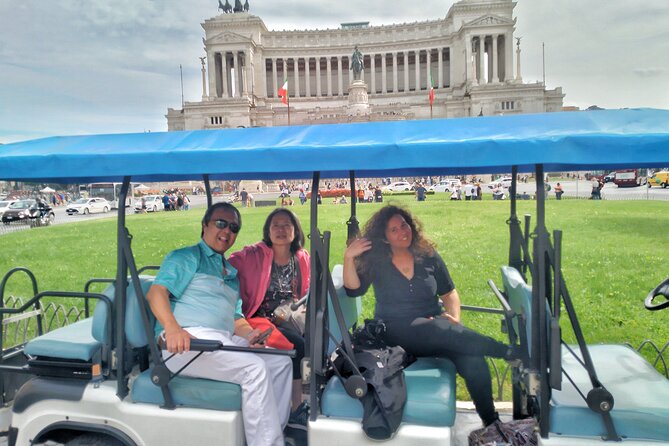
- Private electric golf cart: Your group rides alone with a local driver-guide, making it easier to ask questions and request small route changes.
- A fast Rome orientation: The route links Trevi Fountain, Piazza Venezia, the Imperial Forums, Circus Maximus, the Colosseum, Campo Marzio, and Santa Maria Maggiore.
- Aventine hill viewpoints: Giardino degli Aranci offers wide rooftop views, while the Aventine itself gives you a quieter side of central Rome.
- Gelato is included: The tasting at Gelateria La Romana dal 1947 features a traditional recipe and handcrafted gelato.
- Exterior sightseeing only: Admission to the Colosseum, Roman Forum, and Pantheon is not included, so this is a city overview rather than an archaeological-site tour.
- Pickup has limits: Hotel pickup and drop-off are available only from listed hotels inside the central restricted-traffic zone, and requests should be made at least 24 hours ahead.
Why a golf cart works well in central Rome

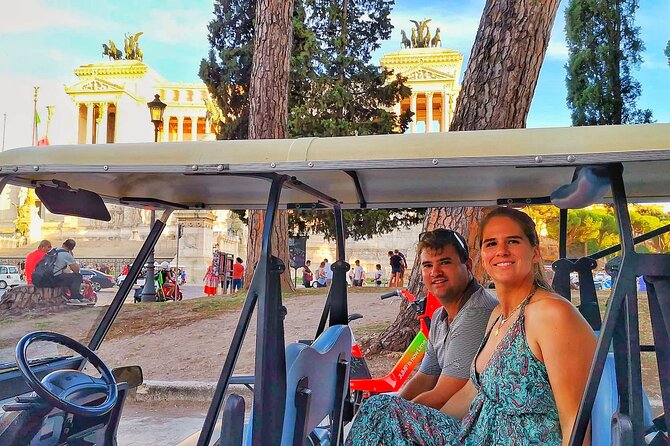
Rome’s historic center is compact on a map but tiring in real life. The streets twist, the pavement can be uneven, and major sights are separated by hills, traffic, and crowded sidewalks. A golf cart takes away much of that physical strain while keeping you close to the street.
You still see Rome at ground level. This is not a sealed coach with glass between you and the city. You hear traffic, see daily life, and pass through streets that larger vehicles cannot always use. The tradeoff is noise. Your guide does not use headphones or an audio system, so you may need to ask for a repeat when scooters or buses pass.
The private setup is important. You are not following a fixed group of strangers, and the guide can spend more time on the places that interest you. Several guides receive warm praise for their personal approach, including Cristian, Matteo, Alex, Christian, Stefano, Margarita, Mattia, and Robin. The exact guide depends on the date, but the consistent theme is clear: the best part of the tour is the human explanation along the way.
I would book this near the beginning of a Rome visit. It helps you understand where the major areas sit in relation to one another. You can then return to the Colosseum, Pantheon, fountains, or churches that deserve more time.
More Wine Tours in Rome
- Rome: Tuscany & Montepulciano Day Trip with Lunch & Wine Tasting
★ 4.5 · 5,232 reviews - Rome: Pasta & Tiramisu Class with Fine Wine by the Vatican
★ 4.9 · 4,852 reviews - Rome Food Tour: Unlimited Tastings with Fine Wine & Barolo
★ 5.0 · 3,365 reviews
Trevi Fountain and the story behind its water
The first major stop is Trevi Fountain, with about 20 minutes to look around and take photographs. The fountain marks the end of the Acqua Vergine aqueduct, one of the water systems that served ancient Rome and still supplies the fountain today.
The name Trevi refers to the meeting of three roads. The older water system was revived in 19 BC, and the traditional story says Roman technicians found the source with help from a young virgin. Your guide can give this setting a useful layer of context instead of leaving you with only a photo stop.
Twenty minutes is enough to admire the fountain, but not enough for a long pause if the square is packed. The tour does not include a dedicated wait for the best angle or a quiet period for lingering. Think of this as an introduction, then return independently if Trevi becomes one of your favorite places.
Piazza Venezia and the Imperial Forums
At Piazza Venezia, you see the Monument to Vittorio Emanuele II, including the Tomb of the Unknown Soldier. The huge white monument can feel almost theatrical, but it represents the creation of modern Italy and the country’s first king.
The route then follows Via dei Fori Imperiali toward the Colosseum. This straight avenue crosses or borders sections of the Forum of Trajan, Forum of Augustus, and Forum of Nerva. You can see ancient remains on both sides as the cart moves through the center of Rome.
This is one of the tour’s strongest stretches because it connects the ancient city in a simple visual line. You do not need to memorize every emperor or ruin. Instead, you begin to understand how the monumental center extends from Piazza Venezia toward the amphitheater.
The stop at Via dei Fori Imperiali lasts about 15 minutes. That is enough for orientation and pictures, though it is not a replacement for entering the Roman Forum. Admission to the Forum is not included, and the tour provides an outside view only.
Theatre of Marcellus, Circus Maximus, and Constantine’s Arch
The route also passes the Theatre of Marcellus, an ancient open-air theatre built near the end of the Roman Republic. Romans once came here for drama and song. Its surviving structure helps show how public entertainment was part of ordinary city life, not just a special event for emperors.
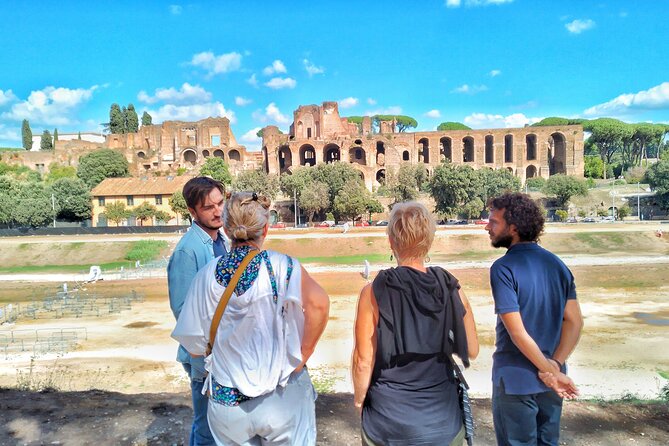
Next comes Circus Maximus, the enormous chariot-racing stadium between the Aventine and Palatine hills. It was the first and largest stadium of ancient Rome, built for mass entertainment. Today, the open space can be hard to picture as a roaring racecourse, which makes a good guide especially useful.
Near the Colosseum, you also see the Arch of Constantine. Rome invented the victory arch, and three major examples still survive in the city. Constantine’s arch is tied to the emperor who helped Christianity take control of the Roman world.
These passing stops are valuable because they broaden the tour beyond the usual postcard list. The limitation is that some are described as brief views rather than full visits. If you want to study the Theatre of Marcellus or Circus Maximus in detail, plan a separate walk.
More pizza and gelato sessions:
- Pompeii and Mount Vesuvius Day Trip from Rome with Pizza Lunch
★ 4.5 · 6,151 reviews - Cooking Class in the Heart of Rome: Pizza and Tiramisu Making
★ 5.0 · 1,330 reviews - Rome: Traditional Pizza Cooking Class near Piazza Navona
★ 4.7 · 1,241 reviews - Rome Highlights City Tour by Golf Cart with Gelato
★ 5.0 · 1,088 reviews
Giardino degli Aranci and the quieter Aventine
Giardino degli Aranci, the Garden of Oranges, is one of the most appealing pauses on the route. From the Aventine hill, you get a rooftop view across Rome. The stop lasts about 20 minutes, giving you time to slow down after the denser ancient-center sights.
I like this part because it changes the mood. Trevi and Piazza Venezia can feel crowded and intense. The Aventine feels more removed, with a pleasant walk and a broad view of the city below. You are still close to the center, but the experience is less frantic.
The itinerary also includes the wider Aventine area, described as one of Rome’s seven hills and an important center of Christian worship. It was once outside the main ancient city and remains a good place to escape the noise for a while.
Mobility matters here. The tour is listed as wheelchair friendly if you communicate that when booking, and a golf cart reduces the need to cover long distances. Still, you should confirm any specific mobility needs in advance because hilltop areas can involve walking and uneven surfaces.
The Colosseum from the outside
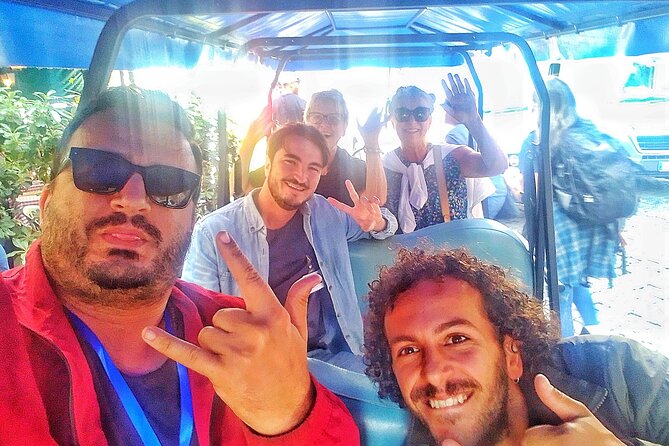
The Colosseum is the tour’s big visual payoff. You get about 15 minutes near Rome’s most famous amphitheater, also known by its proper name, the Flavian Amphitheatre. The guide explains the arena’s role in gladiatorial combat and imperial entertainment.
Fifteen minutes is enough to stand back, take photographs, and hear the main story. It is not enough to explore the underground passages, arena floor, upper levels, or exhibition areas because admission is not included.
This distinction matters when you compare the price with a Colosseum entry tour. At $115.16 per person, the experience pays for private transport, a local guide, hotel pickup when eligible, and a broad route through central Rome. It does not pay for archaeological-site entry. If stepping inside the Colosseum is your main goal, you need a separate ticket and more time.
The route also points out what is described as the first condominium in the world, dating from ancient Rome. That small detail helps you picture the city as a place where ordinary people lived in dense apartment blocks, not only a collection of palaces and temples.
Campo Marzio and the changing face of Rome
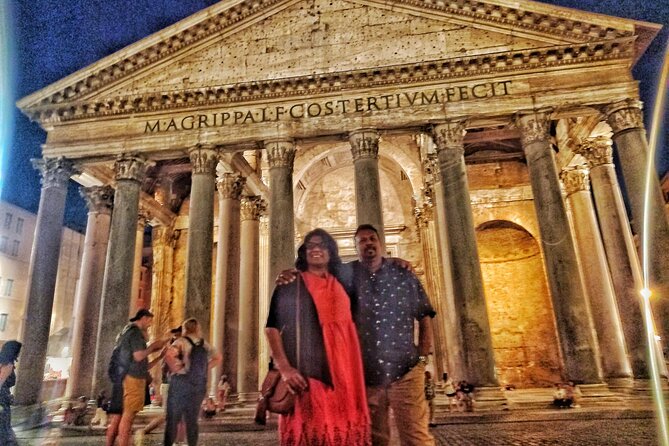
Piazza in Campo Marzio introduces you to Rome’s historic center, where ancient remains, Baroque squares, Renaissance palaces, and narrow lanes sit close together. The planned stop lasts about 20 minutes.
This part of the route is less about one famous monument and more about how Rome layers different periods in the same neighborhood. You may pass from an ancient foundation to a later church or palace within a short distance. A private guide can point out those changes as you go, which is much more useful than simply ticking off names.
The tour’s private nature is especially helpful here. If you have already seen the major fountains, your guide may be able to focus on streets or places you missed. Alex, Cristian, and Mattia are specifically praised for adapting the route or helping with restaurant suggestions. That kind of local help can make the tour useful beyond its scheduled stops.
Santa Maria Maggiore and a final taste of Rome
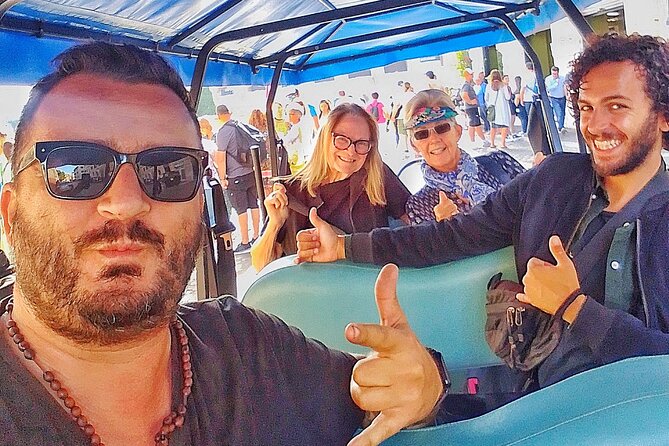
The Basilica di Santa Maria Maggiore is the final major sightseeing stop, with around 15 minutes inside. The church is known for its mosaics, ornate chapels, and the sacred relic associated with Christ’s crib.
A quarter hour gives you a quick look at the interior and its major features. If you care about church art, you may want to return on your own for a slower visit. The value here is that the basilica adds a religious and artistic dimension to a route otherwise heavy on ancient monuments.
The tour ends with gelato at Gelateria La Romana dal 1947. The tasting uses a recipe dating to 1947 and focuses on creamy, handcrafted gelato made with quality ingredients. This is more than a sweet bonus. After several hours of monuments and dates, a simple food stop makes the tour feel connected to present-day Italy.
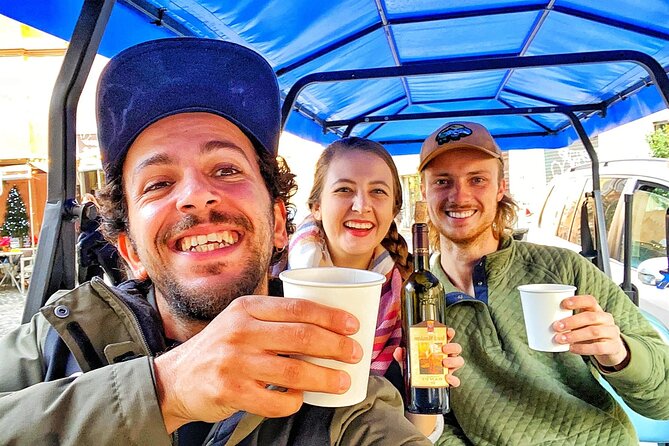
The title also refers to a local experience with gelato or wine, and one tour experience included a bottle of red wine. The supplied details specifically confirm the gelato tasting, so I would clarify the exact wine option before booking if that is important to you.
Guides, comfort, and the real pace
The strongest praise goes to the guides. Cristian is described as warm, funny, and good at finding less obvious corners. Matteo receives repeated approval for clear explanations and an easy manner. Alex is praised for tailoring the route, answering questions, and helping with restaurants. Christian handled rainy weather well and made the tour comfortable for a visitor recovering from a broken leg.
Those details tell you what to expect from the format. You are not simply driven past monuments. You can ask questions, request photo pauses, and discuss where to eat afterward. The guide can also make the ride feel safer and less tiring for an older family member or someone with limited mobility.
The ride itself is not silent. Traffic noise is the most important practical drawback. Since there are no headphones, sit close to the guide when possible and ask for a pause at a quieter spot if you miss an explanation. Morning, afternoon, and sunset departures are mentioned in the experiences, so timing can shape the feel of the ride. A sunset outing may offer softer light, while a daytime departure can help you get your bearings before independent sightseeing.
Pickup and drop-off are offered at listed hotels inside Rome’s restricted central traffic zone. Golf carts cannot go outside that area, and pickup requests must be made at least 24 hours before departure. If your accommodation is outside the approved list, you will need to reach the meeting point yourself.
Who gets the best value at $115.16?
At $115.16 per person, this is not the cheapest way to see Rome. It can be good value for a private group that wants comfort, local commentary, and a large number of sights in a short period.
The value improves if you are visiting Rome for the first time, have only a few days, or want to avoid a long walking route. It also makes sense for families, couples, and groups with mixed energy levels. A golf cart can help you see the city without asking everyone to march from one monument to the next.
The price is harder to justify if you prefer slow museum visits or already know the center well. You will spend only 10 to 20 minutes at many locations, and entry to the Colosseum and Roman Forum is extra. Independent sightseeing will cost less, though it will also require more planning, walking, and navigation.
The tour is offered in English, with guides also described as speaking Russian and Spanish. It is a private activity for your group only. Children under two are not accepted, and service animals are allowed.
Should you book this Rome golf cart tour?
Book it if you want a comfortable first look at Rome, especially near the start of your stay. The private guide, hilltop viewpoints, broad route, photo pauses, and gelato stop create a pleasant orientation with a personal feel.
Skip it if your priority is entering the Colosseum, Roman Forum, and Pantheon during the same outing. This is an outside sightseeing tour, not a detailed archaeological visit. Also think carefully about traffic noise, brief stops, weather, and the pickup-zone restriction.
For the best experience, tell the operator about mobility needs when booking, request pickup at least 24 hours ahead, and treat the tour as a map for the rest of your visit. Let Cristian, Matteo, Alex, or whoever guides you point out where to return. Then spend your next few days exploring Rome at the slower pace its stones deserve.
FAQ
How long does the private golf cart tour last?
The experience lasts approximately three hours.
Is the Colosseum entrance ticket included?
No. The Colosseum, Roman Forum, and Pantheon are seen from outside, and admission is not included.
Is hotel pickup available?
Hotel pickup and drop-off are available from listed hotels inside Rome’s restricted central traffic zone. Pickup requests should be made at least 24 hours before the tour.
Is the tour suitable for wheelchair users?
The experience is listed as wheelchair friendly when mobility needs are communicated at booking.
Is gelato included?
Yes. The tour includes a tasting at Gelateria La Romana dal 1947, featuring handcrafted gelato made with a traditional 1947 recipe.
Can I cancel for a full refund?
Yes, if you cancel at least 24 hours before the experience start time. Poor weather or failure to meet the minimum number of participants may result in a different date or a full refund.
More Vineyard Visits and Tastings
- Rome: Pasta Making Class with Wine, Limoncello, and Dessert
★ 4.9 · 3,177 reviews - Rome: Trastevere Food tour with Free-Flowing Fine Wine
★ 5.0 · 2,853 reviews - Learn to Make Pasta & Tiramisu with Wine and Limoncello Included
★ 5.0 · 2,345 reviews - Rome: Award Winning Trastevere Group Food Tour with Wine
★ 5.0 · 2,273 reviews
Just added around Rome
- Rome City, Pantheon, and Trevi Fountain Walking Tour★ 5.0 · 249 reviews
- Rome: Skip the line Vatican Museums & Sistine Chapel Tour★ 4.2 · 251 reviews
- Rome: Tivoli Day Trip with Villa d’Este and Villa Adriana★ 4.5 · 251 reviews
- Transfer Rome center – Ciampino Airport★ 4.5 · 251 reviews
- Rome: Cannondale E-Bike Evening Tour with Optional Dinner★ 4.9 · 251 reviews
- VIP Colosseum, Roman Forum & Palatine Hill & Special Access Sites★ 4.5 · 252 reviews
- Private Vatican Museums Hidden Gems Tour with Optional Pick-Up★ 5.0 · 253 reviews
- Vatican Museums & Sistine Chapel Skip-the-Line Guided Tour★ 4.6 · 254 reviews
Wine Tours, compared.
Tuscany Day Trip from Florence: Siena, San Gimignano, Pisa and Lunch at a Winery
Read our review →
Small-Group Wine Tasting Experience in the Tuscan Countryside
Read our review →
Pasta & Tiramisu Cooking Class with Unlimited Wine
Read our review →
Pisa, Siena and San Gimignano Day Trip with Lunch & Wine Pairing
Read our review →
Tuscany & Montepulciano Day Trip with Lunch & Wine Tasting
Read our review →Browse the lists this tour appears in