
Review · WALKING TOURS
Discover the Charm of Palermo: A 3-Hour UNESCO Sites Walking Tour
Palermo reveals its secrets on foot. This three-hour walk links baroque and Norman-Arabic landmarks with markets, churches, fountains, and lively streets, giving you a useful first look at the Sicilian capital. I especially like the mix of grand monuments and everyday Palermo, plus the included cannolo or granita at the end. The main drawback is that most monuments are viewed from outside, and the Palatine Chapel is not included in the visit.
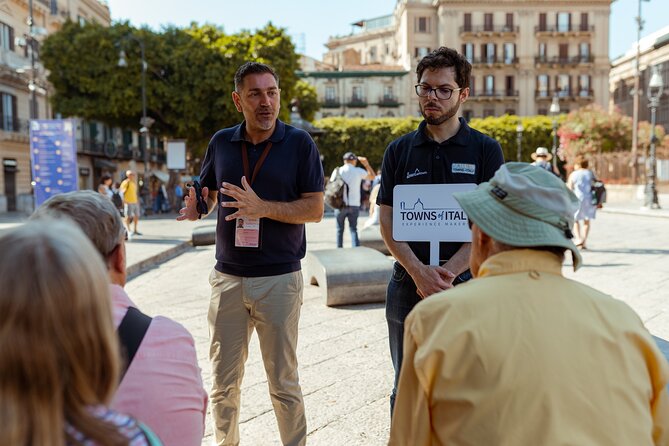
It is a fast-moving introduction rather than a slow, detailed study of every church. Guides such as Valeria, Renata, Fabio, Laura, and Giada have been praised for clear English, local stories, food advice, and warm conversation. Plan this tour early in your stay, wear good walking shoes, and leave time afterward to return to the places that catch your eye.
In This Review
- Key points to know before you book
- Why this walk works best on your first day
- Teatro Massimo begins the story with scale
- Via Maqueda and the Galleria delle Vittorie
- San Domenico and Palermo’s public memory
- Markets, Garraffo Fountain, and Palermo’s working center
- Santa Maria dell’Ammiraglio and the layered city
- Piazza Pretoria and Quattro Canti
- Palermo Cathedral brings the Norman story inside
- Villa Bonanno and the Norman Palace finish
- The included Sicilian treat is a smart finish
- Pace, group size, weather, and practical value
- Should you book this Palermo walking tour?
- FAQ
- How long does the Palermo UNESCO walking tour last?
- Where does the tour begin?
- Where does the tour end?
- Is the tour offered in English?
- Is Palermo Cathedral admission included?
- Can I enter the Palatine Chapel during the tour?
- Is food included?
- Are hotel pickup and drop-off included?
- What is the maximum group size?
- Can I cancel for a full refund?
Key points to know before you book
- Palermo in three hours: Cover Teatro Massimo, markets, churches, Quattro Canti, the Cathedral, Villa Bonanno, and the Norman Palace in one compact route.
- Cathedral entry included: You go inside Palermo Cathedral, while the Royal Palace and Palatine Chapel are viewed from outside on this experience.
- A real taste of the city: The walk crosses open-air markets, where street food, narrow lanes, and daily life provide a break from formal sightseeing.
- Strong local guiding: Guides including Valeria, Renata, Fabio, Debbie, and Giada have been praised for history, personal insight, and restaurant tips.
- Small enough to manage: The group is capped at 20 people, with confirmation at booking and a mobile ticket.
- Good value at $31.88: The price includes the guide, Cathedral admission, and a Sicilian cannolo or granita, but not hotel transport.
Why this walk works best on your first day
Palermo can feel like several cities placed on top of one another. Greek, Roman, Arab, Norman, Spanish, and Italian influences appear in the streets, churches, courtyards, and public squares. Without some orientation, it is easy to admire the buildings without understanding why they look so different from one block to the next.
This tour gives you that framework in about three hours. You move from Teatro Massimo and Via Maqueda toward markets and churches, then continue through the historic center to the Cathedral and the Norman Palace. It is a useful way to mark places on your mental map before returning independently.
I would book it near the start of your Palermo stay. Several guides, including Fabio and Lara, have been praised for offering practical suggestions about food and places to revisit. Giada has also been noted for adjusting the walk to hot conditions by keeping the group in the shade when possible.
The pace is brisk. That helps the tour cover a lot of ground, but it may not suit you if you walk slowly or want long stretches for photography. Rest stops are built into the route, yet this is still a city walk, not a gentle stroll around one square.
More Walking Tours in Palermo
- Palermo: NO Mafia Walking Tour
★ 4.8 · 2,431 reviews - Palermo Original Street Food Walking Tour by Streaty
★ 5.0 · 2,105 reviews - Palermo: Street Food and History Walking Tour
★ 4.9 · 1,294 reviews
Teatro Massimo begins the story with scale
The meeting point is at Via Volturno 44, close to Teatro Massimo. The opera house receives a short stop of about five minutes, with no admission included or needed for this exterior visit.
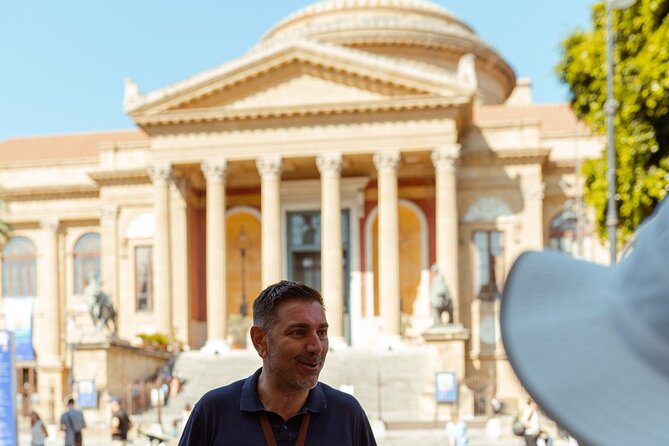
Teatro Massimo Vittorio Emanuele is Italy’s largest opera house and one of Europe’s largest. It is famous for its acoustics and its grand position on Piazza Verdi. Even if you do not attend a performance, the building makes a strong opening image: huge, formal, and built to announce Palermo’s cultural ambitions.
The guide uses the theater to place modern Palermo in context before leading you into the older center. You should not expect an interior tour here. The value is the explanation and the chance to see one of the city’s best-known façades without spending extra time inside.
Via Maqueda and the Galleria delle Vittorie
From the theater, the route heads into central Palermo and passes the Galleria delle Vittorie. This five-story commercial mall once represented a more polished side of city life, but decades of neglect have left it deteriorated, despite restoration efforts.
That contrast is useful. Palermo’s beauty is not limited to freshly restored monuments. You will also see worn façades, unfinished corners, and buildings that carry the marks of changing fortunes. The gallery gives the guide an opening to discuss the city beyond postcard scenes.
The walk crosses Via Bandiera, where an open-air market adds noise, color, and movement. This is one of the stronger parts of the route for anyone who wants to see ordinary street life alongside famous architecture. Keep your camera ready, but do not expect time for serious shopping. The group needs to keep moving.
San Domenico and Palermo’s public memory
Chiesa di San Domenico receives about ten minutes from the outside. Its church and square are among the most important stops in central Palermo, second in scale and importance only to the Cathedral in the city’s religious landscape.
San Domenico is also known as a Sicilian pantheon because important figures are buried there. The church has a special place in modern Palermo as a symbol connected with the fight against the Mafia. That gives the stop more weight than a quick architectural photo.
This is where a good guide matters. The building alone cannot explain the relationship between religion, public memory, and anti-Mafia feeling in Sicily. Guides such as Peter and Renata have been praised for connecting major events with the city’s present-day identity.
More guided walks:
- Palermo No Mafia walking tour: discover the Anti-mafia culture in Sicily
★ 5.0 · 1,011 reviews - Palermo: Private Custom Walking Tour with Local Guide
★ 4.7 · 661 reviews - Palermo: Street Food Walking Tour with Local Guide & Tasting
★ 4.9 · 632 reviews - Palermo Walking Tour and Street Food
★ 5.0 · 617 reviews
Markets, Garraffo Fountain, and Palermo’s working center
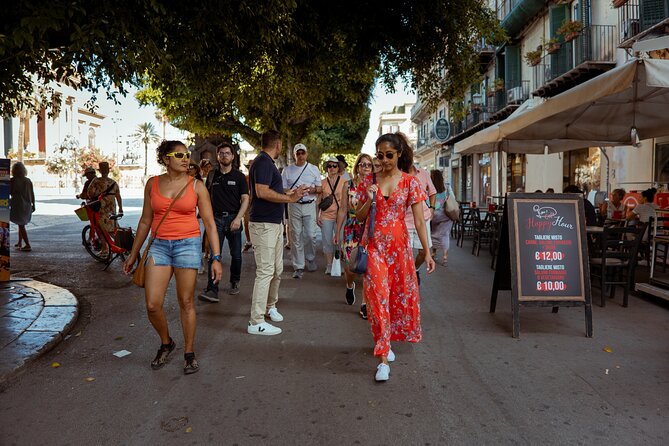
The walk continues through the market around Piazza Caracciolo. This area winds through alleys and nearby streets and is tied to the old name la Bucceria, from the French word for a butcher’s shop. Meat was once the market’s main trade, though today the district reflects a wider food culture.
You get only a short look, so treat this as an introduction rather than a market visit. If you spot a place you want to try, make a note and return later. One of the most useful features of the tour is that it shows you where you may want to spend more time on your own.
The route also reaches the Garraffo Fountain, a baroque fountain in Piazza Marina. Public fountains like this help explain how Palermo’s squares were designed as social spaces, not just traffic points. The setting connects the old Cassaro, now Via Vittorio Emanuele, with the historic center’s public life.
You also pass the former Palermo Stock Exchange. It was active from 1845 until 1997 and was once the most important exchange in Sicily. Its story adds an economic layer to the tour, showing that Palermo was not only a religious and political center but also a place of trade and finance.
Santa Maria dell’Ammiraglio and the layered city
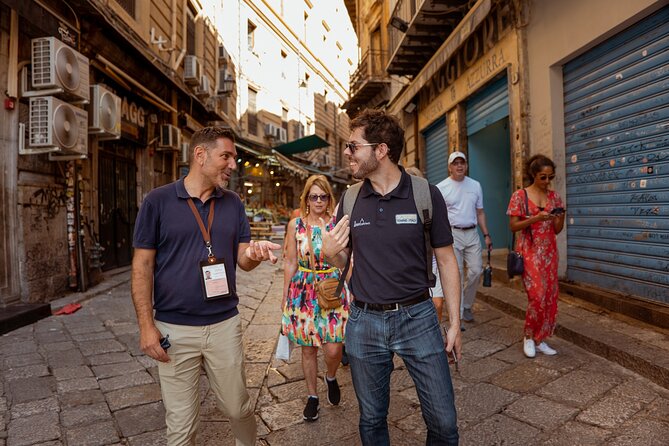
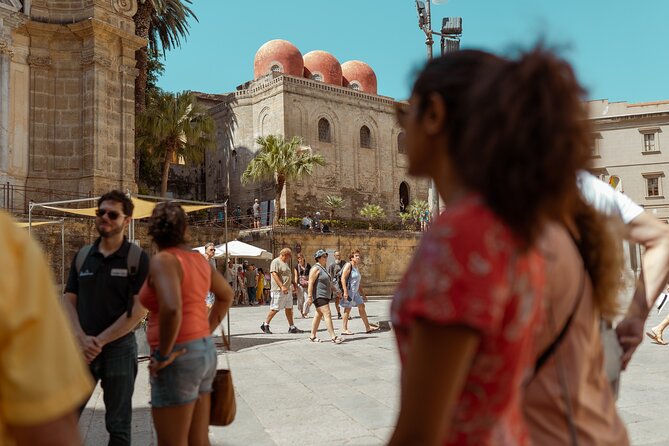
One of the most rewarding exterior views comes at Piazza Bellini, where Santa Maria dell’Ammiraglio is also called La Martorana. The church was built between 1143 and 1185 by the Greek admiral George of Antioch, who dedicated it to the Virgin Mary.
Its identity reflects Palermo’s mixture of cultures. Greek-Byzantine worship continues there, with ceremonies held in ancient Greek or Albanian through the Italo-Albanian Catholic Church. Even from outside, the church helps you understand that Palermo’s history is not a simple handoff from one ruling group to another.
The route passes along the descent of the Judges, linking Piazza Sant’Anna and Piazza Bellini. The street name recalls judges of the old Praetorian Court, who once lived in the nearby monastery of Santa Caterina. Small streets like this are where the walking format earns its keep. A bus could take you near the big monuments, but not through these historical connections.
Piazza Pretoria and Quattro Canti
Piazza Pretoria gets about 20 minutes. Its centerpiece is the large fountain created by Florentine sculptor Francesco Camilliani for a garden in Florence before being moved to Palermo. The square once held a garden belonging to the nuns of San Domenico al Maglio, and later gained the Palazzo di San Clemente.
The fountain is crowded with sculpted figures and is one of Palermo’s most striking baroque spaces. It also has a long-standing reputation for being unusually exposed and theatrical. Your guide can explain how the square developed and why this imported Florentine work became part of Palermo’s civic identity.
Next comes Quattro Canti, officially Piazza Vigliena. Four buildings frame the intersection, with construction beginning in 1608 and decorative work completed in 1663. The four façades were designed as a kind of urban stage, marking the meeting point of Palermo’s ancient quarters.
Allow yourself time to look upward. The statues, columns, and curved façades are easy to miss when traffic, pedestrians, and your group compete for attention. Twenty minutes here is enough for an explanation and photos, but not for a careful architectural study.
Palermo Cathedral brings the Norman story inside
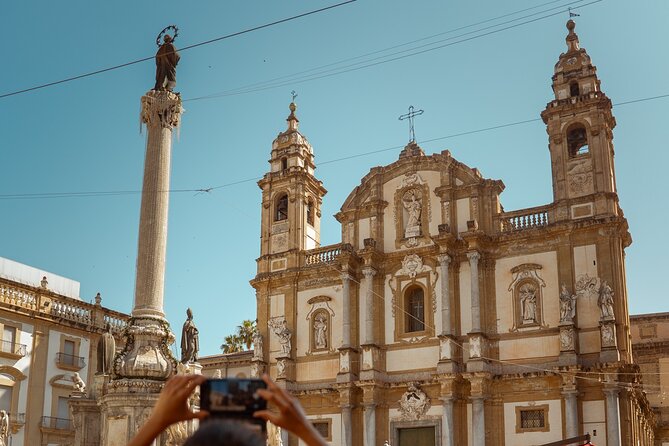
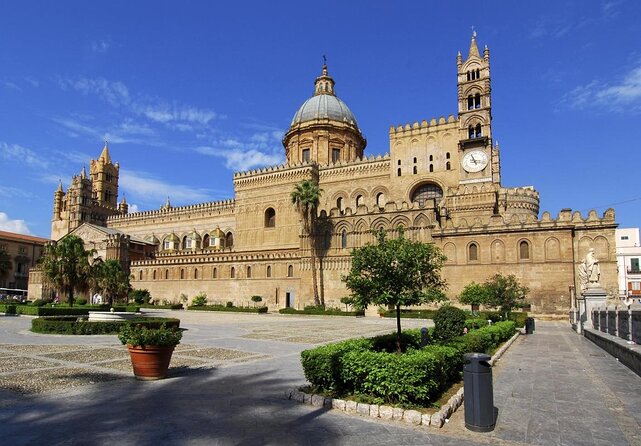
The Cathedral receives about 30 minutes, and entry is included. This is an important distinction because much of the tour’s monument viewing happens outdoors.
The Cathedral was built by the Normans in 1184 on a site that had previously held a Muslim mosque over an earlier Christian basilica. Its appearance changed over the centuries, so you see Gothic, medieval, Arab-influenced, and neoclassical elements together. A passage from the Koran remains engraved on one of the columns, a small but memorable sign of the city’s layered past.
The building was also intended to surpass the Cathedral of Monreale, which explains its scale and ambition. Palermo and Monreale competed through architecture, and that rivalry helps make sense of the oversized forms and elaborate decoration.
Thirty minutes is enough for a guided introduction, but do not confuse it with a full visit. If you want to study the chapels, tombs, roof, or treasury at length, return later. The included admission gives you a valuable first look without requiring a separate ticket decision.
Villa Bonanno and the Norman Palace finish
Villa Bonanno is a palm-filled public garden created in 1905 by mayor Bonanno. The stop lasts about ten minutes and includes views of statues and busts of notable people from Palermo.
Roman patrician houses with mosaics were found here, including mosaics of the seasons and Orpheus. Those pieces are now in the National Archaeological Museum, so you will not see them in place during this tour. The garden is still a helpful pause after the dense streets and formal squares.
The final major stop is Palazzo dei Normanni, also called the Royal Palace. It records Palermo’s long political history, from early Punic settlement through later periods of rule. The Palatine Chapel inside is the star attraction, with sumptuous mosaics that form one of the clearest examples of Arab-Norman art in Sicily.
Here is the key limitation: the tour explains the palace and Palatine Chapel from outside, but admission is not included. The tour description highlights the chapel and its UNESCO status, yet you should not book this experience expecting to walk inside and study the mosaics.
That may be disappointing if the chapel is your main reason for visiting Palermo. The upside is that the guide helps you understand what you are seeing and where to return. Check the palace’s opening arrangements separately if you plan an independent visit.
The included Sicilian treat is a smart finish
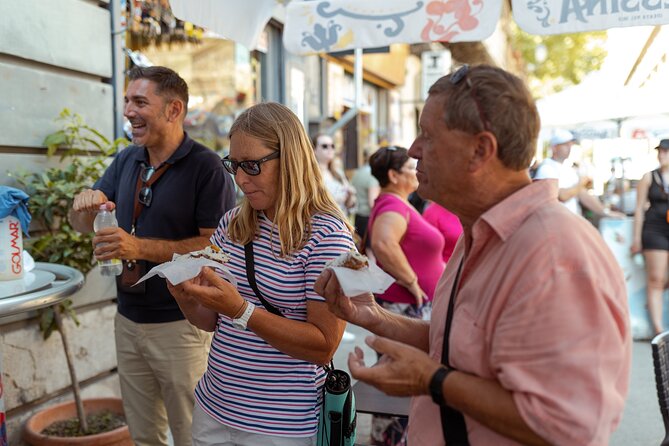
The tour includes a typical Sicilian cannolo or granita. That small food stop adds more than a sweet ending. Palermo’s food culture is part of its identity, and tasting something local helps connect the market streets with the city’s daily habits.
A cannolo is the richer choice, while a granita may feel better on a hot day. Some guides have recommended enjoying a cannolo or lemon granita in the courtyard at La Dolceria di Santa Caterina. The exact treat or location may depend on the departure, so think of it as a pleasant included taste rather than a full food tour.
Coffee stops and pastry suggestions have also been part of the experience for some groups. Do not expect lunch, but do use the guide’s food advice to plan your next meal.
Pace, group size, weather, and practical value
At $31.88 per person, the tour offers solid value if you want a guide, Cathedral entry, and a snack in one package. You are paying mainly for orientation and interpretation, not for a long list of interior admissions.
The group can include up to 20 people. That is large enough to create a little street-management work, but small enough for a guide to answer questions. Some departures have been much smaller, even private in feel, while others may reach the stated limit.
The walk operates in all weather. Palermo’s sun can be intense, and rain can make stone streets slippery, so wear supportive shoes and bring weather protection. One group completed the route in cold rain and still found it worthwhile, but conditions will affect your comfort.
There is no hotel pickup or drop-off. You meet at Via Volturno 44 and return to the same meeting point. The route is near public transportation, but the supplied information does not specify a transfer service.
Most people can take part, and service animals are allowed. Pets are not permitted. If you have limited mobility or another special need, contact the provider in advance so the team can try to help.
Free cancellation is available up to 24 hours before the start time. Changes or cancellations inside that window are not accepted for a refund.
Should you book this Palermo walking tour?
Book it if you want a strong first orientation, enjoy history told through streets and buildings, and can maintain a steady walking pace. It is especially useful for a first morning in Palermo, when you want restaurant ideas, neighborhood guidance, and a clear plan for the next few days.
Skip it if your top priority is spending long periods inside the Palatine Chapel, shopping through markets, or examining each monument at leisure. You will see many highlights, but the tour moves quickly and several major sites are exterior stops.
For most people, the best plan is simple: take this walk early, listen for the places you want to revisit, then return independently to the Cathedral, markets, or Norman Palace. The cannolo or granita is a nice bonus. The real value is leaving with a map in your head and a better sense of why Palermo looks, sounds, and tastes the way it does.
FAQ
How long does the Palermo UNESCO walking tour last?
The tour lasts approximately three hours.
Where does the tour begin?
It begins at Via Volturno 44, 90138 Palermo, Italy.
Where does the tour end?
The experience ends back at the meeting point.
Is the tour offered in English?
Yes. It is offered in English with a licensed English-speaking guide.
Is Palermo Cathedral admission included?
Yes. Entrance to Palermo Cathedral is included.
Can I enter the Palatine Chapel during the tour?
No. The Palatine Chapel and Royal Palace are viewed from outside, and admission to the Palazzo dei Normanni is not included.
Is food included?
Yes. The tour includes a typical Sicilian cannolo or granita.
Are hotel pickup and drop-off included?
No. Hotel pickup and drop-off are not included.
What is the maximum group size?
The tour has a maximum of 20 participants.
Can I cancel for a full refund?
Yes, if you cancel at least 24 hours before the experience start time. Cancellations or changes made less than 24 hours before the start time are not refunded.
More 3-Hour Experiences
- Discover Palermo in 3 hours. Art, history, markets and street food
★ 5.0 · 352 reviews - Eat Like a Local: Venice 3-Hour Small-Group Food Tasting Tour
★ 5.0 · 3,137 reviews - Jewish Ghetto and Synagogues with Jewish Roman Guide 3 Hours
★ 5.0 · 907 reviews - Naples: The Holy Mile 3-Hour Guided Tour
★ 4.9 · 711 reviews
Just added around Palermo
- Palermo Sicilian Street Food Tour: Small Group with a Local★ 4.8 · 259 reviews
- Palermo, tour tra monumenti unici e mercati colorati★ 4.9 · 271 reviews
- Sicilian Cooking Class★ 5.0 · 289 reviews
- From Palermo: Villa Romana and Valley of the Temples Trip★ 4.6 · 294 reviews
- Palermo: Norman Palace and Palatine Chapel Tour with Tickets★ 4.7 · 298 reviews
- Discover Palermo in 3 hours. Art, history, markets and street food★ 5.0 · 352 reviews
- Palermo: Guided City Walking Tour w/Customizable Itinerary★ 4.6 · 390 reviews
- Mondello,CapoGallo Reserve Boat Tour with Snacks and Drinks★ 4.9 · 439 reviews
Walking Tours, compared.

Guided Walking Tour & Last Supper Visit with Ticket
Read our review →
Rialto Bridge & Offbeat Unusual Venice Walking Tour
Read our review →

Private 3 hrs Venice Tour: St Mark’s, Walking tour & Boat tour
Read our review →

Skip the line: Uffizi and Accademia Small Group Walking Tour
Read our review →Browse the lists this tour appears in