
Review · COLOSSEUM & ROMAN FORUM TOURS
Ancient Rome Guided Tour: Colosseum, Forum and Palatine & Pick Up
Ancient Rome comes alive on foot. This half-day tour links the Colosseum, Roman Forum, and Palatine Hill, giving you Rome’s essential ruins in one organized visit. I especially like the included transportation and the wireless headsets, which make a crowded archaeological site easier to follow.
I also like the panoramic views from Palatine Hill and the way a good guide can connect the ruins to everyday Roman life. Guides such as Rita, Nicoletta, Roger, Alessa, and Marcello have earned especially warm praise for clear storytelling and thoughtful pacing. The main caution is that the experience depends heavily on your guide, and pickup can require a surprisingly early wait in your hotel lobby.
In This Review
- Key points to know before booking
- What this Rome tour covers
- Pickup from your hotel, with one important catch
- Starting high on Palatine Hill
- Following the Sacred Way through ancient Rome
- Entering the Colosseum for about an hour
- Seeing the Roman Forum as a working city
- The guide matters more than the script
- Heat, cobblestones, and the real physical demand
- Is $98.86 a fair price?
- Who should book this experience?
- Final verdict: a strong introduction with practical caveats
- FAQ
- How long does the Ancient Rome Guided Tour last?
- Which sights are included?
- Is admission included?
- Is hotel pickup included?
- How early should I be ready for pickup?
- Where do I meet the tour if my hotel is not covered?
- Is transportation provided after the tour?
- What identification must I bring?
- Can a person with a pacemaker join the tour?
- Is the tour suitable for people with limited mobility?
Key points to know before booking
- Three major ancient sites in about three and a half hours: You see Palatine Hill, the Colosseum, and the Roman Forum in one focused morning or afternoon.
- Hotel pickup saves effort: Central hotel pickup is offered, but you may need to be ready 45 minutes before departure, or 60 minutes for some non-central hotels.
- A walking tour over rough ground: Expect cobblestones, marble slabs, uneven paths, steps, sun, and very little shade in places.
- Guides can make the difference: Strong guides have used humor, historic images, water breaks, shade stops, and clear directions to keep the visit engaging.
- Bring official photo identification: Your passport or ID card is mandatory, and the name supplied at booking should match it closely.
- Small enough to feel manageable: The group can reach 20 people, with wireless audio headsets included.
What this Rome tour covers
This is a guided visit to the core of ancient Rome, lasting about 3 hours and 30 minutes. The entrance ticket covers the Colosseum, Roman Forum, and Palatine Hill, and transportation is included as part of the pickup service.
At $98.86 per person, the price is not simply the cost of admission. The Colosseum ticket is valued at €18, with a €2 reservation fee, while the rest pays for the guide, transportation, tour organization, and audio equipment. I consider that reasonable if you want a structured introduction and do not want to work out the complicated entry arrangements yourself.
You are paying for convenience and interpretation, not just access to ruins. If you already know ancient Roman history and prefer to wander at your own pace, the price may feel high. If this is your first visit, a good guide can help you understand what you are looking at instead of seeing a field of broken columns and half-buried stones.
The tour is offered in English, though the company notes that a guide may operate in more than one language. Ask for clear details at booking if your group needs a fully English-language presentation.
More ways into the Colosseum and Forum:
- Colosseum, Roman Forum & Palatine Guided Tour
★ 4.7 · 63,148 reviews - Rome: Colosseum, Palatine Hill and Roman Forum Guided Tour
★ 4.8 · 32,814 reviews - Rome: Guided Tour of Colosseum, Roman Forum & Palatine Hill
★ 4.7 · 27,897 reviews
Pickup from your hotel, with one important catch
Hotel pickup is useful in Rome, where the Colosseum area can be reached easily by public transportation but still feels confusing on a first visit. You are asked to be in the hotel lobby 45 minutes before departure. For some hotels outside the central area, the instruction is 60 minutes early.
That advance time is the part you need to understand. Pickup is not a quick taxi-style collection at the advertised tour time. The vehicle may arrive well before the walking portion begins, and one customer reported waiting until the planned pickup time had passed. Another person misunderstood the timing and missed the vehicle, then had to pay for a taxi.
Confirm the pickup time and hotel coverage before the day of the tour. If your hotel is not covered, the alternative meeting point is inside Colle Oppio Park, at Via delle Terme di Tito near the corner of Via Nicola Salvi. This location is close to the Colosseum, but you are responsible for getting there yourself.
Transportation is included, but the condition of the vehicle may vary. One report described a dirty van, so I would treat the pickup as a practical service rather than a luxury transfer. The key benefit is reducing the stress of finding the right entrance and meeting place.
There is no drop-off at the end. Plan your next stop from the Colosseum area, or ask your guide for directions before the group breaks up.
Starting high on Palatine Hill
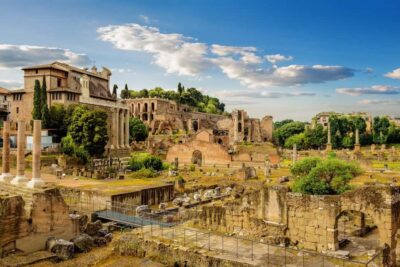
Palatine Hill is usually the first major stop, and it is a smart place to begin. Rising about 40 metres above the Roman Forum, it gives you a broad view over the ruins below and toward the Circus Maximus on the opposite side.
This hill is tied to Rome’s earliest traditions and later became the preferred address of emperors. From the time of Augustus, imperial residences were built here. The word palace itself is linked to Palatine, so you are walking through the setting that gave the world that familiar term.
The best guides use this stop to explain how Rome grew from a settlement on its hills into an imperial capital. You can look down into the Forum and begin to understand its layout before walking among the individual ruins.
The views are one of the tour’s strongest rewards. They help you see the Forum as a connected civic center, not a random collection of walls. You may also get good views toward the Circus Maximus, the long valley once used for chariot racing and public events.
There are drawbacks. Palatine Hill is not a polished garden path. You should expect uneven surfaces, steps, and uphill walking. In hot weather, the combination of stone, open ground, and limited shade can be tiring. Guides who stop in shaded areas and schedule water breaks are especially helpful here.
The stated itinerary gives this stop only a very short time, but the broader archaeological visit includes the hill as part of the guided area. Exact pacing can change according to entrance procedures, crowds, weather, and the guide’s route.
Following the Sacred Way through ancient Rome
The Via Sacra, or Sacred Road, was the principal street of ancient Rome. It ran through the Forum and connected important religious sites, eventually leading toward the Colosseum.
Walking this route gives the ruins a sense of movement. Ancient Romans did not experience the Forum as a quiet archaeological park. They crossed it for political business, religious ceremonies, legal matters, trade, public announcements, and military celebrations.
The tour also introduces the Roman triumph, a public ceremony honoring a victorious commander. A triumph was not just a parade. It was a civic and religious event that presented military success as a service to the Roman state.
This is where the guide’s storytelling matters most. Bricks and columns are hard to read without context, but the Sacred Way provides a natural thread through the site. A good explanation can show how temples, roads, arches, and government buildings worked together.
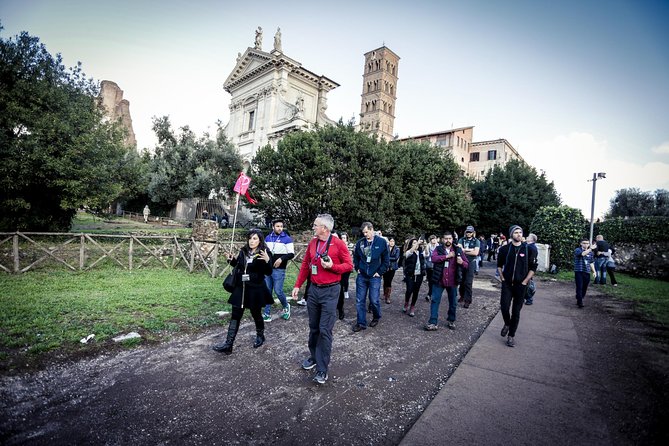
Do not expect every stop to be a long, quiet lecture. This is a moving tour in an exposed archaeological zone. You may pause for explanations, then walk again while other groups pass nearby. Stay close to your guide and listen through the wireless headset.
A few more reviews worth comparing before you book
- Vatican: Museums & Sistine Chapel Entrance Ticket
★ 4.5 · 144,003 reviews - Vatican Museums & Sistine Chapel Tour with Optional Basilica
★ 4.3 · 67,413 reviews - Vatican Museums, Sistine Chapel & St Peter’s Basilica Guided Tour
★ 4.5 · 39,149 reviews - Rome: Colosseum & Forum with Audio Guide App -Optional Arena
★ 4.2 · 24,770 reviews
Entering the Colosseum for about an hour
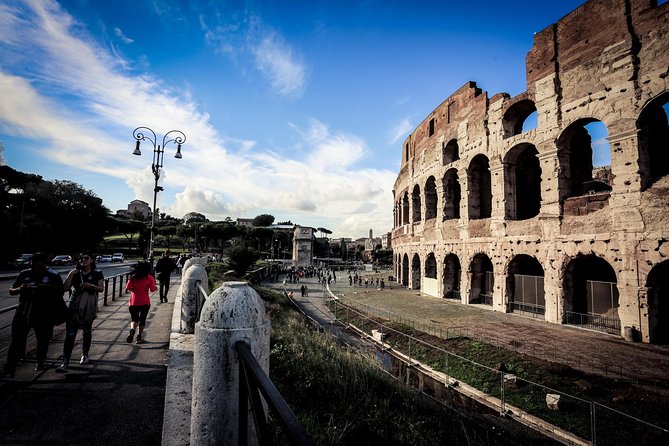
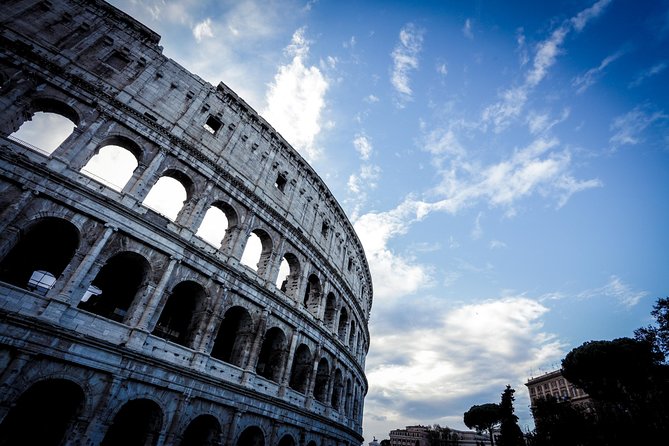
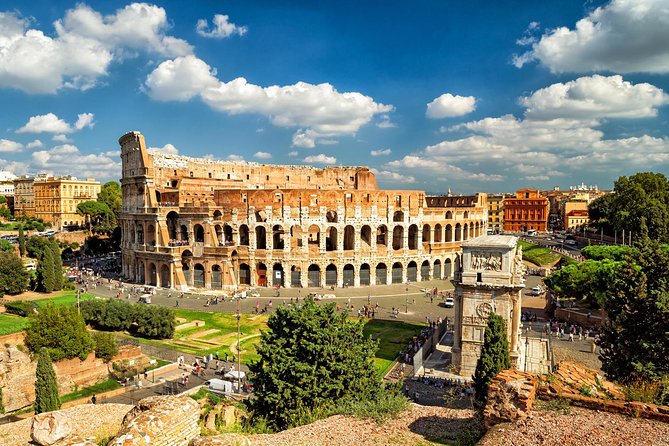
The Colosseum is the visual centerpiece, and the tour allows about an hour here. Built from travertine, tuff, and brick-faced concrete, it remains the largest amphitheatre ever built.
Its scale is easy to underestimate in photographs. Once inside, you can see how the oval design organized huge crowds and how the seating tiers shaped the experience. The surviving structure also makes clear that this was a carefully engineered public building, not merely a dramatic arena.
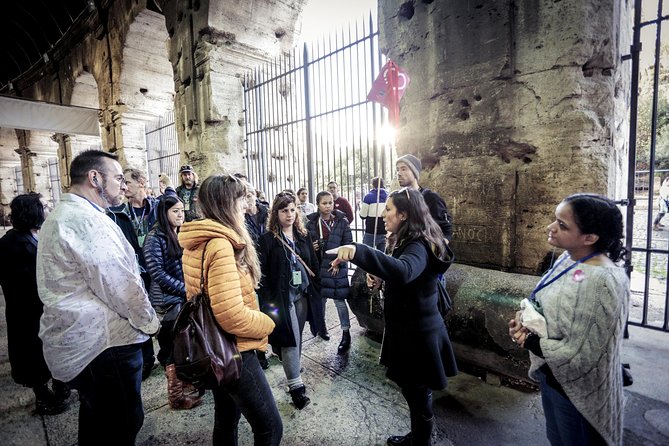
Your guide should help explain the building’s purpose, construction, and place in Roman public life. The best presentations add human detail without turning the visit into a theatrical performance. Rita, for example, was praised for showing images of how the structure once looked compared with what remains today. That kind of visual comparison can make the ruined walls easier to understand.
The included reservation and entrance arrangements are a major advantage. Colosseum entry is controlled, and a guided reservation can save you from trying to coordinate a separate ticket and time slot. The tour is not a private visit, and you should still expect crowds, but the organized entry removes one common source of Rome frustration.
The Colosseum is also where identification rules matter most. Bring your passport or ID card, even if you normally travel around Europe without showing it. The full names of all participants must be provided at booking, and one person had trouble because the booking used a nickname rather than the name on official identification. The issue was resolved, but it caused avoidable stress.
If you have a pacemaker, you must show the required certificate. Without it, admission may be refused unless you undergo screening. This is not a detail to leave until the entrance gate.
Seeing the Roman Forum as a working city
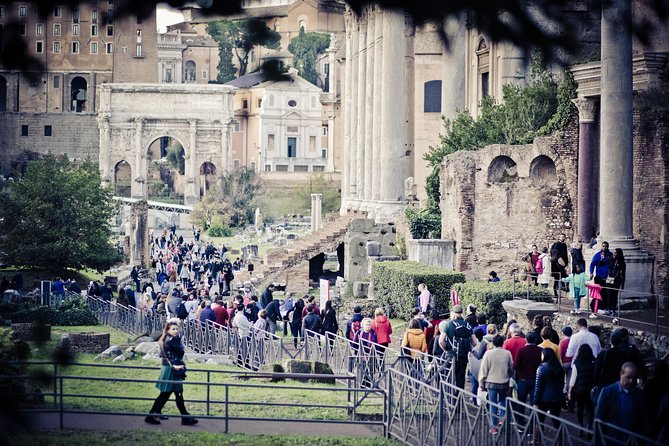
The Roman Forum is a rectangular civic space surrounded by the remains of major government, religious, and public buildings. Ancient citizens called it the Forum Magnum, or simply the Forum.
This part of the visit often requires the most imagination. The Colosseum still has a strong outline, but the Forum is spread across open ground. Your guide needs to point out what each ruin was used for and explain how the pieces fit together.
The Via Sacra is widest through the Forum, and walking along it gives you a direct connection to the city’s old ceremonial center. You are following the route used for religious processions, political movement, and triumphal events.
The Forum’s open setting is both its strength and its weakness. You get wide views and a sense of the site’s size, but there is limited shade. On a hot sunny day, hats, sunscreen, and water are not optional extras. Strong guides have looked for shaded places to speak and paused so people could drink.
The tour may also bring the modern city into view. Along Via dei Fori Imperiali, the straight road connecting Piazza Venezia and the Colosseum, you can see parts of the Forums of Trajan, Augustus, and Nerva. Archaeological work has continued beneath and beside the road, showing that ancient Rome is not a finished story simply because much of it is in ruins.
The guide matters more than the script
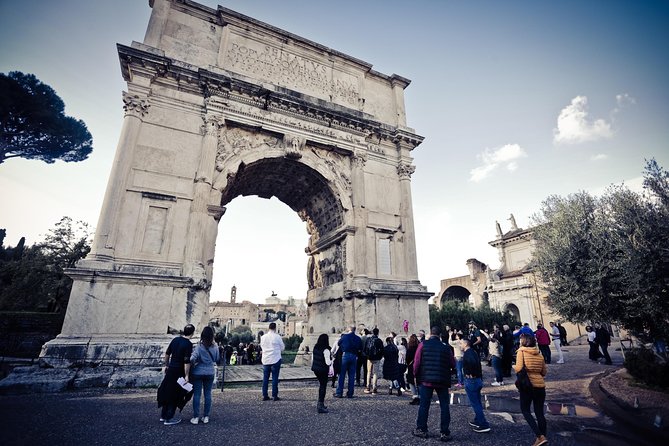
The strongest part of this experience is the human explanation. Several guides have been praised for humor, clear English, good pacing, and the ability to keep both adults and children interested. Roger was noted for giving clear instructions and water breaks, while Nicoletta was praised for helping with photographs, questions, and comfort.
Marcello, Alessa, Lina, Luciana, Letty, Caro, and Eglie also received warm praise for making the ancient sites understandable and enjoyable. These comments point to a real strength: the company has guides who can turn a fast visit into a memorable history lesson.
But the quality is not perfectly consistent. One guide was criticized for rushing an older participant, speaking too little, and spending too much time discussing construction materials instead of the site’s larger story. Another had trouble keeping the group informed and was difficult to understand. One person also found it hard to keep up because the guide did not use a visible flag.
That variability is important. A guided tour is not automatically good simply because the entrance tickets are included. You should stay near the guide, use the headset, and speak up promptly if you cannot hear or understand. If someone in your party walks slowly, tell the guide at the start and keep that person toward the front or center of the group.
The maximum group size is 20. That is not a private tour, but it is more manageable than a large coach group. Group discipline still matters. Count family units when regrouping, keep an eye on the guide’s marker, and do not assume the group will wait indefinitely at every corner.
Heat, cobblestones, and the real physical demand
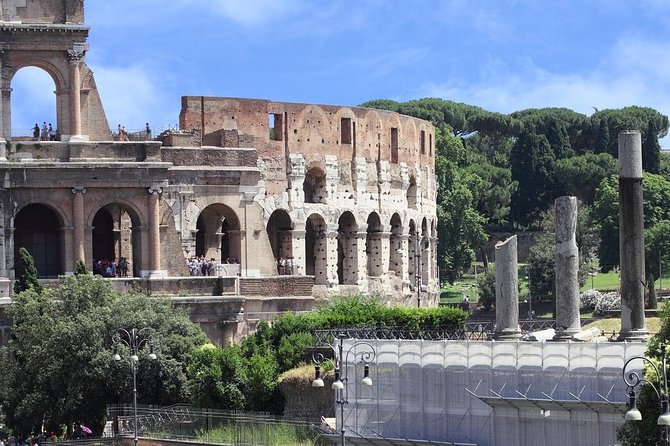
This is a moderate walking experience, not a gentle sightseeing ride. The ground includes cobblestones, marble slabs, uneven archaeological paths, and steps. Running shoes or other firm walking shoes are the sensible choice.
Summer heat can make the 3.5-hour visit feel longer. Large sections of Palatine Hill and the Forum are exposed, and shaded areas are limited. Carry water, wear a hat, use sunscreen, and choose the morning departure if you have a choice. One person specifically preferred the morning tour, and earlier hours generally offer a more comfortable rhythm for outdoor ruins.
The tour is not recommended for people with impaired mobility. The ancient surfaces are not consistently smooth, and the route includes elevations and rough ground. Children can attend, but they must be accompanied by an adult. Families should judge the heat and walking distance carefully, especially with younger children.
A guide may slow the group for water or shade, but you should not rely on the tour to solve every physical challenge. Wear the right shoes and arrive prepared.
Is $98.86 a fair price?
The price makes the most sense if you value time, structure, and assistance. You receive admission to three major sites, a professional guide, wireless audio equipment, transportation, the Colosseum ticket, and the reservation fee.
The ticket and fee alone are listed at €20 per person. The remaining amount covers the guide and operational services. That is a fair arrangement for a first-time visitor who wants the main ancient sights explained in one half-day.
The value drops if pickup causes a long wait or if your guide gives a thin presentation. Since the walking route is fixed around famous sites, the guide is the part that turns a ticket bundle into a useful tour. I would book it for convenience and historical orientation, not because it guarantees a private or deeply specialized experience.
Free cancellation is available until 24 hours before the start time. Changes or cancellations inside that window are not accepted for a refund. The experience also requires a minimum number of participants, so a cancellation by the operator can result in another date, a different experience, or a full refund.
Who should book this experience?
I would choose this tour if you have limited time in Rome and want to cover the three essential ancient sites without arranging separate tickets. It is also a good fit if you prefer having a guide explain the political, religious, and architectural meaning of the ruins as you walk.
Families may like the mix of famous sights and storytelling, especially with a guide who uses humor and keeps children involved. The tour can work well for older children and teenagers, but the heat and rough surfaces require planning.
I would think twice if you need a slow pace, have impaired mobility, dislike group schedules, or want extended time for photography. The tour can include photo opportunities, and some guides have helped families take pictures, but the primary goal is to move through the main sites within a set time.
Final verdict: a strong introduction with practical caveats
I recommend this tour for a first visit to ancient Rome, especially if hotel pickup and skip-the-line organization are worth paying for. Palatine Hill, the Colosseum, and the Roman Forum form a powerful half-day route, and a strong guide can make the ruins far easier to read.
Book with care. Confirm your hotel’s coverage, be ready well ahead of departure, bring matching official identification, and prepare for heat and uneven stone. The overall rating of 4.5 from 540 ratings reflects a generally successful experience, but the uneven guide quality means this is best viewed as a well-organized group tour, not a guaranteed masterclass.
If you want the major sights, useful context, and a simple way into Rome’s ancient center, the price is defensible. If you want a private pace or specialist-level detail, spend your money elsewhere.
FAQ
How long does the Ancient Rome Guided Tour last?
The tour lasts approximately 3 hours and 30 minutes.
Which sights are included?
The tour includes Palatine Hill, the Colosseum, and the Roman Forum. The guided archaeological area also includes references to the Via Sacra and Via dei Fori Imperiali.
Is admission included?
Yes. Entrance to the Colosseum, Roman Forum, and Palatine Hill is included.
Is hotel pickup included?
Pickup is offered, but coverage depends on your hotel. You should ask the hotel reception or contact the booking office to verify service coverage.
How early should I be ready for pickup?
You should be ready in the hotel lobby 45 minutes before departure. For some non-central hotels, you should be ready 60 minutes before departure.
Where do I meet the tour if my hotel is not covered?
The meeting point is inside Colle Oppio Park, at Via delle Terme di Tito near the corner of Via Nicola Salvi.
Is transportation provided after the tour?
Transportation is included for the pickup service, but drop-off is not included at the end.
What identification must I bring?
You must bring your passport or ID card on the day of the tour. The full names supplied at booking should match your official identification closely.
Can a person with a pacemaker join the tour?
A person with a pacemaker must show a certificate. Without the certificate, admission may not be allowed unless the person is screened.
Is the tour suitable for people with limited mobility?
The tour is not recommended for individuals with impaired mobility. It requires a moderate level of physical fitness and includes cobblestones, marble slabs, uneven surfaces, and walking around outdoor ruins.
Just added around Rome
- Rome City, Pantheon, and Trevi Fountain Walking Tour★ 5.0 · 249 reviews
- Rome: Skip the line Vatican Museums & Sistine Chapel Tour★ 4.2 · 251 reviews
- Rome: Tivoli Day Trip with Villa d’Este and Villa Adriana★ 4.5 · 251 reviews
- Transfer Rome center – Ciampino Airport★ 4.5 · 251 reviews
- Rome: Cannondale E-Bike Evening Tour with Optional Dinner★ 4.9 · 251 reviews
- VIP Colosseum, Roman Forum & Palatine Hill & Special Access Sites★ 4.5 · 252 reviews
- Private Vatican Museums Hidden Gems Tour with Optional Pick-Up★ 5.0 · 253 reviews
- Vatican Museums & Sistine Chapel Skip-the-Line Guided Tour★ 4.6 · 254 reviews
Colosseum & Roman Forum Tours, compared.
Colosseum, Roman Forum & Palatine Guided Tour
Read our review →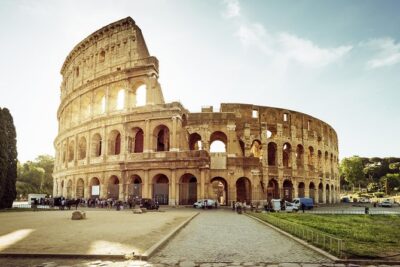
Colosseum, Palatine Hill and Roman Forum Guided Tour
Read our review →
Guided Tour of Colosseum, Roman Forum & Palatine Hill
Read our review →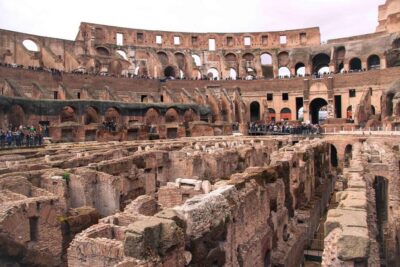
Colosseum & Forum with Audio Guide App -Optional Arena
Read our review →
Colosseum, Roman Forum and Palatine Hill Guided Tour
Read our review →
Colosseum, Forum & Palatine Hill Tour & Optional Arena
Read our review →
Colosseum, Roman Forum, Palatine with Multimedia Video
Read our review →
Colosseum, Palatine Hill & Roman Forum Guided Tour
Read our review →Browse the lists this tour appears in