
Review · MUSEUMS
Rome: Leonardo da Vinci Exhibition Entrance Ticket
Leonardo’s sketches are only the beginning. At Rome’s Leonardo da Vinci Exhibition, full-scale working models turn his ideas about flight, water, war, music, and machines into something you can see and often touch. Set below the Palazzo della Cancelleria near Campo de’ Fiori and Piazza Navona, this compact museum makes a good change from Rome’s crowded major sights.
I especially like the hands-on displays, which help children and adults understand how Leonardo’s designs worked, and the calm underground setting, a welcome break during a hot Roman afternoon. The $10 admission is strong value, though you should know this is a small exhibition rather than a full-day museum, and the optional audio guide costs extra.
The visit can take 45 to 60 minutes if you move steadily, but I would allow up to two hours if you read the explanations, watch the short presentations, and try many of the machines. It suits families, curious adults, and anyone interested in engineering as much as Renaissance art.
In This Review
- Key points before you go
- Finding the exhibition near Campo de’ Fiori
- Four sections that organize Leonardo’s restless mind
- Water: movement, pressure, and control
- Air: Leonardo’s early ideas about flight
- Fire: weapons, force, and military design
- Earth: construction, machines, and everyday engineering
- The machines are the real reason to visit
- Holograms and interactive installations add modern energy
- The audio guide is worth considering
- How long the visit takes and who will enjoy it
- Is the $10 ticket good value?
- Practical details for your Rome day
- Should you book the Leonardo da Vinci Exhibition?
- FAQ
- Where is the Leonardo da Vinci Exhibition in Rome?
- How much does admission cost?
- How long is the ticket valid?
- Is a guide included with admission?
- Can I touch the inventions?
- Is the exhibition suitable for children?
- Is the exhibition wheelchair accessible?
- What else is inside the Palazzo della Cancelleria?
Key points before you go
- More than 65 full-scale inventions: See models based on Leonardo’s drawings, including flying machines, military devices, bridges, instruments, and water mechanisms.
- Touch-friendly design: You can interact with almost all the machines and build your own version of one of Leonardo’s bridge designs.
- Four natural forces: The exhibition is arranged around Water, Air, Fire, and Earth, giving Leonardo’s wide-ranging work a clear structure.
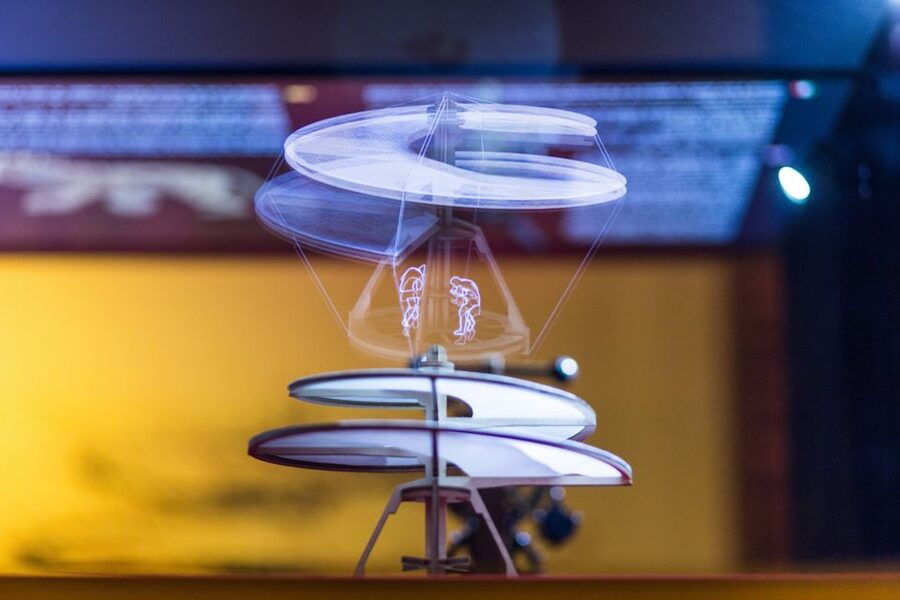
- Nine 3D holograms: Holographic displays present Leonardo’s paintings and inventions in a modern, theatrical format.
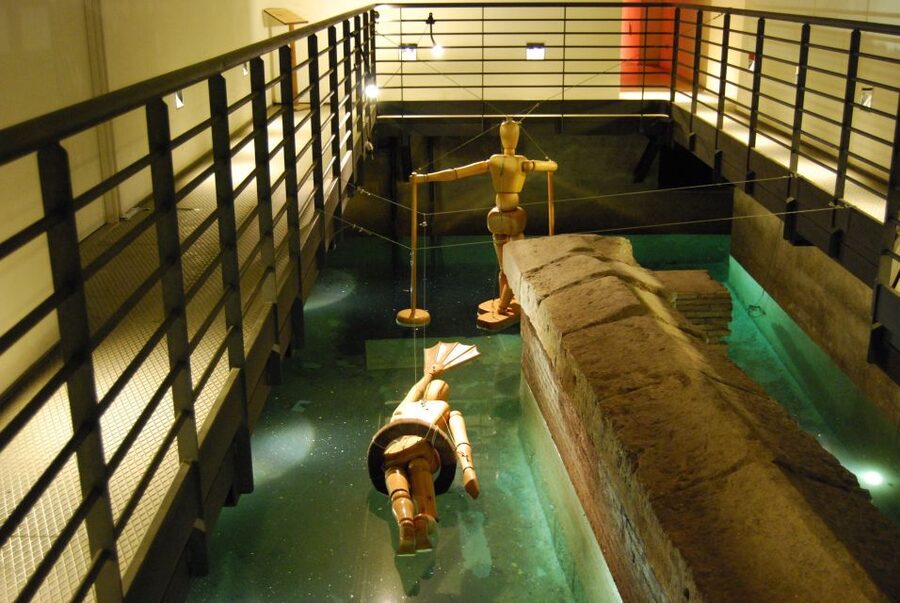
- A Roman tomb underground: The Palazzo della Cancelleria contains the tomb of architect Auro Irzio, dating from 43 BC, set beside an underground natural pond.
- Optional audio guide: The extra-cost guide adds useful detail, especially if you want more than the basic English signs.
Finding the exhibition near Campo de’ Fiori
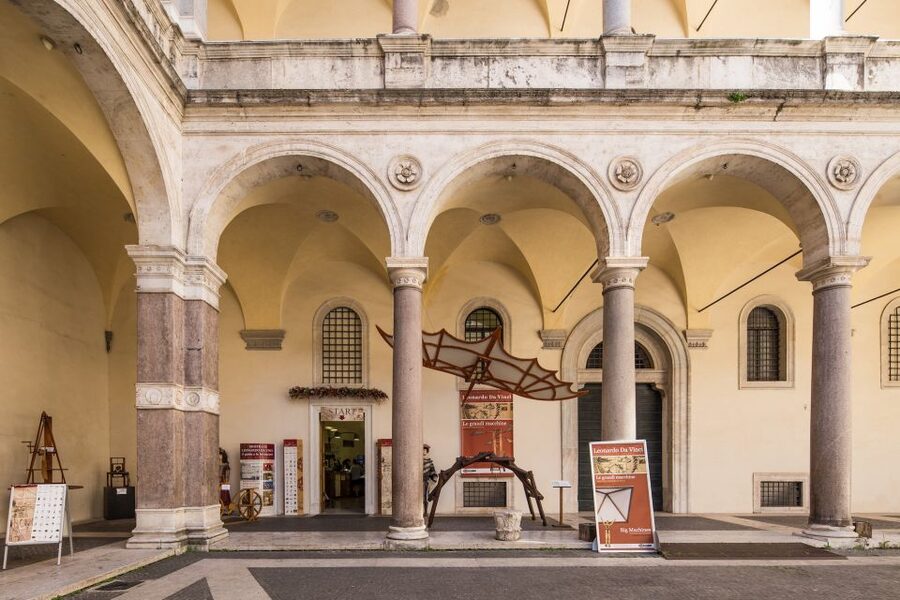
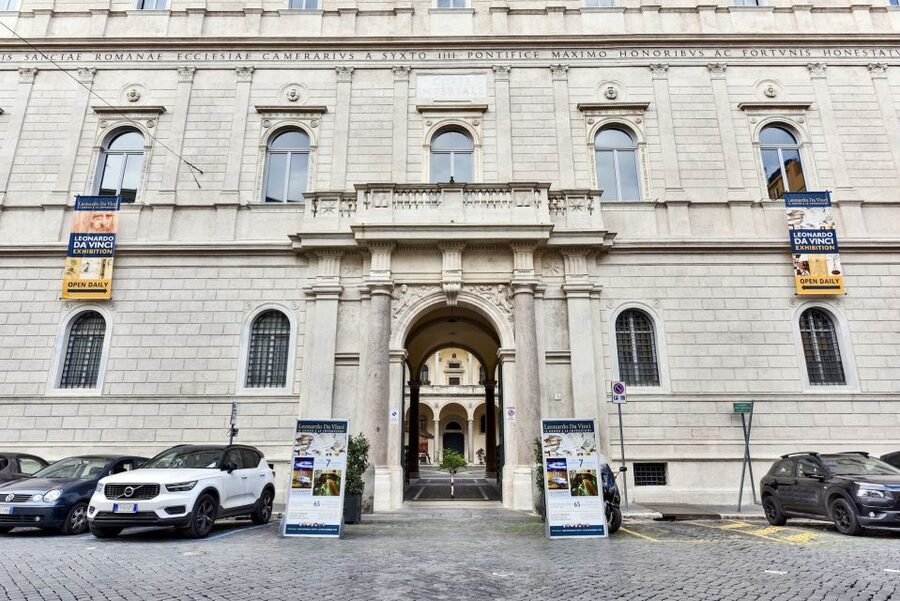
The entrance is at Piazza della Cancelleria 1, in the historic Palazzo della Cancelleria. It is close to Campo de’ Fiori and Piazza Navona, so the exhibition fits easily into a walking day through central Rome.
The building itself adds interest before you reach the displays. It is owned by the Vatican, and its upper floor houses the Sacra Rota, the church tribunal involved in marriage annulment cases. You do not visit that working area as part of the exhibition, but knowing what occupies the building gives the setting a little extra character.
The museum is below ground, which has two practical benefits. It feels quieter than many of Rome’s famous attractions, and it can be pleasantly cool when the streets outside are baking. The underground location also explains why the Roman tomb and natural pond feel like part of the visit rather than a separate sight.
The exhibition provides skip-the-ticket-line entry. Entrance is available until one hour before closing, so do not leave this stop until the last minute. The exact starting times depend on availability, and the ticket is valid for one day rather than representing a guided tour with a fixed itinerary.
More Museum Tours in Rome
- Vatican: Museums & Sistine Chapel Entrance Ticket
★ 4.5 · 144,003 reviews - Vatican Museums & Sistine Chapel Tour with Optional Basilica
★ 4.3 · 67,413 reviews - Vatican Museums, Sistine Chapel & St Peter’s Basilica Guided Tour
★ 4.5 · 39,149 reviews
Four sections that organize Leonardo’s restless mind
The displays are divided into four broad sections: Water, Air, Fire, and Earth. This is a useful way to approach Leonardo, because he did not work in only one field. He was an artist, engineer, scientist, architect, sculptor, musician, and military designer.
The organization also keeps the collection from feeling like a random room full of old-fashioned machines. As you move through the sections, you begin to see repeated ideas. Leonardo watched natural forces closely, then tried to adapt them for transport, construction, defense, and daily use.
Some signs and room numbers can be confusing. A few people have found that the numbering does not always flow clearly from one room to the next, and the audio guide does not always follow the physical order of the exhibition. I recommend taking a moment at the entrance to look at the layout before pressing ahead.
Water: movement, pressure, and control
Leonardo’s water studies reveal how closely he watched rivers, currents, and the movement of liquid. Models in this section help you think about water not simply as part of the scenery, but as a force that can be measured and used.
This is one of the most helpful areas for children because the principle is visible. You do not need a technical background to understand the basic aim of a device when you can see its moving parts. The models turn a drawing into a physical problem: how do you lift, direct, or control water?
The subject also connects to Leonardo’s wider interest in engineering. He was not merely sketching attractive ideas. He was studying how materials and forces might work together. The displays give you a practical sense of that process.
Air: Leonardo’s early ideas about flight
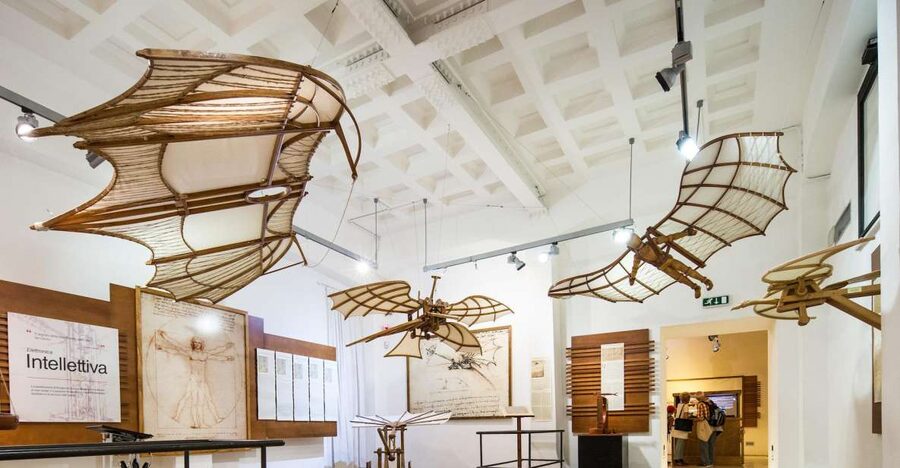
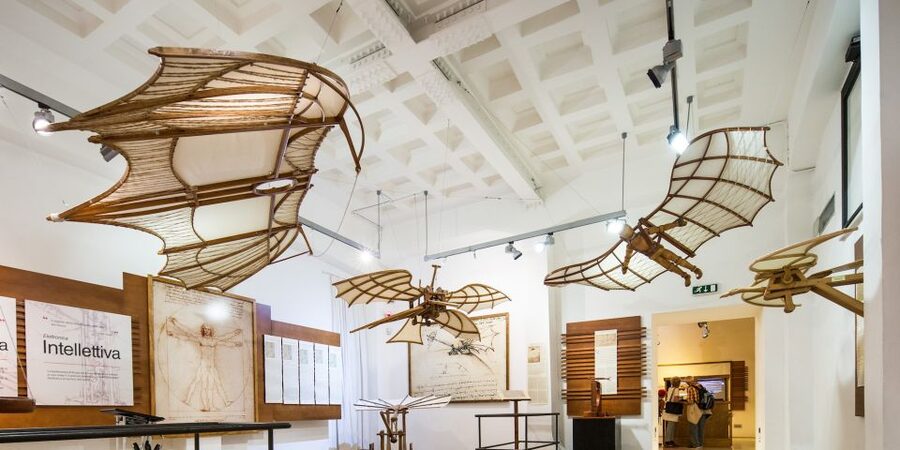
Leonardo’s flying machines are among the exhibition’s most memorable models. His sketches show an intense interest in birds, wings, and the possibility of human flight. Full-scale reproductions make those studies easier to understand than a small page in a book.
You can compare Leonardo’s observations with the shape and structure of the machines built from them. Some ideas look inventive, while others remind you how much remained unknown about lift and powered flight. That mixture is part of the fun. The exhibition does not need to pretend every design would have worked exactly as planned.
The models also show why Leonardo remains relevant to modern engineering. His ideas were not modern aircraft, but they reflect a way of thinking that begins with observation, tests a theory, and tries to solve a practical problem.
More galleries and collections:
- Rome: Vatican Museums, Sistine Chapel & Basilica Tour
★ 4.3 · 13,872 reviews - Vatican Museums & Sistine Chapel Skip-the-Line Entry Ticket
★ 4.4 · 13,838 reviews - Rome: Vatican Museums, Sistine Chapel & Basilica Tour
★ 4.7 · 13,217 reviews - Rome: Vatican Museums & Sistine Chapel Guided Tour
★ 4.3 · 12,117 reviews
Fire: weapons, force, and military design
The Fire section includes military inventions and devices connected with force and defense. Leonardo’s interest in warfare can surprise people who know him mainly for the Mona Lisa and The Last Supper.
A model of his tank is one of the stronger visual displays. Seeing the armored design at full scale gives you a better idea of its ambition than reading a short caption. Other military machines show Leonardo applying his skills as a designer to the demands of his patrons.
This part may appeal most to older children and adults. It also adds balance to the popular image of Leonardo as a peaceful painter. His notebooks contain beauty and curiosity, but also practical designs intended for military use.
Earth: construction, machines, and everyday engineering
The Earth section brings together mechanical devices, building ideas, scientific instruments, and architectural studies. Here, the exhibition makes a clear connection between Leonardo’s drawings and modern transportation, construction, and mechanical design.
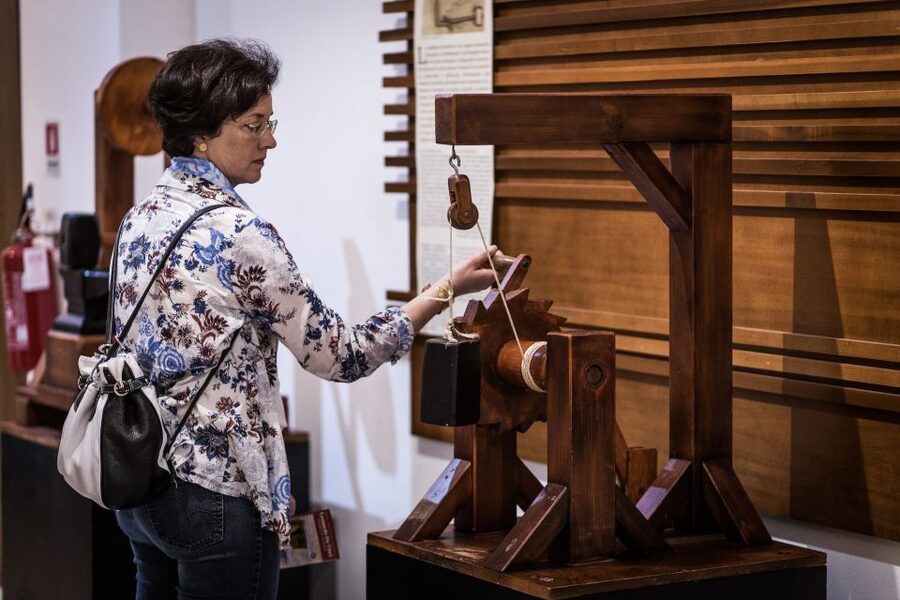
The bridge activity is particularly useful. You can build your own version of a bridge based on one of Leonardo’s designs, which changes the experience from looking at a model to solving a small structural puzzle. It is simple, but it makes the engineering principle stick.
Musical instruments and scientific tools add variety. They remind you that Leonardo’s curiosity did not stay inside one profession. A single visit can move from architecture to music, then to transport and machinery without leaving the same set of ideas behind: balance, motion, proportion, and careful observation.
The machines are the real reason to visit
The exhibition presents more than 65 full-scale machines made from Leonardo’s designs. They are reproductions, not original Renaissance objects, but that is exactly what makes the visit accessible.
You can often get close to the mechanisms and touch or operate them. That hands-on approach was praised again and again for making the drawings come alive. Instead of wondering how a sketch might translate into wood, rope, gears, or metal, you can study the finished model and see what Leonardo was attempting.
The condition of individual machines can vary. A few may look worn or be less satisfying than others, and not every mechanism is equally easy to understand at first glance. Still, the collection works as a whole because the models give you a physical sense of Leonardo’s working method.
The displays are also useful for families. Children have space to experiment with many of the inventions, while adults can spend time reading about the science and engineering behind them. Keep an eye on young children, though. One detailed visit described trip hazards and unclear touch or do-not-touch boundaries, so this is not a place to let very small children run ahead unattended.
Holograms and interactive installations add modern energy
Nine holograms present Leonardo’s paintings and inventions in 3D. These displays give the museum a multimedia feel and break up the rows of physical models.
The holograms are not a replacement for original artworks. They are best treated as visual explanations, helping you see an invention in operation or understand how a painting relates to Leonardo’s wider body of work. A copy of The Last Supper is also included, but the machines are likely to hold your attention longer if engineering is your main interest.
Seven interactive installations use Leonardo’s drawings to explain more of his ideas. These are especially useful if you learn better through movement and demonstration than through long wall panels. The museum is educational without demanding the concentration of a formal lecture.
Background music gives the rooms a calm mood. That atmosphere, combined with the underground setting, makes the exhibition feel slower and less hectic than many central Rome attractions. It is a modest museum, but the presentation is thoughtful and easy to approach.
The audio guide is worth considering
A guide is not included, but you receive a gadget with admission. The optional audio guide costs extra and is one of the more worthwhile additions if you want context beyond the basic labels.
English explanations are available throughout the exhibition, and the written information is generally clear. The audio guide adds longer explanations, details about Leonardo’s work, and links between his ideas and modern uses. It can make a short visit feel more substantial.
There is one small drawback. The audio route does not always match the order of the rooms, so you may need to look around for the item being discussed. The room numbering can also feel unclear. I would use the guide flexibly rather than treating it as a strict step-by-step tour.
For a first visit, I would choose the audio guide if you have a strong interest in Leonardo, engineering, or Renaissance science. If you are stopping in for a quick family activity, the English signs and interactive machines may be enough.
How long the visit takes and who will enjoy it
The advertised duration is one day because the ticket remains valid for the day of your visit. That does not mean you need to spend a full day inside.
Plan on 45 to 60 minutes for a focused visit. If you try many of the machines, watch the holograms, use the audio guide, and read the explanations, two hours is possible. Several people found it easy to fit into a busy Rome schedule because it is compact and does not overwhelm you.
I would recommend it most for:
- Families with school-age children who enjoy hands-on activities
- Adults interested in engineering, inventions, architecture, or science
- Leonardo fans who want to see models based on his technical drawings
- Anyone needing a cool indoor stop near Piazza Navona
- Visitors looking for a quieter attraction than Rome’s best-known monuments
Art lovers who want original Leonardo paintings should adjust their expectations. This is mainly an exhibition about inventions, studies, and ideas. The copy of The Last Supper and the holographic presentations add an art element, but the full-scale machines are the main event.
Is the $10 ticket good value?
At $10 per person, this is one of the easier Rome admissions to justify. The museum is not large, but the ticket buys an active experience rather than a quick look at a few display cases.
The value depends on how you visit. A rushed 20-minute walk through would feel less rewarding. Give the machines time, try the bridge, read the explanations, and watch the multimedia displays, and the price feels fair. Two adults can spend a pleasant hour here for less than the cost of many major Roman attractions.
The gift shop is another plus. It offers Leonardo-themed items and educational souvenirs that feel different from the usual postcard and magnet selection found around central Rome.
The main limitation is scale. If you expect a huge museum with original masterpieces, you may leave sooner than planned. If you want a clear, affordable introduction to Leonardo’s inventions, the small size works in your favor.
Practical details for your Rome day
The exhibition is wheelchair accessible, and skip-the-ticket-line entry keeps arrival simple. You do not need a guide to visit, but the extra audio option can add useful detail.
Because the museum is near Campo de’ Fiori and Piazza Navona, pair it with nearby sights rather than making a separate cross-town trip. It works well before lunch, after a walk through the historic center, or during the hottest part of the afternoon.
Staff are regularly described as friendly and helpful, which matters in a small museum where a quick explanation at the desk can save you from confusion about the room order. Try not to arrive within the final hour before closing, even though entry is technically allowed until then.
Cancellation is free up to 24 hours in advance, and you can reserve now and pay later. That flexibility is useful if your Rome schedule is still changing.
Should you book the Leonardo da Vinci Exhibition?
I would book this exhibition if you want an affordable, interactive stop that explains Leonardo through machines rather than only paintings. The strongest reasons are the 65 full-scale models, the chance to test many of them, the cool underground rooms, and the way the four sections connect Leonardo’s ideas across science, art, and engineering.
Choose the audio guide if you want fuller explanations. Skip it if you are short on time or mainly want the hands-on displays.
This is not a replacement for Rome’s major museums, and its compact size may disappoint anyone expecting original masterpieces. For families, curious adults, and visitors with an hour to spare near Piazza Navona, though, it is an easy recommendation and very good value at $10.
FAQ
Where is the Leonardo da Vinci Exhibition in Rome?
It is located at Piazza della Cancelleria 1, near Campo de’ Fiori and Piazza Navona, inside the Palazzo della Cancelleria.
How much does admission cost?
The listed price is $10 per person.
How long is the ticket valid?
The ticket is valid for one day. The actual visit commonly takes about 45 to 60 minutes, though you can spend up to two hours if you study the displays and use the interactive features.
Is a guide included with admission?
No. A guide is not included, but an optional audio guide is available for an additional cost. English explanations are also provided with the exhibits.
Can I touch the inventions?
You can touch and play with almost all the machines on display. The exhibition also includes an activity where you can build your own version of one of Leonardo’s bridges.
Is the exhibition suitable for children?
Yes. The interactive machines make it suitable for children, and the displays can appeal to both children and adults. Keep a close eye on very young children because some areas may have trip hazards or unclear touch instructions.
Is the exhibition wheelchair accessible?
Yes, the activity is wheelchair accessible.
What else is inside the Palazzo della Cancelleria?
The building is owned by the Vatican and is notable for its architecture. It also contains the tomb of architect Auro Irzio, dating from 43 BC, beside an underground natural pond.
Just added around Rome
- Rome City, Pantheon, and Trevi Fountain Walking Tour★ 5.0 · 249 reviews
- Rome: Skip the line Vatican Museums & Sistine Chapel Tour★ 4.2 · 251 reviews
- Rome: Tivoli Day Trip with Villa d’Este and Villa Adriana★ 4.5 · 251 reviews
- Transfer Rome center – Ciampino Airport★ 4.5 · 251 reviews
- Rome: Cannondale E-Bike Evening Tour with Optional Dinner★ 4.9 · 251 reviews
- VIP Colosseum, Roman Forum & Palatine Hill & Special Access Sites★ 4.5 · 252 reviews
- Private Vatican Museums Hidden Gems Tour with Optional Pick-Up★ 5.0 · 253 reviews
- Vatican Museums & Sistine Chapel Skip-the-Line Guided Tour★ 4.6 · 254 reviews
Museums, compared.

Vatican: Museums & Sistine Chapel Entrance Ticket
Read our review →
Vatican Museums & Sistine Chapel Tour with Optional Basilica
Read our review →
Vatican Museums, Sistine Chapel & St Peter’s Basilica Guided Tour
Read our review →
Skip-The-Line Uffizi Gallery Timed Entry Ticket
Read our review →
Vatican Museums, Sistine Chapel & Basilica Tour
Read our review →
Vatican Museums & Sistine Chapel Skip-the-Line Entry Ticket
Read our review →Vatican Museums, Sistine Chapel & Basilica Tour
Read our review →
Vatican Museums & Sistine Chapel Guided Tour
Read our review →Browse the lists this tour appears in