
Review · GOLF CART TOURS
Rome: Catacombs and Appian Way Golf Cart Small-Group Tour
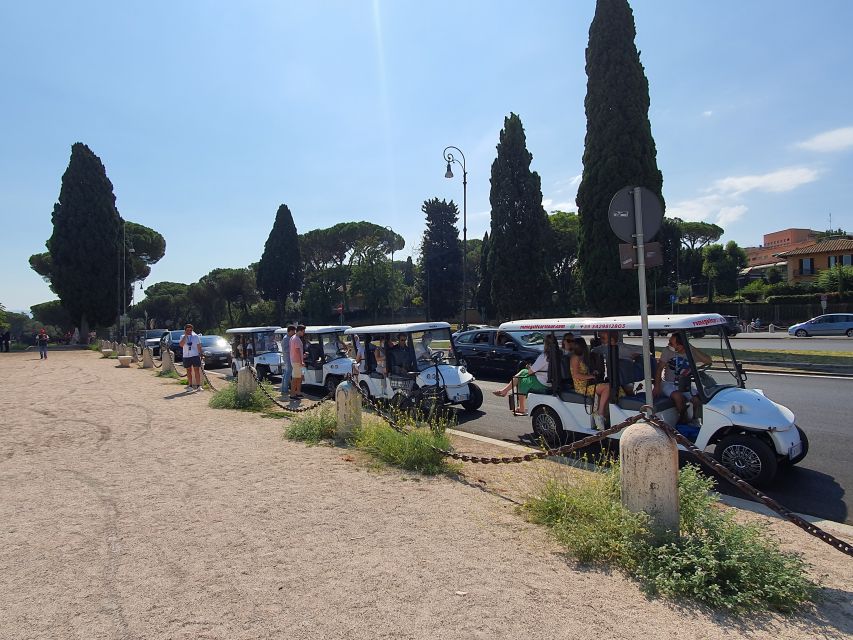
Rome rewards strong legs, but this tour gives them a break. A small golf cart carries you from the Colosseum to the Appian Way, with ancient ruins, churches, and catacombs along the way. I especially like the wide-ranging route and the chance to reach places that are too far apart for a comfortable walking tour. The included headset also helps you follow the guide through city traffic.
The underground visit is the other big draw. You descend about 16 meters into the Catacombs of Rome, then return to the surface for an original Roman road and several quiet archaeological sites. The main caution is comfort: the cart can bump over cobbled streets, and the catacombs require about 50 uneven steps down and 50 back up. Guides such as Federico, Antonella, Anna, and Alessandro receive especially warm praise for bringing the old stones to life. At $113.29 per person, this is best for seeing a lot in little time, not for lingering at every monument.
In This Review
- Key points to know before booking
- Why a golf cart makes sense in Ancient Rome
- Meeting near Termini and getting settled
- The Colosseum and Baths of Caracalla
- Domine Quo Vadis and the Appian Way
- Choosing between San Callixtus and San Sebastian
- Basilica of Saint Sebastian and the early Christian story
- Circus of Maxentius and the Roman road beyond the center
- Pyramid of Caius Cestius and Aurelian Rome
- Circus Maximus, the Mouth of Truth, and central Rome
- What the guides add to the three-hour route
- Is $113.29 a fair price?
- Who should book this tour?
- FAQ
- How long does the Rome golf cart and catacombs tour last?
- What language is the tour conducted in?
- What is included in the price?
- Is hotel pickup provided?
- Where does the tour finish?
- Which catacombs will the tour visit?
- Are the catacombs suitable for wheelchair users?
- What should I bring for the catacombs?
- Should you book it?
Key points to know before booking
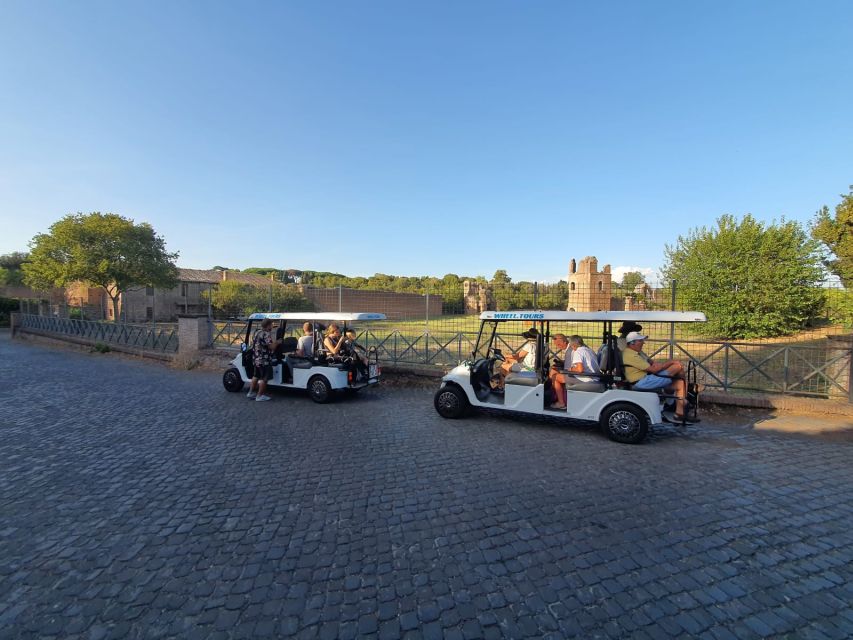
- The route covers far more than the usual center: You pass the Colosseum, Baths of Caracalla, Circus Maximus, Pyramid of Caius Cestius, Theatre of Marcellus, and other landmarks.
- The Appian Way gives the tour its character: You can walk on original Roman paving and visit sites outside the dense historic center.
- The catacombs are a serious underground visit: Expect cool, humid air, uneven flooring, no elevator, and many irregular steps.
- The golf cart saves time and energy: It connects scattered sights in about three hours, though traffic and the open-sided design can affect views.
- The guides are a major part of the experience: Federico, Antonella, Anna, Alessandro, Claudio, and others are praised for humor, clear explanations, and passion for Rome.
- The meeting point is convenient: It is a five-minute walk from Termini Central Train Station, and the tour finishes there.
Why a golf cart makes sense in Ancient Rome
Ancient Rome is not one compact archaeological park. The Colosseum, Baths of Caracalla, Appian Way, catacombs, Circus Maximus, and Pyramid of Caius Cestius are spread across a sizeable part of the city. Seeing them on foot in one morning would mean a lot of pavement, waiting at crossings, and less time listening to the stories that connect each place.
The golf cart solves that problem in a simple way. You ride between stops while your English-speaking guide explains what you are seeing, then get out for selected visits and photographs. This is a good format if you have only a few days in Rome, or if your feet are already protesting after several days of museums and piazzas.
You should not expect a private car or a smooth limousine ride. Rome’s streets can be rough, and cobbled sections produce a noticeable jolt. One useful detail is the headset, which lets you hear the guide despite traffic and the sound of the cart. Several guides are praised for making the trip funny as well as informative, with Federico often singled out for vivid explanations and theatrical storytelling.
The cart design has one tradeoff: you may not see every building clearly while moving. Traffic, parked vehicles, and the cart’s frame can block part of a monument. Treat the ride as a moving introduction, then use the stops for your best photographs and closer looks.
More catacombs and Appian Way trips:
- Rome: Crypts and Catacombs Underground Tour with Transfers
★ 4.6 · 5,341 reviews - The Original Roman Crypts and Catacombs Tour with Transfers
★ 4.5 · 4,896 reviews - Rome: Catacombs of St. Callixtus Entry Ticket & Guided Tour
★ 4.6 · 3,037 reviews
Meeting near Termini and getting settled
The starting point is about a five-minute walk from Termini Central Train Station. Look for the guide holding a Wheel Tours sign. That central location is useful if you arrive by train, are staying near the station, or want to fit the tour into a day of sightseeing without crossing Rome first.
The activity lasts three hours, though one experience description also refers to a four-hour outing. Check the exact duration and departure time when you select your date. Morning and afternoon departures can follow slightly different catacomb arrangements, so confirm which site is included for your chosen time.
The golf cart tour, guide, bottled water, headsets, and catacomb admission are included. Hotel pickup, food, and other drinks are not. The tour returns to the same meeting point, which makes planning lunch or another central visit fairly easy.
The Colosseum and Baths of Caracalla
The route begins with a drive by the Colosseum. You do not enter the amphitheater on this experience, so think of this stop as a visual introduction rather than a full Colosseum visit. Your guide can place the arena in the larger story of Ancient Rome while you look at its massive exterior from the cart and stop for photographs as arranged.
That distinction matters if the Colosseum is your top priority. You will need a separate ticket and visit to explore the interior. On the other hand, skipping an interior visit is exactly what allows this tour to cover so much ground in only three hours.
The Baths of Caracalla follow, another impressive reminder that Roman public life involved more than arenas and emperors. The ruins once formed a huge bathing complex, and the surviving walls and vaults help you picture the scale of Roman engineering and social life. You drive by rather than spend a long period walking through the site, but the guide’s explanation gives you a reason to return later if the baths catch your interest.
This early stretch is a good example of the tour’s rhythm: ride, listen, stop, photograph, and move on. It favors context and variety over a slow archaeological study.
Domine Quo Vadis and the Appian Way
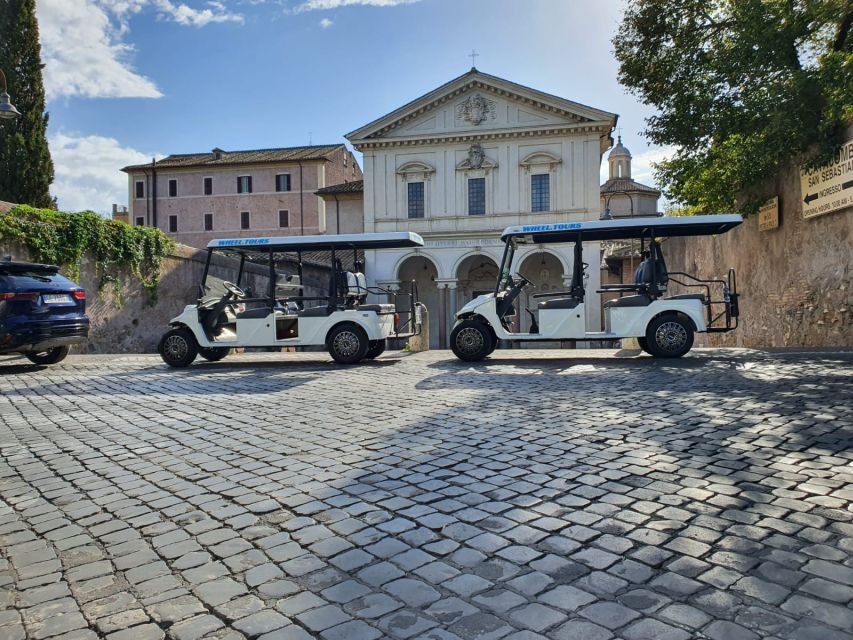
The Church of Domine Quo Vadis adds a religious story to the imperial ruins. It is associated with the account of Saint Peter meeting Jesus on the road, and the church offers a quieter pause than the major Roman sights. The setting helps connect early Christian tradition with the road that carried people out of the ancient city.
The Appian Way is the emotional center of the tour for many people. This ancient road is more than a photo backdrop. Walking on original paving gives you a physical sense of Roman construction, travel, and endurance. You are not simply looking at a road in a museum display. You are standing on the route itself, with centuries of footsteps under you.
The stop is also valuable because it takes you beyond Rome’s crowded core. The shift from dense city streets to the older road and archaeological surroundings changes the pace of the morning. I would save a little attention for the guide here, since the meaning of the road is easier to appreciate when you understand its role in Roman life.
Wear shoes with a firm sole. The surface is ancient and uneven, and the itinerary already includes the catacomb stairs. This is not the place for delicate footwear.
More golf cart tours:
- Rome by Golf Cart Private Tour: Beyond the Landmarks
★ 5.0 · 4,361 reviews - Rome on a Golf Cart Semi-Private Tour Max 6 with Private Option
★ 5.0 · 2,502 reviews - Rome Highlights by Golf Cart Private Tour
★ 5.0 · 2,379 reviews - Rome Highlights City Tour by Golf Cart with Gelato
★ 5.0 · 1,088 reviews
Choosing between San Callixtus and San Sebastian
The catacomb section is the tour’s most distinctive feature. You descend around 16 meters underground into early Christian burial spaces, where narrow passages and carved chambers offer a sobering look at Rome’s religious past. The site is sacred, so the mood is quiet and respectful rather than theatrical.
The exact catacomb depends on the departure. Afternoon tours visit the Catacombs of San Callixtus, while morning tours feature San Sebastian. The Basilica of Saint Sebastian is also included as an interior visit, with religious art and historic objects to see above ground.
The underground temperature is about 15 degrees Celsius, or 59 degrees Fahrenheit, and the air is humid. Bring a light layer even in warm weather. You should also carry a face mask or protective covering, as requested in the practical instructions.
This portion demands more than casual walking. There are approximately 50 irregular steps going down and another 50 coming back up. There is no elevator, no place to sit along the way, and the floor is uneven. The catacombs are not wheelchair accessible and are not recommended if you have serious walking problems or claustrophobia.
That warning is not a minor footnote. If enclosed spaces make you uneasy, the underground portion may overshadow everything else. If you are comfortable with tight passages and stairs, the catacombs provide an intimate look at a side of Rome that a standard city tour rarely reaches.
Basilica of Saint Sebastian and the early Christian story
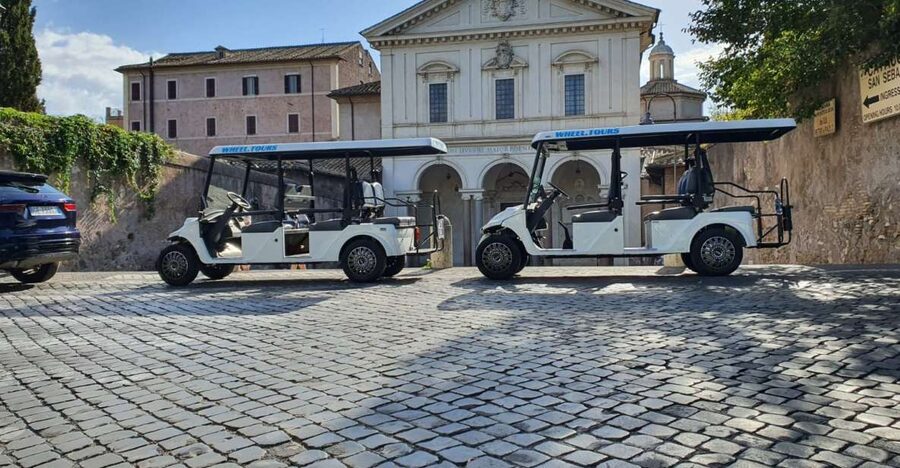
The Basilica of Saint Sebastian gives the underground visit a more open and reflective counterpart. You can step inside, see sacred objects, and consider how early Christian worship developed alongside the public and political life of the Roman world.
The church also gives the tour a useful change of pace. After the traffic, cart ride, and stairs, an interior stop lets you slow down. Several guide accounts praise this part of the route as an unexpectedly intimate alternative to Rome’s biggest churches.
Remember that the catacombs and basilica are religious places. Modest clothing and respectful behavior are appropriate. The information provided specifically asks you to bring a face covering, so keep one accessible rather than buried in your day bag.
Circus of Maxentius and the Roman road beyond the center
The Circus of Maxentius is one of the less familiar stops, and that is part of its appeal. Instead of repeating only Rome’s headline monuments, the tour uses the golf cart to reach a site many short city walks would skip. Your guide’s explanation helps you understand how the ancient complex fit into the wider Appian Way area.
This is where the cart earns its price most clearly. You cover ground quickly without spending your energy on long walks between disconnected ruins. Alessandro, one praised guide, is noted for leading a very small group through the Appian Way and surrounding sites while answering questions and keeping the ride lively.
The route also offers a broader sense of Rome’s scale. The city is not just the Colosseum, Trevi Fountain, and Pantheon. Its outskirts contain roads, tombs, churches, walls, and public buildings that reveal how much of the ancient city lies beyond the famous center.
Pyramid of Caius Cestius and Aurelian Rome
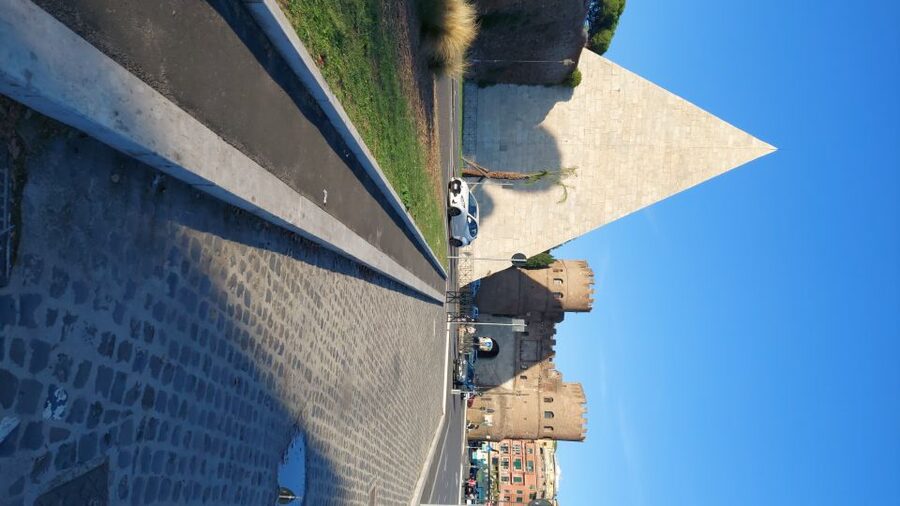
The drive by the Pyramid of Caius Cestius is one of the tour’s most surprising visual moments. This sharply geometric tomb looks out of place beside Rome’s more familiar brick and marble ruins, yet it belongs to the city’s ancient story.
The route also passes parts of the Aurelian Walls, adding another layer to the picture of Rome. The walls show the city as a defended urban center, not only as a collection of temples and monuments. You may not have time for a detailed stop at every section, but the guide can explain how these structures relate to the city’s growth and protection.
This moving format works best when you listen first and photograph when the cart stops. Trying to capture every landmark while rolling through traffic can be frustrating, particularly if the cart’s sides or nearby vehicles interrupt your view.
Circus Maximus, the Mouth of Truth, and central Rome
At the Belvedere of Romulus and Remus in the Circus Maximus, the tour pauses for views across one of Rome’s great ancient public spaces. The scale is easier to grasp from a viewpoint than from a crowded street. You can picture the Circus as a massive venue for public events while also seeing how modern Rome has grown around it.
The route then drives by the Mouth of Truth. This ancient mask is famous for the old hand-in-the-mouth legend, but the stop also fits the tour’s broader purpose: showing how Roman monuments continue to collect stories long after their original use has vanished.
The Theatre of Marcellus brings you close to another major ancient entertainment building. From there, the ride continues toward Venetian Square and the Fatherland Monument. These later landmarks help you compare different periods of Rome without adding another long museum visit.
The final views include the Column of Trajan, known for its carved spiral scenes. Again, this is a drive-by rather than an extended interior visit. You gain a well-planned sweep through Rome’s political, religious, military, and public spaces, but you will need separate time if you want to study the column or monument closely.
What the guides add to the three-hour route
The strongest part of this tour is not simply the vehicle. It is the guide’s ability to turn a fast route into a connected story. Federico is praised for helping people picture ancient buildings as they once looked, rather than leaving them with isolated piles of stone. He also uses humor and theatrical touches, which can make a long explanation easier to remember.
Antonella is praised for mixing Roman history with religion, botany, and word origins, while Anna receives credit for enthusiasm and clear communication. Alessandro is described as both thorough and entertaining, and Claudio is praised for making the trip relaxed and approachable. Other guides, including Meryl, Martino, Arvin, Silia, Francesca, Adonella, and Dave, are also singled out for warmth, humor, or strong command of Rome’s past.
Guide quality can vary on any scheduled departure, so I would not book solely to secure one particular person. Still, the pattern is clear: this route depends heavily on the guide. The headset helps, but the real value comes from the explanations, answers, and stories delivered between stops.
Is $113.29 a fair price?
At $113.29 per person, this is not a bargain transport ride. The price includes the golf cart, an English-speaking guide, bottled water, headsets, and admission to the catacombs. You are also paying for a small-group format and for the time saved by linking sites that are awkward to combine independently.
The value improves if you want a broad first look at Ancient Rome and do not want to spend another day walking. It is also useful late in a Roman stay, when your feet need a break but your sightseeing list is not finished. One particularly useful account describes choosing the cart after a rainy-day cancellation of an e-bike tour and staying dry. That is a practical advantage when the weather turns unpleasant.
The price is harder to justify if you prefer long visits, independent wandering, or major interiors. You do not enter the Colosseum, Baths of Caracalla, or every monument along the route. You also pay for the convenience of a guided overview, not a full archaeological tour at each stop.
Who should book this tour?
I would choose this tour if you want to see many Roman sites in one compact outing, especially the Appian Way and catacombs. It suits first-time visitors who need orientation, returning visitors who want a different side of Rome, and anyone tired of crossing the city on foot.
It is a good match for adults and older children who can handle three hours of sightseeing, cart movement, and underground stairs. One guide account specifically suggests that young children may not enjoy the format, and that seems fair: the content is historical and the catacombs are quiet, enclosed, and physically demanding.
I would think twice if you use a wheelchair, have serious walking problems, or dislike confined spaces. Also reconsider it if your priority is spending an hour inside one major monument. The cart gives you breadth, not prolonged access.
Book with a light layer, firm shoes, and realistic expectations about the ride. Keep your camera ready at stops, listen through the headset while moving, and confirm the morning or afternoon catacomb site before paying.
FAQ
How long does the Rome golf cart and catacombs tour last?
The stated duration is three hours. Check the available starting times and the exact duration shown for your selected departure.
What language is the tour conducted in?
The live tour guide speaks English.
What is included in the price?
The price includes the golf cart tour, tour guide, bottled water, headsets, and entrance to the catacombs.
Is hotel pickup provided?
No. Hotel pickup and drop-off are not included. You meet the group near Termini Central Train Station, about a five-minute walk from the station.
Where does the tour finish?
The tour ends back at the original meeting point.
Which catacombs will the tour visit?
The afternoon itinerary visits the Catacombs of San Callixtus. Morning tours feature San Sebastian. Check the details for your selected departure.
Are the catacombs suitable for wheelchair users?
No. The monument is not wheelchair accessible. It has about 50 irregular steps down, another 50 up, uneven flooring, no elevator, and no seating along the route.
What should I bring for the catacombs?
Bring a face mask or protective covering and dress for a constant temperature of about 15 degrees Celsius, or 59 degrees Fahrenheit, with humid air. Comfortable shoes are also sensible because of the uneven floor and stairs.
Should you book it?
Book this tour if you want a smart overview of Ancient Rome with less walking and a memorable visit to the Appian Way and catacombs. The route is ambitious, and the best guides make the ruins easier to picture and the transitions entertaining.
Skip it if you need wheelchair access, dislike enclosed spaces, or want to enter and study Rome’s major monuments at length. For most able-bodied adults seeking a practical, story-filled introduction to Rome beyond the standard center, the golf cart is a clever choice, and the $113.29 price can be fair for the ground covered in three hours.
Just added around Rome
- Rome City, Pantheon, and Trevi Fountain Walking Tour★ 5.0 · 249 reviews
- Rome: Skip the line Vatican Museums & Sistine Chapel Tour★ 4.2 · 251 reviews
- Rome: Tivoli Day Trip with Villa d’Este and Villa Adriana★ 4.5 · 251 reviews
- Transfer Rome center – Ciampino Airport★ 4.5 · 251 reviews
- Rome: Cannondale E-Bike Evening Tour with Optional Dinner★ 4.9 · 251 reviews
- VIP Colosseum, Roman Forum & Palatine Hill & Special Access Sites★ 4.5 · 252 reviews
- Private Vatican Museums Hidden Gems Tour with Optional Pick-Up★ 5.0 · 253 reviews
- Vatican Museums & Sistine Chapel Skip-the-Line Guided Tour★ 4.6 · 254 reviews
Golf Cart Tours, compared.
Rome by Golf Cart Private Tour: Beyond the Landmarks
Read our review →
Rome on a Golf Cart Semi-Private Tour Max 6 with Private Option
Read our review →
Golf Cart Tour to Fiesole Roman Theatre and Museum
Read our review →
Eco-Friendly Golf Cart City Tour with Audio Guide
Read our review →
Rome Highlights City Tour by Golf Cart with Gelato
Read our review →
Golf Cart Small-Group Guided Tour: Rome City Highlights
Read our review →
Browse the lists this tour appears in